The SaaS bill problem creeps up on you. Six tools at $20 each is $120 a month. Add team seats, premium tiers, and the inevitable usage upgrades and a solo founder is north of $200 a month before the year is half over.
The self-hosted alternative isn't free, but it's close. One Hetzner VPS, Coolify as the deploy layer, five open-source apps. The whole thing runs on $20 a month and replaces $120 in subscriptions.
The myth is that self-hosting takes a weekend per app. The reality is that Coolify makes most of these one-click installs that finish in ten minutes.
The Five Tools Worth Replacing First
Not every SaaS deserves the self-hosted treatment. The five that pay back fastest are the ones you use daily and the ones that bill per seat. That's Notion for docs, Slack for chat, Zapier for automation, Calendly for booking, and Mailchimp for email.
The replacements are AppFlowy for Notion, Mattermost for Slack, n8n for Zapier, Cal.com for Calendly, and Listmonk for Mailchimp. All five are open source, all five have working production deployments, and all five run on the same modest VPS.
One VPS, Coolify, And The Stack Architecture
The architecture is dead simple. One Hetzner cloud VPS at the CX22 tier (2 vCPU, 4GB RAM, 40GB SSD) costs about $6 a month. Add a $4 backup add-on and you're at $10. Install Coolify as the deploy layer and you've got the foundation.
Coolify is the open-source PaaS that makes self-hosting tolerable. It's a Heroku-shaped UI over Docker Compose. Click a service, point it at your domain, Coolify sets up Let's Encrypt and reverse-proxies through Traefik automatically.
Each app gets a subdomain. chat.example.com for Mattermost, docs.example.com for AppFlowy, and so on. One Cloudflare wildcard DNS record points everything at the VPS. Setup time is roughly 30 minutes for Coolify and another 5 to 15 minutes per app.
Mattermost Replacing Slack
Mattermost is the open-source Slack clone that's been around the longest. Channels, threads, direct messages, file uploads, slash commands. The UI is close enough to Slack that nobody on your team will complain.
The Coolify install is a one-click service. Set the domain, pick the Postgres backend, click deploy. You'll be at a working login screen in under ten minutes. Add SSO if you need it, which takes maybe twenty extra minutes for the Google OAuth setup.
What you lose. The Slack ecosystem of apps. If your workflow depends on Loom for chat, Notion for embedded docs, and twelve other integrations, Mattermost feels lonely. For a solo founder or a team of three, the gap doesn't matter.
AppFlowy Replacing Notion
AppFlowy is the Rust-based Notion clone that hit production quality in 2025 and kept going. Pages, databases, kanban boards, calendars. The block editor feels less polished than Notion's but the data is yours.
The Coolify deploy is again straightforward. The catch is that AppFlowy's hosted version offers a generous free tier, so if you're a solo founder you might keep using their cloud and only self-host when team sharing matters.
What you lose. The Notion ecosystem of templates, the AI features, and the polished embed previews. The first one isn't really a loss because you can write better docs without templates. The other two depend on whether they're load-bearing for how you actually work.
n8n Replacing Zapier
n8n is the open-source automation platform that genuinely beats Zapier on flexibility. It has 500+ integrations, a visual workflow builder, and a code node for the times when the visual builder isn't enough.
For pricing, Zapier's pro tier is around $74 a month for 2,000 tasks. n8n self-hosted is free and runs unlimited workflows. The break-even is roughly fifteen workflows, after which n8n is the obvious win.
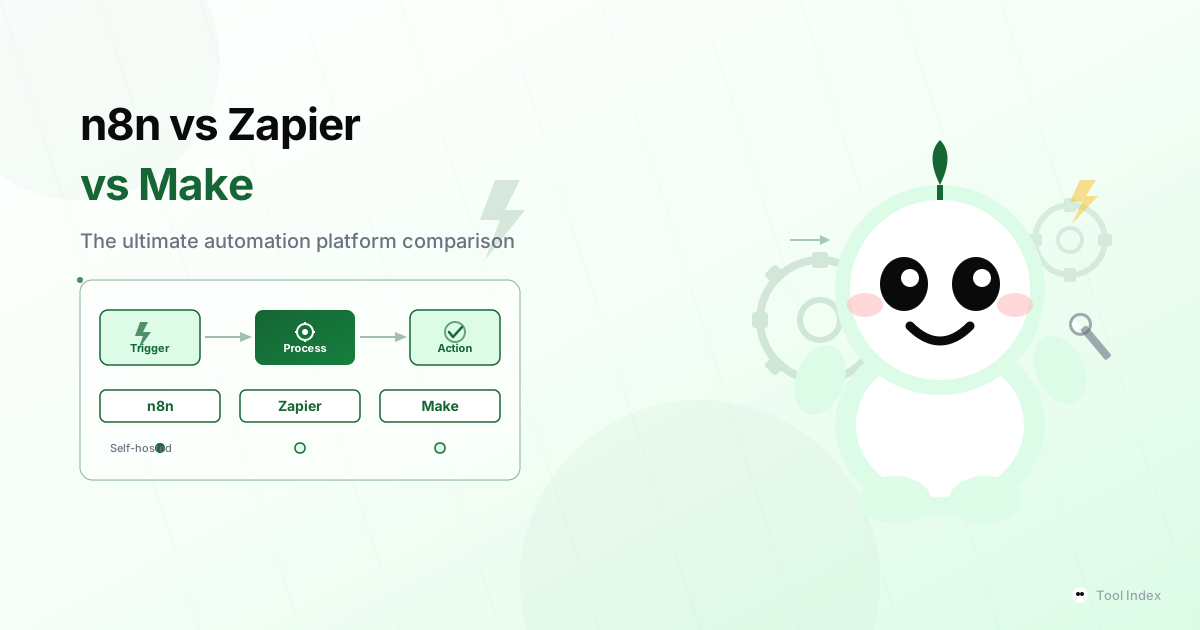
What you lose. The Zapier app marketplace is bigger. If you need to connect a niche SaaS that nobody else has wired into n8n yet, you'll build the connector yourself with the HTTP request node. For the broader landscape, the n8n versus Zapier versus Make comparison covers the trade-offs.
n8n is the single best self-hosted swap on this list. It's not just cheaper than Zapier; it's actually better for most production workflows.
Cal.com Replacing Calendly
Cal.com is the open-source booking platform that does everything Calendly does and a few things Calendly doesn't. Multiple event types, custom availability, payment collection through Stripe, team round-robin routing.
Coolify ships it as a one-click service. Configure the database, set the domain, wire up your Google Calendar or Outlook through OAuth. Working booking page in under twenty minutes.
What you lose. Nothing meaningful. Cal.com's hosted product is also genuinely good, so you can use their cloud free tier until self-hosting matters for branding or data residency reasons.
Listmonk Replacing Mailchimp
Listmonk is the high-performance newsletter and bulk email manager built in Go. It handles lists, segments, campaigns, and analytics. The UI is cleaner than Mailchimp's because it doesn't try to be ten products at once.
The catch is deliverability. Listmonk sends through your own SMTP, which means you need Amazon SES, Resend, Postmark, or another transactional email provider. SES is the cheapest at roughly $0.10 per thousand emails. Resend and Postmark are more expensive but easier to set up.
At 50,000 contacts, Mailchimp's Standard tier costs around $310 a month. Listmonk plus SES at the same volume costs roughly $15 a month in send fees. Annual savings are well into four figures. For the broader newsletter comparison, see the planned email marketing tools 2026 roundup.
Install Hours Per Tool And The Real Total
Honest install hours from a real weekend. Coolify itself takes about 60 minutes including DNS setup. Mattermost is 30 minutes. AppFlowy is 25 minutes. n8n is 20 minutes. Cal.com is 30 minutes including Google Calendar OAuth. Listmonk is 45 minutes including the SES domain verification dance.
That's about four hours of focused work to move the entire stack. Not zero, but very far from the "plan a weekend per app" stories that scared everyone off self-hosting in 2021.
Annual Savings And The Hidden Hosting Cost
The savings math is honest. Five tools at typical solo-founder pricing add up to roughly $120 a month, or $1,440 a year. The self-hosted stack runs $120 a year for the VPS plus maybe $50 to $100 a year for transactional email if you actually send much.
The hidden cost is your time on the day something breaks. Once or twice a year you'll need to update Coolify, restart a container, or restore from backup. Budget an hour per incident. That's roughly $1,200 in annual savings minus four hours of work.
The right test isn't "can I self-host this." It's "do I value the four hours a year of maintenance less than the $1,200 in saved subscriptions." For most solo founders, the answer is yes.
The One Feature We Lost And The Workaround
The one feature we genuinely lost in the swap was Slack's Huddles. Mattermost's voice chat exists but it's clunkier. The workaround is to use Jitsi Meet, also self-hosted on the same Coolify, for any voice-and-screen-share moment.
The other thing we missed less than expected was Mailchimp's automation builder for drip sequences. Listmonk's automation is simpler. n8n picks up the slack for anything complex. The trick is to wire n8n to Listmonk through the HTTP API and run sequences as workflows.
The Migration Order That Saves Pain
Don't try to swap all five at once. The order that worked best on a real migration was n8n first (replaces Zapier, frees up budget immediately), then Cal.com (low-stakes integration with Google Calendar), then Listmonk (set up SES alongside while old Mailchimp still sends), then Mattermost (do this on a Friday so the team has the weekend to adjust), and AppFlowy last (because the doc migration is the most disruptive).
Each swap takes a few hours of focused work plus a week of usage to confirm everything still functions. Stacked over a month, the full migration ships without anyone on the team feeling overwhelmed.
What This Stack Doesn't Replace And Why
Five tools is enough for most solo founders but the stack doesn't pretend to cover everything. Stripe stays. The replacement (BTCPay Server for crypto, or self-hosted payment-processor wrappers) is not viable for any business that takes credit cards seriously.
GitHub stays. Self-hosted Gitea on Coolify works but loses the ecosystem of GitHub Actions, Dependabot, and the social graph of pull request reviewers. The savings don't justify the loss.
Linear or Jira stays for issue tracking. Plane and OpenProject exist but they're roughly six months behind Linear on the polish curve. For a team that runs sprints, this is the wrong place to compromise.
Cloudflare stays for DNS, CDN, and DDoS protection. The free tier covers everything an indie hacker needs and the self-hosted alternatives don't get close on global PoP coverage.
For the broader open-source angle, the open source alternatives roundup covers the full ten-swap list. And the indie hacker AI stack piece covers the SaaS that's still worth paying for. For Coolify itself, the official documentation walks through every supported service. The Hetzner Cloud pricing page shows the current CX22 and CX32 tier rates if you want to spec the box yourself.
Frequently Asked Questions
How big does the VPS need to be?
For five apps and a solo team, the Hetzner CX22 (2 vCPU, 4GB RAM) is enough. For a team of ten, step up to CX32 (4 vCPU, 8GB RAM) at $13 a month. Past twenty users, scale to CX42 at $24 a month.
What if I'm not technical?
Coolify lowers the bar significantly but you still need to manage DNS, edit env vars, and recover from the occasional broken container. If you've never SSH'd into a server, this stack will hurt. Hire a one-day freelancer to set it up and you skip the pain.
How do I back this up?
Hetzner offers a snapshot backup add-on for $4 a month. Take a daily snapshot, keep 7 days of history. For the database tables you really care about, Coolify can also send dumps to S3 or Backblaze nightly.
What about uptime?
One VPS is one point of failure. Realistic uptime is 99.9 percent, which is about 9 hours of downtime a year, mostly during your own upgrades. For mission-critical workloads, keep using SaaS. For internal-team tools and side projects, the trade-off is fine.
Can I run more than five apps on the same VPS?Yes. The 4GB RAM ceiling is the limit, not the disk. Plausible Analytics, Umami, Vaultwarden, NocoDB, Ghost, and a dozen other services all fit on the same box if you're careful with memory. The 10-swap open source piece covers the next tier.Is self-hosted email deliverability really viable?
Through SES or Postmark, yes. Don't try to run your own SMTP. The IP reputation curve takes months and the deliverability hits hard at first. Pay the transactional provider; it's still 90 percent cheaper than Mailchimp.
What about security?
Coolify handles Let's Encrypt automatically. Enable Hetzner's firewall to lock SSH to your IP. Run unattended-upgrades on the base OS. That's roughly 90 percent of the actual risk surface for a non-critical-business workload.
Can I move my Notion data into AppFlowy?
Yes, through the markdown export. Notion's API also has a programmatic export. The block-to-block conversion isn't perfect because AppFlowy doesn't support every Notion block type, but the document core moves cleanly.
Should I self-host my own LLM too?
For most solo founders, no. The OpenAI and Anthropic APIs are cheaper than the GPU you'd need to run a useful local model. Self-hosted LLMs make sense when data residency is non-negotiable or you have very specific fine-tuning needs.