Say "link building" to a founder and watch their soul leave their body. It sounds like cold outreach, guest posts on marketing blogs, and agency invoices with the word "synergy" somewhere in the deck.
Here's what nobody tells you. Your first 100 backlinks don't require any of that. They're mechanical. They sit in queues, forms, and profile pages, waiting for you to show up and claim them.
I run a directory, so yes, I have a horse in this race. I'll disclose it when it trots past. Everything else here is simply what works for a new SaaS domain in 2026.
Your first 100 links are a checklist, not a campaign. Save the creativity for links 101 and up.
Why the First 100 Are Mechanical
A new domain has zero corroboration. Search engines, and now AI assistants, decide whether you're real by checking whether the rest of the web agrees that you exist.
The first 100 links are that agreement. They come from pages whose entire job is listing companies: directories, launch platforms, marketplaces, profiles. Nobody needs persuading. You just have to do the forms.
There's a second reason to care in 2026. AI assistants answer "what tool should I use" questions by grounding in pages they can retrieve, and a company with no footprint beyond its own homepage barely exists to that layer. The first 100 links are also your entity's paper trail for the machines that now read the web on your buyers' behalf.
Directory Submissions: 20 to 40 Links
The biggest single block. General directories, niche directories, review sites, alternatives engines. I keep a tiered list of the 50 worth doing, so I won't repeat the names here.
A reality note from our own runs. Forms fight back, queues take weeks, and a chunk of submissions silently fail. When we submitted one SaaS to 73 directories, we confirmed 20 the same session and the rest trickled or died quietly. Budget patience or budget money.
A mix of dofollow and nofollow will come back from this block. Take both. We'll get to why in a minute.
Do them in tiers rather than alphabetically. Review marketplaces and Crunchbase first because their queues move slowest, then the alternatives engines, then the niche directories for your category, then the general web directories whenever. That tiering logic is the whole spine of the 50-directory post above.
Launch Platforms: 10 to 15 More
Every launch venue leaves a permanent page behind: Product Hunt, Uneed, Fazier, Peerlist, Devhunt, BetaList, MicroLaunch, the lot. Launch on them over a few weeks and each one leaves a link like a tide line.
The links are the side effect of a good launch, and the users are the prize. But if you're counting links, this block is nearly free effort since you were launching anyway.
Sequence the circuit over four to six weeks rather than one chaotic day. Each launch page carries its own weight, and some venues' pages rank for your brand name within days, which is free real estate on your own search results.
Badges and Embeds: 5 to 10
This one runs in two directions. First, you place their badge. Plenty of directories and launch platforms give you placement, or better placement, in exchange for a badge on your site. Ours works this way too: the free Tool Index listing asks for the badge, and I'm telling you that in plain text rather than burying it in step four.
Second, and more powerful, they place yours. Ship a small "powered by" or "built with" badge for your own users, and every customer site that embeds it links back to you. The website builders and form tools all grew this way, and it still works in 2026.
A quality note: badge links work when the badge means something. A "featured on" wall of eleven grey logos in a footer helps nobody. One or two badges from platforms your buyers respect, placed on a real page, age much better.
Integration Pages: The Most Underrated Links in SaaS
If your product integrates with anything, every partner is a potential link. The marketplace listing on the big platform you integrate with, the partner's "works with" page, and your own integration pages that partners link back to.
These links live on high-authority domains and carry real buyer intent. One decent integration listing is worth a dozen directory entries, and nobody treats it as link building, which is exactly why it works.
The flow that works: build the integration, write your own integration page with real screenshots, then email the partner's marketing team with the link. Half of them add you to their directory within a month, because their integrations page is somebody's OKR too.
Comparison and Alternatives Swaps: 5 to 10
Find the tools adjacent to yours. Not competitors, neighbors: the email tool your users also use, the analytics product that shows up in the same stack screenshots.
Then swap sanely. You list them on your "works well with" page, they list you on theirs. No money, no anchor-text demands, just two small companies agreeing to exist near each other. And make sure the alternatives engines and best-of pages in your category actually include you, because pages like our developer tools list are where that long-tail traffic actually lands.
Expert Quotes: 3 to 8 Real Ones
HARO in its original form is gone, but the format lives on through Featured, Qwoted, Help a B2B Writer, and SourceBottle. Journalists post questions, you answer fast with something specific, and they quote you with a link.
Two rules. Answer within the hour, and give a number or a story instead of a platitude. This is the only block on this list that produces genuinely high-authority editorial links, which is why it's worth the inbox noise.
A good pitch looks like this: your real title, one specific number or anecdote from your business, two sentences of context, and no link to your pricing page. Reporters quote humans, not brands, and definitely not paragraphs that read like a press release.
Free Tools: The Link Magnet That Keeps Paying
A tiny free calculator, generator, or checker adjacent to your product earns links passively for years. It's the only thing on this list resembling content marketing, and it's still not a guest post.
Keep it genuinely useful and shamelessly niche. A webhook payload formatter beats a generic marketing ROI calculator, because seven bloggers will link the former and zero will link the latter.
Host it on your main domain, not a separate one. The links need to land on the domain you're building, and a subfolder like /tools/formatter passes every bit of that value straight to the product pages next door.
Profiles That Actually Count: 10 to 15
Your GitHub org, Crunchbase, Wellfound, StackShare, Peerlist, Indie Hackers, and a founder LinkedIn that points at the product. Mostly nofollow. Entirely worth it.
These are the pages search engines and LLMs use to triangulate that your company is one coherent entity. Fill them in completely, use the same name, tagline, and logo everywhere, and point them all at the same domain.
Do them in one afternoon while the asset kit is open. The blurb you paste today becomes the answer machines give tomorrow when someone asks who makes your product, so paste the good one.
What to Skip Entirely
PBNs. Fiverr gigs promising 500 high-authority links for $15. Blog comment packages. Expired-domain redirects. Anything where the seller says "juice" without meaning fruit.
Best case, they do nothing and you're out fifty bucks. Worst case, you spend next spring writing a disavow file. The whole point of the first 100 is building a profile that looks like a real company, because you are one.
If a link costs $3 and required no human judgment to place, it's worth exactly what an algorithm trained on a trillion of these decides it's worth. Nothing.
Dofollow, Nofollow, and Anchor Text Without the Religion
A dofollow link passes ranking credit. A nofollow link mostly doesn't, but it still gets crawled, still sends real clicks, and still corroborates your entity everywhere it matters, including inside AI-assistant answers.
A healthy first-100 profile is roughly half nofollow, and that's fine. It's what real companies look like.
Anchor text: your brand name, overwhelmingly. A few "brand name, the X tool" variants are fine. Zero self-placed anchors like "best crm software 2026", because that pattern is the fastest way to make 100 links look like 100 receipts.
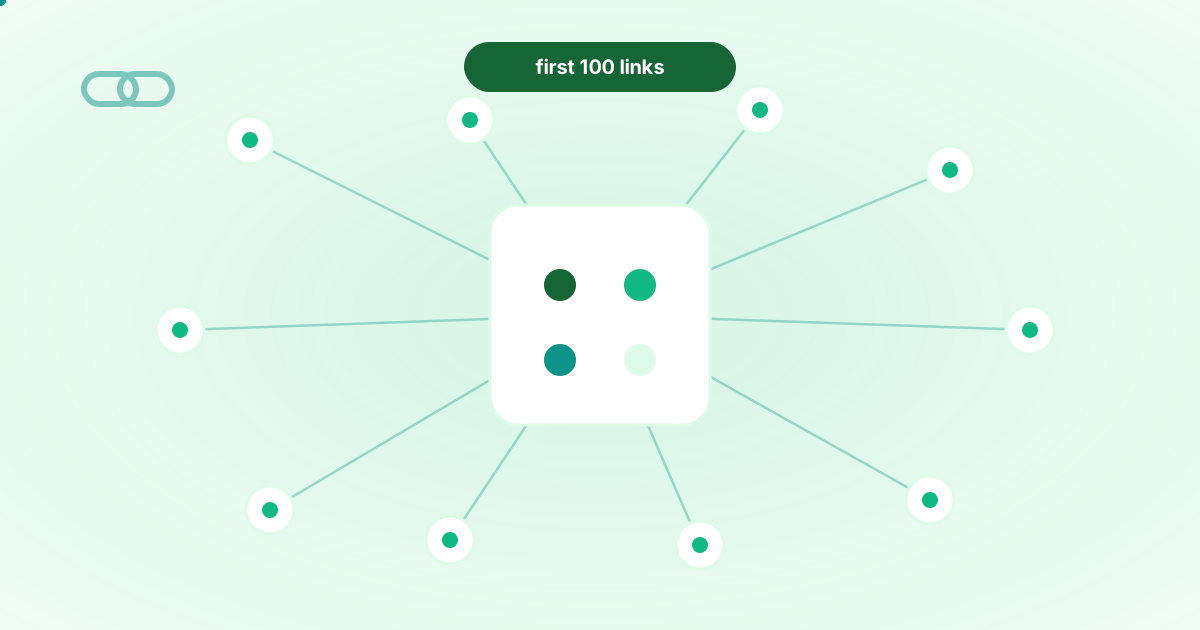
Run the math: 30 directories, 12 launches, 8 badges, 10 integration pages, 8 swaps, 5 quotes, and 12 profiles is 85 links before you've written a single article. The last 15 arrive on their own once those exist.
How Fast Should the 100 Arrive
Slower than you'd like, faster than you'd fear. Six to ten weeks is a natural pace for the whole checklist, with directories and profiles front-loaded and expert quotes trickling in whenever journalists bite.
Don't stress about link-velocity myths. A new company getting listed in the places new companies get listed is the most natural pattern on the web. What looks unnatural is 400 identical links appearing in a week, which is exactly what the $15 gig sellers deliver.
Do the Checklist or Delegate It
All of this is doable by one founder in spare hours over a month or so. The directory block is the most tedious part, which is why our distribution service exists: $225 submits you to 50+ directories, $350 to 100+, humans plus automation, proof links delivered.
Either way, do the boring blocks first. The first 100 links buy the boring credibility that makes everything after them work better: the launches, the content, even the ads. Skip them and you're building on sand. Do them and every later link lands on a foundation.