Sponsored editorial review. Obidos purchased Tool Index's Launch Bundle, which includes this article alongside a featured placement on Tool Index. Payment covers the work and placement; it does not purchase a favorable verdict, an organic ranking, or a traffic guarantee. Links to Obidos in this article are qualified as sponsored.
Review scope: We inspected the Obidos homepage, pricing page, user guide landing page, and Spenego Software about page on September 24, 2026, in a desktop browser. We did not create an account, arrange a trial, make a purchase, download the guide, enter a private dashboard, or test an installation. The screenshots show the actual public interface from that visit, so this assessment covers the product case presented by Spenego rather than verified operation inside Obidos.
A controlled repository from Spenego Software
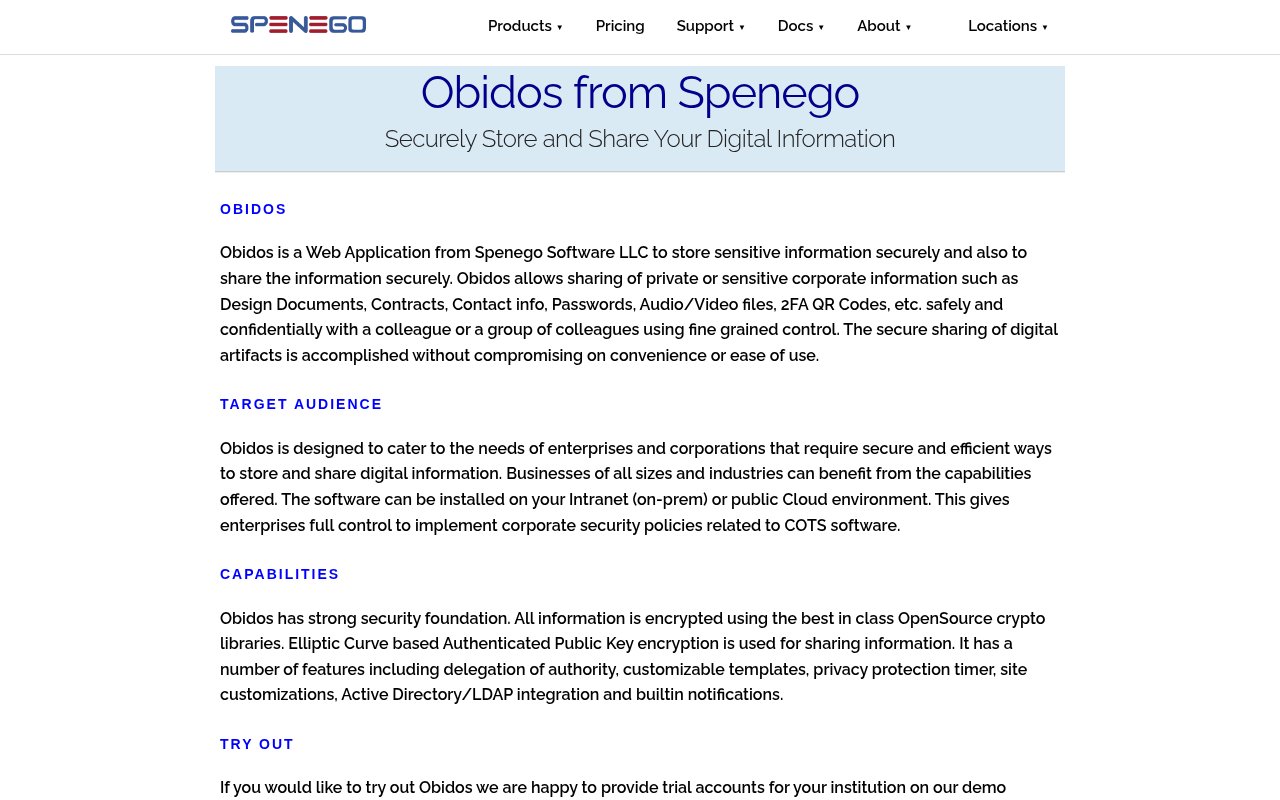
Obidos is a browser based repository for sensitive corporate information. Spenego Software says it can hold items as different as passwords, contracts, design documents, contact details, 2FA QR codes, and audio or video files. Its central idea is to put those artifacts in one controlled system and share each one with a colleague or group through fine-grained permissions.
The product comes from Spenego Software LLC, which identifies itself as a group of software professionals in Exton, Pennsylvania. The company says its work follows IETF standards and established security practices. Those are useful signals of intent, though the public pages don't give enough technical evidence to assess the implementation behind them.
This is not presented as a general cloud drive or a consumer password vault. Obidos sits between document storage, internal knowledge management, and enterprise secrets sharing, with deployment on an organization's own intranet or in its public cloud environment. That broad remit is its most interesting quality and also the source of several questions the site does not resolve.
The homepage makes the basic proposition easy to understand, even for a buyer who has not yet decided whether the problem belongs to IT, security, or operations. It names recognizable information types and connects them to access control instead of dwelling on abstract platform language. We came away with a clear view of the intended category, but not of the software experience behind it.
Obidos has a sensible product thesis, but the public proof is thinner than the breadth of that thesis.
- Sensitive records and files in one repository
- Sharing with individual colleagues or groups
- Deployment on an intranet or public cloud
- Customizable templates for different information types
The organizations it is built to serve
Spenego aims Obidos at enterprises and corporations that need to store and share private information. The examples cross departmental lines, from contracts and design files to passwords and 2FA material. That makes the clearest audience an organization whose sensitive records are scattered among shared drives, password managers, email, and informal handoffs.
The deployment model should be most relevant to teams that want operational control over where the application runs. An intranet installation may suit organizations with internal hosting standards, while deployment in the organization's own public cloud can fit teams that prefer cloud infrastructure without handing the repository itself to a typical software service. The site says both options are available, but it does not explain their architecture or administrative burden.
The product may also fit organizations where access needs to follow roles and groups rather than a single shared vault. Active Directory or LDAP integration, delegation of authority, built in notifications, and site customization all point toward managed corporate use. The pages do not say which editions include each feature, so buyers should not assume every capability is available on the least expensive plan.
Small teams are not ruled out, and the pricing starts at a per user rate. Still, the need to host the software, arrange a trial through the company, and understand the permission model adds overhead. A team that only needs shared passwords would likely find a conventional business password manager easier to evaluate and narrower in scope.
- IT and security teams managing shared credentials
- Operations groups holding sensitive contacts and subscriptions
- Legal or executive teams controlling contracts and private files
- Organizations with an existing directory and internal hosting practice
The user journey is described more than shown
From a user's point of view, the stated flow is straightforward. A person would store a sensitive item, use a customizable template where appropriate, and grant access to a colleague or group. The site also names notifications and a privacy protection timer, suggesting that Obidos is meant to manage the life of a record rather than merely accept an uploaded file.
Delegation of authority could matter when ownership changes or an administrator needs to distribute responsibility. Directory integration could also reduce the work of recreating organizational identities and groups. However, the public copy does not show how users request access, approve sharing, recover deleted information, transfer ownership, or review who has opened an item.
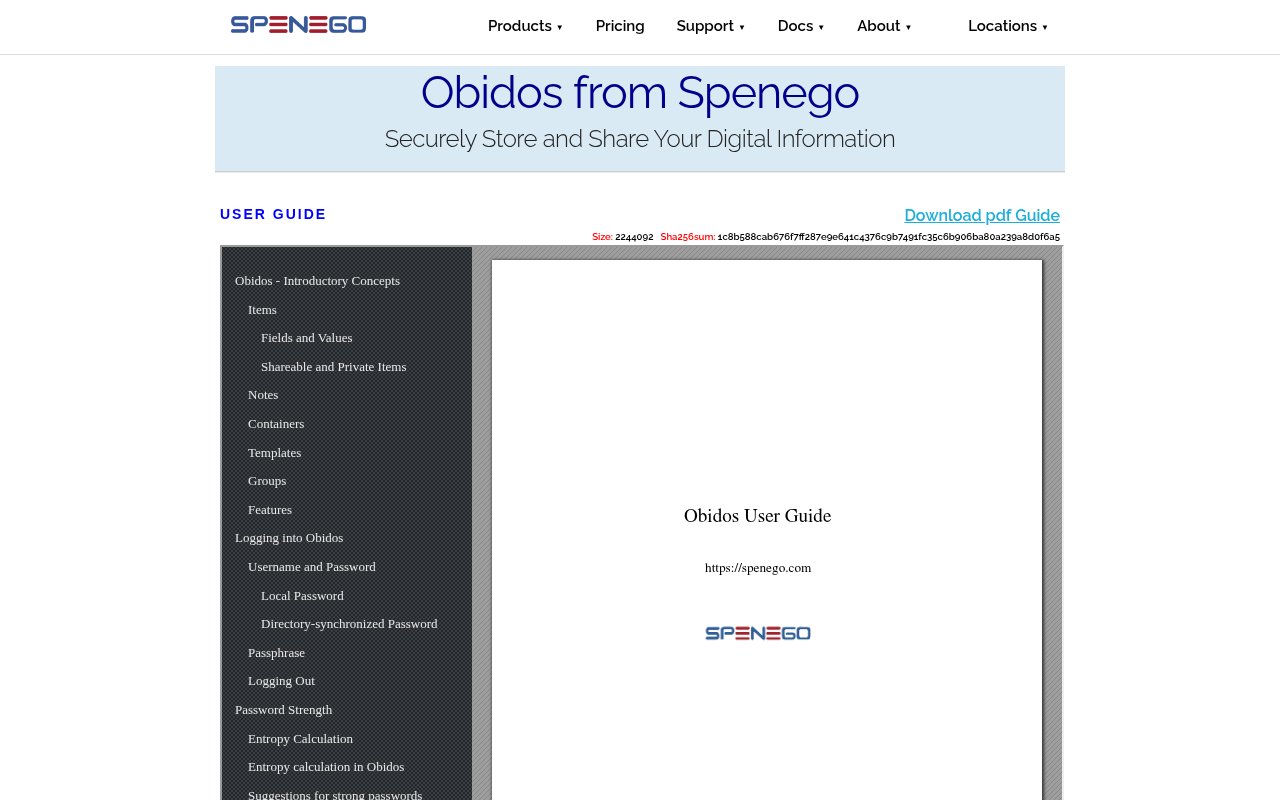
The public user guide page contains a PDF download entry, a file size, and a SHA256 checksum. Publishing a checksum is a thoughtful detail for a downloadable document, since it gives administrators a way to verify the file they received. The captured page itself offers no table of contents or task instructions, and we did not download the PDF as part of this visit.
Because no working interface or guided tour was public, we could not assess navigation, search, template creation, bulk import, permission editing, mobile behavior, or accessibility. These are core parts of the daily experience for a repository, not cosmetic details. Prospective buyers will need the arranged trial to learn whether the workflow is efficient at their expected volume.
A secure repository still has to make the right action obvious when a user is in a hurry.
Security and deployment deserve a closer look
Spenego says all information is encrypted with open source cryptographic libraries. It also says sharing uses elliptic curve based authenticated public key encryption. That is more specific than a generic claim that data is secure, but an algorithm family alone cannot establish whether storage, key handling, authentication, recovery, and updates are designed well.
The promised fine-grained control is relevant because Obidos covers information with very different audiences. A contract, a corporate password, and a 2FA recovery artifact should not automatically inherit the same readership or handling rules. Individual and group sharing, directory integration, and delegated authority form a plausible control model, although the public pages don't document its exact permission levels.
Self-hosting can give an organization more control over network placement, backups, and administrative policy. It also transfers meaningful responsibility to that organization, including patching, monitoring, availability, and recovery. The site does not publish the supported platforms, infrastructure requirements, backup process, upgrade path, logging behavior, or expected maintenance effort on the pages we inspected.
Security buyers should ask where encryption keys live, which data is encrypted at rest and in transit, how administrators are separated from record readers, and whether audit events can be exported. They should also ask about independent testing, incident response, supported identity controls, and the privacy timer's exact behavior. None of those answers appeared in the captured text, so they remain evaluation questions rather than faults we can prove.
- Key custody and recovery
- Audit logs and export options
- Backup and restore procedures
- Patch cadence and supported versions
- Administrator access boundaries
- Authentication and session controls
Pricing is clear at the top and vague underneath
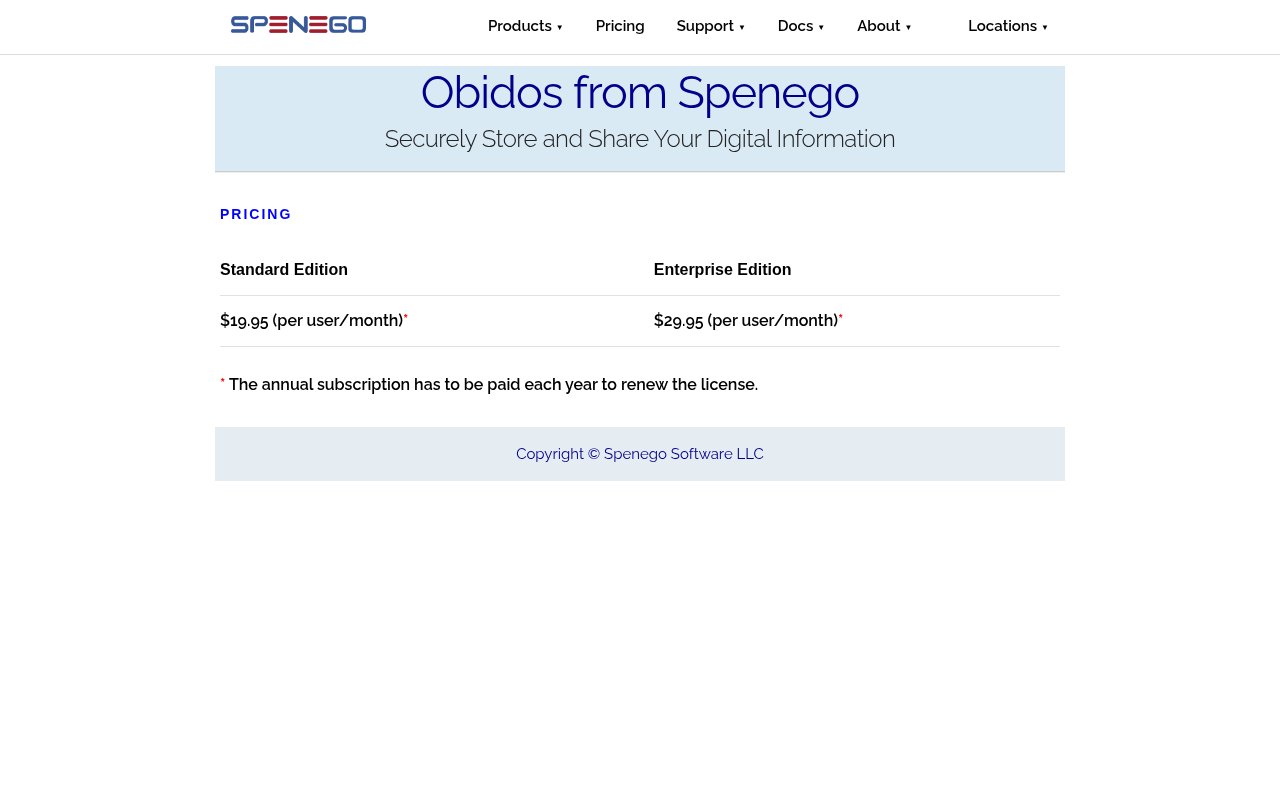
The captured pricing page lists Standard Edition at $19.95 per user per month and Enterprise Edition at $29.95 per user per month. A note says the annual subscription must be paid each year to renew the license. That gives buyers a useful starting point and makes the $10 monthly per user difference between the two commercial editions visible.
The page does not publish a feature matrix beside those prices. Although the site navigation names a license comparison and an Open Source Edition, the captured pricing text gives no price or licensing terms for that edition. It also does not state minimum seat counts, billing thresholds, setup fees, support entitlements, upgrade terms, or whether a trial has a fixed duration.
A company with 100 licensed users would see a material difference between the two listed rates, so edition boundaries matter. Buyers need to confirm whether capabilities such as directory integration, delegation, templates, notifications, and customization vary by edition. The public pages we inspected do not support an answer.
Trial access is not self-service on the homepage. Spenego asks institutions to contact the company so it can arrange accounts on a demo system. That may allow a guided evaluation, but it also adds a step before a buyer can compare the product with tools that offer immediate sign-up or a public demo.
The rates are visible, but the cost cannot be judged properly until the edition boundaries are visible too.
- Standard Edition at $19.95 per user per month
- Enterprise Edition at $29.95 per user per month
- Annual subscription renewal required
- Open Source Edition pricing not stated in the captured pricing text
Where the public case holds up
Obidos addresses a real gap between password storage and document storage. Organizations often have sensitive material that does not fit neatly in either category, such as a 2FA image, a private contact record, or a design file with a limited audience. A templated repository with item level sharing is a coherent answer to that mixed collection.
The homepage is disciplined about naming its audience, deployment choices, and representative content. It does not make visitors infer whether the product is intended for personal use or corporate administration. The visible commercial rates also help a buyer decide early whether a deeper evaluation is financially plausible.
The security description includes identifiable mechanisms rather than relying entirely on broad assurance. Open source cryptographic libraries and authenticated public key encryption are meaningful topics for technical follow-up. Likewise, Active Directory or LDAP integration signals awareness that access in an enterprise repository needs to connect with existing identity management.
The combination of structured templates and support for varied files is the strongest differentiator stated on the site. It suggests that a team could keep consistent fields for repeated record types without excluding documents or media. We could not test that design, but it gives Obidos a more distinct purpose than a generic encrypted folder.
Where it falls short
The largest limitation is the lack of a visible product interface. The homepage explains the concept, but there are no captured screens showing a repository, record, permission dialog, activity history, template editor, or administration area. Without those views, buyers cannot judge whether the product makes complicated access decisions understandable.
The second limitation is incomplete technical evidence for the security case. The site names encryption methods but does not explain key custody, audit coverage, backup protection, administrative access, external assessment, or update practices. For a system intended to hold passwords and 2FA material, those details are central to evaluation.
Pricing also stops before the comparison becomes useful. Two rates are public, yet the captured page does not map features, service levels, or support to Standard and Enterprise. The navigation's reference to an Open Source Edition raises another reasonable question that the pricing text does not answer.
Documentation discovery is weak on the captured user guide page. It offers a PDF and checksum but no visible contents, online articles, release notes, or setup overview. A contact arranged demo may answer many of these questions, but the public site makes buyers do that work before they can form a grounded shortlist.
There are also no public details in the captured pages about mobile access, browser support, import and export formats, integrations beyond Active Directory or LDAP, audit reporting, or disaster recovery. We don't treat every absent detail as an absent product feature. We do treat the collective silence as a limitation of the evaluation experience.
Obidos asks to be trusted with unusually sensitive material before its public site shows enough reasons for that trust.
- No public interface tour in the captured pages
- No detailed security or key management documentation
- No captured feature comparison between editions
- No published infrastructure or maintenance requirements
- No self-service trial path
How Obidos compares with familiar alternatives
For passwords, recovery codes, and shared credentials, 1Password Business and Bitwarden are the most obvious comparisons. Their scope is centered on password management, which can make them a cleaner choice when credentials are the main problem. Obidos makes a broader case by including contracts, design documents, contacts, and media in the same controlled repository.
Bitwarden is especially relevant for teams that place a high value on a self-hosted option, while a conventional password manager benefits from a category buyers already understand. Obidos should win only when its templates and support for mixed corporate artifacts reduce the need for several separate stores. The current public pages do not show enough workflow detail to prove that advantage.
For documents and internal knowledge, Microsoft SharePoint and Atlassian Confluence are familiar alternatives. They cover collaboration and organizational content more broadly, while Obidos is positioned around confidentiality and selective sharing. A buyer already committed to one of those ecosystems should compare its access controls and governance with Obidos before adding another repository.
HashiCorp Vault belongs in the comparison when the priority is application secrets, dynamic credentials, or infrastructure automation. That is a different job from giving business users a place for contracts, contacts, and private files. Obidos appears more human centered and content oriented, so it should not be treated as a direct substitute for a machine secrets platform without technical proof.
The choice ultimately follows the material being protected. Credential heavy teams should start with a password manager, document heavy teams should test their existing collaboration platform, and engineering teams should evaluate a secrets manager. Obidos is most compelling in the overlap, where mixed sensitive records need templates, selective sharing, directory based access, and organization controlled hosting.
- 1Password Business for managed workforce credentials
- Bitwarden for password management with a self-hosted option
- Microsoft SharePoint or Atlassian Confluence for broader document collaboration
- HashiCorp Vault for application and infrastructure secrets
Pros and cons
- Covers credentials, documents, contacts, media, and 2FA artifacts in one stated model
- Supports organization controlled deployment on an intranet or public cloud
- Combines individual and group sharing with customizable templates
- Lists Standard and Enterprise per user rates on the public pricing page
- Names Active Directory or LDAP integration and delegated authority
- Captured pages show no working interface or detailed user workflow
- Public security claims lack key management, audit, backup, and testing details
- Pricing does not show which capabilities belong to each commercial edition
- Open Source Edition terms are absent from the captured pricing text
- Trial accounts require contacting Spenego instead of immediate self-service access
Organizations that host their own business systems and need one controlled repository for mixed sensitive records, especially when templates, directory integration, and group based access matter.
Verdict
Obidos has a credible place between a password manager and a document platform, particularly for organizations that want to control deployment. Its public pricing and clear use cases earn it a closer look, but the site does not yet supply enough interface, edition, or security detail for a confident purchase decision. A serious evaluation should begin with a guided trial and a technical review of keys, permissions, auditing, backups, and maintenance.
You can look at Obidos yourself at spenego.com, or read what other builders say on its Tool Index listing. This review reflects what the public site showed on 2026-09-24; products change, so treat the details as a snapshot.