Same three prompts. Every major AI video generator. A woman walking through rainy Tokyo at night. A golden retriever catching a frisbee in slow motion. A close-up product shot of a coffee mug with steam rising.
Simple enough to be fair. Complex enough to show real differences.
The headline finding? You can get genuinely usable video for six bucks a month. Or pay $200 for the absolute best. The gap matters, but not as much as the pricing suggests.
The Contenders
| Platform | Entry Price | Max Resolution | Max Duration | Key Strength |
|---|---|---|---|---|
| Sora / Sora Pro | $200/mo (ChatGPT Pro) / API pay-per-use | 1080p | 20 seconds | Best quality, prompt understanding |
| Veo 3 | Free (VideoFX) / API | 1080p | 8 seconds | Native audio, free access |
| Kling 2.0 | $5.99/mo | 1080p | 10 seconds | Best value, character consistency |
| Runway Gen-4 | $12/mo | 4K (upscaled) | 10 seconds | Creative control, style transfer |
| Hailuo/Minimax | Free tier / $9.99/mo | 1080p | 6 seconds | Natural motion, free tier |
| Pika 2.1 | $8/mo | 1080p | 5 seconds | Speed, special effects |
Sora and Sora Pro
Let's start with the one everyone wants to know about.
Sora produces the most cinematic video from any AI generator. Full stop. The Tokyo rain scene wasn't just good - it was genuinely beautiful. Realistic reflections on wet pavement shifting as the camera moved. Proper depth of field. Pedestrians with natural gait variation, not the clone-stamped crowd movements you see elsewhere.
The golden retriever was where Sora showed off. Fur rippling in the wind. The frisbee bending slightly on impact. Background blur consistent with actual slow-motion footage. Every other platform had at least one uncanny-valley moment. Sora had none.
The coffee mug steam? Closest to real footage we've seen. Subtle wisps affected by what appeared to be air currents in the scene.
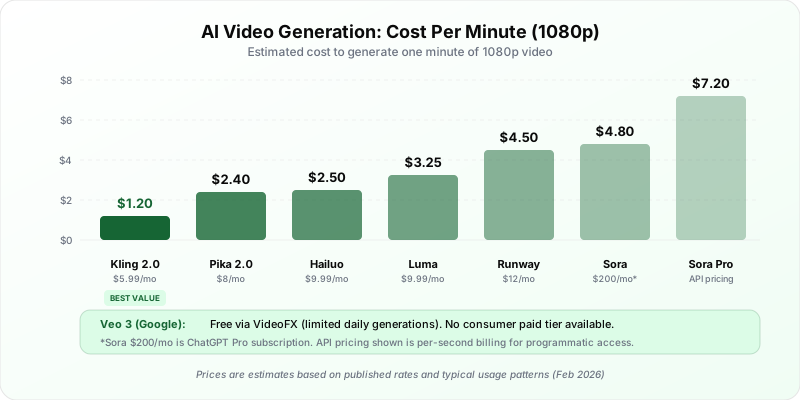
The problem is the price. ChatGPT Pro at $200/month is the consumer access point. Via API, one minute of Sora Pro video at 1080p costs $7.20. That's 6x more expensive than Kling for quality that's maybe 15% better in most cases.
Our take: Sora Pro is for ad agencies, film production houses, brands that need every frame perfect. For everyone else, the quality-to-price ratio doesn't make sense.
Kling 2.0
Kling is the story of this comparison.
At $5.99/month for Standard, it produces video that was state-of-the-art six months ago. And it's still competitive with platforms charging 5-30x more.
The Tokyo scene was impressive. Reflections weren't quite as nuanced as Sora's - more uniform glossiness versus per-puddle variation - but it looked good. Pedestrians moved naturally. Neon reflected properly. A non-expert wouldn't see the difference without a side-by-side.
Where Kling genuinely wins: character consistency. We generated five separate clips of the same woman in different scenes, and she was recognizable in all five. For narrative content, social media series, any project where the same character appears multiple times - this isn't a nice-to-have. It's the feature.
The Pro tier at $29.99/month gives you 660 credits, extended durations, and priority queue. Cost per minute lands around $0.90-1.50. That's 5-8x cheaper than Sora Pro.
Veo 3
Google's Veo 3 does one thing no other platform can: native audio generation.
It doesn't just make video. It creates matching sound effects, ambient audio, and dialogue. Our Tokyo scene came with rain sounds, footsteps on wet pavement, distant car horns, and a faint siren. Nobody else does this.
Video quality is excellent - arguably second only to Sora Pro. The golden retriever's fur physics were nearly as good as Sora's. The coffee mug steam had subtle turbulence patterns suggesting real fluid dynamics.
The problem is access. VideoFX (Google Labs) is free but has a waitlist, rate limits, and limited daily generations. There's no middle-ground paid tier. Free or enterprise. For someone who wants to pay $20/month and make videos, Veo 3 is frustratingly unavailable as a product despite being available as a technology.
The 8-second max is also the shortest here. Meaningful limitation for production work.
Runway Gen-4
Runway's been in AI video longer than anyone. Gen-4 reflects that in one specific area: creative control.
Motion brush lets you paint exactly where things should move. Camera paths let you specify pan, zoom, tracking. Style references let you upload an image and say "make the video look like this."
For our test prompts, raw text-to-video quality was below Sora, Kling, and Veo. The Tokyo scene looked slightly more "rendered" than real. The golden retriever had a brief tail morphing artifact. But we uploaded a moody, desaturated reference image - and Runway generated video that perfectly matched that style. No other platform came close.
If you're a creative professional who knows exactly what you want, Runway gives you the tools to get there. If you're typing prompts and hoping for the best, you'll get better results elsewhere for less money.
Pricing is confusing. Credits vary by resolution and model. The Basic plan at $12/month gives roughly 40 seconds of Gen-4 video. Not a typo. Forty seconds. You need Standard at $28/month for any meaningful work.
Hailuo/Minimax
Consistently punches above its weight.
The golden retriever test was Hailuo's standout. Motion quality was the most natural of any platform except Sora. The dog's movement was fluid, frisbee trajectory correct, slow-motion smooth. For the first 4 seconds, genuinely indistinguishable from real footage. Seconds 5 and 6 showed slight degradation - a pattern across all Hailuo generations. Starts strong, wobbles toward the end.
The free tier (10 generations/day, 720p, watermarked) produces better video than several paid competitors' entry tiers. We weren't expecting that.
At $9.99/month for 1080p without watermark, it competes directly with Kling. Kling wins on character consistency and duration. Hailuo wins on motion naturalness, especially for animals and people.
Pika 2.1
Fastest generator in our test. Most fun to use. And we mean that as both compliment and limitation.
Under 60 seconds for most clips. Need 20 variations to find the right one? Pika makes that practical.
The special effects are what make it unique. Physics-based transformations - explode, melt, crush, inflate - that turn static images into eye-catching social content. Gimmicky in the best way. Exactly what performs on TikTok and Reels.
For our standard prompts, quality was the lowest. Tokyo lacked atmospheric depth. The retriever had a noticeable morphing issue. Coffee mug was flat. At $8/month for 150 credits (roughly 30 clips), it's cheap enough that lower quality is a fair trade for speed and volume.
Pika isn't where you go for cinematic quality. It's where you go for fast iteration, social content, and creative effects. In that niche, nothing else comes close.
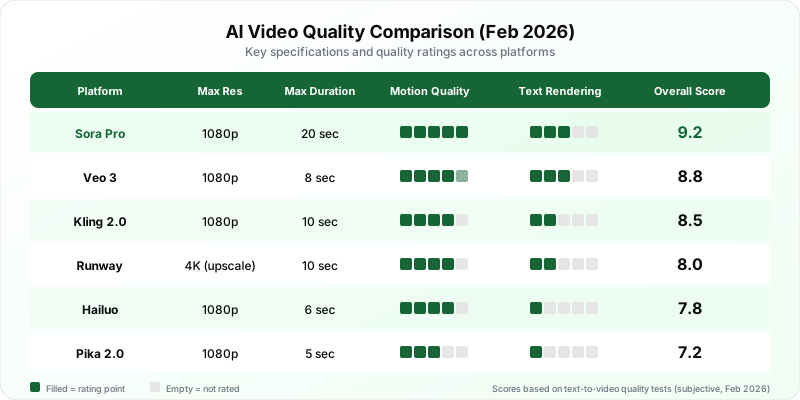
Quality Ranking
Subjective quality ranking for text-to-video, February 2026. Based on motion, physics, lighting, and prompt adherence.
- Sora Pro (9.2/10) - Best overall by a clear margin. 5-8x the price of Kling.
- Veo 3 (8.8/10) - Excellent plus native audio. Limited access.
- Kling 2.0 (8.5/10) - The value champion. 85-90% of Sora quality at 15-20% of the price.
- Sora standard (8.3/10) - Noticeable quality gap from Pro.
- Runway Gen-4 (8.0/10) - Best creative control, middling text-to-video.
- Hailuo/Minimax (7.8/10) - Surprisingly strong motion. Weak on duration.
- Pika 2.1 (7.2/10) - Fast and fun. Quality trails the pack.
That 2-point spread sounds small. In practice, the gap between 9.2 and 7.2 is the difference between "this looks like real footage" and "this looks like a really good AI video." Both are useful. Different purposes, different price points.
Cost Per Minute of 1080p Video
The number that actually matters for production budgets.
| Platform | Cost Per Minute (1080p) | Notes |
|---|---|---|
| Veo 3 (VideoFX) | Free (limited) | No paid consumer tier |
| Kling 2.0 (Standard) | $0.90-$1.50 | Best value for quality |
| Pika 2.1 (Basic) | $1.60-$3.20 | Cheapest for rapid iteration |
| Hailuo (Basic) | $2.00-$3.00 | Best free tier available |
| Runway Gen-4 (Standard) | $3.40-$5.60 | Worth it only for creative control |
| Sora (API) | $4.80 | High quality, steep price |
| Sora Pro (API) | $7.20 | Best quality available anywhere |
Kling at $1.50/min versus Sora Pro at $7.20/min. A 5x price difference for a quality gap most audiences won't notice. For a 10-video social campaign, that's $15 versus $72. At scale, these numbers matter enormously.
The Recommendation
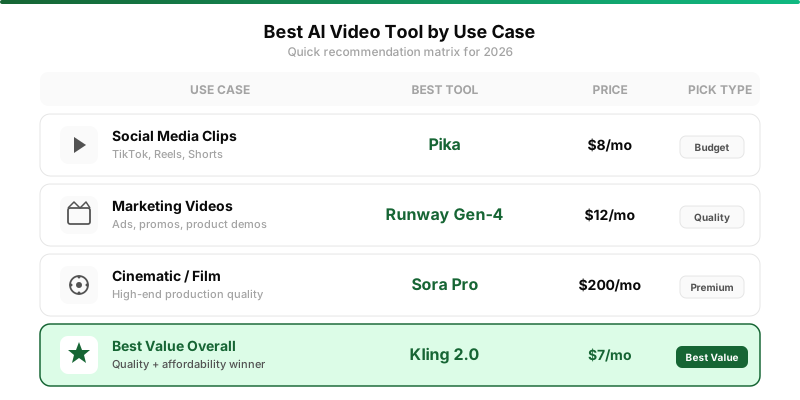
For most people, start with Kling 2.0 at $5.99/month. Best quality-to-price ratio on the market. Best character consistency. Gentle learning curve. Even when you outgrow it, it stays useful for drafts before running finals through something pricier.
Budget truly zero? Hailuo's free tier has no business being as good as it is. Use it until you have a reason to pay. If you can get access to Veo 3 on VideoFX, that works too.
Need the absolute best and your project justifies the cost? Sora Pro via API is unmatched. The gap is real. It's just not $200/month real for most use cases.
Need precise creative control? Runway Gen-4 is the only serious option. Text-to-video is middling, but image-to-video with creative controls is the best available.
Fast, cheap social content with thumb-stopping effects? Pika 2.1.
The smartest approach in 2026 is keeping Kling as your daily driver, Sora for hero content, and Pika for the weird creative stuff. Total for all three: under $45/month. That's less than one stock video clip cost three years ago.
Browse more AI creative tools in our directory, or explore all tools to find what fits your workflow.