I run a tool directory and I sell a directory submission service. Which means this post is me explaining, carefully, why you should expect less than the sales page implies. Marketing genius, I know.
But wrong expectations are why founders quit this channel right before it starts working. So here's the actual deal, timeline attached, uncomfortable parts included.
If a submission service promises you traffic, close the tab. Directories are a links-and-visibility play. The traffic, when it comes, arrives through the side door months later.
What Directories Won't Do
They won't flood you with visitors. A single directory listing might send a handful of clicks a month. Some send none. That's true of ours too, for most listed tools, on most days.
The mechanics explain it. Directory visitors browse categories, compare five tools, and click through to one or two. Your listing is one card in a grid, and even a great directory splits its traffic across thousands of listed products. Expecting a firehose from that layout is a geometry error, not a marketing one.
If you're buying submissions to fix a traffic problem this quarter, spend the money on ads or content instead. Genuinely. I'd rather lose the order than the expectation game.
What You're Actually Buying
Five things, in descending order of certainty. None of them is a traffic chart that impresses anyone in week one, and every one of them compounds.
First, backlinks that compound. Twenty to forty referring domains landing over a few weeks is the fastest legitimate foundation a young domain can get, and it's the backbone of the first-100-backlinks playbook.
Second, brand-query real estate. When someone searches your product's name, a wall of listings, reviews, and profiles shows up instead of a single lonely homepage. That wall converts skeptics, the same way a second opinion converts a nervous restaurant-picker who already chose.
Third, AI-assistant citations. This is the newest one and founders underrate it badly. LLMs ground their answers in exactly this kind of structured, categorized content, and Bing Copilot regularly cites directory pages directly in its answers. When someone asks an assistant for tools that solve your problem, the retrieval layer has to have seen you somewhere. Directories are the somewhere.
Your next hundred customers might never see your homepage in a search result. They'll see an AI answer that either mentions you or doesn't, based on what the assistant found when it went looking.
You can watch this happen yourself. Ask a few assistants for the best tools in your category and check what they cite. The sources are disproportionately directories, best-of lists, and comparison pages, because that's the content already shaped like an answer.
Fourth, long-tail discovery. Directory category pages rank for thousands of small "best X for Y" queries that no startup would ever target with its own content. Each listing is a ticket into those pages.
And fifth, occasionally, a real customer. Rare, high intent, and weirdly loyal, because they found you while actively hunting for a solution instead of being interrupted by an ad.
The Realistic Timeline
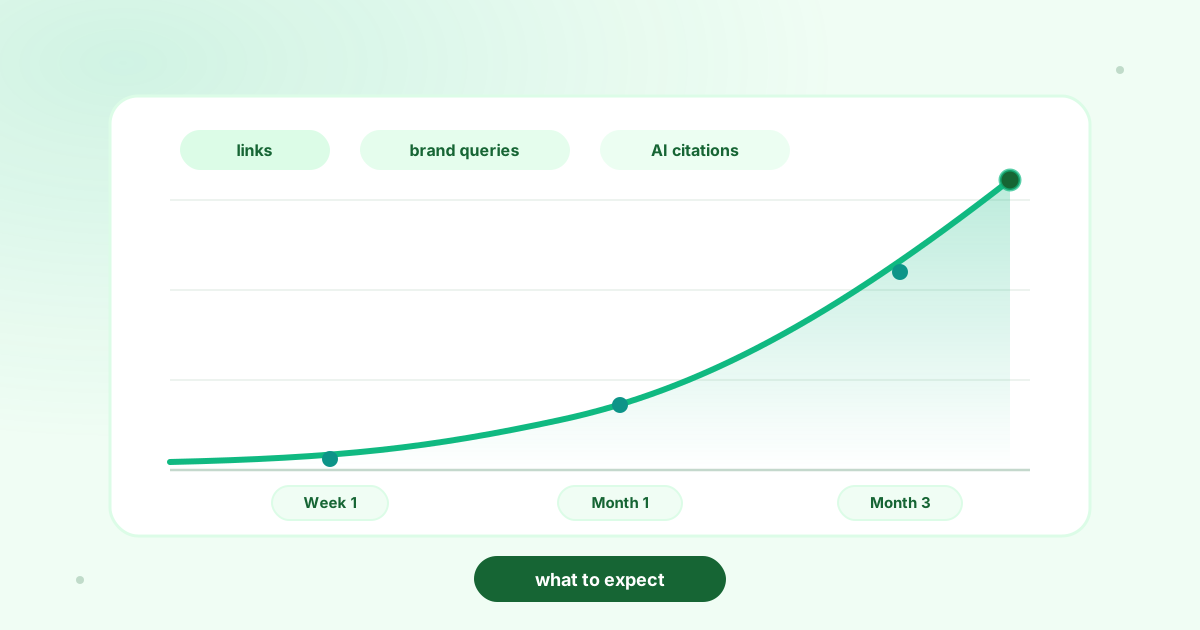
| Period | What Happens | What You'll Feel |
|---|---|---|
| Week 1 | Confirmations, a few instant listings, lots of queues | Underwhelmed |
| Month 1 | Approvals land, links get indexed, referring domains climb | Mildly encouraged |
| Month 3 | Category pages rank, brand queries tick up, AI answers cite you | Quietly convinced |
Week 1: Confirmations and a Few Instant Wins
Your inbox fills with confirmation emails. A few directories publish immediately, and when we ran our own 73-directory experiment, Viesearch had our listing live the same day. Most submissions, though, enter review queues that move on editorial time, not startup time.
Traffic impact this week: approximately nothing. This is normal and not a signal of anything.
Use the quiet week for hygiene instead. Check that every live listing has the right logo, the right tagline, and a working link. A misspelled category on day three is a five-minute fix now and a permanent embarrassment in a screenshot later.
Month 1: The Links Get Counted
The majority of approvals land somewhere in weeks two through five. Links get crawled and indexed, your referring-domains chart develops an actual slope, and Search Console starts showing impressions for queries you never wrote content for.
You might see your first trickle of referral visits. Single digits. Resist the urge to judge the channel here.
This is also when the silent failures surface. Listings you were sure you submitted simply never appear, which matches what we measured in our own run. Re-submit the missing ones, or chase the proof links if you paid someone.
Month 3: The Compounding Shows Up
This is where it gets quietly good. The category pages you're listed on rank and send long-tail visitors. Brand-name searches return a full, credible wall of results. AI assistants start mentioning you in answers because their retrieval found you in three more places than before.
And usually somewhere in here, a signup tells you they found you on a directory you forgot you submitted to. One customer covers the whole campaign. That's the actual ROI shape: nothing, nothing, then a durable little engine.
None of it arrives as a spike. It arrives as floors rising: slightly more branded search, slightly more direct traffic, one extra referral source with suspiciously good conversion. Compounding always looks boring from inside any single week.
How to Measure It Properly
Three numbers, checked monthly, and nothing else. Referring domains, from any backlink tool's free tier. Brand-query impressions, from Search Console. And a spot-check of two or three AI assistants asked about your category, noting whether you appear.
Write them down on the first of the month. The channel's whole value lives in the slope of those three lines, and none of them moves meaningfully inside any given week, which is why founders who check daily always conclude it failed.
The Cost Math That Matters
Measure cost per referring domain, not cost per click. Clicks are the wrong unit for this channel.
Doing it yourself, 40 to 50 quality submissions is a couple of full founder days plus follow-ups, and the forms genuinely fight back. Even with a purpose-built robot, our own run confirmed 20 of 73 in a session. Hand-counting your hourly rate against that is sobering arithmetic for most funded founders.
Done-for-you, our distribution service is $225 for 50+ directories or $350 for 100+, run by humans plus automation, with proof links delivered. That works out to a few dollars per referring domain, which is the entire pitch, and roughly a tenth of what agencies charge for "link building" that produces the same chart.
Visibility upgrades are a different product entirely. On Tool Index, the paid listing tiers buy placement: $29.99 gets a 24-hour review and 7 days featured, $149.99 gets 30 days featured plus homepage spotlight and a newsletter mention. Placement is about being seen this month. Links are about being found for years. Buy them for different reasons.
When DIY Makes Sense
You're pre-revenue and time-rich. Do it yourself, genuinely. Free listings like ours cost minutes, and working the list teaches you the shape of the channel better than any post can.
DIY is also right when your product is niche enough that ten hand-picked directories beat a hundred generic ones. A developer tool belongs in developer directories, and you know which those are better than any vendor.
Budget it honestly though. The hidden cost of DIY isn't the first pass, it's the follow-up: re-checking queues, fixing rejected listings, chasing the ones that vanished. Half the value of doing it once yourself is that you'll never again wonder whether submission services earn their fee.
When Paying Makes Sense
You have revenue and no time, which describes most founders past their first ten customers. The math is unforgiving: if your hours are worth more than the service, doing the forms yourself is expensive vanity.
Whoever you pay, including us, hold them to one standard. Proof links, delivered, for every submission. Everything else in the pitch is decoration.
And check what "100 directories" means before buying from anyone. If the list is padded with graveyards and link farms, 100 is worse than 40. Volume is only a feature when every entry is a page a human being might actually visit.
The only unforgivable outcome is paying for submissions and receiving a spreadsheet instead of URLs. Proof links or it didn't happen.
The Verdict
Directories are the cheapest compounding channel a young SaaS can buy, and the worst instant-gratification channel it can buy. Both things are true at once.
Treat them like index funds. Boring, bought early, left alone to compound while louder channels get your attention. Set the horizon at 90 days, count referring domains and brand queries instead of sessions, and this channel quietly outperforms its invoice.
Expect a traffic flood instead, and you'll cancel at week three. Right before it works.
If you want the full picture before spending anything, start with the 50 directories worth submitting to and the experiment write-up above. Twenty minutes of reading, and you'll know more about this channel than most of the agencies selling it.