
Fenzo AI
Turn any question or your notes into an interactive AI course in about a minute
Gallery
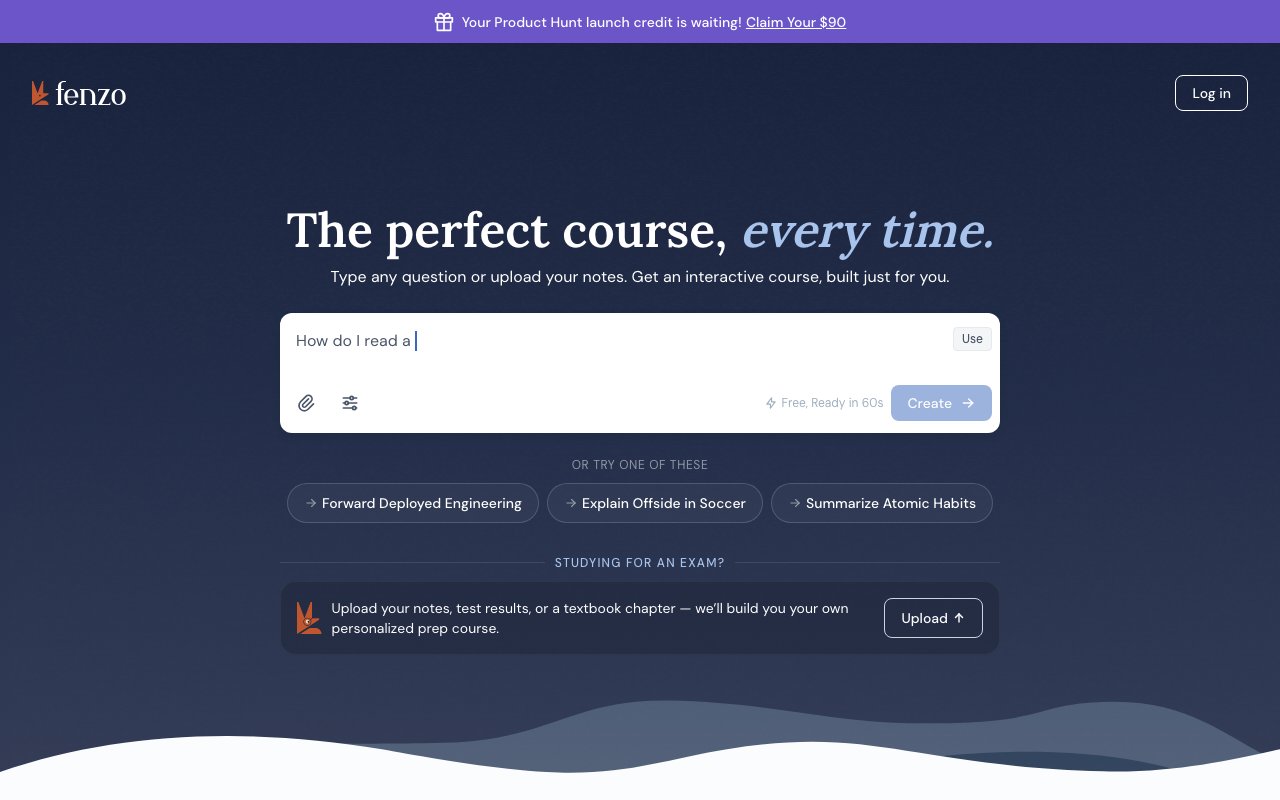
About Fenzo AI
Fenzo AI is a learning platform that turns any question, a set of notes, or a textbook chapter into a full interactive course in about a minute. Instead of stitching a subject together from scattered videos and articles, you tell it what you want to learn and it builds a structured lesson path around that exact request. The pitch is simple, type any question or upload your notes and get an interactive course built just for you, with the promise that you get the perfect course, every time. The result is meant to feel like something written for you rather than a generic playlist you have to adapt yourself.
The problem it goes after is how passive most online learning has become. You watch a video, nod along, and forget most of it by the next morning, partly because nothing ever asked you to prove you understood it. Generic courses also rarely meet you where you are, so you sit through material you already know before you reach the part you actually needed, and you give up somewhere in the middle. Fenzo starts from your own input, which means the scope is set by the question in front of you instead of a fixed syllabus built for the average student. That framing is the whole point, since a course aimed at exactly your gap is one you're far more likely to finish.
In practice you type a question or upload your notes, and the system generates a course within roughly sixty seconds. Each course is built around active learning, so lessons arrive with embedded quizzes, recall prompts, and an AI tutor that asks follow-up questions to check whether an idea actually landed rather than letting you skim past it. Programming topics get a live code editor right inside the lesson, so you can run and edit examples without leaving the page or setting up an environment. Flashcards handle the spaced repetition that helps concepts move into long-term memory. The whole loop is designed so you're doing something on almost every screen, answering, recalling, or writing code, rather than only reading.
It isn't locked to one shape of content either. You can get a traditional multi-lesson course, a focused book summary, or a deep dive on a narrow specialized topic, depending on what you feed it. That range makes it as useful for a quick concept refresher the night before an exam as it is for a longer structured study plan you work through over weeks. Because each course is generated on demand, you can also spin up several angles on the same subject and compare how they explain it, which helps when the first pass doesn't quite click.
The audience is deliberately broad. Students revising for exams get targeted practice on the exact topics they're weak on, and professionals building a new skill get a course scoped to their gap rather than a beginner overview they've already outgrown. Curious learners get a fast, structured way into an unfamiliar subject without wading through a page of search results first, and they can follow a tangent the moment it appears. Teachers use it too, standing up lesson material, quizzes, and summaries in a fraction of the time it would take to build them by hand.
Part of the appeal is how little you have to prepare before you start. You can paste a single confusing question, drop in a messy set of lecture notes, or hand it a chapter you're stuck on, and it does the work of turning that raw input into an ordered path with a beginning, a middle, and checkpoints along the way. That low barrier matters most in the moment you actually want to learn something, when the last thing you want is to go hunting for the right course first. The book summary format is handy for getting the shape of a title before committing to the whole thing, and the specialized deep dives are there when a single narrow concept is the entire blocker.
Where it stands apart is the insistence on interaction. Plenty of tools will generate a wall of text or a script you passively read and then close a minute later. Fenzo leans on quizzes, recall prompts, a questioning tutor, and hands-on code so the learner stays active, which is where retention actually comes from. The cross-course knowledge graph on higher tiers also tries to connect what you learn across topics rather than treating every course as an island, so earlier material gets reinforced as you branch into related subjects.
Access is freemium. You can create courses for free to see whether the format clicks for you, with Pro and Max plans layering in visual interactive courses, custom course creation, an AI mentor, book summaries, progress tracking, and sharing. Max sits above Pro with the most capable model, personalized book summaries, a higher mentor quota with priority responses, that cross-course knowledge graph, and roughly double the sharing reach. The plan cards describe what each tier unlocks but don't always post exact prices on every view, so it's worth opening the pricing page before you decide. For anyone who learns better by doing than by watching, it's a low-friction way to turn a single question into something you can actually practice.
Key Features
- Course generation in about a minute
- Embedded quizzes and recall prompts
- AI tutor with follow-up questions
- Live in-lesson code editor
- Flashcards for spaced repetition
- Book summaries and topic deep dives
Pros & Cons
What we like
- Turns any question or notes into a structured course
- Active recall and quizzes instead of passive reading
- In-lesson code editor for programming topics
- Free tier to try the format before paying
Room for improvement
- Exact plan prices aren't posted on the cards
- Generated courses need a human accuracy check
- Best for self-paced learning, not formal accreditation
- Younger product with a smaller community
Frequently Asked Questions
What is Fenzo AI?
Is Fenzo AI free?
Who is Fenzo AI for?
How is Fenzo AI different from watching videos or a generic course?
Best For
Featured in
Alternatives to Fenzo AI

Reviews (8)
Recommended without reservation
Found Fenzo AI on a Show HN thread and I am glad I clicked. Where it really wins is free tier to try the format before paying. The interface stays out of my way, which I appreciate. No regrets so far.
Recommended without reservation
Tried Fenzo AI on a side project first, then rolled it out everywhere. Performance has been steady even when I lean on it hard. Setup was painless and I was productive the same day. It earns its place in my stack.
Genuinely impressed
Picked Fenzo AI for the price, stayed for the quality. Got real value out of live in-lesson code editor. The defaults are sensible, so I was not fighting settings on day one.
Finally something that fits
Found Fenzo AI on a Show HN thread and I am glad I clicked. Their take on in-lesson code editor for programming topics is genuinely good. The thing I keep coming back to is how reliable it is. Mostly using it for turning lecture notes into a practice course.
Worth a look
Three months of Fenzo AI later, here is what holds up. Got real value out of active recall and quizzes instead of passive reading. Recommending it to people in a similar spot.
It just works
Fenzo AI has quietly become part of my daily flow. Where it really wins is flashcards for spaced repetition. Mostly using it for summarizing a book into an interactive lesson. Hard to imagine going back to my old setup.
Worth a look
Started using Fenzo AI casually, now it is pinned in my dock. Their take on flashcards for spaced repetition is genuinely good. It just works, day after day, without surprises. Found it works best for turning lecture notes into a practice course.
It just works
Hadn't planned on switching, but Fenzo AI was hard to ignore. Where it really wins is course generation in about a minute. The interface stays out of my way, which I appreciate. Mostly using it for summarizing a book into an interactive lesson. It earns its place in my stack.
Badge builder
Add Fenzo AI to your website
Choose a badge style and size, preview it here, then copy the generated HTML. Badge images are self-contained SVGs and do not require an external script.

<a href="https://toolindex.net/tools/fenzo-ai?ref=badge" target="_blank" rel="noopener">
  <img src="https://toolindex.net/badge/fenzo-ai/medium.svg" alt="Fenzo AI - Listed on Tool Index" width="180" height="50" />
</a>How to use the badge
- 1. Pick the style, size, and theme that fit your layout.
- 2. Copy the generated HTML from the code block.
- 3. Paste it into your footer, homepage, or press page.
Standard badge available
The standard listing badge is available now. Score and circle badges are limited to tools currently ranked in the top 10 of a category.
Badge clicks return visitors to this profile with a referral tag so the source remains identifiable.
Related Tools

Apatero AI
The creator studio for AI image, video, audio, 3D, and avatars, now at apatero.ai.
Kevin Gabeci Toolkits
Seven AI toolkits for writing books, making music, cutting video, and building agents.

Warp
The modern terminal reimagined with AI and collaboration

Bolt.new
Prompt-to-deployed full-stack app inside the browser
Work on Fenzo AI? Request listing access or correction