
SoloDevStack
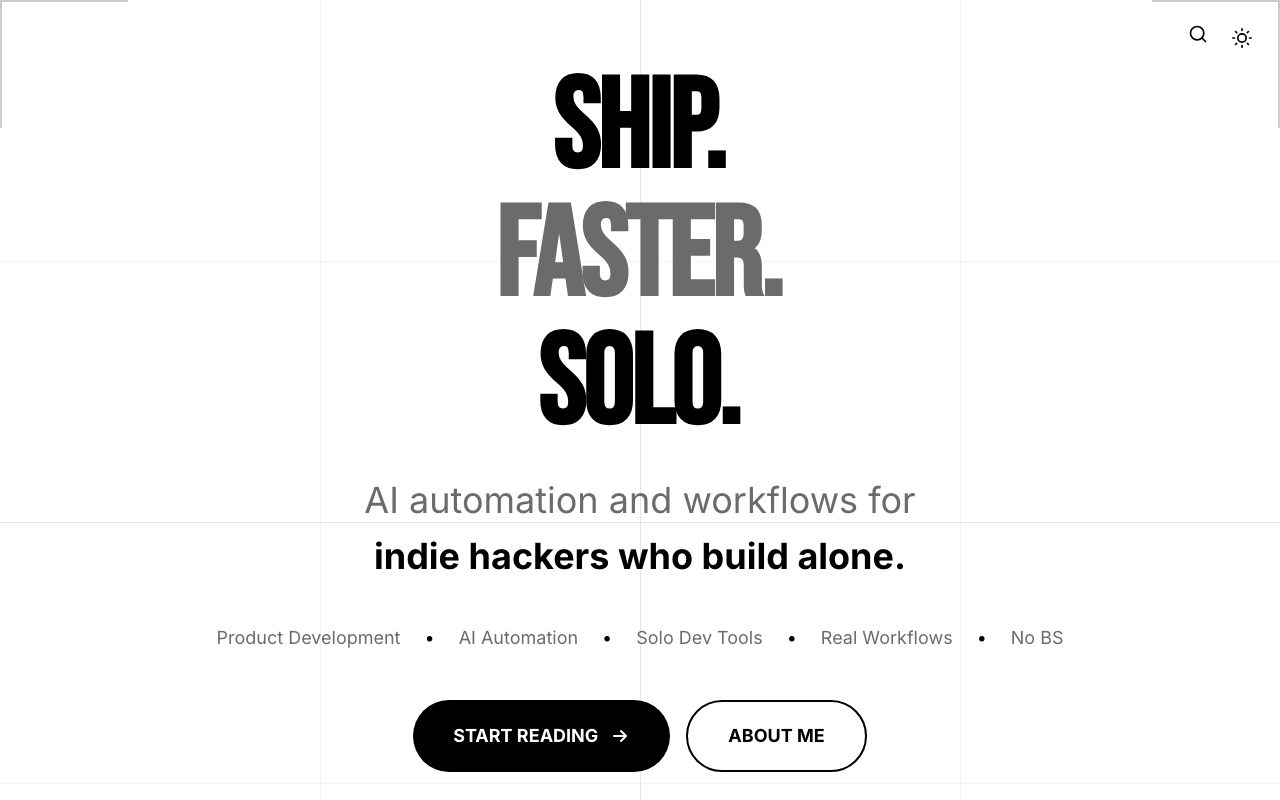
A solo developer blog built on head-to-head tool comparisons, 580+ posts deep.
Gallery
About SoloDevStack
SoloDevStack is a blog for people building software on their own. Not a boilerplate, not a starter kit, not a product you buy. It is an archive of roughly 580 posts about the decisions a solo developer has to make, and the overwhelming majority of them are head-to-head tool comparisons.
That ratio is the point. Of the posts on the site, more than 430 are direct comparisons framed for one specific reader, the person who has nobody else to ask.
Astro vs Angular. Algolia vs Meilisearch. Amplitude vs PostHog. Angular vs Qwik. Every one of them ends with "for Solo Developers," because the right answer changes completely when there is no team to absorb the maintenance.
What The Archive Actually Contains
The categories come straight out of the post frontmatter and the distribution is lopsided in a useful way.
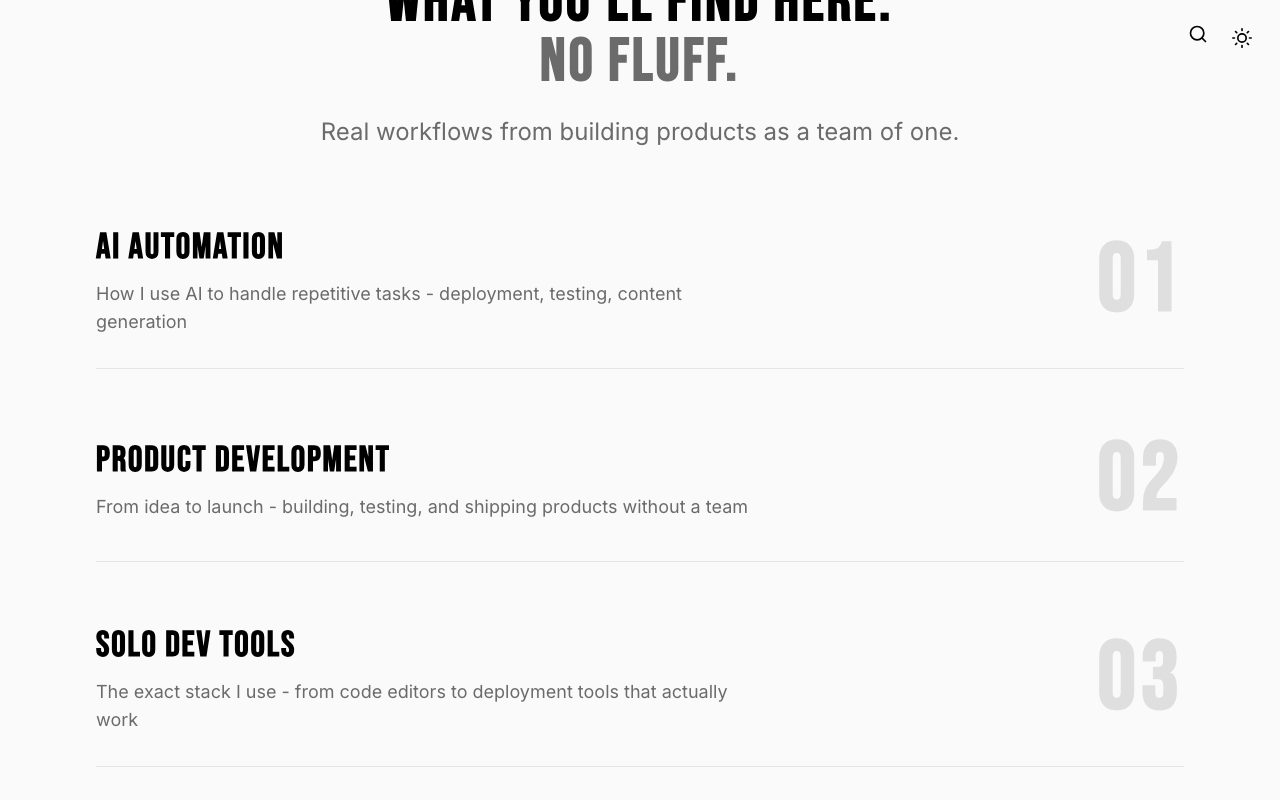
Tool comparisons dominate at over 430 posts. Build guides account for roughly 46, tech stack write-ups for about 39, game development for 25, and build-in-public posts for around 17. A smaller tail covers productivity, personal reflection, and specific projects.
So if you arrive with a question shaped like "should I use X or Y," the odds are good that it has already been answered here, and answered from the constraint that matters to you rather than from an enterprise procurement perspective.
Why The Solo Framing Changes The Answer
Most tool comparisons are written as though the reader has colleagues. They weigh team collaboration features, onboarding curves for new hires, and enterprise support tiers.
None of that applies when you are one person. What matters instead is how much of your weekend a tool will eat, whether you can debug it alone at midnight, and what happens to your project if the maintainer disappears.
Take Algolia versus Meilisearch. The enterprise answer and the solo answer diverge almost immediately once hosting and cost enter the picture. The site consistently reasons from the second position.
The Build-In-Public Thread
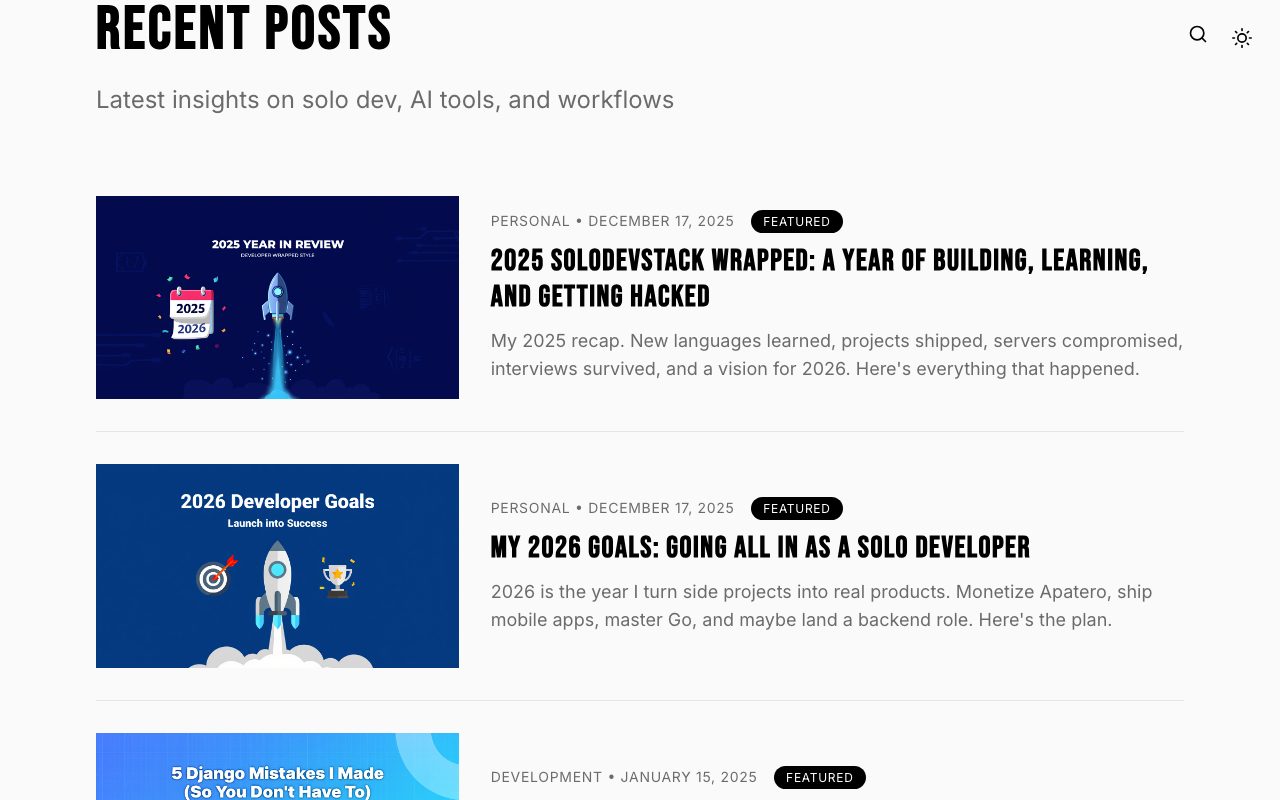
Alongside the comparisons there is a running personal record. "2025 SoloDevStack Wrapped: A Year of Building, Learning, and Getting Hacked" is the annual retrospective, and the third item in that title is not a joke.
"My 2026 Goals: Going All In as a Solo Developer" and "10 Things I Wish I Knew Before Going Solo" cover the career side. "5 Django Mistakes I Made (So You Don't Have To)" is the format at its most useful, which is a specific technical postmortem rather than general advice.
"The Backend Behind An AI Image Product" and "AI Wrapper Stack Guide for Solo Developers" are the architecture write-ups, describing systems that were actually built rather than diagrammed.
Game Development
Twenty five posts cover game development, which is unusual for a blog otherwise focused on web and backend work. It reflects the author genuinely shipping browser games alongside the web products, so the coverage comes from practice rather than from chasing a keyword.
Who It Is For
Solo developers and very small teams choosing between two tools and wanting the decision framed around maintenance burden instead of feature parity.
Indie hackers and side project builders who need to move fast without accumulating infrastructure they cannot maintain alone.
Developers considering going independent, who will get more out of the build-in-public posts than the comparisons.
It is less suited to engineers on funded teams. The reasoning consistently optimises for a constraint you do not have, which makes the conclusions less transferable.
Language Coverage
Published across twelve locales, with indexed paths for Spanish, French, German, Japanese, Korean, Chinese, Portuguese, Hebrew, Hindi, Indonesian, and Vietnamese alongside English.
Reading It Cold
Do not read it cold. It is a reference archive, so search the two tools you are deciding between and read that one post.
The exception is the build-in-public cluster. The wrapped post and "10 Things I Wish I Knew Before Going Solo" both read well end to end and give you the author's context before you take architectural advice from a stranger.
Where It Falls Short
Comparison posts age. A stack opinion written against one version of a framework can drift quietly out of date, and an archive this size cannot be continuously refreshed by one person.
The volume is also uneven in depth. With more than 430 comparisons, some are considerably more thorough than others.
And the solo framing is a genuine limit as well as the selling point. If you are evaluating tools for a team, the conclusions here are reasoned from the wrong constraint.
Key Features
- Regular blog posts on solo development
- Digital toolkits for specific workflows
- Privacy focused desktop life OS
- AI automation guides and tutorials
- Honest tool reviews without affiliates
- Receipts first methodology from real builds
Pros & Cons
What we like
- No affiliate links so recommendations are unbiased
- Content comes from shipping actual products
- Blog is completely free with no paywall
- Toolkits address specific narrow problems
Room for improvement
- Single author so publishing pace is moderate
- Toolkits sold separately on external platform
- Desktop app is still in active development
- Focus is narrow to solo developer workflows
Frequently Asked Questions
What is SoloDevStack?
Is SoloDevStack free?
Who is SoloDevStack for?
Does SoloDevStack use affiliate links?
Best For
Featured in
Tags
Alternatives to SoloDevStack
Hack2hire
Practice real SDE interview questions from top tech companies with expert worked solutions
Cursor
VS Code fork built around an AI pair-programmer

Warp
The modern terminal reimagined with AI and collaboration

Replit
Browser IDE plus Replit Agent that builds and deploys apps from a prompt
Our take
Tool Index Editorial · Jul 2026· 4.1/5
SoloDevStack is a reference archive rather than a blog you read front to back, and treating it as the former is how you get value from it.
The scale is the story. Roughly 580 posts, and more than 430 of them are direct X-versus-Y comparisons, every one framed for the same reader. Astro vs Angular. Algolia vs Meilisearch. Amplitude vs PostHog. Angular vs Qwik. The suffix is always "for Solo Developers," and that framing is not decoration.
It changes the answer. Most comparisons weigh team collaboration, onboarding curves for new hires, and enterprise support tiers, none of which exist when you are one person. What matters instead is how much of your weekend a tool consumes, whether you can debug it alone at midnight, and what happens if the maintainer walks away. Algolia versus Meilisearch diverges almost immediately once hosting and cost enter from that position.
Around the comparisons sit roughly 46 build guides, 39 tech stack write-ups, 25 game development posts, and 17 build-in-public entries. The last group is the one worth reading end to end. "2025 SoloDevStack Wrapped: A Year of Building, Learning, and Getting Hacked" is the annual retrospective and the third item in that title is not a joke. "5 Django Mistakes I Made (So You Don't Have To)" is the format at its best, a specific postmortem instead of general advice.
Two honest limits. Comparison posts age, and an archive this size cannot be continuously refreshed by one person, so check the publish date on anything stack-critical. Depth is also uneven across 430-plus comparisons. And the solo framing that makes it valuable is exactly what makes it wrong for you if you are choosing tools for a team.
Editorial opinion from the Tool Index team, written from the public product pages. Not a user review.
Reviews (3)
Quietly excellent
SoloDevStack is one of those tools you stop noticing because it just works. Genuine strength: content is specifically relevant to indie developers and small teams. Got real value out of practical tutorials focused on shipping products as a solo developer. Sticking with SoloDevStack.
Pros
- Covers the business and cost angle of technical decisions, not just features
- No sponsored bias in tool recommendations
Onboarded the team in a day
Honest take: SoloDevStack delivers most of what the marketing promises. Honestly impressed by how content is specifically relevant to indie developers and small teams. Worth calling out the curated lists of tools organized by category and use case too. Wish they'd address how coverage may lean toward web development stacks over other domains. Sticking with SoloDevStack.
SoloDevStack, better than expected
Have been using SoloDevStack for a while, here's where I land. The biggest win has been content is specifically relevant to indie developers and small teams. Their take on in-depth tool and framework comparisons tailored to solo developers is solid. Worth the price for what I get out of it.
Pros
- Covers the business and cost angle of technical decisions, not just features
- Regularly updated with new tools and framework releases
- Content is specifically relevant to indie developers and small teams
Badge builder
Add SoloDevStack to your website
Choose a badge style and size, preview it here, then copy the generated HTML. Badge images are self-contained SVGs and do not require an external script.

<a href="https://toolindex.net/tools/solodevstack?ref=badge" target="_blank" rel="noopener">
  <img src="https://toolindex.net/badge/solodevstack/medium.svg" alt="SoloDevStack - Listed on Tool Index" width="180" height="50" />
</a>How to use the badge
- 1. Pick the style, size, and theme that fit your layout.
- 2. Copy the generated HTML from the code block.
- 3. Paste it into your footer, homepage, or press page.
Score badge available
SoloDevStack qualifies for the score and circle badges based on its current top-10 positionin Writing.
Badge clicks return visitors to this profile with a referral tag so the source remains identifiable.
Related Tools

Kevin Gabeci
Solo developer building web apps, cozy browser games, and AI creator toolkits.

Coolify
Self-hostable, open source alternative to Heroku and Netlify

Confluence
Atlassian's long-running team wiki that anchors many enterprise knowledge stacks

Apatero AI
The creator studio for AI image, video, audio, 3D, and avatars, now at apatero.ai.
Work on SoloDevStack? Request listing access or correction