Apatero Studio
FeaturedCreator studio for AI image, video, audio, 3D, and avatars. Every model worth using, in one workspace.
Gallery
About Apatero Studio
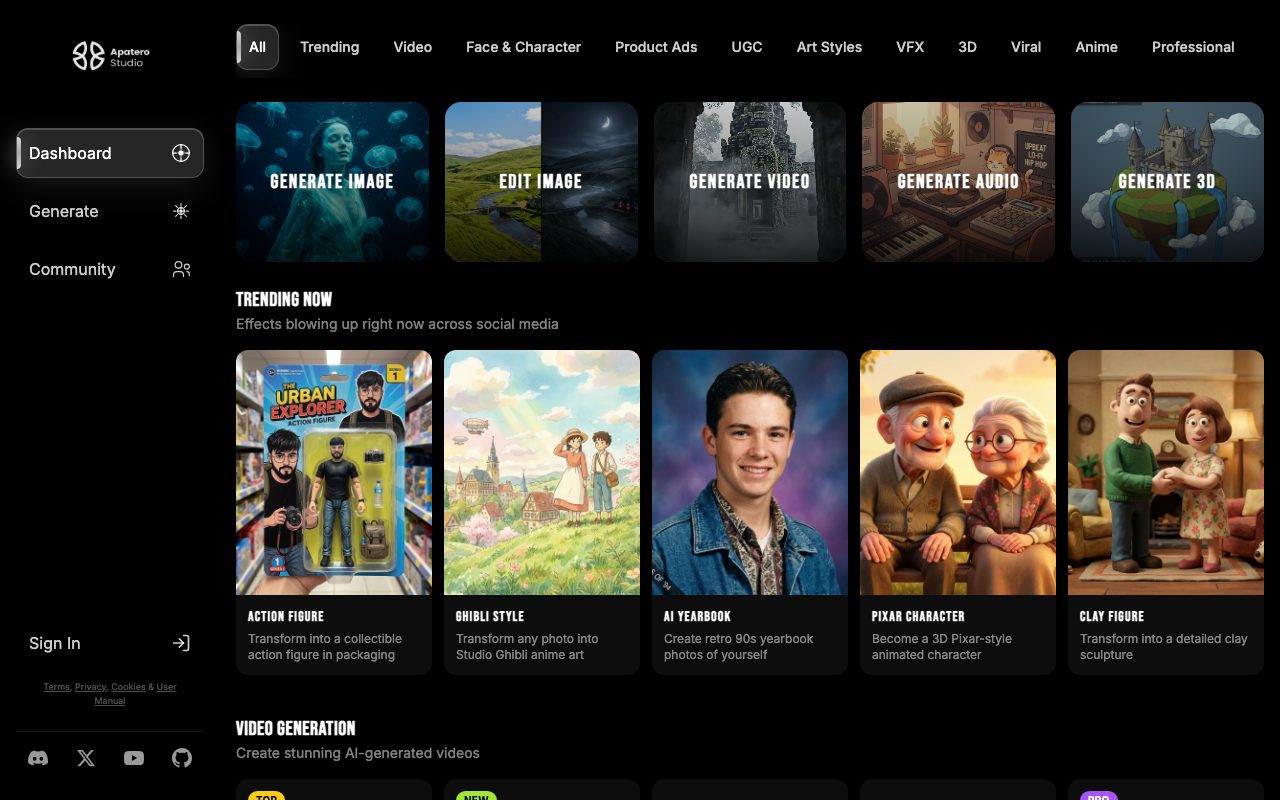
Apatero Studio is the creator-grade studio for AI image, video, audio, 3D, and avatar generation. Every model worth using runs inside one workspace, behind one credit balance, with one unified gallery.
The pitch is the meta-layer. Instead of paying for FLUX on one site, Kling on another, Suno on a third, and gluing them together with browser tabs, you pick a modality, pick a model, and run. References flow from image into video into audio without re-downloading anything.
The product lives at apatero.ai (the new canonical product home) and apatero.com (the marketing and blog surface). Same login, same credits, same dashboard either way.
What Apatero Studio actually does
Apatero is opinionated about being model-agnostic. The team's job is to keep the model library current, the workflows fast, and the surface clean so creators stop tab-juggling and start shipping.
Image generation
The image stack covers the live frontier: FLUX (Schnell, Dev, Pro, FLUX 2), Imagen, Nano Banana, Qwen Image, Stable Diffusion variants, and the open-source community models worth running. Every model is wired through the same prompt panel with consistent controls for seeds, samplers, and aspect ratios.
Custom LoRA training is built in. Character LoRAs, style LoRAs, and concept LoRAs all train on Apatero's own pipeline (FluxGYM-based) and the resulting LoRAs slot directly into the gen workflow in the same studio.
Video generation
The video side runs the heavyweights: Kling, Sora, Veo, Wan 2.2/2.5, Hunyuan, LTX, and the comparison list grows every month. Image-to-video, text-to-video, and motion-controlled workflows all share the same starting frame and prompt panel, so a still you generated this morning can become a clip this afternoon without leaving the studio.
Audio + music
Music, sound design, voice cloning, and ambient generation are part of the same studio. Useful when you are scoring a video you generated upstream and want the same project to hold the master audio.
3D + avatars
3D asset generation and avatar pipelines round out the modality coverage. Avatars in particular handle the consistent-character workflow that is otherwise a real pain to glue together across separate tools.
Who Apatero Studio is for
The honest fit is creators who already use AI generation as part of their workflow and are tired of running five subscriptions. If you currently pay for Midjourney plus Runway plus Suno plus a LoRA trainer plus a 3D tool, you are the primary audience.
It is also for teams that want one billing relationship, one media library, and one set of credentials for everyone instead of five seat licenses across five vendors.
It is less useful for someone who only generates one modality, one model, once a month. The breadth is the value, and the breadth is wasted on someone who already has a single tool they love.
What Apatero Studio is not
It is not a foundation model trained in-house. Apatero does not invent the underlying generation models. The product is the studio surface, the LoRA training pipeline, the unified gallery, the multi-model workflow, the credit system, and the model curation.
It is not a no-code automation platform. Outputs are creator deliverables, not automated brand campaigns. If you want a fully autonomous "post a finished video to TikTok every day" loop, you would wire Apatero into a scheduler downstream.
It is not an adult content platform. All generation runs under a safe-for-work moderation policy. Clean, brand-safe creator content only.
Pricing breakdown
Free tier to get a feel for the studio without billing. Paid plans start at $9.99 per month and scale on credits. The token-based model means you pay for what you generate, not for arbitrary tier brackets where you might leave half your quota on the table.
Each model has its own credit cost depending on compute, a Sora-class video clip costs more credits than a FLUX Schnell image, for example. The credit cost is shown before you run, no surprise overages.
Higher-volume creators scale into larger credit packs. Custom-pipeline users who want a managed local training stack have a tier for that too.
Standout features
Every modality in one studio
The biggest win is the breadth. Image, video, audio, 3D, and avatar all sit behind the same login. References move between modalities without re-downloading. Projects hold the whole asset stack instead of being fragmented across five vendor accounts.
Model-agnostic by design
New SOTA models land in the catalog every month. You are not locked into a single house style. When FLUX 2 ships, you can use it the same day. When the next Sora-class model lands, same.
Built-in LoRA training
The LoRA training pipeline is part of the product, not a separate tool. Character LoRAs train inside your credit allocation and the resulting LoRAs are immediately usable in the same image gen workflow.
Token pricing that respects your wallet
Pay-as-you-generate beats arbitrary subscription tiers for most creator workflows. You never pay for capacity you do not use. Heavy weeks scale up naturally, slow weeks scale down.
Honest tradeoffs
The model menu is real surface area. New users do have to spend a day learning which model fits which brief. The flip side is that once you have the map, the studio is significantly faster than tab-hopping between five vendors.
Apatero is opinionated about staying model-agnostic instead of building a single signature style. If you want a tool whose entire personality is one distinctive aesthetic (the Midjourney V6 vibe, for example), Apatero is not that. The point is exactly the opposite: every model in the live frontier, your choice per project.
Apatero Studio vs alternatives
The closest comparisons are multi-model studios in the same lane: Krea, Leonardo, Magnific, Recraft, Ideogram. Single-modality tools like Midjourney (image-only) and Runway (video-leaning) overlap on individual surfaces but do not cover the same breadth.
The other comparison set is the open-source stack: rolling your own with ComfyUI, A1111, and a folder of model checkpoints. That stack is more flexible and more painful. Apatero is the managed-studio answer to that workflow.
If you want a head-to-head matrix across the full landscape, the Best AI image generators and Best AI video generators pages cover the alternatives.
Common questions
Which models are actually included?
The catalog updates monthly as new SOTA models land. As of the latest snapshot: FLUX (Schnell, Dev, Pro, FLUX 2), Imagen, Nano Banana, Qwen Image, Kling, Sora, Veo, Wan, Hunyuan, LTX, Suno, ElevenLabs, and a rotating set of open-source community models. The /models page inside the studio is always live.
Can I train custom LoRAs?
Yes. The training pipeline is built around FluxGYM workflows and runs inside your credit allocation. Character LoRAs, style LoRAs, and concept LoRAs all work.
Is there a free tier?
Yes. The free tier lets you test the studio across multiple modalities before committing. Paid plans start at $9.99 per month.
What is the difference between apatero.com and apatero.ai?
Same product. apatero.ai is the new canonical product home. apatero.com is the marketing and blog surface. Your account works on either domain.
Is the content safe-for-work?
Yes. The platform runs a SFW moderation policy. Clean, brand-safe creator output only.
Who built Apatero Studio
Apatero is built by an indie team focused on AI content infrastructure. The same team behind Melodex on the music-curation side.
You can find them on Twitter as @ApateroGroup, on Instagram as @apaterostudio, and on GitHub at the Apatero-Org. Real team, real responses.
Support is reachable via the contact form on apatero.ai or via DM on any of those channels.
Bottom line
Apatero Studio is the multi-modal AI creator studio in one workspace. If you are currently running five subscriptions across image, video, audio, 3D, and avatar tools, this is the consolidation play.
At $9.99 for the entry plan and a free tier to test with, the math is friendly enough to try without thinking about it. The actual test is to take a project you are already working on and rebuild it end-to-end inside the studio. If the project goes faster, you have your answer.
If you only ever touch one modality and one model, this product is overkill for you. If your workflow already touches three or more, Apatero is the cleanest consolidation in the category.
Tutorial / Demo
Key Features
- Multiple AI models (FLUX, Kling, Sora, and more)
- Custom LoRA training for personalized results
- Image and video generation in one platform
- Token-based pay-as-you-go pricing
- API access for developers
- Batch generation and queue management
- Built-in upscaler and editor
- Priority processing for subscribers
Pros & Cons
What we like
- Access to multiple models in one place
- Train your own LoRAs
- Good output quality
- Pay for what you use with tokens
- New models added regularly
Room for improvement
- Takes time to learn all the options
- Some models need higher tier plans
- Queue times when busy
Frequently Asked Questions
What is Apatero Studio used for?
Is Apatero Studio free to use?
What are the pros and cons of Apatero Studio?
Who should use Apatero Studio?
Best For
Featured in
Tags
Alternatives to Apatero Studio

Our take
Tool Index Editorial · May 2026· 4.5/5
What Apatero Studio is really selling — beyond the marketing copy — is launch ready-made ai influencer personas in any niche.
On the strengths side: Access to multiple models in one place, Train your own LoRAs, and Good output quality. What to watch for: Takes time to learn all the options and Some models need higher tier plans.
In short: Apatero Studio is a solid pick when you need content creators, and a harder sell if takes time to learn all the options would be a dealbreaker.
Editorial opinion from the Tool Index team, written from the public product pages. Not a user review.
Reviews (13)
Hit the Apatero Studio sweet spot
Tried half a dozen options before landing on Apatero Studio. What stands out is how train your own LoRAs. Got real value out of token-based pay-as-you-go pricing. Worth the price for what I get out of it.
Pros
- Access to multiple models in one place
- Good output quality
Quietly excellent
Came to Apatero Studio after frustration with what I had before. The thing I keep coming back to: good output quality. Their take on custom LoRA training for personalized results is solid. Found it works best for marketing teams.
Pros
- New models added regularly
- Pay for what you use with tokens
- Good output quality
It just works
Apatero Studio has quietly become part of my daily flow. Where it really wins is pay for what you use with tokens. Got real value out of custom LoRA training for personalized results. Glad I made the switch.
Finally something that fits
Adopted Apatero Studio for one project, ended up using it for more. The biggest win has been good output quality. Their take on image and video generation in one platform is solid. Still recommending it to people in similar setups.
Easy 5 from me
Skeptical at first because Apatero Studio looked too simple. It's not. Genuine strength: pay for what you use with tokens. Got real value out of priority processing for subscribers. It fits well for digital artists. Would buy again without thinking twice.
Pros
- Train your own LoRAs
Not for us, but might suit others
Got Apatero Studio on the recommendation of someone I trust. Genuine strength: new models added regularly. Honest gripe: takes time to learn all the options. Might revisit when they iterate further.
Pros
- Access to multiple models in one place
Cons
- Queue times when busy
- Takes time to learn all the options
Stuck the landing for our team
The pitch for Apatero Studio sounded too good to be true. Mostly true. The biggest win has been train your own LoRAs. Worth calling out the API access for developers too. Mostly using it for AI influencer creators. Hard to imagine going back to my previous setup.
Solid product, even better support
Honest take: Apatero Studio delivers most of what the marketing promises. What stands out is how new models added regularly. Worth the price for what I get out of it.
Pros
- New models added regularly
- Pay for what you use with tokens
Did exactly what I needed
Apatero Studio is one of those tools you stop noticing because it just works. The thing I keep coming back to: good output quality. The multiple AI models (FLUX, Kling, Sora, and more) is more useful than I expected. Honest gripe: some models need higher tier plans.
Pros
- Train your own LoRAs
- Good output quality
Worth the price of admission
Adopted Apatero Studio for one project, ended up using it for more. Real selling point: access to multiple models in one place. The multiple AI models (FLUX, Kling, Sora, and more) is more useful than I expected. It fits well for AI influencer creators.
Beautiful demo, painful reality
The pitch for Apatero Studio sounded too good to be true. Mostly true. Where it really wins is pay for what you use with tokens. The priority processing for subscribers is more useful than I expected. Found it works best for digital artists. Wish they'd address how queue times when busy. Might revisit when they iterate further.
Pros
- New models added regularly
- Train your own LoRAs
Cons
- Some models need higher tier plans
- Queue times when busy
Solid daily driver
Found Apatero Studio on a Reddit thread, glad I clicked. The thing I keep coming back to: good output quality. Honest gripe: takes time to learn all the options. Sticking with Apatero Studio.
Pros
- New models added regularly
- Good output quality
Cons
- Queue times when busy
- Some models need higher tier plans
Pulled its weight from week one
Hadn't planned on switching, but Apatero Studio was hard to ignore. The biggest win has been access to multiple models in one place. Multiple ai models (flux, kling, sora, and more) works the way you'd hope. Found it works best for marketing teams. One thing that bugs me: some models need higher tier plans. Easy yes for anyone weighing the same trade-offs.
Badge builder
Add Apatero Studio to your website
Choose a badge style and size, preview it here, then copy the generated HTML. Badge images are self-contained SVGs and do not require an external script.

<a href="https://toolindex.net/tools/apatero?ref=badge" target="_blank" rel="noopener">
  <img src="https://toolindex.net/badge/apatero/medium.svg" alt="Apatero Studio - Listed on Tool Index" width="180" height="50" />
</a>How to use the badge
- 1. Pick the style, size, and theme that fit your layout.
- 2. Copy the generated HTML from the code block.
- 3. Paste it into your footer, homepage, or press page.
Score badge available
Apatero Studio qualifies for the score and circle badges based on its current top-10 positionin Design.
Badge clicks return visitors to this profile with a referral tag so the source remains identifiable.
Related Tools
Apatero AI
The creator studio for AI image, video, audio, 3D, and avatars, now at apatero.ai.
Kevin Gabeci Toolkits
Seven AI toolkits for writing books, making music, cutting video, and building agents.

Warp
The modern terminal reimagined with AI and collaboration

Bolt.new
Prompt-to-deployed full-stack app inside the browser
Work on Apatero Studio? Request a listing correction