
Midjourney
Create stunning AI artwork from text prompts
Gallery
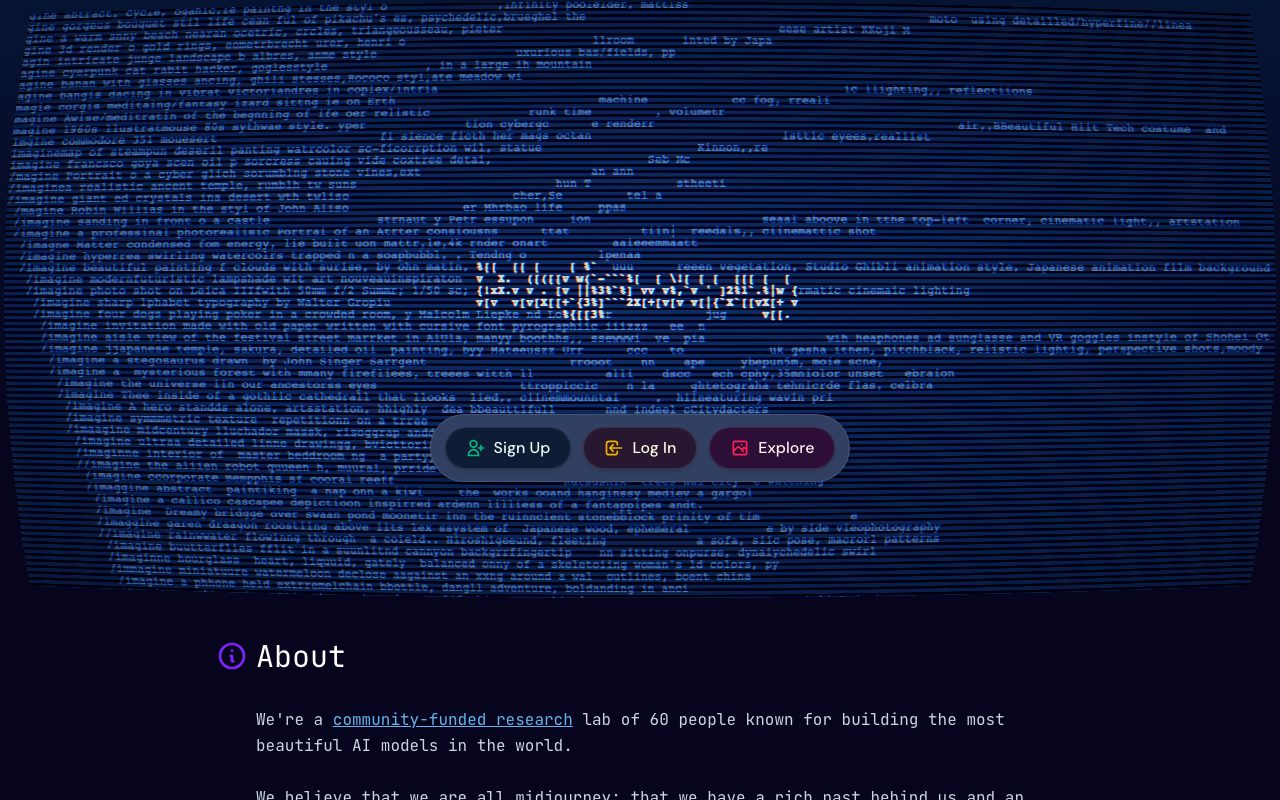
About Midjourney
Midjourney is the AI image generator that prioritized aesthetic quality over everything else. It launched in 2022 and quickly became the default for creators who wanted images that looked like art, not stock photos.
It also has the most opinionated UX in the category. You used to have to use Discord. Then a real web app showed up. Either way, Midjourney's images stay distinctive.
What Midjourney actually does
You give Midjourney a text prompt. It returns four image variations. You upscale the one you like, vary it further, or remix it with a new prompt. That's the loop.
Beyond text-to-image, Midjourney does style tuning, panning, zooming, blending images together, and a Describe mode that goes the other direction (image to prompt). The toolkit has expanded steadily.
The newer web app makes Midjourney feel like a normal app finally. Discord still works for power users who built habits there. Both interfaces hit the same model.
Who Midjourney is for
Concept artists building mood boards. Marketers needing on-brand visuals fast. Book cover and album art designers. Game designers prototyping characters. Architects visualizing interiors before models exist.
It's less appropriate for technical product visuals where exact accuracy matters. Photorealistic logos, exact charts, or precise brand assets still need other tools.
Midjourney pricing breakdown
Midjourney has no free tier. Plans start at $10 per month for Basic with 200 generations. Standard runs $30 per month with unlimited Relaxed mode. Pro runs $60 per month with stealth mode for private generations.
The Mega plan tops out at $120 per month. Pricing roughly doubles each tier with proportional features and usage.
Annual billing knocks 20 percent off. Most regular users land on Standard or Pro depending on whether they care about privacy.
Standout Midjourney features
Aesthetic quality is the moat. Midjourney's defaults look like art. You don't need to over-engineer prompts to get something usable.
Style tuning lets you train custom aesthetic profiles. Once dialed in, you reuse the same style across hundreds of images for consistent campaigns.
Pan and zoom extend images outside their original borders. The new content blends naturally with the original. Useful for creating banners or vertical formats from square outputs.
Blend mode mixes multiple images. Drop in three references, get a composite that pulls from all three. The output sometimes feels like a happy accident.
Frequent model updates keep raising the bar. Each major version is a noticeable quality jump. The team ships sharper outputs every six months or so.
Honest tradeoffs
The Discord-first history is still confusing for new users. The web app helps, but you'll find tutorials referencing /imagine in Discord channels. Plan for a learning curve.
Limited control over exact composition. Stable Diffusion with ControlNet beats Midjourney on precise pose, layout, or scene control. Midjourney prefers vibe over specifics.
No free tier. You commit $10 just to experiment. Other generators offer free credits to test before you pay.
Commercial use has restrictions depending on plan. Pro tier and above clear those concerns. Basic users should read the terms before shipping commercial work.
Midjourney is the right pick when you want art. It's the wrong pick when you need a specific photograph.
Midjourney vs the alternatives
The biggest peer is DALL-E 3, baked into ChatGPT. DALL-E 3 follows prompts more literally. Midjourney leans more artistic.
Stable Diffusion is the open-source champion. Self-hostable, infinitely customizable, free. Midjourney is the polished commercial pick instead.
Flux is the new open-weight model from Black Forest Labs. It's the strongest free-or-cheap challenger to Midjourney's quality.
Ideogram leads on text rendering inside images. Midjourney has improved here but Ideogram is still ahead.
See best AI image generators, Midjourney alternatives, and Midjourney vs DALL-E.
Bottom line on Midjourney
Midjourney remains the aesthetic leader. The Discord legacy is fading and the web app is genuinely good. Pricing is reasonable for the quality.
If you're producing visual content where look-and-feel matters, Midjourney is still the safe pick. Pair it with a precision tool when you need exact control.
Midjourney prompt techniques
Less is often more. "Cinematic portrait of a woman, golden hour, 35mm film" beats a paragraph of adjectives. Midjourney already brings strong defaults; over-prompting fights them.
Aspect ratio matters. The default square output rarely fits real use cases. Set --ar 16:9 for landscape, --ar 9:16 for vertical, --ar 4:3 for traditional formats.
Style references via --sref let you anchor outputs to a specific look. Drop in a Pinterest image you love, generate variations that share its mood. The consistency unlocks brand work.
Use --no to exclude unwanted elements. "--no text" prevents Midjourney from generating gibberish text inside images. Helpful for product shots and clean compositions.
Midjourney for specific industries
Marketing teams use Midjourney for campaign visuals, blog hero images, and social posts. The aesthetic quality means less post-processing. The output ships closer to final.
Game studios prototype characters and environments. Concept art that took weeks now takes hours. Final assets still need professional artists, but the early phase compresses dramatically.
Architects and interior designers visualize spaces before they're built. Client presentations use Midjourney renders alongside real CAD output.
Authors generate book cover concepts. Self-published writers especially benefit from being able to iterate on covers without hiring a designer for each test.
Midjourney common questions
"Is Midjourney commercial use OK?" Pro and higher tiers grant commercial rights. Basic tier has restrictions. Check current terms.
"How do I get consistent characters?" Use --cref with a reference image, or seed prompts for repeatability.
"Can Midjourney do photorealism?" Yes, very well in v6 and later. Photorealistic prompts often produce results indistinguishable from photography.
"What about animation?" Not natively. Pair Midjourney stills with Runway or Kling AI for motion.
Final word on Midjourney
Midjourney remains the aesthetic leader in AI image generation. The web app fixed the biggest UX complaint. Pricing is fair for the quality.
If visual quality matters and you can spare $10 per month to start, Midjourney is the safe pick. The output usually ships without heavy post-processing, which beats every alternative on time-to-finished-asset.
Midjourney for design teams
Brand teams use Midjourney for moodboards and creative exploration. Generate fifty stylistic variations in an afternoon, narrow to three directions, present to stakeholders. The early-phase compression is dramatic.
Marketing teams produce campaign visuals at scale. Holiday creative, seasonal banners, social posts. Midjourney's aesthetic consistency means outputs ship without heavy retouching.
Product teams generate placeholder hero images during design phases. Real photoshoots happen later. Midjourney fills the gap when timelines don't accommodate live photography.
Editorial teams produce illustration for blog posts, newsletters, and articles. The output looks intentional rather than stock-photo generic.
Midjourney style consistency
Style references via --sref pin outputs to a specific aesthetic. Drop in a reference image, generate variations that preserve its mood. The consistency across an entire campaign becomes achievable.
Style codes (numerical seeds for aesthetics) let you pin a specific look across many prompts. Once you find a style code that works for your brand, reuse it indefinitely.
Personal style training trains a profile on your taste. The model learns what you've upvoted and biases future outputs toward your preferences.
Combining style references with subject prompts gives you predictable variations. "Style of [reference], subject of [your description]" works reliably.
Midjourney for non-designers
Bloggers generate post illustrations. Authors generate book cover concepts. Indie game developers generate character art and environment concepts. The barrier to producing real visual work has collapsed.
The skill that matters now is prompt craft, not Photoshop technique. Good prompts produce good output. Iterating quickly beats trying to engineer the perfect first prompt.
Midjourney compared deeply
Versus DALL-E 3: DALL-E follows prompts more literally. Midjourney leans more artistic. Use DALL-E when accuracy matters; Midjourney when vibe matters.
Versus Flux: Flux is the strong open-weight challenger. Quality is comparable on many prompts. Open weights mean you can self-host and customize. Midjourney remains the polished commercial product.
Versus Stable Diffusion with ControlNet: SD has more precise control over composition. Midjourney has cleaner default aesthetics. They serve different needs.
Midjourney long-term outlook
The AI image category has matured. Midjourney, DALL-E 3, Stable Diffusion, Flux, and Ideogram all coexist. Each has its strengths.
Midjourney's aesthetic moat held up better than expected. Even as competitors caught up technically, Midjourney's defaults still produce more "artistic" output.
The web app fixed the biggest UX complaint. Discord-required workflows alienated many potential users. The web interface is finally a normal app.
Pricing has been steady. The $10 starter tier remains accessible. Higher tiers earn their cost for heavy users who need stealth, faster generation, or more total images.
For new users in 2026, Midjourney is still a solid first stop in AI image generation. The aesthetic quality and the active community make it sticky.
Tutorial / Demo
Key Features
- Text-to-image generation with natural language prompts
- Style tuning and aesthetic customization controls
- Image upscaling up to 4x resolution
- Vary and remix existing images with subtle or strong variations
- Pan and zoom to extend images beyond their original borders
- Blend multiple images together for composite results
- Describe mode that analyzes images and generates prompts
Pros & Cons
What we like
- Produces exceptionally high-quality, artistic images with minimal prompt engineering
- Strong community and shared prompt inspiration through Discord
- Fast generation times, especially on higher subscription tiers
- Consistent aesthetic quality that often requires less post-processing
- Regular model updates with significant quality improvements
Room for improvement
- Requires Discord for primary access, which is unintuitive for many users
- Limited control over exact composition and specific details compared to Stable Diffusion
- No free tier available, subscriptions start at $10/month
- Generated images have restrictions on commercial use depending on plan
Frequently Asked Questions
What is Midjourney used for?
Is Midjourney free to use?
What are the pros and cons of Midjourney?
Who should use Midjourney?
Best For
Featured in
Tags
Alternatives to Midjourney
Google Imagen
Google DeepMind's text-to-image model with class-leading text rendering, served in Gemini and ImageFX
DALL-E
OpenAI's image generator, now folded into ChatGPT and the gpt-image-1 Images API for text-to-image and edits
Playground
AI design studio for image generation, logos, social posts, and merch built on multiple swappable models
Adobe Firefly
Adobe's commercially safe generative AI for images and video, trained on licensed and public domain content
Our take
Tool Index Editorial · May 2026· 4.6/5
If you're evaluating Midjourney, the headline is simple: create stunning ai artwork from text prompts, and most teams will get value out of the box.
Where it wins: Produces exceptionally high-quality, artistic images with minimal prompt engineering, Strong community and shared prompt inspiration through Discord, and Fast generation times, especially on higher subscription tiers. Honest gripes: Requires Discord for primary access, which is unintuitive for many users and Limited control over exact composition and specific details compared to Stable Diffusion.
In short: Midjourney is a strong pick when you need concept art and mood boards for creative projects, and a harder sell if requires Discord for primary access, which is unintuitive for many users would be a dealbreaker.
Editorial opinion from the Tool Index team, written from the public product pages. Not a user review.
Reviews (8)
Wanted to love it, couldn't
A month of using Midjourney, here's what holds up. Where it really wins is produces exceptionally high-quality, artistic images with minimal prompt engineering. Mostly using it for architectural and interior design visualization. Wish they'd address how no free tier available, subscriptions start at $10/month. Decent product, just not the right fit for me.
Pros
- Fast generation times, especially on higher subscription tiers
Cons
- Requires Discord for primary access, which is unintuitive for many users
Quietly excellent
Have been using Midjourney for a while, here's where I land. Genuine strength: produces exceptionally high-quality, artistic images with minimal prompt engineering. Their take on image upscaling up to 4x resolution is solid. Hard to imagine going back to my previous setup.
Pros
- Consistent aesthetic quality that often requires less post-processing
- Produces exceptionally high-quality, artistic images with minimal prompt engineering
Worth the price of admission
Midjourney isn't perfect but it's the best I've used in this category. Honestly impressed by how produces exceptionally high-quality, artistic images with minimal prompt engineering. Their take on text-to-image generation with natural language prompts is solid. It fits well for book cover and album art illustration. Worth the price for what I get out of it.
Midjourney has been a quiet upgrade
Midjourney isn't perfect but it's the best I've used in this category. The biggest win has been consistent aesthetic quality that often requires less post-processing. Their take on style tuning and aesthetic customization controls is solid. It fits well for concept art and mood boards for creative projects. Would buy again without thinking twice.
Pros
- Fast generation times, especially on higher subscription tiers
- Consistent aesthetic quality that often requires less post-processing
Cons
- No free tier available, subscriptions start at $10/month
Genuinely impressed
Took a few weeks for Midjourney to click, then it stuck. Where it really wins is produces exceptionally high-quality, artistic images with minimal prompt engineering. Blend multiple images together for composite results works the way you'd hope. Mostly using it for marketing and social media visual content creation. Easy yes for anyone weighing the same trade-offs.
Pros
- Consistent aesthetic quality that often requires less post-processing
- Strong community and shared prompt inspiration through Discord
Recommended without reservation
The pitch for Midjourney sounded too good to be true. Mostly true. Genuine strength: strong community and shared prompt inspiration through Discord. Found it works best for architectural and interior design visualization. It would be a 5 if not for generated images have restrictions on commercial use depending on plan.
Honest take after six months
Midjourney has quietly become part of my daily flow. Honestly impressed by how strong community and shared prompt inspiration through Discord. Mostly using it for game asset prototyping and character design. Still recommending it to people in similar setups.
Pros
- Strong community and shared prompt inspiration through Discord
Bought it for one feature, stayed for ten
Skeptical at first because Midjourney looked too simple. It's not. Real selling point: regular model updates with significant quality improvements. Their take on vary and remix existing images with subtle or strong variations is solid. It would be a 5 if not for no free tier available, subscriptions start at $10/month. Easy yes for anyone weighing the same trade-offs.
Badge builder
Add Midjourney to your website
Choose a badge style and size, preview it here, then copy the generated HTML. Badge images are self-contained SVGs and do not require an external script.

<a href="https://toolindex.net/tools/midjourney?ref=badge" target="_blank" rel="noopener">
  <img src="https://toolindex.net/badge/midjourney/medium.svg" alt="Midjourney - Listed on Tool Index" width="180" height="50" />
</a>How to use the badge
- 1. Pick the style, size, and theme that fit your layout.
- 2. Copy the generated HTML from the code block.
- 3. Paste it into your footer, homepage, or press page.
Score badge available
Midjourney qualifies for the score and circle badges based on its current top-10 positionin AI Image Generators.
Badge clicks return visitors to this profile with a referral tag so the source remains identifiable.
Related Tools
Apatero AI
The creator studio for AI image, video, audio, 3D, and avatars, now at apatero.ai.
Kevin Gabeci Toolkits
Seven AI toolkits for writing books, making music, cutting video, and building agents.

Warp
The modern terminal reimagined with AI and collaboration
Bolt.new
Prompt-to-deployed full-stack app inside the browser
Work on Midjourney? Request listing access or correction