Tomesphere
An interactive atlas of millions of research papers with AI summaries
Gallery
About Tomesphere
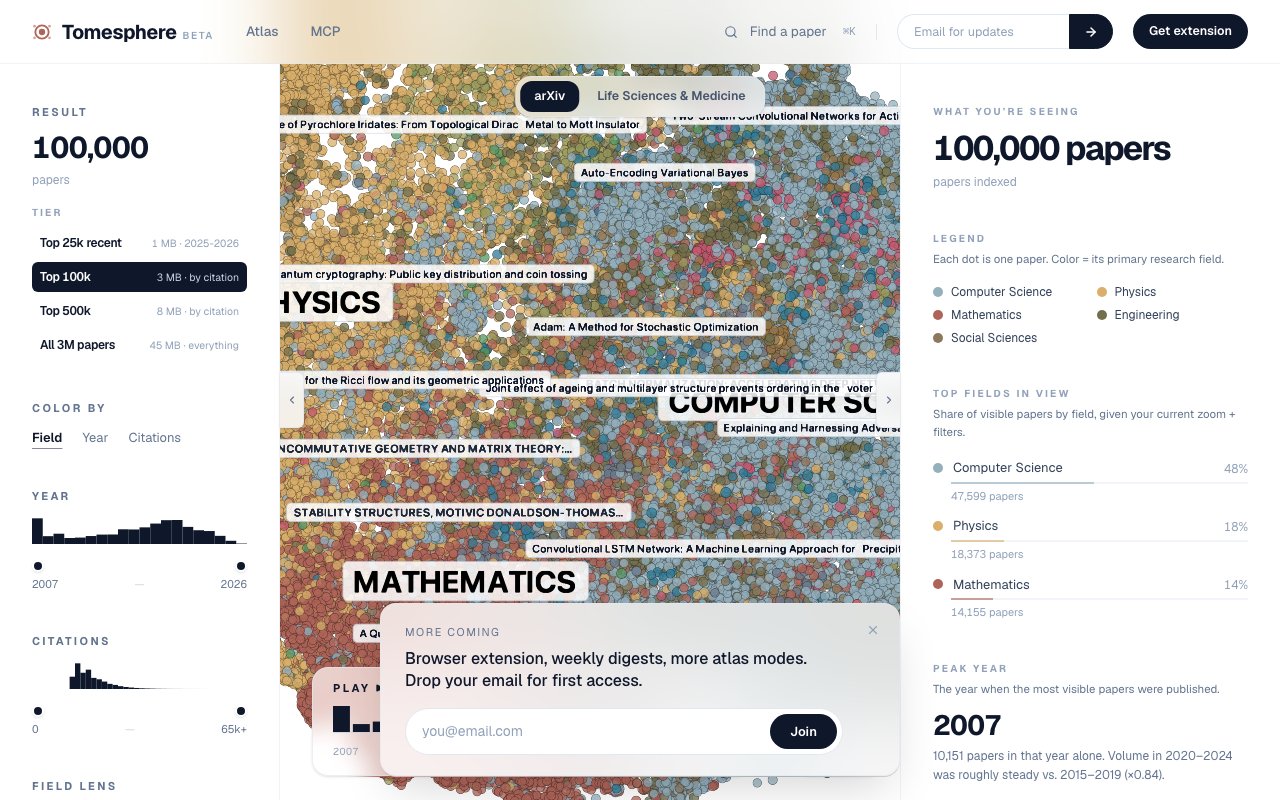
Tomesphere is an interactive atlas of scientific literature. Instead of a flat list of search results, it lays millions of research papers out as a zoomable map, grouping related work so you can see the shape of a field and move around it visually. The flagship view loads a large cloud of papers as binary point buffers, roughly 45 MB of them, so after the first fetch you can zoom into neighbourhoods of related work, jump to a specific paper with a quick search, and open per-paper insights right there rather than bouncing back out to a separate results page.
Under the surface it's a large, structured index rather than just a pretty visualization. Tomesphere pulls together roughly 8 million papers across six sources, including PubMed Central at around 5 million, arXiv at about 3 million, plus bioRxiv, medRxiv, eLife, and F1000. It then organizes them into more than 25,000 semantic clusters with topic labels spread across millions of labeled papers. That clustering is what makes the atlas navigable, since papers about the same idea end up near each other instead of scattered across an endless results list.
The part that saves the most time is the summaries. Each paper gets an AI-generated TLDR meant to tell you whether it's relevant in about ten seconds rather than ten minutes of reading the abstract and skimming figures. When you're triaging dozens of hits from a search, that difference compounds quickly, and it's the feature most likely to change how you actually work through a reading list. It shifts the first pass from careful reading to fast scanning, so you spend your real attention only on the handful of papers that survive that filter.
On top of the summaries, Tomesphere links each paper out to a surprising amount of related material. There are hundreds of thousands of connected code repositories and models, over a million gene-to-paper links, hundreds of thousands of protein accessions, more than a hundred thousand clinical trials, and a comparable number of structural database entries. It also surfaces trust signals, so alongside a paper you can see peer reviews, whether it has been retracted, and its citation metrics, which helps you judge how much weight to give a result before you commit to reading it in full.
In practice you can come at it from either direction. If you already know the paper you want, a quick search jumps you straight to its page, where the summary, the linked artifacts, and its neighbours in the map are all laid out together. If you're exploring instead, you start from the atlas, drift into a cluster that looks relevant, and let the layout suggest nearby work you wouldn't have thought to search for. Either way you land on a paper page that doubles as a hub for everything connected to it.
It's built for anyone who has to keep up with a literature that grows faster than they can read. That's researchers and graduate students first, but the product is also explicitly designed to feed AI tools. It offers a Chrome extension so you can pull insights on whatever paper you're viewing in your browser, integrations aimed at ChatGPT, Claude, Bing, and Perplexity, and clean markdown paper exports, its own .mdtwin files, so a model can ingest a tidy version of a paper rather than wrestling with a raw PDF. That last piece matters if you're building your own research assistant, since a clean markdown twin is far easier for a model to reason over than a scanned document.
What makes it different is the combination of scale, structure, and the map. Plenty of tools summarize a single paper or search a database, but Tomesphere tries to give you the whole terrain at once and keep every point tied to rich, linked metadata underneath. The atlas is the heaviest surface on the site, and the team notes it can take ten to twenty seconds to load the full set, so for slower connections or mobile there are lighter per-paper pages to work from instead, and you don't have to render the entire map just to read one entry.
Tomesphere is in beta, and it reads like a product still adding surface area. There's an email signup for early access to new features, links to its accounts on X and LinkedIn, and no pricing posted yet, so the practical move is to try the atlas and the extension and see whether the visual, summary-first approach fits how you read. It's the kind of tool that's hard to judge from a description alone, since the real payoff is in how quickly you can skim a cluster and decide what's actually worth opening. For a field where the sheer volume of new work is the real problem, a map with fast triage and deep linked context attached is a genuinely different way in.
Key Features
- Zoomable atlas of millions of papers
- AI-generated TLDR summaries
- Semantic clustering with topic labels
- Chrome extension for any paper
- Linked code, genes, proteins, and trials
- Integrations with ChatGPT, Claude, and Perplexity
Pros & Cons
What we like
- Turns a huge literature corpus into a visual map
- Fast AI summaries speed up relevance triage
- Rich linked metadata beyond the abstract
- Works alongside AI chat tools and a browser extension
Room for improvement
- Still in beta with evolving features
- Atlas is data-heavy and slow to load
- No published pricing yet
- Broad coverage means summary quality can vary
Frequently Asked Questions
What is Tomesphere?
How many papers does it cover?
Is Tomesphere free?
Who is Tomesphere for?
Best For
Featured in
Alternatives to Tomesphere

Reviews (12)
Good, with a few caveats
Three months of Tomesphere later, here is what holds up. Their take on integrations with chatgpt, claude, and perplexity is genuinely good. What stands out is how little babysitting it needs. It fits well for triaging new papers with quick ai summaries. It would be a five if not for broad coverage means summary quality can vary.
Exactly what I needed
Tomesphere has quietly become part of my daily flow. Their take on integrations with chatgpt, claude, and perplexity is genuinely good. It handles the boring parts so I can focus on the work that matters. No regrets so far.
Pulled its weight from week one
Found Tomesphere on a Show HN thread and I am glad I clicked. Got real value out of works alongside ai chat tools and a browser extension. What stands out is how little babysitting it needs. Found it works best for finding related work across disciplines. Would sign up again without thinking twice.
Pulled its weight from week one
Have been running Tomesphere for a while, here is where I land. Got real value out of zoomable atlas of millions of papers.
Genuinely impressed
Hadn't planned on switching, but Tomesphere was hard to ignore. Their take on chrome extension for any paper is genuinely good. No regrets so far.
Decent with some rough edges
Tried Tomesphere on a side project first, then rolled it out everywhere. Their take on linked code, genes, proteins, and trials is genuinely good. Setup was painless and I was productive the same day. Mostly using it for exploring a research field visually. It would be a five if not for atlas is data-heavy and slow to load. Glad I made the switch.
Quietly excellent
Tried Tomesphere on a side project first, then rolled it out everywhere. Their take on ai-generated tldr summaries is genuinely good. It slotted into my routine without much fuss. It fits well for feeding structured paper data into an ai tool. Easy yes for anyone weighing the same trade offs.
Finally something that fits
Tried Tomesphere on a side project first, then rolled it out everywhere. Where it really wins is zoomable atlas of millions of papers. It fits well for exploring a research field visually. Easy yes for anyone weighing the same trade offs.
Does the job, a few gripes
Picked Tomesphere for the price, stayed for the quality. What stands out is how little babysitting it needs. It does what it says, which is rarer than it should be. The catch is atlas is data-heavy and slow to load. It earns its place in my stack.
Recommended without reservation
Hadn't planned on switching, but Tomesphere was hard to ignore. Their take on fast ai summaries speed up relevance triage is genuinely good. It slotted into my routine without much fuss. Found it works best for feeding structured paper data into an ai tool. Glad I made the switch.
Pulled its weight from week one
Tomesphere solves a real problem for me without making a fuss about it. The output quality holds up better than I expected. It fits well for exploring a research field visually. It earns its place in my stack.
Finally something that fits
Three months of Tomesphere later, here is what holds up. It just works, day after day, without surprises.
Badge builder
Add Tomesphere to your website
Choose a badge style and size, preview it here, then copy the generated HTML. Badge images are self-contained SVGs and do not require an external script.

<a href="https://toolindex.net/tools/tomesphere?ref=badge" target="_blank" rel="noopener">
  <img src="https://toolindex.net/badge/tomesphere/medium.svg" alt="Tomesphere - Listed on Tool Index" width="180" height="50" />
</a>How to use the badge
- 1. Pick the style, size, and theme that fit your layout.
- 2. Copy the generated HTML from the code block.
- 3. Paste it into your footer, homepage, or press page.
Standard badge available
The standard listing badge is available now. Score and circle badges are limited to tools currently ranked in the top 10 of a category.
Badge clicks return visitors to this profile with a referral tag so the source remains identifiable.
Related Tools

Apatero AI
The creator studio for AI image, video, audio, 3D, and avatars, now at apatero.ai.
Kevin Gabeci Toolkits
Seven AI toolkits for writing books, making music, cutting video, and building agents.

Warp
The modern terminal reimagined with AI and collaboration

Bolt.new
Prompt-to-deployed full-stack app inside the browser
Work on Tomesphere? Request listing access or correction