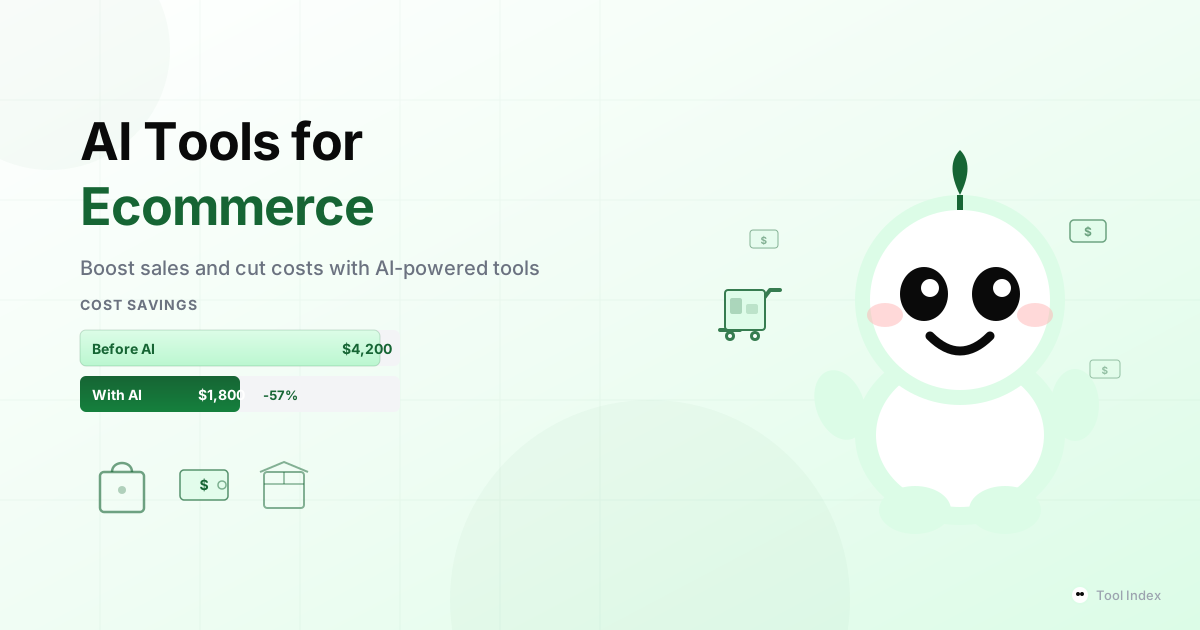
The average ecommerce store doing $10K-$500K a month spends $15,000 to $25,000 on payroll. Copywriter, photographer, support rep, email person, data analyst. Five salaries before you've sold a single extra unit.
We spent three months swapping those roles for AI tools across a dozen stores. Not in theory. Actually doing it and tracking every dollar.
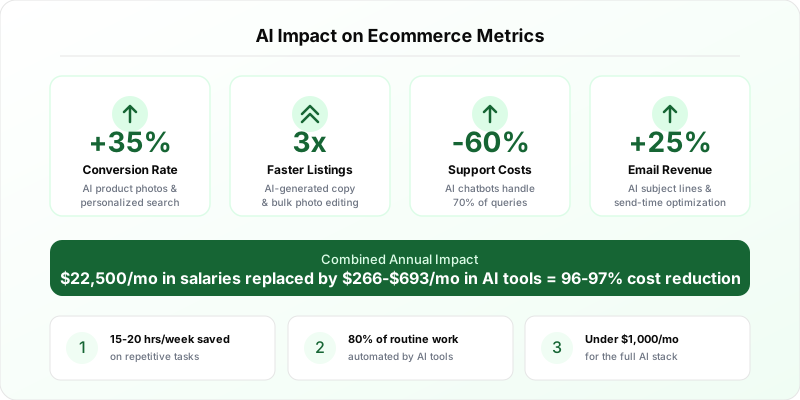
The short version? A solid AI stack handles about 80% of what those five people do. For under a grand a month. Sometimes under $300.
That's not a marginal improvement. That's a different business model entirely.
The Five Roles AI Replaces (and How)
Each "employee" here is really a set of repetitive tasks. AI doesn't replace judgment. It replaces the grind.
| Role | Annual Salary (US) | AI Tool Replacement | Monthly AI Cost |
|---|---|---|---|
| Copywriter | $55,000 | Jasper AI / ChatGPT | $20-$125 |
| Product Photographer | $45,000 | Photoroom / Apatero | $14-$80 |
| Customer Support Rep | $40,000 | Tidio AI / eDesk | $29-$89 |
| Email Marketer | $60,000 | Klaviyo AI | $45-$150 |
| Data Analyst | $70,000 | Triple Whale | $129-$279 |
| Total | $270,000/yr ($22,500/mo) | $237-$723/mo |
Even at the absolute high end with every premium tier, you're under $1,000 a month versus $22,500 for humans. The math is so aggressive it feels wrong. But store after store is making this transition, and the results hold.
The Full AI Ecommerce Stack
1. Product Descriptions and Copy: Jasper AI
Jasper's been the go-to for ecommerce copy since 2024. In 2026, it's gotten noticeably better.
The Brand Voice feature is why it beats ChatGPT here. Feed it your existing copy, and it learns your tone. Product descriptions, ad headlines, email subjects - they come out sounding like you wrote them. Not "robot trying to imitate you." Actually you.
We tested it against raw ChatGPT on a 200-SKU Shopify store. Jasper needed editing on about 15% of descriptions. ChatGPT? More like 60%. The difference comes down to brand consistency. ChatGPT is brilliant but generic. Jasper remembers your brand says "buttery soft" instead of "comfortable."
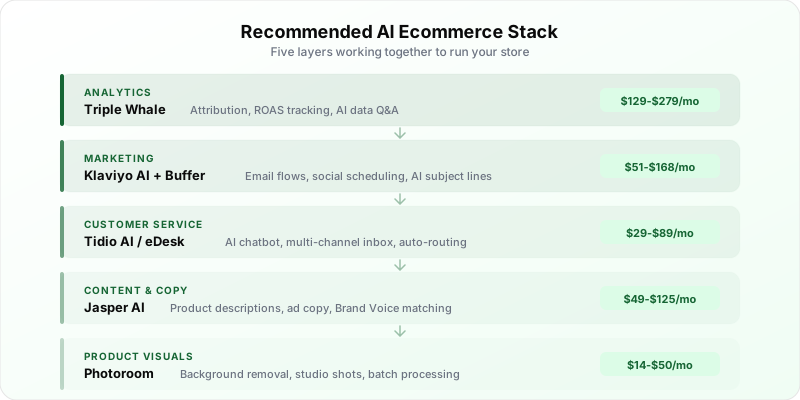
You'll pay $49/month on the Creator plan for one seat with SEO mode. The Pro plan at $125/month unlocks five seats and three Brand Voices. Most stores under $100K/month won't need Pro. And honestly, if you're already paying for ChatGPT Plus at twenty bucks a month, use that for basic descriptions and save Jasper for the high-stakes stuff - landing pages, ad campaigns, email sequences.
Where it genuinely struggles: brand storytelling, nuanced positioning, anything requiring emotional understanding of why someone buys a $200 candle. It handles the 80% that's formulaic. The other 20% still needs a human.
2. Product Photos: Photoroom and Apatero
This category blew us away more than any other.
Photoroom has become the standard. Snap a mediocre photo on your phone - bad lighting, kitchen counter background - and Photoroom strips it clean. Studio-quality backdrop. Perfectly sized for Amazon, Shopify, Instagram. Thirty seconds per image.
The Starter plan at $14/month is all most stores need. No watermarks, HD exports, batch processing. Pro at $50/month adds API access for bigger operations.
For stores that need more creative product imagery - lifestyle shots, AI-generated scenes beyond simple background swaps - Apatero fills the gap at $24.99/month. It's the space between "white background product shot" and "hire a photographer for a lifestyle shoot."
One caveat: both tools still struggle with highly reflective surfaces. Jewelry, watches, chrome fixtures. For those, you still want a real photographer for hero shots. AI handles the catalog images fine.
3. Customer Support: Tidio AI
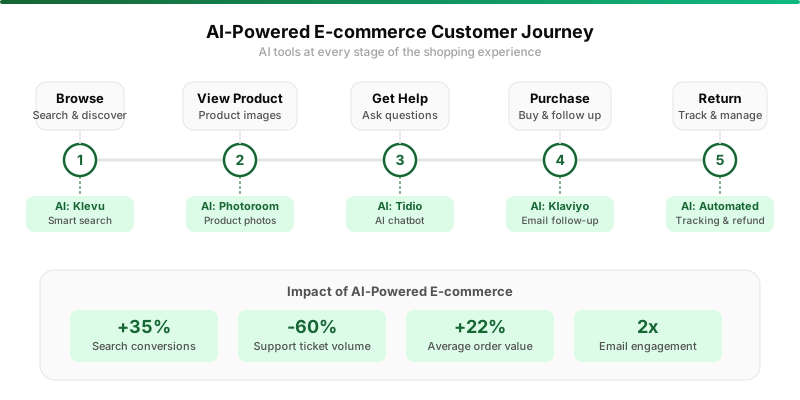
Tidio's Lyro AI chatbot is the best thing to happen to ecommerce support since canned responses. It learns from your FAQ, order data, and past conversations, then handles up to 70% of incoming questions automatically. "Where's my order?" "What's your return policy?" "Do you ship to Canada?" All handled. 24/7. In your brand voice.
The chatbot plan starts at $29/mo. Lyro AI runs $39/mo for 50 AI conversations. For stores getting more than 50 support tickets a month, it pays for itself immediately.
We tested it on a mid-size Shopify store doing about 200 tickets a week. Lyro resolved 68% without escalation. The remaining 32% still went to a human, but pre-triaged and summarized, cutting handle time in half.
For multi-channel sellers (Amazon + eBay + Shopify), look at eDesk at $89/month instead. It aggregates everything into one AI-powered inbox. For single-store operators, stick with Tidio.
4. Personalization and Search: Klevu
Here's where we need an honest conversation about budget.
Klevu is extraordinary. When someone types "blue running shoes size 10," it understands intent even if your product titles say "Azure Performance Runner" with size buried in a variant dropdown. The recommendations engine learns browsing patterns and genuinely increases average order value.
But Smart Search starts at $449/month. Recommendations is another $449. That makes Klevu a tool for stores doing at least $50K/month. Below that, the ROI doesn't pencil out. For smaller stores, Shopify's built-in Search & Discovery app works fine for free. Not great. Fine.
A store doing $200K/month told us Klevu increased conversion by 18% in the first month. At that revenue level, the $900/month investment pays for itself many times over.
5. Email Marketing: Klaviyo AI
Klaviyo isn't just the best ecommerce email platform. It is the ecommerce email platform. Everyone else is playing catch-up.
Predictive analytics tells you who's about to churn before they churn. AI subject lines consistently outperform human-written ones in A/B tests - we've seen this across dozens of stores and it still surprises us. Send-time optimization figures out your LA customer opens at 7am Pacific while your New York customer opens at 9am Eastern. Automated segmentation catches patterns you'd never spot manually.
The free tier covers 250 contacts with 500 emails a month. Paid starts at $45/month for up to 500 contacts and scales with your list. Add SMS for $75/month.
The abandoned cart flows alone justify the subscription. We consistently see 10-15% recovery rates with Klaviyo's AI-optimized sequences. For a store with $100K/month in revenue and 70% cart abandonment, that's real money showing up every month.
6. Analytics: Triple Whale
If you run paid ads for an ecommerce store, you know the attribution nightmare. Meta says one thing, Google says another, Shopify says a third. None of them agree.
Triple Whale fixes this with a unified dashboard. But the real star is Moby, their AI assistant. Ask it "What was my ROAS on Meta ads last week?" in plain English. It just... tells you. No digging through dashboards. No exporting CSVs.
Growth starts at $129/month. Pro at $279/month adds Moby and advanced attribution. It's not cheap. But we watched one store discover through Moby that 40% of their Meta ad spend was going to audiences that hadn't converted in 90 days. One adjustment saved them $3,200/month. The tool paid for itself in a week.
7. Inventory: Inventory Planner by Sage
The unglamorous tool that prevents the most expensive mistakes. It forecasts demand based on sales history, seasonality, and trends, then tells you exactly when and how much to reorder.
Starting at $249/month, it only makes sense at scale. But for stores managing 100+ SKUs with seasonal fluctuations? The cost of one bad inventory bet - ordering 5,000 units of something that doesn't sell - dwarfs a year of subscriptions.
Total Stack Cost: Three Scenarios
Not every store needs every tool. Here's how to build the stack based on where you are.
| Scenario | Tools Included | Monthly Cost | Best For |
|---|---|---|---|
| Starter ($10-50K/mo) | ChatGPT Plus, Photoroom Starter, Tidio Lyro, Klaviyo Email | ~$125/mo | Solo operators, bootstrapped stores |
| Growth ($50-200K/mo) | Jasper Pro, Photoroom Pro, Tidio + eDesk, Klaviyo Email+SMS, Triple Whale Growth | ~$550/mo | Small teams, multi-channel sellers |
| Scale ($200K+/mo) | All above + Klevu, Triple Whale Pro, Inventory Planner, Apatero for creative | $1,500-2,000/mo | Established brands, operations-heavy stores |
The Starter tier shocks people. For $125/month, a solo founder can run a store that looks and operates like it has a team of five. That's less than a nice dinner out.
What AI Still Can't Do
We'd be dishonest if we didn't call out the gaps.
Brand strategy is the big one. AI can write copy all day, but it can't decide what your brand stands for or why a 25-year-old in Brooklyn should care about your product versus ten competitors in her feed.
Complex customer issues - returns disputes, damaged goods, custom orders - still need a human. AI handles first response and triage. Someone with empathy and authority makes the judgment calls.
Product development, supplier relationships, crisis management? Entirely human domains. AI can tell you 47 customers complained about the zipper. It can't negotiate with your manufacturer to fix it.
Shopify vs WooCommerce Compatibility
Quick note: every tool here works with Shopify. Most work with WooCommerce. The exceptions are Triple Whale (built primarily for Shopify) and Photoroom (Shopify has a native app, WooCommerce requires export/upload). If you're on WooCommerce, budget an extra hour of setup per tool.
The Recommendation
Start with three tools. Just three.
Klaviyo for email - the abandoned cart flows alone justify it. Photoroom for product photos - the time savings are immediate. Tidio for support - your customers get 24/7 responses, you get your evenings back.
Combined cost: under $100/month. Combined time savings: 15-20 hours per week.
Add Jasper and Triple Whale once you pass $50K/month. Save Klevu and Inventory Planner for $200K+. And don't try to adopt everything at once. Each tool takes a week to properly set up. Rush it and you'll blame the tool for your bad configuration.
The AI stack isn't about firing your team overnight. It's about eliminating the grind so your small team can focus on the decisions that actually grow the business.
Explore more AI automation tools and browse our full directory to find the right fit for your store.