We'll skip the part where we tell you AI is "transforming business." You've heard it.
Here's the question that actually matters: if you run a small business and you're spending real money on real people doing real tasks, which AI tools will put cash back in your pocket? And how much?
Most articles list 30 tools with a paragraph each and call it a day. We did the opposite. Nine tools, real math, grounded in actual pricing and realistic usage. Some pay for themselves in the first week. Others only make sense at scale. We'll tell you which is which.
Summary Table
| # | Tool | Category | Monthly Cost | What It Replaces | Est. Monthly Savings |
|---|---|---|---|---|---|
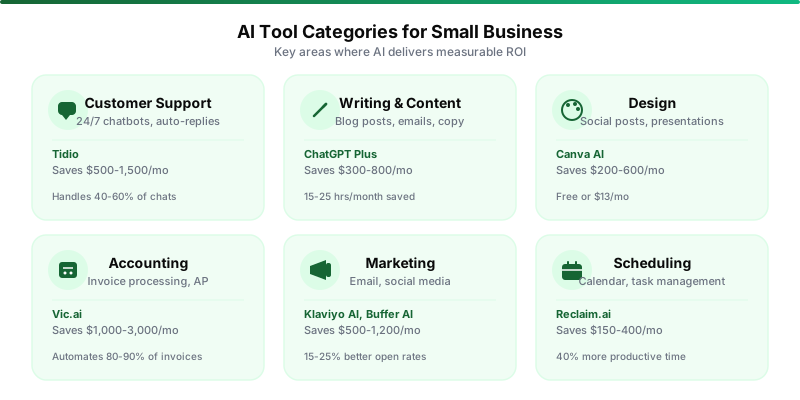
| 1 | Tidio | Customer Support | $29-89/mo | Part-time support agent | $500-1,500 |
| 2 | ChatGPT Plus | Writing/General | $20/mo | Freelance writer hours | $300-800 |
| 3 | Canva (Free/Pro) | Design | $0-13/mo | Freelance designer for basic work | $200-600 |
| 4 | Vic.ai | Accounting | Custom pricing | Manual invoice processing | $1,000-3,000 |
| 5 | Reclaim.ai | Scheduling | $0-8/user/mo | Scheduling admin time | $150-400 |
| 6 | Klaviyo AI | Email Marketing | $20-45/mo (small list) | Email copywriter + strategist hours | $300-700 |
| 7 | Buffer AI | Social Media | $6-12/mo/channel | Social media manager hours | $200-500 |
| 8 | HireVue | Hiring | Custom pricing | Initial screening hours | $500-2,000 |
| 9 | Julius AI | Data Analysis | $20-50/mo | Data analyst hours | $400-1,200 |
1. Tidio: Customer Support on Autopilot
Of everything on this list, Tidio delivers the most dramatic and immediate ROI.
Think about it. Customer support is expensive, repetitive, and largely predictable. The same 20 questions account for 70% of your inbox. "Where's my order?" "What's your return policy?" "Do you ship internationally?" Tidio's Lyro AI chatbot learns from your FAQ, help docs, and past conversations to handle these automatically. Twenty-four hours a day. Never calls in sick.
For a small e-commerce store getting 200+ support chats a month, the math is straightforward. Budget around $90 total for the Growth plan plus Lyro. Net savings: $500 to $1,500 a month. That's not speculative. That's arithmetic.
One caveat: Lyro pricing scales with conversation volume. Once you exceed plan limits, costs climb. Plan for growth or you'll get a surprise bill right when business picks up.
2. ChatGPT Plus: The $20 Swiss Army Knife
At twenty bucks a month, this might be the highest-ROI tool any small business owner can buy. Not because it does any one thing perfectly, but because it does a dozen things well enough to save you hours every week.
Think about what you spend time writing. Blog posts, product descriptions, customer emails, social media captions, internal memos, job postings, press releases. Each one takes time.
Freelance content writers charge $0.10 to $0.30 per word. A single 1,000-word blog post runs $100 to $300. ChatGPT gives you a solid first draft in 30 seconds.
You still need to edit and fact-check everything. Can't stress that enough. It's a first-draft machine, not a publish-ready one.
But the time savings from starting with a decent draft instead of a blank page? We estimated 15 to 25 hours saved monthly across writing, email drafting, brainstorming, and basic research. That's $300 to $800 in value for a $20 tool. The math is almost embarrassing.
3. Canva AI: Design Without a Designer
Canva crossed an important threshold last year. Its AI features are now good enough that most small businesses don't need a freelance designer for routine visual work. Social media posts, email headers, presentation slides, simple ad creatives. Handled.
The free tier is surprisingly capable. Three AI designs per day, thousands of templates, enough for occasional use. Thirteen bucks a month unlocks Pro: 500 Magic Write uses, the brand kit for consistent styling, background remover, premium templates.
Were you previously hiring a designer for 5 to 10 hours of basic graphic work at $25 to $75 per hour? Canva eliminates most of that spend.
Know its limits. Canva AI is excellent for templated, pattern-based design. It can't replace a designer for brand identity work, complex illustrations, or anything requiring genuine creative judgment. Use it for the 80% that's formulaic. Hire a human for the 20% that needs taste.
4. Vic.ai: The Big-Ticket Accounting Play
This is the high-stakes entry on the list. Biggest cost, biggest potential savings.
Vic.ai automates invoice processing, expense categorization, and accounts payable workflows. It learns your coding patterns over time, eventually hitting 80 to 90 percent automation on invoice processing.
For a business processing 500+ invoices monthly, a bookkeeper manually entering and coding those spends 40+ hours on the task. Vic.ai compresses that down to oversight and exceptions, saving 30 to 35 hours of bookkeeper time. Custom pricing typically runs $500 to $2,000 a month for small to mid-size businesses.
Critical caveat: this tool only makes sense at scale. If you process fewer than 100 invoices monthly, the cost will exceed the savings. For very small businesses, the built-in AI features in QuickBooks or Xero are a better starting point.
5. Reclaim.ai: Get Your Calendar Back
Less flashy than everything else on this list. That's exactly why it works.
Reclaim automatically schedules your tasks, meetings, habits, and focus time on Google Calendar or Outlook. It defends your calendar from back-to-back meetings and finds optimal times for deep work.
The free Lite plan covers individual use surprisingly well. Paid plans start at eight bucks per user per month, with team scheduling at $12. Even conservatively, saving 30 minutes per day per person equals 10 hours per month recovered.
Net savings: $150 to $400 per person per month, mostly as time you get back rather than dollars directly saved. You won't see it on a balance sheet. You'll feel it in your stress levels.
6. Klaviyo AI: Your Email List Is Neglected
If you sell anything online, your email list is probably your most valuable asset and your most neglected one.
Klaviyo's AI attacks this from every angle. It writes subject lines, predicts optimal send times, segments audiences automatically, and generates email copy. Everything built specifically for e-commerce.
Free tier covers up to 250 contacts with 500 emails a month. Paid starts at $20 for 251 to 500 contacts and scales with list size. The features that matter most: the subject line generator consistently outperforms human-written lines in A/B tests, and predictive analytics identify who's about to churn, who's ready to buy, and when to reach them.
We estimated 8 to 15 hours saved monthly. For e-commerce businesses, Klaviyo often pays for itself through improved email revenue alone, before you count time savings.
7. Buffer AI: Stop Writing Social Posts Manually
Writing 5 posts per platform per week across 3 platforms takes 8 to 12 hours weekly. That's a part-time job devoted to social media.
Buffer's AI Assistant cuts content creation time by roughly 60%. It generates post copy, suggests hashtags, repurposes long-form content into social snippets, and recommends optimal posting times.
Free tier is usable: 3 channels, 10 scheduled posts each. Essentials at $6 per channel and Team at $12 per channel unlock unlimited scheduling plus the full AI Assistant. For a 3-channel setup at $18 to $36 a month, you save 5 to 7 hours per week.
Not the biggest savings on this list. But for a tool that costs less than a lunch, the ROI is hard to argue with.
8. HireVue: Only If You Hire a Lot
Biggest asterisk on the list: this only makes sense if you hire frequently.
HireVue uses AI to screen initial video interviews, assess candidate responses, and rank applicants. It handles the most brutal part of hiring, screening 50 to 200 applicants per role where a recruiter spends 15 minutes per candidate doing the same repetitive evaluation.
For companies hiring 5+ roles simultaneously, it saves 100+ hours per month in screening time. Custom pricing typically runs $25,000 to $75,000 a year for mid-size companies.
Post one job per quarter? Not justified. Full stop. And be aware of ongoing legal and ethical debates around AI bias in hiring tools. Never let AI make final hiring decisions without human review.
9. Julius AI: The Sleeper Pick
This one flies under the radar.
Julius AI lets you upload spreadsheets, CSVs, and databases, then ask questions in plain English. It generates charts, summaries, and insights without you knowing SQL, Python, or even pivot tables.
Plans start at $20 a month for individuals and $50 per user for teams. A freelance data analyst charges $50 to $100 an hour, and most small businesses that need one can't justify the cost, so they make decisions by gut instead. Julius changes that equation.
We estimated $400 to $1,200 in monthly savings, or more importantly, better decisions for businesses currently flying blind because they can't afford an analyst.
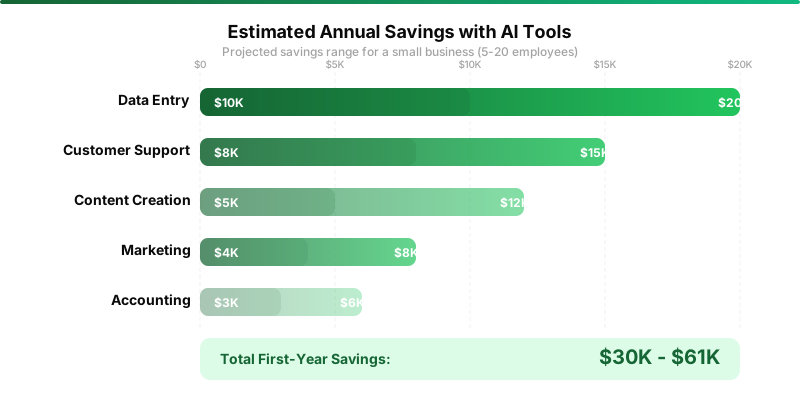
Total Potential Savings
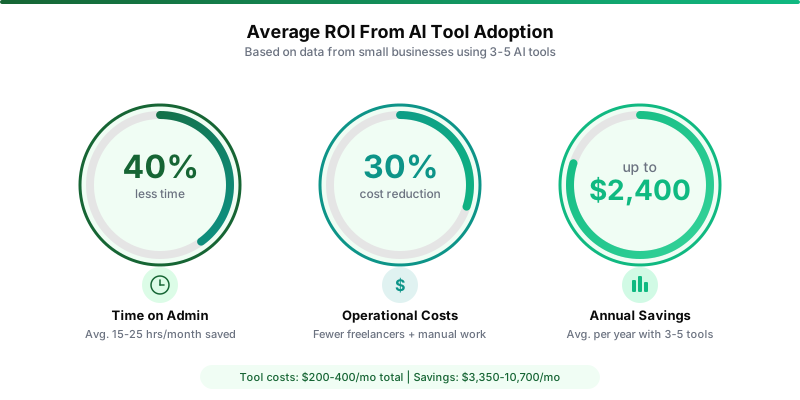
Start with the tools that match your biggest pain points. Don't try to adopt everything at once.
Who Should NOT Use These
Fewer than 5 customers? Stop reading this and go find customers. You're pre-product-market-fit, and optimizing operations with AI tools is procrastination disguised as productivity.
Thinking about replacing your entire team with AI? You're misunderstanding what these tools do. They augment human work. They don't replace judgment, creativity, or the relationships that keep customers coming back.
Heavily regulated industry? Verify any AI tool meets your compliance requirements before adoption. The last thing you need is an efficiency gain that costs you a violation.
Where to Start
If you adopt only one tool, make it ChatGPT Plus at $20 a month. It covers the widest range of tasks with the lowest barrier to entry. Then add Canva (free) for design and Reclaim.ai (free) for scheduling. That's $20/month total covering writing, design, and time management. When you're ready to invest more, Tidio and Klaviyo deliver the clearest dollar-for-dollar ROI.
Find more AI tools for your business in our complete directory or explore tools by productivity category.