Every week someone lists an app for sale at a number they made up in the shower. Sometimes it's ten times what any buyer will pay. Sometimes, and this is the part that hurts, it's a third of what they could have got.
The market for small software is not mysterious. Buyers of products under $50,000 use the same handful of rules, and once you know them you can price your own product in an afternoon.
This is that afternoon.
The Only Three Numbers Buyers Start With
Revenue, profit, and how much of the product is you.
Revenue is the last twelve months, straight from the payment processor. Not the dashboard you built, not the spreadsheet. Buyers want the export because it shows refunds and churn, and because founders round up.
Profit is revenue minus everything the product needs to exist. Hosting, third-party APIs, the email service, domains, any contractor. If your AI tool makes $2,000 a month and spends $900 on inference, a buyer prices it on $1,100. They aren't being harsh. They're going to pay that bill.
The third number has no column in a spreadsheet, and it moves the price more than the other two. How much of the business stops when you walk away? Support you answer personally, a sales motion that runs on your Twitter account, a codebase only you can deploy. Every one of those is a discount, usually 20 to 40 percent, because the buyer is paying for a business and getting a job.
A product that runs without its founder is worth more than a bigger product that doesn't. Buyers are paying for the part they don't have to do.
The Multiples, Plainly
For recurring revenue, buyers talk in multiples of annual revenue. Here's the range you'll actually see on small deals this year.
| Situation | What buyers pay |
|---|---|
| Under $1k MRR, product finished, real users | 1x to 2.5x annual revenue, often a round number like $2,500 or $5,000 |
| $1k to $10k MRR, growing, low churn | 3x to 4x annual revenue |
| Flat or shrinking revenue | 1x to 2x, sometimes just the value of the code and domain |
| Founder does all support and sales | Knock 20 to 40 percent off whatever the row above says |
| Content or directory site with ad or listing revenue | 25x to 40x monthly profit |
| Free product with real traffic, no revenue | $0.50 to $2 per monthly organic visitor, plus something for the domain |
Two things about that table. The ranges are wide because buyers are pricing risk, and risk is specific to your product. And "annual revenue" means the trailing twelve months, not this month times twelve. A product that hit $800 last month and $300 the month before is not an $800 MRR business.
Three Worked Examples
The tidy micro-SaaS
A form builder with $450 MRR, 60 paying customers, 3 percent monthly churn, $40 a month in costs, no support to speak of. Revenue last twelve months: $4,900.
Multiple: middle of the small-product range, call it 2.5x. Price: about $12,000. Nothing about it depends on the founder, the margin is near 100 percent, and a buyer can see exactly what they're getting. This is the easiest kind of sale there is.
The AI wrapper with a crowd
An image tool with $1,800 MRR, 400 paying users, $1,100 a month in inference and hosting, plus a blog that brings 30,000 organic visits a month. Revenue last twelve months: $19,000. Profit: about $8,000.
Here the buyer ignores the top line. On profit, 3x gives $24,000. But the blog is a second asset: 30,000 monthly visits at a dollar each is another $30,000 of traffic value to a buyer who knows how to monetise it. A realistic asking price is $40,000 to $50,000, and the seller who lists it at "3x revenue, $57k" will wait a long time.
The tired side project
A Chrome extension with 12,000 weekly active users, no revenue, a 4.4 rating, last updated eight months ago. There is no revenue to multiply, so the buyer prices the audience: $0.20 to $1 per weekly active user for a general utility. Call it $3,000 to $6,000, more if the niche is one where a paid tier obviously works.
Notice what each example is really selling. The first sells revenue. The second sells traffic. The third sells an audience. Price the thing you actually have, not the thing you wish you had.
The Mistakes That Cost Sellers the Most
Listing at a "target" price instead of a market price. Buyers see hundreds of listings. An app priced at 8x revenue doesn't get negotiated down, it gets skipped.
Hiding costs. Every buyer rebuilds your cost sheet before paying. If they find $600 a month you didn't mention, they don't just adjust the price. They stop trusting the rest of the listing.
Counting revenue that isn't there. A big customer who churned in March still shows in "annual revenue" but every buyer asks for the monthly breakdown. Show it yourself.
Waiting to fix the handover until a buyer asks. A README that gets a stranger to a running deploy in an afternoon is worth real money. Write it before you list.
What the Sale Actually Costs
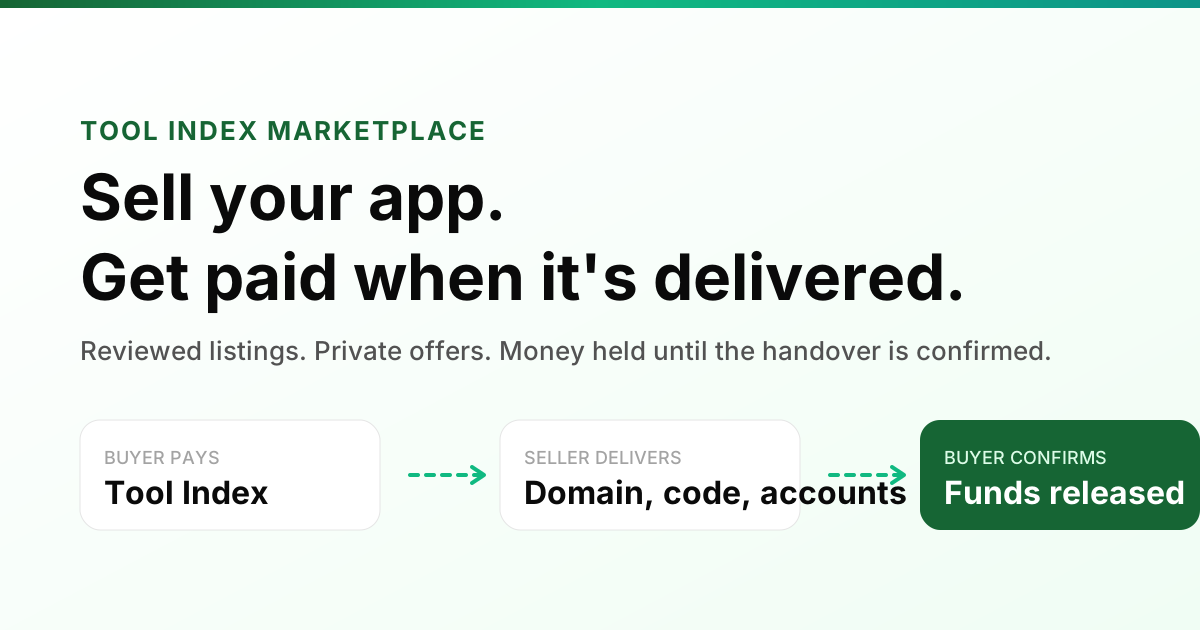
On Tool Index a listing is $49 once, which pays for a human to check your transfer evidence before the listing goes public. When a deal closes, the fee is 1 percent of the price, minimum $19, maximum $199, plus whatever the card processor takes. It comes out of the release to you, and the buyer pays the agreed price and nothing else.
The bigger cost, on any platform, is closing badly. That's the next post: how escrow closings work and why you shouldn't sell without one.
A Number You Can Defend
Pull the last twelve months from your processor. Subtract every cost. Be honest about how much of the product is you. Pick the row in the table that matches. That's your number, and you'll be able to explain every dollar of it to the person on the other side of the conversation.
When you're ready, list it here. There's a guide for each kind of product, from micro-SaaS to Chrome extensions, with the numbers buyers use for each.