Sponsored editorial review. Kalanos Grader purchased Tool Index's Launch Bundle, which includes this article alongside a featured placement on Tool Index. Payment covers the work and placement; it does not purchase a favorable verdict, an organic ranking, or a traffic guarantee. Links to Kalanos Grader in this article are qualified as sponsored.
Review scope: We inspected the Kalanos homepage and About page on November 23, 2026 in a desktop browser. We reviewed the public product explanation, sample report, supported input list, pricing text, and company positioning. We didn't create an account, install the package, purchase a service, open a private dashboard, or grade our own dataset. The screenshots show the actual public interface from that visit.
A local grader inside a broader data platform
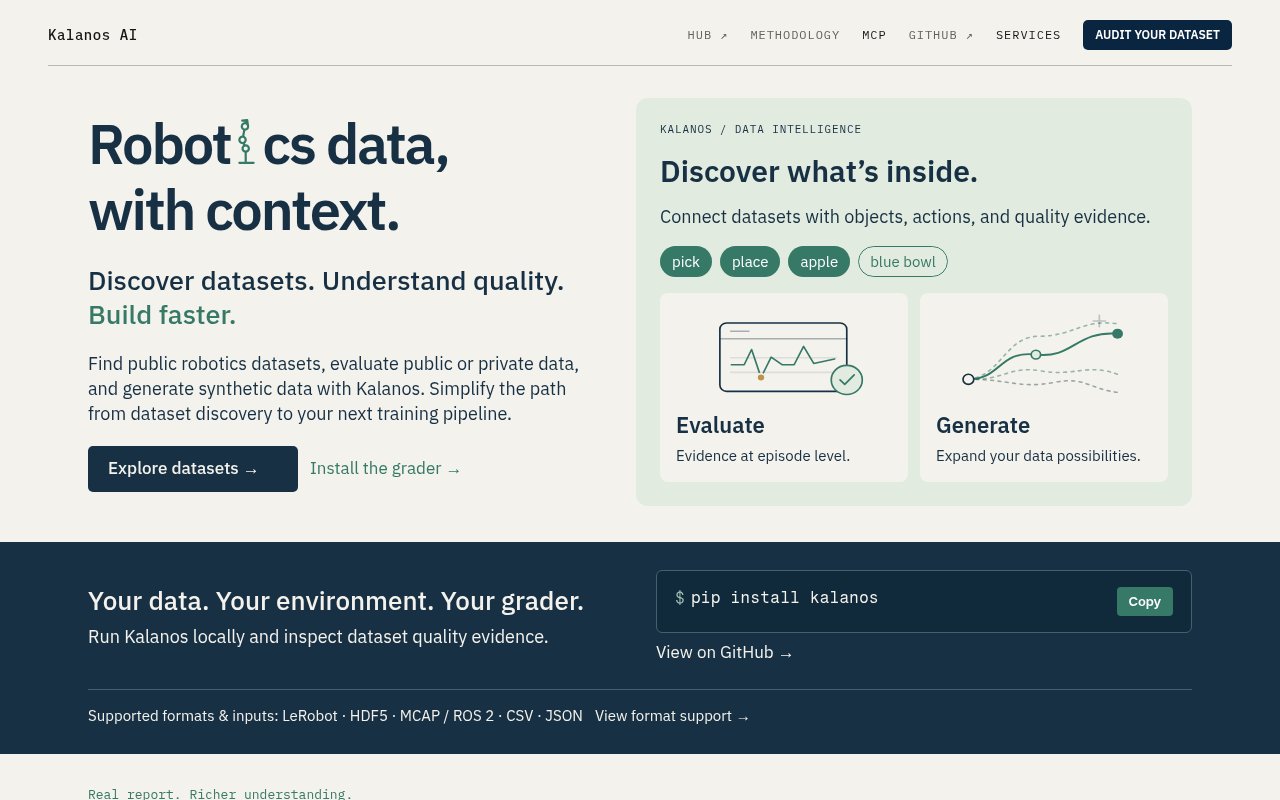
Kalanos Grader is an open source tool for checking robotics datasets before they enter a training workflow. The public site presents it as a local package installed with pip, with support named for LeRobot, HDF5, MCAP and ROS 2, CSV, and JSON inputs. Its job is to surface quality evidence at the dataset and episode levels, then point a reviewer toward recordings that deserve attention.
The product sits within a wider Kalanos AI offering that also includes a public dataset Hub, synthetic data generation, an MCP connection, custom audits, and team services. That wider frame matters because the homepage sometimes shifts from the free Grader to discovery or consulting without a sharp boundary. The Grader itself is the part that runs in a user's environment and keeps reports local unless the user chooses to publish them.
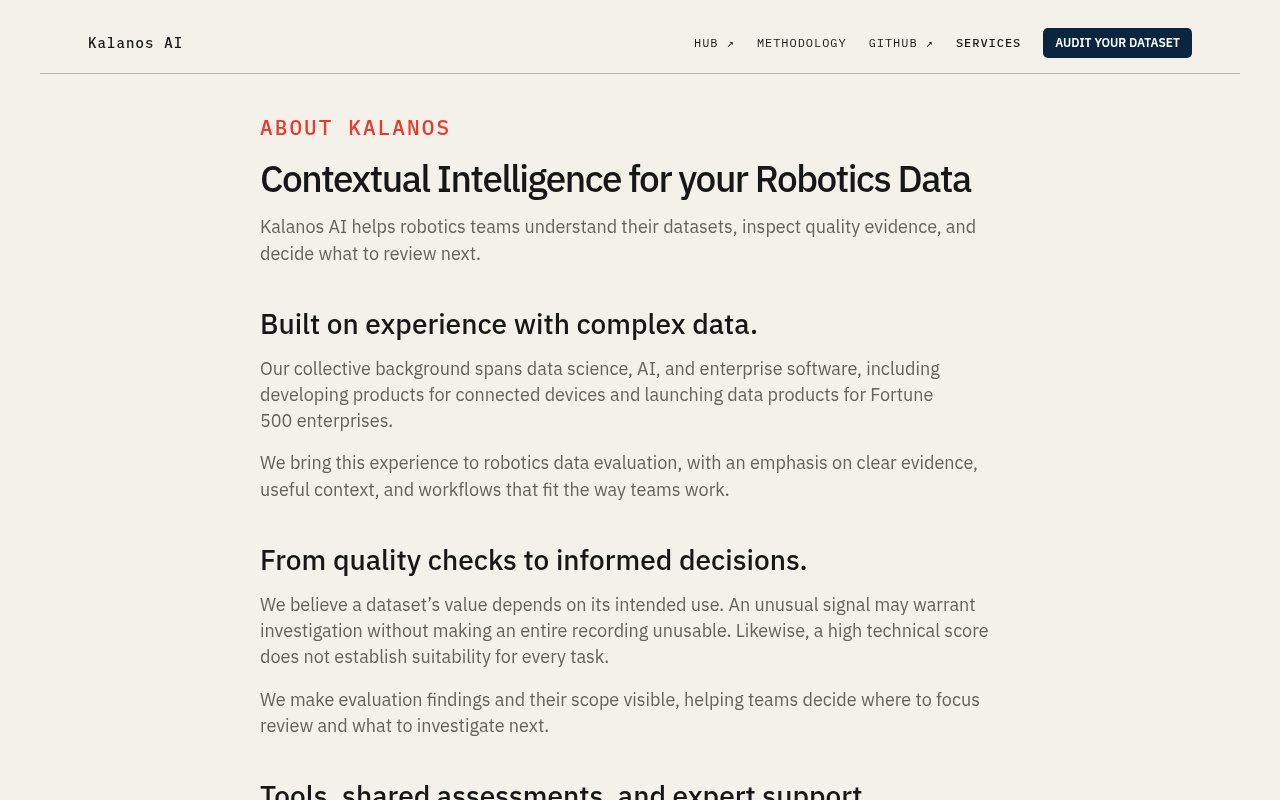
Kalanos AI makes the product. Its About page says the team has experience across data science, AI, enterprise software, connected devices, and data products for large companies, though the captured page doesn't name individual founders or contributors. The stated philosophy is sensible for robotics work, since an unusual signal can deserve inspection without invalidating a whole recording.
Kalanos Grader has a clear purpose even when the surrounding product family makes the homepage feel broader than the tool itself.
Built for robotics data teams with recordings to triage
The clearest audience is a robotics team collecting demonstrations or evaluating public datasets before training. Engineers working with repeated episodes, multiple camera streams, actions, objects, and task instructions should understand the report model immediately. The product is especially relevant when a team has enough recordings that opening every episode by hand is no longer practical.
It also fits researchers and data engineers who need a repeatable first pass across supported formats. Local execution is useful for private recordings, while JSON output can fit an existing pipeline and an HTML report can support focused human review. No account or API key is presented as necessary for local grading, which lowers the barrier for an individual evaluator.
It is less clearly aimed at a nontechnical operations reviewer. Installation is shown as a pip command, and the public pages don't present a desktop application or a guided upload flow for the local Grader. Teams that want shared inventories, published reports, or recurring checks are directed toward the Hub or a conversation with Kalanos rather than a fully described self service team plan.
- Robotics engineers screening demonstrations before training
- Data engineers adding repeatable checks to collection pipelines
- Researchers comparing the condition of public datasets
- Teams handling sensitive recordings that should remain local
The user journey runs from command line to evidence
From a user's point of view, the process starts by installing the kalanos package with pip and pointing it at a supported input. The site says the Grader can assess unlimited local datasets and produce reports on the user's machine. We didn't install it during this review, so the public pages don't let us judge command syntax beyond installation, processing speed, dependency handling, or how much format specific configuration is required.
The useful output is not just a single quality score. The sample report on the homepage shows evaluated episode counts, size after filtering, unique instructions, action and object summaries, sampled episode context, and recorded frames from the start, middle, and end of an episode. That design gives a reviewer several paths from a dataset overview into the evidence behind a finding.
A reviewer can open the HTML report for visual inspection or consume JSON in a data pipeline, according to the product description supplied for the listing. The site emphasizes episode level findings and makes the scope of an assessment visible. This is the right shape for triage because a score can prioritize attention, while episode evidence helps a person decide whether a signal problem actually matters for the intended task.
Publishing is a separate choice. Local reports stay on the machine unless the user elects to publish, while publishing reports through the Hub requires a free API key requested through the contact form. That separation gives private evaluation a simple story, though the public pages don't show the exact handoff from a local report to a shared Hub record.
- Install the package in a Python environment
- Run an assessment on a supported dataset input
- Review the overall score and stated assessment scope
- Move from summary metrics into episode level evidence
- Use the HTML report for inspection or JSON for a pipeline
- Publish only when a shared report is wanted
A cautious philosophy behind the score
The About page provides the most important qualification on the homepage score. Kalanos says dataset value depends on intended use, an unusual signal doesn't automatically make a recording unusable, and a high technical score doesn't prove suitability for every task. That keeps the product from pretending a compact metric can replace engineering judgment.
Its three stated principles are evidence behind assessments, context behind decisions, and value in the workflow. Those ideas show up in the sample report through visible sampling scope, episode counts, actions, objects, instructions, and frames. We like that the product describes what remains unknown as part of evaluation rather than treating uncertainty as something to hide.
This philosophy also sets the limit of automation. The Grader appears designed to narrow the review queue and organize evidence, not make the final keep or discard decision. Teams seeking an automatic certification gate will still need to define their own acceptance rules around the report.
The strongest idea on the site is that a quality score should start an investigation, not end one.
The local grader is free while team work is unpriced
The captured pricing text is straightforward for the local product. Kalanos Grader is free, open source under Apache-2.0, and described as allowing unlimited local dataset grading. Reports remain on the user's machine unless that user chooses to publish them.
Kalanos Hub is also listed as free for browsing public report cards. Publishing a user's own reports requires a free API key, and the page says that key must be requested through the contact form. The captured text doesn't mention usage caps, storage allowances, private sharing limits, or a paid Hub tier.
The Teams offer has no public price. It is labeled Talk to us and is framed around recurring data checks for organizations that collect demonstrations regularly. There is no captured monthly fee, annual fee, seat price, service minimum, or trial detail, so a team can't estimate its budget from the public site alone.
- Grader is free and open source under Apache-2.0
- Unlimited local dataset grading is stated on the homepage
- Hub browsing is free
- Publishing requires a free API key requested through contact
- Teams pricing is not public
Where the public product holds up
Local first processing is the clearest strength. Robotics recordings can be large, sensitive, and awkward to upload, so keeping assessment and reports in the user's environment removes an obvious source of friction. The user also retains control over whether a result becomes public.
The report example is more persuasive than a generic promise of data quality. It connects the score to episode coverage, duration after filtering, instructions, action and object labels, and camera frames. Even without running the package, we could see the type of evidence a reviewer would use to challenge or accept a finding.
Format breadth is another practical advantage on paper. LeRobot, HDF5, MCAP and ROS 2, CSV, and JSON cover several common paths by which robotics data reaches an evaluation workflow. HTML and JSON outputs also serve two different needs, with one suited to inspection and the other to automation.
The product's restraint around conclusions deserves credit. The site explicitly separates technical observations from task suitability and acknowledges assessment scope. That stance is more useful than presenting a high score as proof that a dataset is ready for any model or objective.
- Runs locally and leaves publication under user control
- Shows episode evidence behind an overall score
- Names several robotics and general data inputs
- Offers both human readable and pipeline friendly outputs
- Treats task context as part of the decision
Where it falls short
The public site doesn't explain the Grader deeply enough for a technical buyer to predict adoption effort. It names formats but doesn't show the exact commands for grading, required schema conventions, hardware needs, processing benchmarks, failure behavior, or the checks available for each reader. HDF5 and MCAP can hold many structures, so a format name alone doesn't settle compatibility.
The sample report is detailed, but the captured pages don't define how the 99.0 score is calculated or how individual indicators are weighted. A Methodology link is visible in navigation, yet no methodology page was included in the captured material we reviewed. The result is a good demonstration of output without enough evidence here to audit the evaluator itself.
Collaboration is also underexplained. The pages say the Hub can organize public and private dataset inventories, while the pricing block only explains free browsing and a contact based API key for publishing. They don't spell out permissions, review comments, version history, private report sharing, retention, or the path from a local report into a team workflow.
Finally, commercial planning stops at a contact form. Teams needing recurring checks have no public price, packaging detail, service boundary, or expected response process. The broad homepage also mixes grading, dataset discovery, synthetic generation, MCP access, and expert services, which makes it harder to tell which capabilities are included in the package and which belong to another Kalanos product.
- Reader compatibility lacks format specific detail
- Score construction isn't explained in the captured pages
- Team collaboration features remain vague
- Teams pricing and packaging require contact
- The wider product range blurs the Grader boundary
A focused audit layer beside familiar alternatives
Kalanos Grader isn't a direct replacement for every robotics data tool. Foxglove is the more familiar choice for exploring ROS and MCAP telemetry in a rich visualization workspace, while PlotJuggler is strong for plotting and inspecting time series. Kalanos appears more opinionated about dataset level quality assessment, episode triage, and a report that can be passed into a review process.
LeRobot's own dataset utilities and viewers are a natural option when a workflow already centers on that ecosystem. Kalanos has the broader input story on its homepage and tries to provide one assessment frame across LeRobot, ROS related recordings, and general file inputs. The public pages don't prove equal depth across those formats, so teams should test the reader that matters to them before standardizing.
FiftyOne is another adjacent option for teams whose robotics data work is dominated by images or video and needs visual dataset curation. It has a different center of gravity, while Kalanos presents actions, instructions, signals, episodes, and robot recording context as first class parts of the audit. A custom Python notebook remains the most flexible alternative, but it also leaves scoring, report design, and maintenance to the team.
The choice comes down to the desired layer. Teams that mainly need low level signal exploration may prefer Foxglove or PlotJuggler, and teams with highly specific acceptance rules may stay with notebooks. Kalanos Grader is most interesting when a team wants a repeatable local audit, an accessible HTML artifact, and a route from summary findings to individual episodes.
- Foxglove for interactive ROS and MCAP exploration
- PlotJuggler for detailed time series inspection
- LeRobot utilities for workflows centered on its dataset format
- FiftyOne for visual dataset curation
- Custom notebooks for fully bespoke checks
Pros and cons
- Free local grading is offered under the Apache-2.0 license
- Reports stay on the user's machine unless publication is chosen
- The sample report links a score to episode level context and frames
- Support is named for LeRobot, HDF5, MCAP and ROS 2, CSV, and JSON
- HTML and JSON outputs address review and pipeline use cases
- The captured pages don't explain score calculation or indicator weighting
- Format support lacks schema requirements and reader specific limits
- Team collaboration behavior is described only at a high level
- Teams pricing, packaging, and service boundaries aren't public
- Publishing requires requesting an API key through a contact form
Robotics engineers, researchers, and data teams that want a free local first pass over recorded episodes, with an HTML report for review and JSON output for a pipeline.
Verdict
Kalanos Grader has a credible focus on finding questionable robotics recordings without pretending that one score can certify a dataset. Its local execution, open source license, and episode level evidence make it worth testing before a training run. It isn't yet documented publicly with enough depth to judge reader compatibility, scoring logic, or team operations without installing it and asking Kalanos follow-up questions.
You can look at Kalanos Grader yourself at kalanos.ai, or read what other builders say on its Tool Index listing. This review reflects what the public site showed on 2026-11-23; products change, so treat the details as a snapshot.