I've shipped on both. Two products, two stacks, two completely different lessons.
The first one I built on Firebase in 2022. It felt magical for about three months, then I needed to do an analytics query that joined orders to users to subscription events. Firestore made me write a Cloud Function that read every document, denormalized them into BigQuery, then queried that. For a join that would've been one SQL line in Postgres. I shipped the feature. I never quite forgave the database.
The second one I built on Supabase in late 2024 and it's still humming today. Same shape of app. Auth, storage, realtime, an admin dashboard. The difference was I could open psql and just answer questions. Want to know my top ten paying customers by lifetime value? One query. Need to add a column with a default? One migration. Need to give a contractor read-only access to a single schema? Postgres has had that since the Clinton administration.
So when someone asks me Supabase vs Firebase in 2026, my honest opinion is biased. But the bias is earned. I want to give you a fair comparison anyway, because Firebase still wins for a specific kind of app, and pretending otherwise would be lazy.
The Real Fork: SQL vs NoSQL
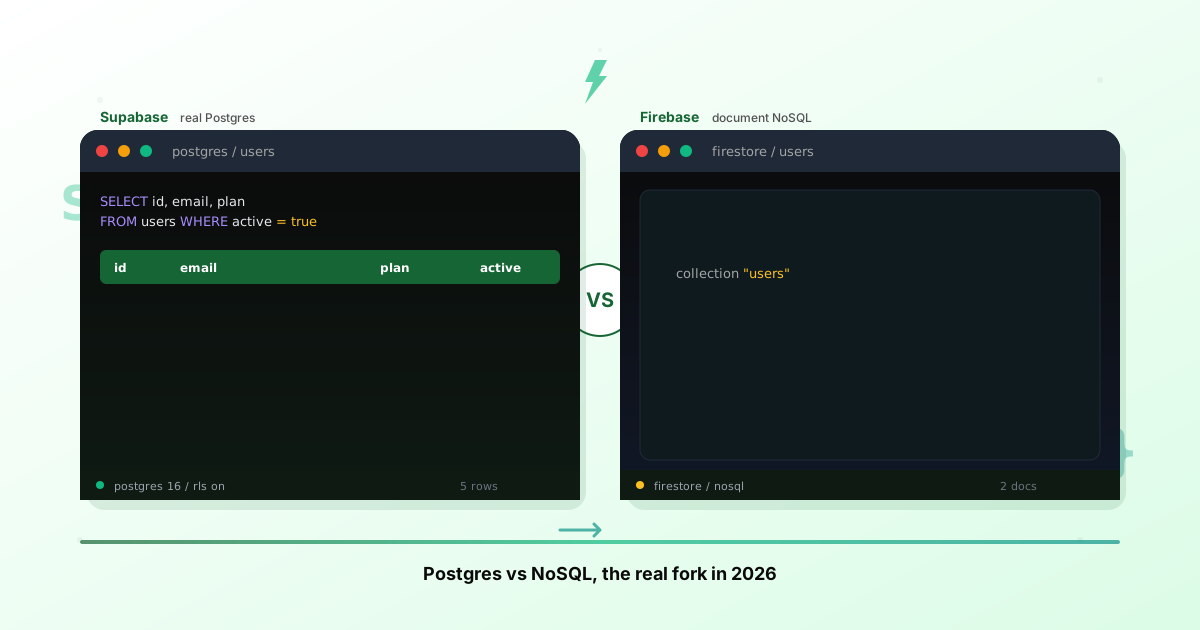
Most comparisons of these two products lead with feature checklists. That's the wrong frame. The interesting fork is the database underneath each one, because everything else cascades from that decision.
Supabase is a managed Postgres database with auth, storage, realtime, and edge functions stitched on top. The database is the real thing. You can connect with psql, you can dump it, you can move it to RDS or Neon tomorrow and your application keeps working.
Firebase's flagship database is Firestore, which is a proprietary NoSQL document store. There's no SQL, no joins in the traditional sense, no ad-hoc analytical queries. Reads and writes are priced per operation. The data model is collections of documents, often nested.
Both shapes have legitimate use cases. The question isn't "which is better." It's "which one matches what you're building." Most indie hackers in 2026 are building things that look like web apps with users, projects, subscriptions, and relationships between them. That's a relational shape. Postgres wins by default.
If you don't already have a strong reason to pick NoSQL, you don't have one. The default for a new web product in 2026 should be Postgres, and Supabase is the smoothest way to get there.
Supabase in Plain English
Supabase is open source. The full stack runs on your laptop if you want it to, and the hosted version is just that same stack with a control plane and a billing system. That's a meaningful detail. You can self-host on a $20 Hetzner box and keep your data forever.
The database is a real Postgres 16 instance. Row-level security is built in and the dashboard makes policies surprisingly approachable. You get extensions like pgvector for embeddings, PostGIS for geo data, pg_cron for scheduled jobs. The full SQL toolbox you'd get with any Postgres.
Auth is a separate service that writes into a special auth.users table. Email and password, magic links, OAuth with Google, GitHub, Apple, the usual. Multi-factor auth is built in. Phone auth via SMS works. The client SDK handles tokens for you.
Storage is S3-compatible. You upload files, you set RLS policies on the storage bucket the same way you'd set them on a table, and you get signed URLs back. The CDN is fine, not exceptional. Realtime is a WebSocket service that subscribes to Postgres logical replication. You write to a row, anybody listening gets the new value. It just works.
Edge functions run Deno on Cloudflare's edge network. You write TypeScript, you deploy, you call them like normal HTTP endpoints. They're fine. Not magical, not broken.
What ties it together is that everything talks to the same Postgres. Your auth is in Postgres. Your data is in Postgres. Your realtime feed reads Postgres. Your edge function queries Postgres. There's one source of truth and it speaks SQL.
Firebase in Plain English
Firebase is a Google product. The brand has been around since 2011, the company bought it in 2014, and it's matured into a tightly integrated suite. The point of Firebase isn't a database. It's a backend-as-a-service that lets a mobile developer ship a real app without writing server code.
Firestore is the document database. You write a JSON-shaped object, it gets stored as a document inside a collection. Documents can contain subcollections, which is how you model relationships. There's no JOIN, no transaction across collections, no ad-hoc analytical queries. Reads, writes, and deletes are billed per operation.
Realtime Database is the older NoSQL store, still around for legacy apps. Most new Firebase projects use Firestore. The realtime listener is the killer feature. You subscribe to a query, and your client gets pushed every change. Fast, cheap, and the part of Firebase that's hard to beat.
Firebase Authentication is the gold standard for mobile auth in my experience. It handles SMS verification, social logins, anonymous-to-authenticated upgrades, and the user lifecycle better than anything else I've used. The SDK is mature on iOS and Android.
Cloud Storage gives you Google Cloud Storage buckets with security rules. Cloud Functions runs Node, Python, and Go. Hosting is a fast static-site CDN. And then there's the analytics layer, which is a different animal entirely. Firebase Analytics, Crashlytics, Performance Monitoring, Remote Config, A/B Testing, and Cloud Messaging for push. All of it sits behind one SDK and one console.
Firebase isn't just a database. It's an app platform with a database attached. If you're shipping a consumer mobile app and you want push notifications, A/B tests, crash reporting, and analytics all wired together out of the box, nothing else even comes close.
The 30-Second Comparison
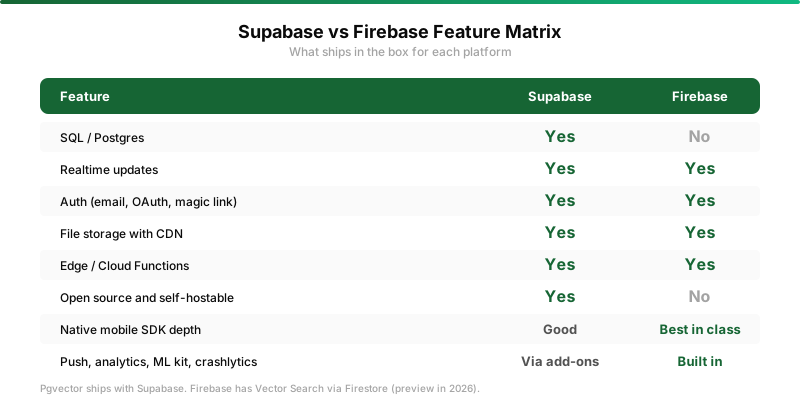
| Dimension | Supabase | Firebase |
|---|---|---|
| Database | Postgres (real SQL) | Firestore (NoSQL) |
| Open source | Yes, fully | No (proprietary) |
| Self-hostable | Yes | No |
| Free tier | 500 MB db, 1 GB storage, 50k MAU | 1 GB Firestore, 5 GB storage, generous Spark plan |
| First paid tier | $25/mo Pro | Blaze pay-as-you-go (~$25 small app) |
| Mobile SDK | Good (Flutter, RN, Swift, Kotlin) | Best in class |
| Vector / AI features | pgvector built in, Supabase AI assistant | Firestore Vector Search, Genkit |
| Lock-in risk | Low (pg_dump and run) | High (Firestore is proprietary) |
Where Supabase Wins
Relational data. If your app has users, projects, teams, tasks, comments, payments, or any combination of those, you're modeling a graph of relationships. Postgres was built for that. You write a query that joins five tables and you get an answer in milliseconds. In Firestore, you'd denormalize, write Cloud Functions to keep copies in sync, and pray.
SQL itself. Two and a half decades of accumulated tooling, drivers, ORMs, query builders, dashboards, and Stack Overflow answers all just work. You hire a backend engineer, they know SQL. You read a Postgres book, the knowledge transfers. The skill is portable.
Open source and self-hosting. Supabase is a stack of open-source services you can run yourself. That gives you a real exit option if pricing changes or the company gets acquired. I've seen at least three teams move from hosted Supabase to self-hosted on Hetzner over the past year to cut their bill. Try that with Firebase. You can't.
Generous free tier without surprise bills. The free tier is flat. You don't pay until you upgrade. If you build a hobby app and it doesn't take off, your bill stays at zero. Firebase Spark is also generous, but the moment you move to Blaze for a single function you've opened the meter. More on that below.
Local development. You can spin up the entire Supabase stack with one CLI command, get a real Postgres, run migrations against it, and write tests against it. The dev loop is fast and familiar. Firebase has emulators, and they've gotten better, but they're not the same product as the cloud version.
The single best argument for Supabase in 2026 is that you can leave. You own your data, you own your schema, and the database under the hood is a fifteen-pound block of granite that's been carved by twenty-eight years of open source. That's the longest bet you can make.
Where Firebase Wins
Mobile-first apps. If you're building an iOS or Android app and you don't want to think about backend at all, Firebase is the answer. The SDK is the smoothest in the industry. Offline support is genuinely first-class, the kind where your app keeps working on the subway and syncs when it comes back. Doing that on Supabase is possible but it's manual labor.
Push notifications. Firebase Cloud Messaging is the standard. iOS and Android both rely on the underlying primitives Google provides. You can wire push from Supabase via OneSignal or Expo, but you're stitching together a thing that Firebase gives you in one line.
Analytics and crash reporting. Firebase Analytics, Crashlytics, and Performance Monitoring all integrate with the same SDK as your data and auth. One install, one console. To get the equivalent on Supabase you're pulling in PostHog or Sentry plus a separate crash reporter. Not hard, just more services to babysit.
ML Kit. On-device machine learning for vision, text recognition, language detection, and barcode scanning. Bundled, free, and fast. Supabase has nothing equivalent because that's not what Supabase is.
Deep Google Cloud integration. If your team already lives in Google Cloud, with BigQuery for analytics and Pub/Sub for messaging, Firebase data flows there cleanly. Firestore can export to BigQuery on a schedule. Cloud Functions sit in the same project. That ecosystem stickiness is real value for teams already inside it.
A/B testing and Remote Config. Firebase ships a real feature-flagging and experimentation product. You can change copy or behavior in your app without redeploying. Supabase doesn't try to compete on this surface.
Pricing Reality
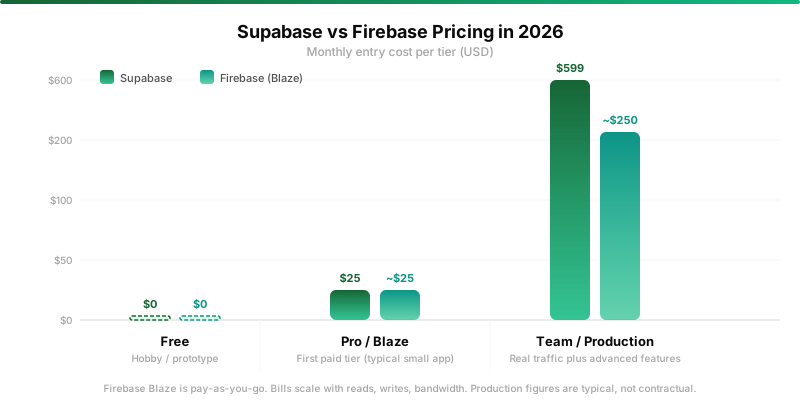
The headline numbers look similar. Both have generous free tiers. Both jump to roughly twenty-five dollars a month for the first paid step. The real story is what happens after that, and it's not the same shape on each side.
Supabase Pro is a flat $25 a month. You get 8 GB of database, 100 GB of storage, 100k monthly active users, and 250 GB of egress. If you exceed any of those, you pay overages. The Team plan is $599 a month with much bigger limits and SOC 2 compliance.
Firebase Spark (free) is genuinely free with hard limits. Firebase Blaze is pay-as-you-go from the first byte over the free thresholds. The bill scales with reads, writes, function invocations, and egress. A small app costs roughly twenty-five bucks a month. A medium-traffic app can hit a few hundred. A successful app with a viral moment can shock you.
The horror stories you've heard about Firebase bills are real, but they're almost always one of two patterns. Either someone wrote a runaway client that read the same collection in a loop, or someone misunderstood how Firestore charges for reads on document lists. Both are fixable once you know what to watch.
For an indie hacker product doing under 10k MAU, both platforms come in around $25 a month. Past that, Supabase is more predictable because the meter is mostly off. Firebase scales smoothly but the meter is always on.
Vendor Lock-In: The Asymmetric Risk
This section is unfair on purpose, because the risk is unfair.
If you build on Supabase and you decide to leave, the path is well-trodden. You take a pg_dump. You stand up Postgres on AWS RDS, Neon, Crunchy, Hetzner, or a literal box in your closet. You point your app at the new connection string. Auth needs porting if you used Supabase Auth specifically, but the user table is just a table. You can be off Supabase in a weekend.
If you build on Firebase and you decide to leave, you're in for months of work. Firestore is proprietary. The query model doesn't translate. There's no equivalent service to migrate to. You'd be rewriting your data layer against a different database (Mongo, DynamoDB, Postgres) and reshaping your code at every read and write. Many teams just don't leave. They live with the bill.
That asymmetry isn't a deal-breaker. Plenty of successful companies have built on Firebase, scaled to millions, and never wanted to leave. But you should know which one you're choosing. With Supabase, you're betting on Postgres, which will outlive both of us. With Firebase, you're betting on Google.
Vendor lock-in isn't about whether you'll ever want to leave. It's about whether you can. Optionality is worth money. Pretending it isn't is how you end up trapped.
AI Features in 2026
Both platforms have leaned into the AI wave hard, and the offerings are starting to converge on shape but diverge on philosophy.
Supabase ships pgvector as a first-class extension. Embeddings live in the same Postgres as your application data, which means you can JOIN a vector search result against your users table and your orders table in a single query. That's genuinely powerful for any RAG-style feature. The Supabase Studio also includes an AI assistant that can write SQL, explain queries, and generate migrations from natural language. It's good. Not magical, but good.
Firebase's bet is Genkit, an open-source framework for building production AI features (RAG, chains, tool use) that runs on Cloud Functions and integrates with Firestore Vector Search. Vector Search itself is in preview as of mid-2026 and lets you do nearest-neighbor queries on Firestore documents. The integration story with Vertex AI is tight if you're already in Google Cloud.
The honest truth is that for AI-heavy apps in 2026, Supabase is the easier path because everything is in Postgres and you can write normal SQL against your embeddings. Firebase is catching up. If you're already in the Google ecosystem and Vertex AI is part of your stack anyway, Genkit will feel natural.
For a deeper look at the AI tool landscape adjacent to this stack, see our 2026 indie hacker tool roundup.
Decision Tree for Picking
I'll spare you the flowchart and just tell you how to choose. Three short questions, in order.
One. Are you building a mobile-first consumer app where push notifications, A/B testing, and crash reporting are core to the loop? If yes, pick Firebase. Don't overthink it. The mobile SDK and the analytics layer alone justify the choice.
Two. Are you building a SaaS app with users, billing, teams, and any kind of dashboard? If yes, pick Supabase. Your queries will be relational. Your future self will thank you. The escape hatch matters when (not if) your needs change.
Three. Do you have an existing investment in either ecosystem? Google Cloud users tend to prefer Firebase because everything talks to BigQuery. Self-hosters and open-source folks gravitate to Supabase. The platform you already trust is the platform you should keep using.
If you genuinely don't know after answering those three, the default is Supabase. The relational shape covers more 2026 indie hacker products than the document shape. The exit ramp is wider. The local dev loop is faster. The bias is mine. The reasoning is honest.
The Verdict for Indie Hackers and Startups
Here's my unhedged take after eight years of shipping on both platforms.
For 2026 indie hackers and most startups, pick Supabase. The reasoning is simple. Your app probably has relational data. Postgres is the most battle-tested, portable, well-documented database on the planet. Supabase wraps it in a developer-friendly platform without taking away the parts that make Postgres great. The free tier is real. The Pro tier is flat. The escape is easy. If your product takes off, you'll still be on Supabase or on a hosted Postgres elsewhere, and the code mostly doesn't change.
For 2026 mobile-first consumer apps, pick Firebase. The mobile SDK depth, the bundled analytics, the push and crash reporting, and the A/B testing tools are still unmatched. If you're building a fitness tracker, a meditation app, a game, or a chat product, Firebase will get you to v1 faster than anything else. The Firestore data model is genuinely fine for that shape of app.
For everyone in the middle, build a 60-second prototype on both. Use the official quickstart. See which console you actually want to live in. The opinion of strangers (including mine) matters less than the texture of working in the product day after day.
If you're stuck, pick Supabase. If you regret it in a year, the migration off is one weekend. If you pick Firebase and regret it, it's a quarter of engineering work. Asymmetric risk is the whole game in early-stage product decisions.
Want a fuller picture of the dev tool stack? Check our roundup of top developer tools and the curated list of solopreneur tool stack. If you're cost-sensitive, the free developer tools list covers the budget angle.
Honest Closing
I've been writing software professionally for fifteen years. I've watched databases come and go. Mongo had its moment in 2014. DynamoDB has its niche. Firestore has its niche too, and I'm not going to pretend otherwise. The team behind Firebase ships well and the integrations are genuinely best in class for what they're for.
What I'll say is this. The thing I want from a backend in 2026 is fewer surprises. I want predictable pricing, portable data, and a query model my brain can fit. I want to be able to debug a problem at 2 AM without spinning up a Cloud Function to read 80,000 documents into a script. Supabase gives me that and Firebase doesn't. That's the whole story for me.
If you want a one-on-one drill-down, our Supabase vs Firebase comparison page walks through specific use cases side by side. Whatever you pick, ship something. The right backend is the one you stop thinking about so you can build the actual product.
That's the only metric that matters.