I've run teams on Trello. I've run teams on Asana. I've also done the migration between them, and it cost me three weeks of my life I'm never getting back. Let me save you some of that.
Most "Trello vs Asana" posts on the internet compare features. They line up boards, lists, timelines, dependencies, and try to declare a winner. That's the wrong axis. After running both at different company sizes, I can tell you the real question isn't which tool has more features. It's how big your team is right now, and how big it'll be in twelve months.
Trello is the platonic Kanban board. Asana is a full project management platform. Picking between them is almost entirely about team size and workflow complexity, not which one ticks more boxes on a spreadsheet. This post is the comparison I wish someone had handed me before I picked wrong the first time.
The Hidden Variable That Decides It
Here's the framing nobody on Twitter wants to make explicit. Team size doesn't just change which tool fits, it changes which tool is even legible to your team.
A two-person shop running Asana looks ridiculous. You're configuring custom fields, setting up portfolios, building approval workflows, and your actual work for the week is "ship the landing page." The tool is louder than the work. People give up and just text each other.
A twenty-person team running Trello also looks ridiculous, but in a different way. You've got fourteen boards, each one is somebody's pet project, nobody knows which board the marketing launch lives on, and three people just rebuilt the same workflow in three different boards because they couldn't find the existing one. The tool isn't loud enough. People give up and just text each other.
The interesting question isn't which tool wins. It's which tool matches your team's current shape. Tools have a natural team-size band where they make work easier instead of harder. Pick outside that band and you're paying a tax every day, in coordination overhead, in onboarding friction, in stuff that quietly never gets done.
Trello's band is roughly one to five people. Asana's band starts around eight or ten and goes up to a few hundred. The five-to-eight gap is the danger zone, and which way you lean depends on how cross-functional your work is and whether you've got dependencies between people.
Trello in Plain English
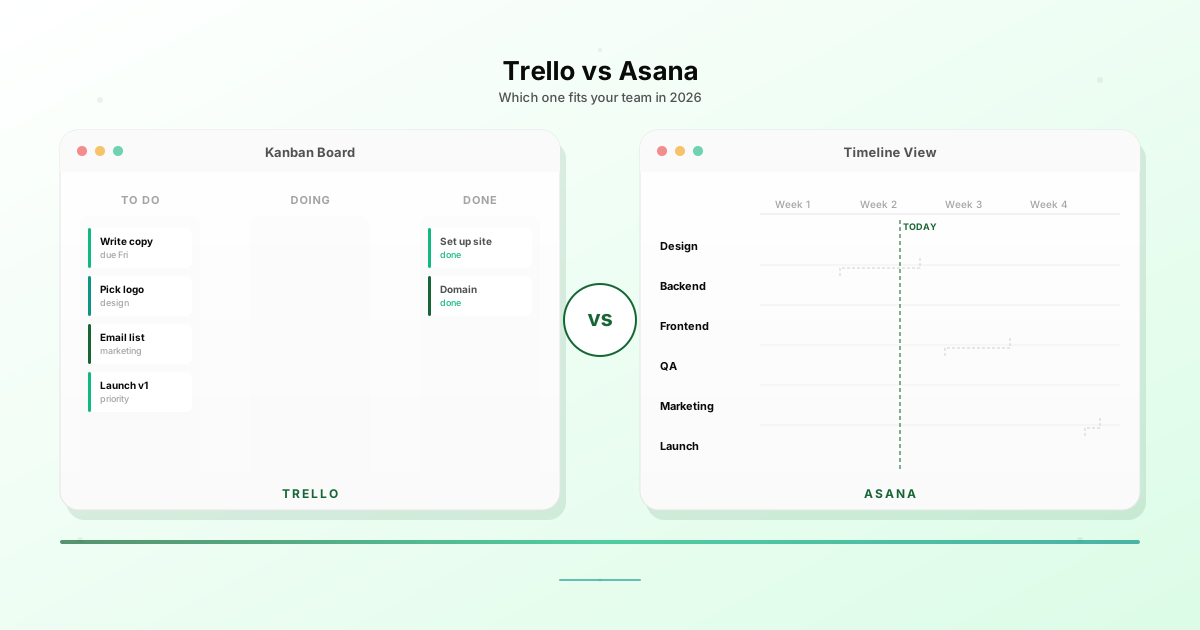
Trello is Kanban in a browser. That's it. That's the whole product. You make a board, the board has lists (columns), the lists have cards. You drag cards left to right as the work moves from "to do" to "doing" to "done." A five-year-old could use it. That's a compliment.
The reason Trello has survived since 2011 is that this metaphor turns out to be exactly right for a huge chunk of small-team work. A solo founder with a content calendar. A two-person agency with a client pipeline. A freelancer tracking projects. A side hustle with a launch checklist. Trello is the right answer for all of those, and it's the right answer because it doesn't try to be more than a board.
The thing that makes Trello more than a toy is Power-Ups. These are integrations and extra features you bolt on to a board, things like calendar views, custom fields, voting, time tracking, and bidirectional sync with calendars. The free tier gives you unlimited Power-Ups now, which used to be the big upgrade reason. Atlassian, who owns Trello, killed that paywall a couple years back.
The other thing that quietly upgraded Trello over the last few years is Butler, the built-in automation engine. Butler lets you write rules like "when a card moves to Done, add a completion date, archive it after seven days, post to Slack." Once you discover Butler, your boards stop being whiteboards and start being lightweight workflows. It's genuinely underrated.
What Trello deliberately doesn't do. It doesn't do Gantt charts (timeline views are limited). It doesn't do real cross-board dependencies. It doesn't do workload balancing across people. It doesn't do portfolios. The Premium tier added some of these as workspace views, but they always feel bolted on, because they are. The product wasn't designed for that work.
Asana in Plain English
Asana is what happens when you take "Kanban board" and ask "but what if it also did everything else." Lists, boards, timelines, calendars, portfolios, goals, workload, custom fields, dependencies, approval workflows, custom rules, forms, the works.
The way Asana actually feels day to day is that every task lives in a project, every project lives in a team, every team lives in your workspace. Within a project you can view the same tasks as a board (Kanban-style), a list (spreadsheet-style), a timeline (Gantt-style), or a calendar. Same data, four views, switch with one click. That's a genuinely good design and a big part of why Asana works for cross-functional teams where different people want to see the same work differently.
The killer feature for mid-sized teams is dependencies. You can mark a task as blocked by another task, and Asana will tell you when the blocker is done, slide your timeline if the blocker slips, and warn you if you're scheduling work on top of something that isn't ready. Trello cannot do this, full stop. If your work has any of "we can't ship until X is finished," Asana is the answer.
Portfolios let you roll up multiple projects into a dashboard, which is how heads of departments stay sane. Goals let you tie work to OKRs (or whatever your quarterly framework is called this year). Workload shows you who's overloaded and who has capacity. These are all things a five-person team doesn't need and a fifty-person team is dying for.
The Asana learning curve is real. Onboarding a new hire to Trello takes about ten minutes. Onboarding to Asana takes a couple of days of "where do I find that thing," and weeks before they really know how to model their work in it. That cost is invisible until you're paying it.
Side-by-Side Comparison
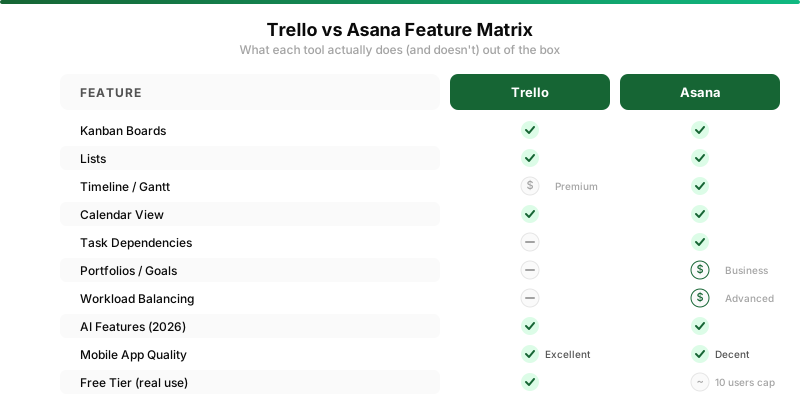
| Dimension | Trello | Asana |
|---|---|---|
| Native form | Kanban board | Multi-view project hub |
| Team-size sweet spot | 1 to 5 people | 10 to 500 people |
| Onboarding time | 10 minutes | 2 days to 2 weeks |
| Dependencies | Not really | First-class |
| Timeline / Gantt | Limited (Power-Up) | Built-in |
| Portfolios / Goals | No | Yes (Business tier) |
| Automation | Butler (powerful) | Rules (more powerful) |
| Free tier | Genuinely usable | Usable but limited at 10 users |
| Paid (per user / mo) | $5 to $17.50 | $10.99 to $24.99 |
Where Trello Wins
Trello wins for solo founders, freelancers, side projects, and small teams up to about five people. It also wins for any team whose work is fundamentally Kanban-shaped, things like content calendars, sales pipelines, hiring pipelines, support queues.
The reason Trello wins these cases isn't just price. It's onboarding speed. When you're three people and the work is moving fast, you can't afford the two days it takes a teammate to learn Asana's mental model. Trello's mental model is "look at the board." That's it. Your part-time freelancer learns it in the meeting where you give them access.
Power-Ups close most of the feature gap for small teams. The Calendar Power-Up gives you due-date visibility. The Custom Fields Power-Up gives you the few extra columns you actually need. Butler covers your automation. For a small team, the stack of "Trello plus three Power-Ups" is genuinely complete, and it costs less than a single Asana seat.
The other quiet win for Trello is the mobile app. It's great. You can run a whole board from a phone without feeling like you're fighting the UI. Asana's mobile app has gotten better but it's still cramped on a phone because there's too much product to fit on a small screen. If you're a sales team running a pipeline from cars and airports, that matters.
If you're a solo founder or a tiny team and you're trying to pick a tool, just install Trello and stop reading. You can graduate to Asana when (and if) you actually need to. See the broader picture in our indie hacker stack.
Where Asana Wins
Asana wins from about eight people on up, and it wins decisively for cross-functional teams where work spans engineering, design, marketing, and operations.
The reason Asana wins here is dependencies and views. When marketing can't launch until engineering ships the backend, and engineering can't ship until design finalizes the spec, you have a chain of dependencies that Trello literally cannot model. Asana can. It tells everyone in the chain what's blocking, what's unblocked, and when the chain slips. That visibility is worth thousands of dollars a year in not-having-meetings-about-status.
Multi-view also matters more than it sounds. The exec team wants to see a Gantt timeline. Engineering wants to see a Kanban board. Marketing wants to see a calendar. Same data, three views, no duplication. In Trello, those would be three different boards that drift out of sync within a week.
Asana's reporting is also actually useful. The Dashboards feature lets you build live charts of work in progress, completion rates, overdue counts, all of it. For a manager running a team of fifteen, this is the difference between knowing what's happening and having a Monday-morning meeting where everyone catches up out loud.
Where Asana goes from "wins" to "destroys" is at the head-of-department level. Portfolios roll up dozens of projects into one view. Goals tie work to OKRs. Workload shows you which engineer is buried and which has slack. None of this is possible in Trello. None of it is needed under ten people.
The Switching Cost Nobody Warns You About
Here's the part most "vs" articles skip, and it's the most important part of this decision.
Migrating a project tool is a nightmare. Not because the export-import is hard (both tools have CSV and API import), but because the mental model is different and your team has to relearn how their work is organized. Permissions, automations, custom fields, integrations, all of that has to be rebuilt by hand. And your team has to live in two tools for weeks while you migrate.
I've done the Trello-to-Asana migration twice. First time at a startup that hit twelve people and outgrew Trello. Second time at a consulting client. Both migrations took three to four weeks of part-time work, and both involved at least one week where productivity dropped because nobody knew where their tasks lived.
The strongest argument for picking Asana early (even at six or seven people) is that you only pay the learning-curve tax once. The strongest argument for staying in Trello as long as possible is that you might never need the complexity, and if you do, future-you will be more experienced at scoping the migration than current-you is.
If you're currently a five-person team that might be twenty-person in twelve months, the honest play is, start in Asana now and accept the slower onboarding. The migration is worse than the friction.
If you're currently a five-person team that'll be a seven-person team in twelve months, stay in Trello. You're not going to outgrow it that fast.
Pricing Reality
Let's talk about what these tools actually cost when you're running them, not the sticker prices.
Trello's free tier is genuinely useful for a small team. You get unlimited cards, ten boards per workspace, unlimited Power-Ups, and basic automation. Most one-to-three person teams will never pay Trello a dollar. The Standard tier at five bucks a user per month gives you unlimited boards and advanced checklists. The Premium tier at ten bucks a user per month gives you the calendar/timeline/dashboard views and unlimited automation. Enterprise is custom pricing.
Asana's free tier (Personal) caps at ten users and doesn't include timeline, dependencies, reporting, or rules. You will outgrow it. The Starter tier is about eleven bucks per user per month and unlocks timeline, dashboards, and basic rules. The Advanced tier at almost twenty-five bucks per user per month unlocks goals, portfolios, workload, and advanced automation. Business and Enterprise tiers exist above that and are custom-priced for fifty-plus seats.
Above twenty seats, the pricing gap shrinks proportionally, because what you're actually paying for in Asana is the team-coordination overhead it absorbs. It's worth more there.
AI Features in 2026
Both tools shipped serious AI features over the last year. Neither one is a reason to pick the tool on its own, but it's worth knowing what you're getting.
Trello's AI is mostly card-level. It can summarize long comment threads, draft a card description from a one-line title, suggest a checklist, translate comments. It's useful, it's not revolutionary. The Butler automation engine got some natural-language scripting where you can describe a rule in plain English and Butler will generate the trigger. That's probably the most genuinely useful AI thing Trello added.
Asana Intelligence is more ambitious. It can write status updates by reading your project, suggest task assignees based on workload, flag at-risk projects, draft goals from a project description, and answer questions like "what blockers are slowing down the Q3 launch?" The status-updates feature alone saves managers hours per week if your team actually uses it. The catch is that Asana Intelligence requires the Business tier or higher, so smaller teams won't see most of it.
If AI features are a deciding factor for you, Asana wins on capability and Trello wins on availability. But honestly, neither tool's AI is good enough yet to flip the team-size verdict. Pick on the fundamentals.
Decision Tree

The Verdict by Team Size
Let me give you the decision the way I'd give it to a friend over a beer.
If you're one to three people and your work fits a Kanban board, install Trello free tier and stop overthinking. You'll never pay them a dollar and you'll never need anything else. The browser extension and mobile app are great. Add Butler automations as you grow.
If you're four to seven people with a mix of types of work but no real cross-team dependencies, you can stay in Trello. Upgrade to Standard ($5/user/mo) for unlimited boards. Add the Calendar and Custom Fields Power-Ups. You're fine here for another year, easy.
If you're eight to fifteen people with multiple projects and some dependencies between people, switch to Asana Starter. The learning curve is real but you'll feel the dependency-tracking benefit within two weeks. Don't bother with Advanced yet, you won't use the portfolios features.
If you're fifteen-plus people, you're cross-functional, you have OKRs or quarterly planning, and managers need rollups, you want Asana Advanced or Business. This is the band Asana was designed for, and at this size Trello is genuinely the wrong tool. The cost of not having portfolios and workload at this scale is meeting time and missed deadlines.
Bonus footnote nobody mentions. Atlassian owns Trello. They also own Jira. Asana sits between the two in terms of seriousness, which means if you outgrow Asana upward (toward serious engineering project management), you're probably going to Jira anyway. The path many large companies actually walk is Trello to Asana to Jira, paying the migration tax twice. Worth knowing.
For more on the broader productivity stack, check our best productivity tools roundup or our list of agency-grade project tools. And if you're also weighing automation platforms, our n8n vs Zapier vs Make piece pairs well with this one, because once you've picked your project tool you'll want to wire it to everything else.
Honest Closing
I know "it depends" is the default cop-out answer in tool comparisons. So let me close with something more honest.
The hardest thing about picking between Trello and Asana isn't the comparison. It's admitting where you actually are right now versus where you wish you were. A lot of founders pick Asana because it feels more "real," and then they spend six months fighting the tool instead of working. A lot of teams stay in Trello two years past when they should have switched, because the migration is scary, and they pay for it in coordination overhead.
Both tools are good. Both are still going to be around in five years. The mistake isn't picking wrong, it's picking based on features instead of team shape, and then refusing to switch when the shape changes.
If you want a deeper look at the entire project-management category, our agency tools index has the full landscape. And if you specifically want a side-by-side data view, the Trello vs Asana comparison page has the structured data version of this post.
Now go pick one and ship something. Your project tool is supposed to disappear into the background. If you're thinking about it more than once a week, you picked wrong.