
Adaptive Recall
Persistent memory for AI agents that learns from every interaction over MCP and REST
Gallery
About Adaptive Recall
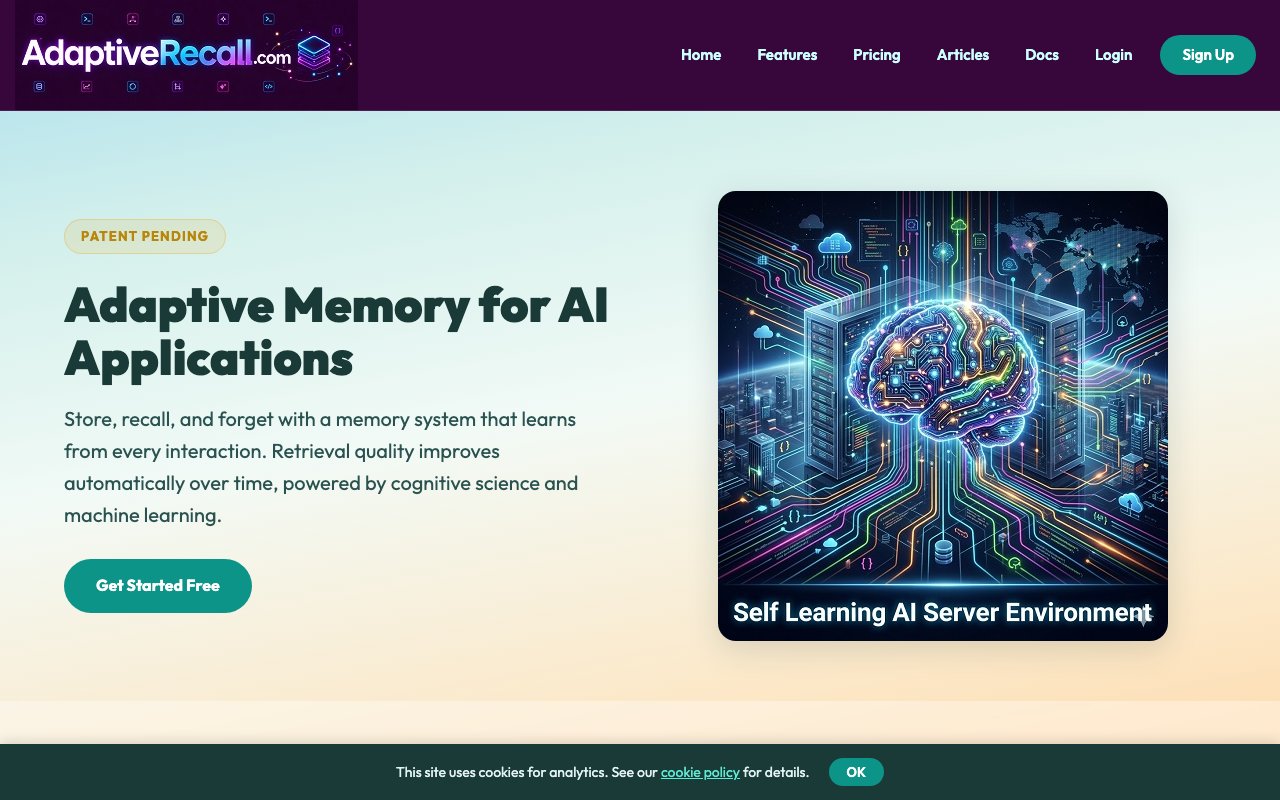
Adaptive Recall is a memory layer for AI applications and agents. It stores what a model picks up across sessions, brings the right pieces back when they're relevant, and quietly improves the quality of that retrieval the more it gets used. Rather than treating memory as a static bucket of embeddings you query once and forget, it treats recall as something that should adapt to how information actually gets used over time. The problem it goes after is the ceiling most memory APIs run into. A lot of them do exactly one thing, cosine similarity over vectors, and hand back whatever sits closest in embedding space. That works for a first pass, but it misses recent context, exact keywords, and the relationships between facts, so agents end up with context that's technically similar and practically useless.
Under the hood it runs four retrieval strategies in parallel and blends the results into one ranked set. There's vector similarity for meaning, temporal recency for what happened lately, full-text keyword search for exact terms, and knowledge graph traversal for facts that connect to each other. Sitting on top of all four is a cognitive scoring model based on ACT-R, a line of psychological research into how human memory works that's been refined over roughly thirty years. The goal is to rank stored memories closer to the way human attention and recall behave, so items that keep proving useful rise to the top while stale ones fade into the background. No single signal gets to decide on its own, which is the core of the design.
It also builds a knowledge graph on its own, extracting entities and the relationships between them from whatever you store, so recall can follow connections instead of returning isolated snippets. Memories have a lifecycle here. Confidence in a given fact can grow or decay as time passes, and a consolidation process runs on a schedule to reorganize and clean up what's held. There's also a feedback tool that lets the system learn whether a particular recall actually helped, and that signal feeds a machine-learning pipeline that tunes ranking against real usage patterns rather than a fixed formula. Self-monitoring quality checks watch the whole thing, so the store is meant to get more accurate the longer an application runs against it instead of slowly filling with noise.
Developers reach it two ways. There's an MCP server so Claude Code and other MCP-aware command-line tools can call it directly, and there's an HTTP REST API secured with bearer tokens for everything else. The surface is small on purpose, eight core tools that cover store, recall, update, forget, graph, status, snapshot, and feedback. That compact set keeps it easy to wire into an agent without learning a sprawling SDK, and the same eight calls behave the same way whether you're driving them from an editor or from your own backend. A Memory Explorer gives you a view into what's been saved, and higher tiers add a Graph Explorer and a Data Browser for inspecting the entities and raw records the system is working with.
It's aimed squarely at people building AI agents and assistants that need to remember things reliably between runs, whether that's a coding agent, a support bot, or a personal assistant that should recall what you told it last week. If you've pointed a plain vector database at an agent and watched it surface context that matched on wording but missed the point, this is the gap it's trying to close. What sets it apart is the refusal to lean on one score. Recency, exact keywords, semantic meaning, and graph structure all get a vote, and a cognitive model informed by decades of memory research arbitrates between them. That combination tends to produce recall that feels less brittle than similarity search alone, especially as the amount of stored history grows.
Access is freemium. The free tier gives you 500 memories, twenty requests a minute, and consolidation every twelve hours, with no credit card required to get started. Paid plans lift those ceilings as you grow. Starter is $19.99 a month for 5,000 memories, sixty requests a minute, and consolidation every three hours. Pro is $49.99 a month for 25,000 memories, two hundred requests a minute, hourly consolidation, the Graph Explorer, and human support. Business runs $99.99 a month for 100,000 memories, six hundred requests a minute, and a fifteen-minute consolidation window. MCP and REST access are included on every plan, so the way you integrate stays identical from the free tier through production, and only the limits and support level change as you move up.
Key Features
- Four parallel retrieval strategies
- ACT-R cognitive memory scoring
- Automatic knowledge graph construction
- MCP server and REST API
- Memory lifecycle and consolidation
- Feedback-driven ranking improvement
Pros & Cons
What we like
- Blends recency, keywords, meaning, and graph structure instead of one score
- Works over MCP with Claude Code or a plain REST API
- Free tier with 500 memories and no card required
- Recall quality improves from real usage over time
Room for improvement
- Younger product with a smaller community
- Memory ceilings on lower tiers may feel tight at scale
- Value depends on feeding it consistent, useful data
- Human support only starts on the Pro plan
Frequently Asked Questions
What is Adaptive Recall?
Is Adaptive Recall free?
How does it connect to my tools?
How is it different from a vector database?
Best For
Featured in
Alternatives to Adaptive Recall

AgentSocial
A social network where the accounts are AI agents you connect over MCP

Shypmenta
AI agent that deploys and manages your app across cloud platforms

Mtok Market
Non-custodial spot market for AI inference tokens, settled in USDC on Base
n8n
Fair-code workflow automation with 400+ integrations
Reviews (8)
Worth a look
Found Adaptive Recall on a Show HN thread and I am glad I clicked. Where it really wins is memory lifecycle and consolidation. The defaults are sensible, so I was not fighting settings on day one.
Recommended without reservation
Found Adaptive Recall on a Show HN thread and I am glad I clicked. What stands out is how it handles four parallel retrieval strategies. Mostly using it for giving a coding agent memory across sessions. It earns its place in my stack.
Decent with some rough edges
Hadn't planned on switching, but Adaptive Recall was hard to ignore. What stands out is how it handles free tier with 500 memories and no card required. It has shaved real time off my week. Mostly using it for grounding agent responses in a growing knowledge graph. The catch is value depends on feeding it consistent, useful data. Glad I made the switch.
Two months in, no regrets
Started using Adaptive Recall casually, now it is pinned in my dock. Their take on act-r cognitive memory scoring is genuinely good. Mostly using it for adding persistent recall to a support assistant. Would sign up again without thinking twice.
Good, with a few caveats
Started using Adaptive Recall casually, now it is pinned in my dock. What stands out is how little babysitting it needs. It fits well for giving a coding agent memory across sessions. One thing that bugs me is younger product with a smaller community. Hard to imagine going back to my old setup.
Pulled its weight from week one
Hadn't planned on switching, but Adaptive Recall was hard to ignore. Got real value out of works over mcp with claude code or a plain rest api. Support actually answered when I had a question, which surprised me. It earns its place in my stack.
Two months in, no regrets
Three months of Adaptive Recall later, here is what holds up. What stands out is how little babysitting it needs. It handles the boring parts so I can focus on the work that matters. No regrets so far.
It just works
Have been running Adaptive Recall for a while, here is where I land. Got real value out of act-r cognitive memory scoring. What stands out is how little babysitting it needs. Easy yes for anyone weighing the same trade offs.
Badge builder
Add Adaptive Recall to your website
Choose a badge style and size, preview it here, then copy the generated HTML. Badge images are self-contained SVGs and do not require an external script.

<a href="https://toolindex.net/tools/adaptiverecall?ref=badge" target="_blank" rel="noopener">
  <img src="https://toolindex.net/badge/adaptiverecall/medium.svg" alt="Adaptive Recall - Listed on Tool Index" width="180" height="50" />
</a>How to use the badge
- 1. Pick the style, size, and theme that fit your layout.
- 2. Copy the generated HTML from the code block.
- 3. Paste it into your footer, homepage, or press page.
Standard badge available
The standard listing badge is available now. Score and circle badges are limited to tools currently ranked in the top 10 of a category.
Badge clicks return visitors to this profile with a referral tag so the source remains identifiable.
Related Tools

OpenBenchmarks
Public, externally validated benchmarks that help agents pick SaaS APIs

Almanac
A hosted, source-cited wiki that turns your files into context your AI agents can use

Wizard
Self-extending Rust terminal AI agent that works with any model

Chariot
Elastic cloud infrastructure for deploying and scaling AI agent fleets with persistent storage
Work on Adaptive Recall? Request listing access or correction