
Wolli
Open framework for AI agents that grow around a purpose and extend themselves
Gallery
About Wolli
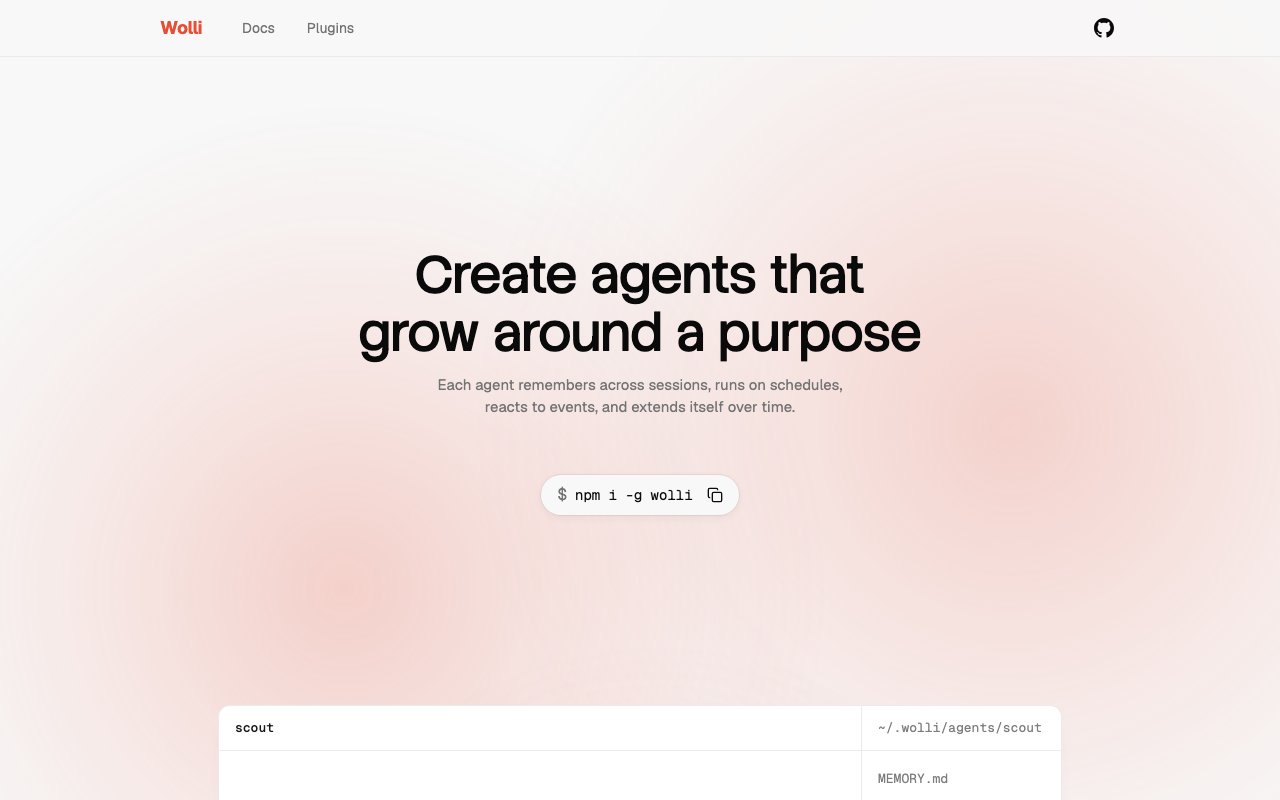
Wolli is an open framework for building AI agents that grow around a single purpose instead of resetting after every request. Rather than treating an agent as a stateless API call, Wolli runs it as an always-on daemon on your own machine, one that remembers past conversations, reacts to outside events, and extends its own abilities over time. The pitch on the site is to create agents that grow around a purpose, and the design follows that literally, since the agent works out what it's for and then builds itself out to serve it.
The core idea is that an agent is a home directory of ordinary files that both you and the agent can edit. Everything lives under a folder on disk, and because the files are the interface, there's no separate registry to maintain. When you or the agent drops in a new capability file, Wolli discovers it automatically. That plain-files approach is what lets an agent author its own skills, tools, workflows, and integrations, since writing a new capability is just writing a file into its own home directory rather than editing the framework itself. Deleting a capability is just as direct, since removing the file removes the ability.
Memory is handled through a small set of frozen files that sit in the agent's system prompt. SOUL.md holds its identity, and the first line is its purpose, which Wolli writes together with you in the very first conversation. MEMORY.md keeps durable notes the agent maintains for itself, and USER.md records facts about you, the human it works for. Alongside those, each conversation is stored as an append-only JSONL tree that acts as the agent's lifetime memory. Nothing is rewritten, so context is reconstructed deterministically from the log every time, which keeps the agent's history auditable instead of hidden inside a black box.
Being always-on is central to how it behaves. Agents run as operating-system daemons, launchd on macOS and systemd on Linux, so they can respond to schedules and events while your machine is on. A daemon exposes an HTTP interface, and clients like the CLI and the TUI attach to it. Workflows bind to typed events, so when a Telegram message arrives it emits a message event that routes to the right session, and a separate workflow fires when the agent finishes to deliver the reply. That event model is what lets an agent wake on its own instead of waiting for you to open a chat window.
Safety and flexibility are built in rather than bolted on. By default the agent runs inside a sandbox, using srt, which wraps Apple Seatbelt or bubblewrap, with Docker available as an option for stronger isolation. That matters when an agent is writing and running its own tools, since the sandbox limits what it can touch. On the model side it's provider-agnostic. You log in over OAuth and can point it at Anthropic, OpenAI, or others, so you're not locked to one vendor and can swap models without rewriting the agent.
The people this is aimed at are developers comfortable on the command line who want a personal, persistent agent they actually control. It ships with built-in integrations like Telegram and a scheduler, and the rest loads from the agent's own home directory as it grows into the job. Because it's local-first, you host it yourself and supply your own model credentials, which is the cost of keeping the whole thing on your own machine rather than in someone else's cloud. In exchange you get an agent whose memory, identity, and tools are all files you can read, edit, and back up.
What makes the approach distinct is that the agent is expected to change over time. Most agent frameworks hand you a fixed set of tools and a prompt, and the agent stays whatever you shipped. Wolli treats the first conversation as the moment the agent decides who it is, then lets it write new workflows and skills as the work reveals what it needs. Because every change is a file on disk, you can watch that evolution happen and step in whenever you want.
Wolli is fully open source under the Apache-2.0 license, with the code on GitHub under opsyhq and published on npm by Opsy, Inc. It's a TypeScript and Node project that needs Node 22.19 or newer, and installation is a single command, npm install -g wolli, after which running wolli starts the setup and the first conversation. There's no paid tier to the framework itself, so the practical cost is whatever you spend on the model provider you connect. For anyone who wants to inspect or extend it, the whole thing is a Node monorepo, so the framework's own internals are as readable as the agents it runs.
Key Features
- File-based agent home directories
- Self-authored SOUL.md identity
- Append-only JSONL session memory
- Event-driven workflow wakeups
- Sandboxed execution by default
- Multi-provider model support
Pros & Cons
What we like
- Fully open source under Apache-2.0
- Agents keep persistent memory across sessions
- Runs locally as an always-on daemon
- Sandboxed execution for safer autonomy
Room for improvement
- Requires Node 22 and command-line comfort
- Younger project with a smaller community
- You supply your own model provider keys
- Local-first design means you self-host it
Frequently Asked Questions
What is Wolli?
Is Wolli open source?
How do you install Wolli?
What makes Wolli different?
Best For
Featured in
Alternatives to Wolli

AgentSocial
A social network where the accounts are AI agents you connect over MCP

Mtok Market
Non-custodial spot market for AI inference tokens, settled in USDC on Base
Vapi
Build voice AI agents that take and place phone calls
n8n
Fair-code workflow automation with 400+ integrations
Reviews (7)
Decent with some rough edges
Wolli solves a real problem for me without making a fuss about it. Got real value out of fully open source under apache-2.0. The interface stays out of my way, which I appreciate. It would be a five if not for local-first design means you self-host it. Worth it for what I get out of it.
Genuinely impressed
Three months of Wolli later, here is what holds up. The runs locally as an always-on daemon is more useful than I expected. Performance has been steady even when I lean on it hard. Worth it for what I get out of it.
Genuinely impressed
Three months of Wolli later, here is what holds up. Support actually answered when I had a question, which surprised me. Performance has been steady even when I lean on it hard. Worth it for what I get out of it.
It just works
Started using Wolli casually, now it is pinned in my dock. Support actually answered when I had a question, which surprised me. It fits well for running a personal always-on assistant. No regrets so far.
Two months in, no regrets
Came to Wolli after getting frustrated with what I had before. Got real value out of agents keep persistent memory across sessions. Mostly using it for automating tasks through telegram or schedules. It earns its place in my stack.
Pulled its weight from week one
Came to Wolli after getting frustrated with what I had before. The sandboxed execution for safer autonomy is more useful than I expected. The defaults are sensible, so I was not fighting settings on day one. Would sign up again without thinking twice.
Solid daily driver
Found Wolli on a Show HN thread and I am glad I clicked. Their take on event-driven workflow wakeups is genuinely good. Support actually answered when I had a question, which surprised me. Found it works best for running a personal always-on assistant. Hard to imagine going back to my old setup.
Badge builder
Add Wolli to your website
Choose a badge style and size, preview it here, then copy the generated HTML. Badge images are self-contained SVGs and do not require an external script.

<a href="https://toolindex.net/tools/wolli?ref=badge" target="_blank" rel="noopener">
  <img src="https://toolindex.net/badge/wolli/medium.svg" alt="Wolli - Listed on Tool Index" width="180" height="50" />
</a>How to use the badge
- 1. Pick the style, size, and theme that fit your layout.
- 2. Copy the generated HTML from the code block.
- 3. Paste it into your footer, homepage, or press page.
Standard badge available
The standard listing badge is available now. Score and circle badges are limited to tools currently ranked in the top 10 of a category.
Badge clicks return visitors to this profile with a referral tag so the source remains identifiable.
Related Tools

OpenBenchmarks
Public, externally validated benchmarks that help agents pick SaaS APIs

Almanac
A hosted, source-cited wiki that turns your files into context your AI agents can use

Wizard
Self-extending Rust terminal AI agent that works with any model

Chariot
Elastic cloud infrastructure for deploying and scaling AI agent fleets with persistent storage
Work on Wolli? Request listing access or correction