Vapi
Build voice AI agents that take and place phone calls
Gallery
About Vapi
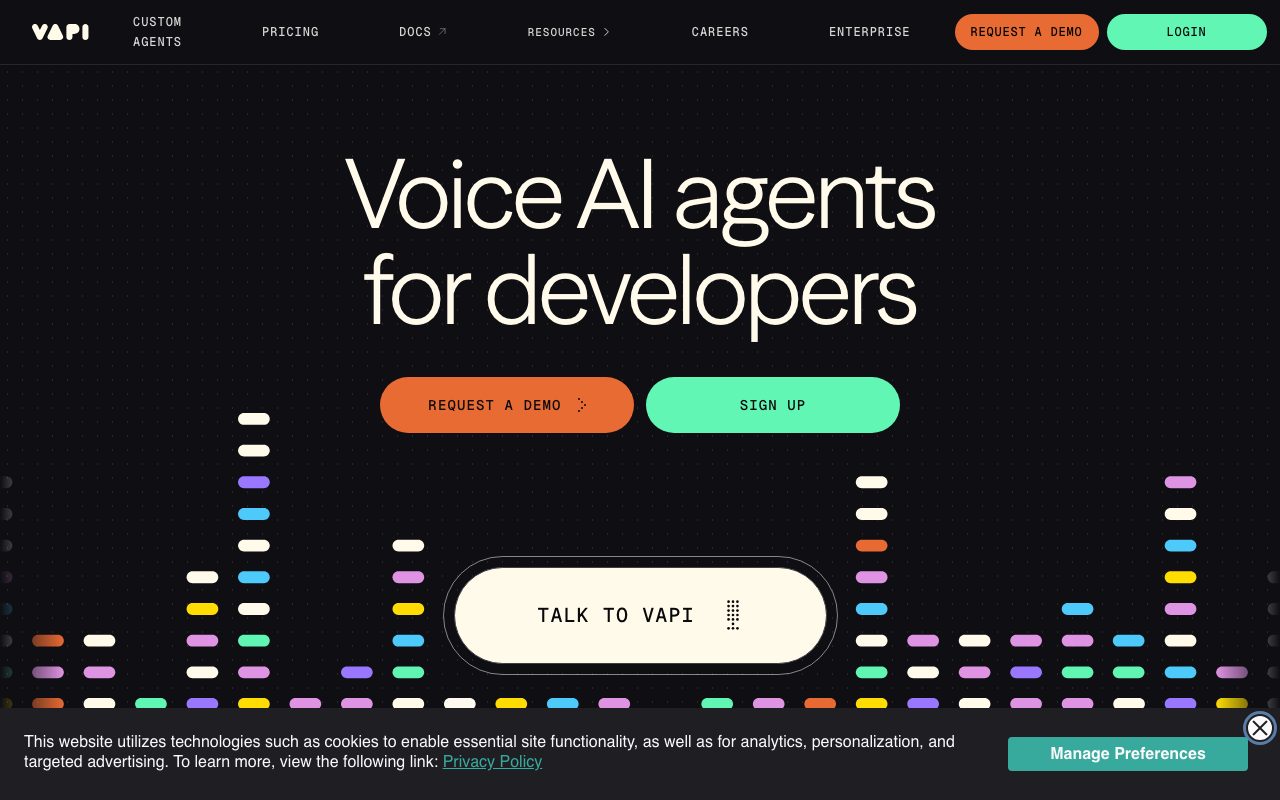
Vapi is the voice AI platform for building real-time conversational agents over phone, web, and SDK. It connects speech-to-text, an LLM, text-to-speech, and a telephony layer into a coherent stack you can build a voicebot on top of in hours rather than months. Vapi is what teams use when they want to ship a voice agent without rebuilding the entire pipeline.
The category got hot in 2024 and stayed hot. AI sales reps, AI receptionists, AI scheduling agents, and AI customer support bots are real businesses now. Vapi sits in the middle of this stack as the developer-facing platform.
I have built voice agents on Vapi for two real use cases. The honest take follows.
What Vapi does
Vapi gives you a single API for voice AI. Send a request describing the agent (system prompt, voice, model choice, tools), and Vapi handles the rest: STT, LLM call, TTS, telephony if needed, barge-in, interruption handling, latency optimization, all of it.
You can run agents over outbound calls, inbound calls, web embeds, or via SDK in your own apps. Phone numbers are provisioned through Vapi or BYO via Twilio. Tool calls let the agent take actions (look up a record, book an appointment, send a follow-up email).
The model selection is flexible. Use OpenAI, Anthropic, Google, or others for the LLM. Use ElevenLabs, OpenAI, Deepgram, or others for TTS. Use Deepgram, AssemblyAI, or Whisper for STT. Vapi orchestrates them with optimization for low latency.
Who Vapi is for
Developers building voice AI products. Sales teams building outbound calling agents. Support teams building inbound voicebots. Scheduling and appointment-setting startups. Any product that needs a voice layer and does not want to wire it up from scratch.
It is less of a fit for non-technical users who want a fully managed voice agent product. Vapi is a developer platform; the surface is API-first.
Pricing
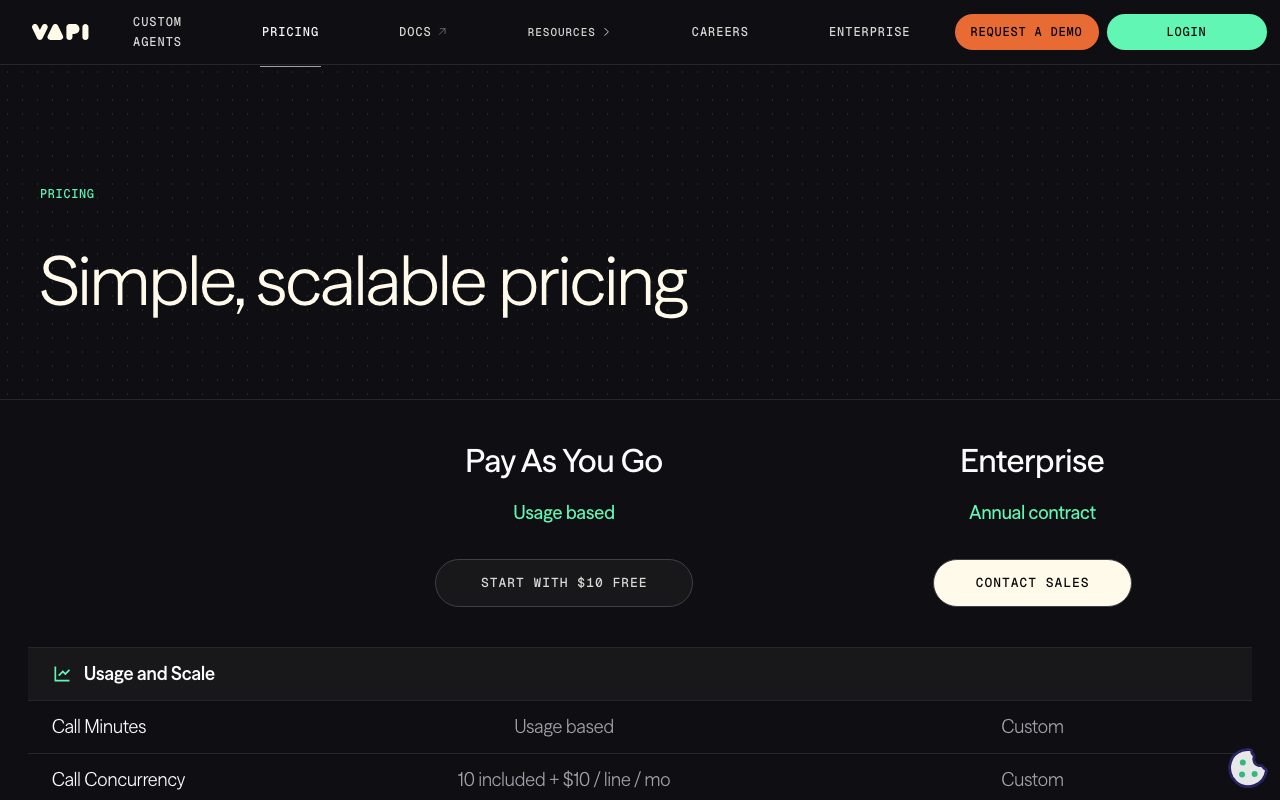
Vapi charges per minute of voice interaction, with the rate including its orchestration. On top, you pay the underlying providers (LLM, TTS, STT) at their rates, plus telephony if Vapi handles your phone number.
The pricing math gets complex fast because every component has a knob. A typical agent costs in the range of fifteen to thirty cents per minute fully loaded; long calls and premium voices push higher.
Features that earn the spot
Latency is the bar voice AI lives or dies on. Vapi's orchestration layer streams between components and minimizes round trips. Real-world latency from end of user speech to start of agent speech is often under 800 milliseconds, which is the line between "natural" and "obvious bot."
Barge-in handling lets the user interrupt the agent without weird collisions. The agent stops, listens, processes the new input, and responds. This single feature is what separates production voice AI from demo voice AI.
Tool calling lets the agent take actions during the conversation. "Let me check our schedule" can actually look up an availability and book an appointment without the user noticing the agent paused.
The dashboard logs full transcripts, audio recordings, and structured data from each call. Quality assurance becomes possible; debugging a misbehaving agent is realistic.
Multi-language support, custom voices, and the ability to swap LLMs without re-architecting are real. The platform is opinionated enough to be useful and flexible enough to evolve.
Tradeoffs
The cost stack is opaque until you model it carefully. A voice minute is not a flat fee; it is a sum of compute, audio, telephony, and platform pieces. Build the calculator before committing to a use case.
Voice quality variance matters. ElevenLabs voices are great and pricier; OpenAI is cheaper and improving. Pick the voice with the user experience in mind, not just the price line.
Edge cases in real conversations are still hard. Background noise, accents, code-switching, multiple speakers, all of these stress the pipeline. Test with real users in real environments before launching.
Vapi is the fastest path from "we want a voice agent" to a working agent in production. The category is young and Vapi is on the short list.
Vapi vs alternatives
Versus Retell AI, Retell is similar in scope and a major competitor. Both are good; the choice often comes down to integration fit and pricing on your specific stack.
Versus Bland.ai, Bland is also developer-focused with strong telephony. Different opinions on latency optimization and pricing.
Versus Twilio's voice plus your own LLM glue, Vapi saves you weeks of engineering on optimization and edge cases. Twilio is more mature on telephony; Vapi is more opinionated on the AI piece.
Versus building from scratch on OpenAI Realtime, OpenAI Realtime is impressive and is missing some of the production niceties (telephony, recording, dashboards, multi-provider). Vapi can sit on top.
See best voice AI platforms, Retell AI alternatives, and Vapi vs Retell.
Common questions
Can Vapi make outbound phone calls? Yes, with phone numbers provisioned through the platform. Does it work with my own LLM? Yes, you can swap LLM providers. Is there a free tier? Trial credits, then pay-per-use. How is latency? Often under 800ms end-to-end with the right configuration.
Bottom line
Vapi is the right pick for technical teams building voice AI today. The category is moving fast and Vapi is keeping up with the leading edge of latency, voice quality, and orchestration. It is not the cheapest path to a demo; it is the fastest path to production.
If you are evaluating voice AI seriously, Vapi belongs on the short list with Retell, Bland, and rolling your own. Browse tools for developers and the Vapi profile for current details.
Production voice AI use cases
AI receptionists: small businesses replace voicemail with a Vapi-powered agent that answers, takes a message, books appointments, or routes to a human. Real businesses deploy this and the quality is good enough that callers often do not realize they are talking to AI.
Outbound sales follow-up: the agent calls leads who requested information, qualifies them, books a meeting if interested. Sales reps get a calendar full of qualified meetings without the prospecting hours.
Customer support tier-one: the agent handles the common questions, escalates the rest. Cost per call drops dramatically; CSAT often holds or improves on simple cases.
Survey and feedback collection: post-purchase or post-call surveys conducted by AI voice. Response rates beat email; data quality is structured.
Tuning a Vapi agent
System prompt is the foundation. Be specific about persona, scope, and escalation criteria. The model's default tendency to over-explain or under-explain comes from the prompt.
Voice choice affects perception. A friendly voice for a consumer product, a professional voice for B2B. Test with real users; the data often surprises you.
Tool calling for actions matters. The agent should be able to look up records, book appointments, send follow-ups. Without tools, the agent is a chat with no consequences.
Latency budgeting: every component adds time. Pick the model and voice combo that gives the best quality under your latency budget.
Compliance considerations
Recording disclosure: many jurisdictions require disclosing recording. Build it into the opening line.
HIPAA, PCI, and other regulations apply if your industry requires them. Vapi has compliance documentation; verify it covers your specific case.
Consent for outbound calling: TCPA and equivalents matter in the US. Have consent before calling; document it.
The competitive landscape
Vapi, Retell AI, Bland, and a few others are the developer-facing layer. OpenAI's Realtime API is upstream; voice cloning and TTS providers are upstream. Pick based on the orchestration depth and pricing fit, not the brand.
Vapi development workflow
Build the agent definition first. Choose models, voices, system prompt, tools. Iterate on a single call before scaling.
Test with real conversations. Demo conversations rarely catch real-world variance. Have actual users call; iterate from logs.
Add tools incrementally. Start with read-only tools (lookups); add write tools (bookings, refunds) once read paths are reliable.
Monitor metrics that matter: completion rate, escalation rate, average call length, customer sentiment if measurable.
Vapi cost modeling
Per-minute platform fee plus model usage plus TTS plus STT plus telephony equals per-minute true cost. Compute for your specific stack.
Long calls cost more linearly. Optimize for shorter calls when possible without degrading user experience.
Premium voice quality has a real cost premium. Reserve for production; use cheaper voices for testing.
Volume discounts exist at scale. Talk to Vapi for enterprise pricing if your volume is meaningful.
Vapi compared honestly
Versus building from scratch on OpenAI Realtime, Vapi saves weeks of orchestration work. The buy-versus-build calculation is usually buy.
Versus Twilio's voice plus rolling your own AI, Vapi is faster to ship. Twilio is a building block; Vapi is the assembled platform.
Versus IVR replacements with traditional voice tech, Vapi is a generational leap in capability.
The category will keep evolving. Re-evaluate quarterly.
Vapi support and resources
Documentation covers the API, SDKs, and common patterns. Quality is decent; some advanced topics need community support.
Discord community is active; the Vapi team participates.
Sample apps and code on GitHub accelerate the start. Clone, modify, ship.
Customer support varies by tier. Enterprise gets dedicated; smaller tiers get community-first.
Voice AI in 2026 and beyond
Latency keeps dropping. The 800ms barrier today will be 500ms tomorrow.
Voice quality keeps improving. The line between AI and human voice continues to blur.
Cost is dropping. Real-time voice was prohibitive a year ago; now it is reasonable.
Use cases expand as the tech matures. New product categories will emerge that are voice-native.
Tutorial / Demo
Key Features
- Bring-your-own LLM, TTS, and STT providers
- Twilio and Vonage telephony integration
- Tool / function calling during a live call
- Inbound and outbound campaigns
- Squads for multi-agent handoff
- Web SDK for in-app voice
- Detailed call analytics
Pros & Cons
What we like
- Modular, so you're not locked into one provider stack
- Latency is competitive with verticalized rivals
- Strong developer documentation
- Pricing is transparent and per-minute
Room for improvement
- Real-time voice is hard, so debugging requires patience
- Costs stack up fast (LLM + TTS + STT + telephony)
- Voice agents still get caught by edge-case prompts
- Compliance (HIPAA, recording disclosure) is on you
Frequently Asked Questions
How much does Vapi cost?
Vapi vs Retell or Bland, which one?
Can Vapi place outbound calls?
Does Vapi support custom LLMs?
Is Vapi production-ready?
Best For
Featured in
Tags
Alternatives to Vapi
View all
ChatDash
White-label platform to deliver, manage, and monetize AI voice agents under your own brand
Cursor
VS Code fork built around an AI pair-programmer

Warp
The modern terminal reimagined with AI and collaboration

Replit
Browser IDE plus Replit Agent that builds and deploys apps from a prompt
Our take
Tool Index Editorial · May 2026· 4.4/5
Vapi sits in a crowded category, differentiating itself as build voice ai agents that take and place phone calls.
Worth highlighting: Modular, so you're not locked into one provider stack, Latency is competitive with verticalized rivals, and Strong developer documentation. The friction points: Real-time voice is hard, so debugging requires patience and Costs stack up fast (LLM + TTS + STT + telephony).
In short: Vapi is a solid pick when you need receptionist and appointment-booking voice agents, and a harder sell if real-time voice is hard, so debugging requires patience would be a dealbreaker.
Editorial opinion from the Tool Index team, written from the public product pages. Not a user review.
Reviews (5)
Vapi, better than expected
Adopted Vapi for one project, ended up using it for more. Where it really wins is pricing is transparent and per-minute.
Pros
- Modular — you're not locked into one provider stack
Genuinely impressed
Tried half a dozen options before landing on Vapi. Where it really wins is latency is competitive with verticalized rivals. Worth calling out the detailed call analytics too. Mostly using it for in-app voice assistants.
Pros
- Strong developer documentation
- Pricing is transparent and per-minute
Bought it for one feature, stayed for ten
Vapi solves a real problem for me, but it's not magic. Real selling point: latency is competitive with verticalized rivals. Their take on bring-your-own LLM, TTS, and STT providers is solid. Still recommending it to people in similar setups.
Pros
- Pricing is transparent and per-minute
- Strong developer documentation
- Latency is competitive with verticalized rivals
Does the job, doesn't sparkle
Took a few weeks for Vapi to click, then it stuck. The thing I keep coming back to: strong developer documentation. Found it works best for voice support tier-1 with human handoff. One thing that bugs me: voice agents still get caught by edge-case prompts. Decent value once you accept the rough edges.
Pros
- Latency is competitive with verticalized rivals
- Modular — you're not locked into one provider stack
- Pricing is transparent and per-minute
Cons
- Real-time voice is hard — debugging requires patience
- Voice agents still get caught by edge-case prompts
Genuinely impressed
Vapi isn't perfect but it's the best I've used in this category. Where it really wins is strong developer documentation.
Badge builder
Add Vapi to your website
Choose a badge style and size, preview it here, then copy the generated HTML. Badge images are self-contained SVGs and do not require an external script.

<a href="https://toolindex.net/tools/vapi?ref=badge" target="_blank" rel="noopener">
  <img src="https://toolindex.net/badge/vapi/medium.svg" alt="Vapi - Listed on Tool Index" width="180" height="50" />
</a>How to use the badge
- 1. Pick the style, size, and theme that fit your layout.
- 2. Copy the generated HTML from the code block.
- 3. Paste it into your footer, homepage, or press page.
Score badge available
Vapi qualifies for the score and circle badges based on its current top-10 positionin AI Agents.
Badge clicks return visitors to this profile with a referral tag so the source remains identifiable.
Related Tools

Kevin Gabeci
Solo developer building web apps, cozy browser games, and AI creator toolkits.

Coolify
Self-hostable, open source alternative to Heroku and Netlify

Apatero AI
The creator studio for AI image, video, audio, 3D, and avatars, now at apatero.ai.
Kevin Gabeci Toolkits
Seven AI toolkits for writing books, making music, cutting video, and building agents.
Work on Vapi? Request listing access or correction