
Perplexity
Answer engine that searches the web and shows its sources
Gallery
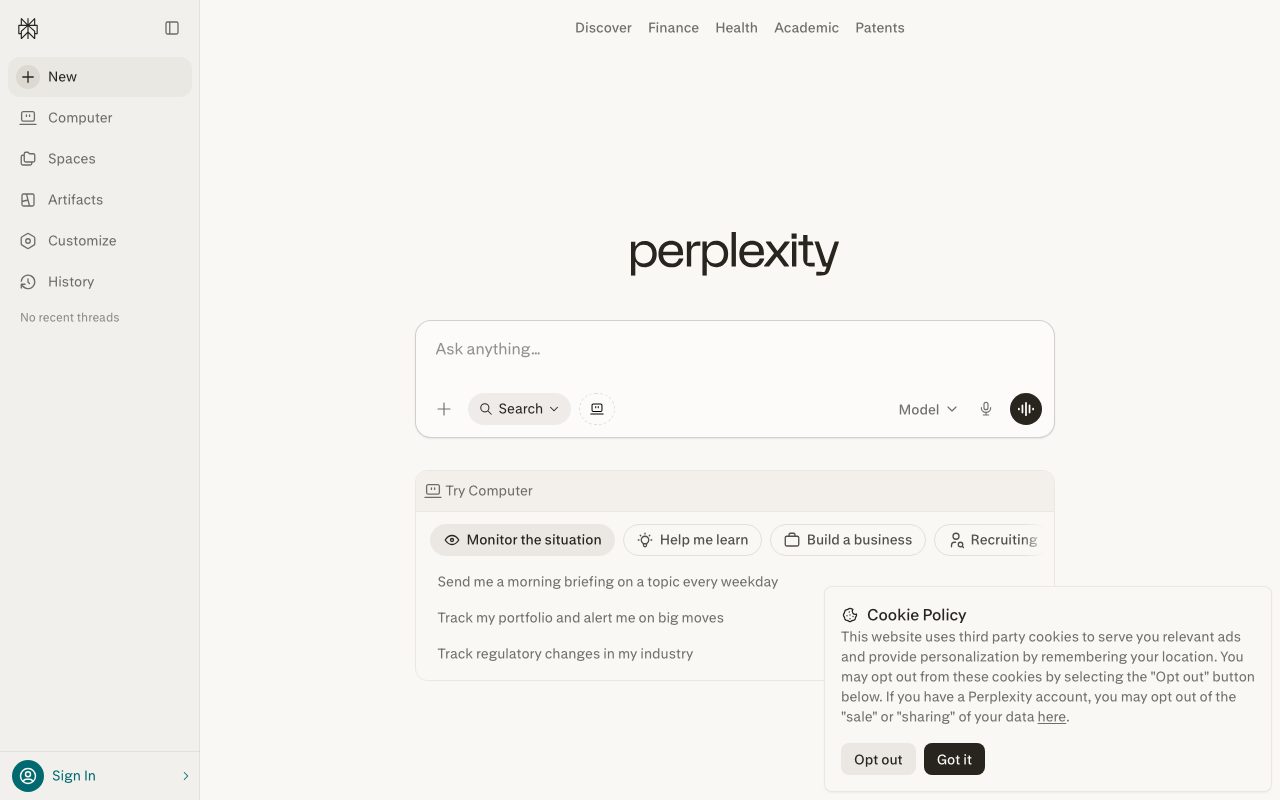
About Perplexity
Perplexity is the answer engine that replaced Google for a lot of curious people. You ask a question, it searches the web, reads what it finds, and writes a sourced answer. The sources are linked inline. The interface stays out of your way. It feels like Wikipedia and ChatGPT had a child that grew up well-adjusted.
The company launched in 2022 and grew fast on the back of a clean product and an aggressive content team. Founder Aravind Srinivas talks about Perplexity as a Google alternative, and for actual question answering (versus shopping or local), it often is.
If you've found yourself ChatGPT-ing factual questions and then double-checking the answers anyway, Perplexity is the merger of those two steps. The search-then-answer pattern works well enough that "perplexity it" is becoming a verb.
What Perplexity actually does
You type a question. Perplexity runs a web search, picks the most relevant sources, and synthesizes an answer with inline citations. You can follow up with related questions, dive into a source, or switch to "Pro Search" for deeper, multi-step research.
The model behind the answer is configurable on Pro. Default uses Perplexity's in-house Sonar model. You can switch to GPT-4, Claude 3.5, or Gemini Pro. The prompt template steers all of them toward web-grounded answers, so they all behave similarly when sourced.
The "answer with sources" pattern
This is the differentiator. Every claim is footnoted. You can click through to verify. For factual questions, this is way better than ChatGPT's "trust me bro" approach. For creative work, it doesn't matter as much.
The citations aren't perfect. Sometimes Perplexity misattributes or oversummarizes. But it's the most accountable answer interface in widespread use.
Pro Search and Spaces
Pro Search runs multi-step research, breaking your question into sub-queries and synthesizing across them. It's slower but better for non-trivial research. Spaces let you create dedicated research environments with custom instructions and shared sources.
Who Perplexity is for
Researchers, students, journalists, analysts, and anyone who asks factual questions for a living. Founders use it for market research. Devs use it for "how do I X in Postgres" questions. Writers use it for fact-checking.
It's not for shopping (Google still wins), local searches (Google still wins), or pure creative work (ChatGPT or Claude wins). For sourced factual answers, Perplexity is best in class.
Perplexity pricing
Free tier covers basic search with limited Pro Searches per day. Pro at $20 a month gets unlimited Pro Searches, model selection, file uploads, and image generation. Enterprise Pro at $40 per user per month adds team management.
The Pro tier is competitive with ChatGPT Plus. If you'd otherwise pay for both, Perplexity Pro often replaces ChatGPT Plus for many use cases.
Features worth knowing
Pro Search (deep research)
Multi-step research that takes 30 seconds to a minute. Better for complex questions where one search isn't enough. The output reads like a research brief with sources.
Spaces
Persistent contexts for ongoing research. Upload PDFs, set instructions, build a Space for a project. Threads stay scoped to the Space's sources and instructions.
API access
Perplexity offers an API for the Sonar models. Useful if you want web-grounded answers in your own product. Pricing is per-token and reasonable.
Model switching
On Pro, you can pick GPT-4o, Claude 3.5 Sonnet, Sonar, or Gemini for any query. Different models handle different prompts better. The flexibility is genuinely useful.
The tradeoffs
Perplexity occasionally hallucinates citations or summarizes inaccurately. It's much better than vanilla LLMs but not infallible. For high-stakes work, you still verify.
The product also depends on the open web staying open. As more sites block AI crawlers, the source coverage could erode. So far Perplexity has navigated this carefully but it's a structural risk.
Perplexity vs alternatives
The honest comparisons are Perplexity vs ChatGPT, Perplexity vs Google, and Perplexity vs You.com. ChatGPT is more conversational and less sourced. Google is faster but unstructured. You.com is similar but smaller.
For sourced answers, Perplexity is the clear pick. See Perplexity alternatives or browse the best AI search engines.
Bottom line on Perplexity
Perplexity is the answer engine that's actually replacing Google for many factual queries. It's not perfect. It is, by a margin, the best at what it does.
If you research for a living or just hate sifting through SEO blogspam to find a fact, Perplexity Pro is $20 well spent. The free tier alone is enough to convince most users to upgrade within a month.
Common Perplexity questions
Is Perplexity replacing Google for me? Maybe partially. For factual research questions, yes, Perplexity is faster and more sourced. For shopping, navigation, and local results, Google is still better. Most heavy users keep both open and pick per task.
How accurate are Perplexity's answers? Better than ChatGPT's, worse than a careful human researcher. The citations help you verify. The model can still misread sources or oversummarize. Trust but verify, especially for high-stakes answers.
Is Pro Search worth it? For non-trivial questions, yes. The multi-step research saves real time. For "when did the Eiffel Tower open" type questions, basic search is enough. Use Pro Search when you'd otherwise open ten tabs.
What about hallucinations?
Reduced compared to vanilla LLMs but not zero. Perplexity occasionally cites a source that doesn't actually contain the claim. Click through to verify if the answer matters. The citation links make this fast.
Does Perplexity work for code?
For "how do I do X in Y framework" questions, often yes. The sourced answers usually pull from actual docs or Stack Overflow. For writing new code from scratch, ChatGPT or Claude in their own apps tend to be better. Perplexity is research, not authorship.
Workflow tips for Perplexity
Use Spaces for ongoing research. Set instructions ("answer in technical detail" or "always include code examples"), upload reference PDFs, and keep threads scoped. Spaces are durable contexts.
Switch models for different questions. GPT-4 for nuance, Claude for long answers, Sonar for speed. The model picker on Pro is genuinely useful, not gimmicky.
Follow up. Perplexity's strength is iterative research. The first answer is rarely the last. Ask for sources, ask for counterpoints, ask for sub-questions.
For research projects, capture findings outside Perplexity. The chat history is searchable but not great for synthesis. Pull key points into Bear, Heptabase, or Notion. Browse tools for researchers for related picks.
Real-world Perplexity scenarios
A consultant uses Perplexity for client research. Industry trends, competitive intelligence, regulatory background. Pro Search handles multi-step research. Citations let them verify before quoting in deliverables. Hours saved per project.
A founder uses Perplexity for market sizing. Spaces hold context per market. Pro Search runs deep questions. The output isn't a McKinsey deck but it's a credible starting point that costs $20/month versus thousands per analyst hour.
A developer uses Perplexity for "how do I do X" questions about libraries they don't know well. The sourced answers usually link to real docs or Stack Overflow threads. Faster than navigating docs sites.
Best practices
Click through citations. Don't trust the synthesis blindly. Click two or three sources. Verify the claim. Catches the occasional misattribution.
Use Spaces for ongoing projects. Set context, upload files, reuse the chat thread. Better than starting a fresh search each time.
Switch models for hard questions. Claude tends to handle nuance better. GPT-4 handles structured tasks. Sonar is fast for simple queries.
Treat Perplexity as your research assistant, not your final author. The synthesis is good enough for orientation, not good enough for shipping. Browse the Perplexity page for community reviews.
Why Perplexity is taking share
Search has been Google's territory for so long that "search disruption" felt like a meme. Then ChatGPT showed people wanted AI-generated answers. Then Perplexity showed people wanted those answers with sources. Now the disruption is real, and Perplexity is one of the few products credibly competing.
The "answer with sources" pattern is the right balance for factual queries. ChatGPT-style chat without sources requires too much trust. Google-style ten blue links requires too much synthesis work. Perplexity threads the needle.
The product strategy matters too. Perplexity stays focused on search. They don't try to be a general-purpose chatbot or a productivity suite. They iterate on the core search experience. That focus shows in the product quality.
For knowledge workers who research as part of their job, Perplexity is increasingly the default. ChatGPT remains useful for creative work. Google remains useful for shopping and navigation. But for the questions worth asking carefully, Perplexity has earned its place.
Perplexity's open question
The big question for Perplexity is whether the open web stays open. As more publishers block AI crawlers and demand licensing fees, Perplexity's source coverage could degrade. The team has navigated carefully so far, but the structural risk is real.
The deals with publishers help. Perplexity's revenue-sharing arrangements with select publishers preserve access while paying for it. Whether that scales to the entire web is unclear. The next few years will test the model.
For users right now, Perplexity is the best AI search product available. The sourced answers, the multi-step research, the model picker. None of the competitors quite match the polish. As the category matures, expect more competition, but Perplexity's head start is meaningful. The product won't disappear quickly even if challengers appear.
Tutorial / Demo
Key Features
- Inline citations on every answer
- Spaces for focused, source-restricted threads
- File uploads on Pro for PDFs and CSVs
- Image and video search results
- Choice of underlying model on Pro
- Comet browser with built-in answer engine
Pros & Cons
What we like
- Citations make hallucinations easier to catch
- Free tier is genuinely useful for daily search
- Faster than running deep-research-style queries manually
- Clean, distraction-free interface
Room for improvement
- Quality of sources varies, sometimes pulling from low-tier blogs
- Rephrases source content closely enough to raise copyright debates
- Pro Search depth is capped per day even on paid plans
- Less useful when the web itself doesn't have the answer
Frequently Asked Questions
Does Perplexity have a free version?
Perplexity vs ChatGPT, which one for research?
Are Perplexity's sources accurate?
Does Perplexity have an API?
What's Perplexity Spaces?
Best For
Featured in
Tags
Alternatives to Perplexity
View all
ChatGPT
AI assistant for conversation and content generation

PropGPT
iOS app that uses AI to analyze player props, spreads, and bets across major sports leagues

Claude
Anthropic's AI assistant tuned for long-context reasoning and writing
Gemini
Google's multimodal assistant wired into Search, Workspace, and Android
Our take
Tool Index Editorial · May 2026· 4.6/5
What Perplexity is really selling — beyond the marketing copy — is answer engine that searches the web and shows its sources.
Worth highlighting: Citations make hallucinations easier to catch, Free tier is genuinely useful for daily search, and Faster than running deep-research-style queries manually. The friction points: Quality of sources varies, sometimes pulling from low-tier blogs and Rephrases source content closely enough to raise copyright debates.
Bottom line: pick Perplexity when you need researching a purchase or technical decision with citations; look elsewhere if quality of sources varies, sometimes pulling from low-tier blogs would be a dealbreaker.
Editorial opinion from the Tool Index team, written from the public product pages. Not a user review.
Reviews (8)
Did exactly what I needed
Found Perplexity on a Reddit thread, glad I clicked. Real selling point: faster than running deep-research-style queries manually. The comet browser with built-in answer engine is more useful than I expected. Found it works best for summarizing recent news with source links. Sticking with Perplexity.
Pros
- Citations make hallucinations easier to catch
Two months in, no regrets
Hadn't planned on switching, but Perplexity was hard to ignore. Honestly impressed by how free tier is genuinely useful for daily search. Glad I made the switch.
Best decision this quarter
Found Perplexity on a Reddit thread, glad I clicked. Genuine strength: clean, distraction-free interface. Worth calling out the comet browser with built-in answer engine too. Main use case: researching a purchase or technical decision with citations.
Pros
- Free tier is genuinely useful for daily search
Onboarded the team in a day
Adopted Perplexity for one project, ended up using it for more. Real selling point: free tier is genuinely useful for daily search. Their take on spaces for focused, source-restricted threads is solid. It fits well for building a Space around a recurring research topic. Sticking with Perplexity.
Pros
- Faster than running deep-research-style queries manually
- Clean, distraction-free interface
- Free tier is genuinely useful for daily search
Hit the Perplexity sweet spot
The pitch for Perplexity sounded too good to be true. Mostly true. What stands out is how free tier is genuinely useful for daily search. Main use case: summarizing recent news with source links. Still recommending it to people in similar setups.
Quietly excellent
The pitch for Perplexity sounded too good to be true. Mostly true. Real selling point: faster than running deep-research-style queries manually. Mostly using it for replacing Google for question-shaped queries. Would buy again without thinking twice.
Solid daily driver
Perplexity isn't perfect but it's the best I've used in this category. Genuine strength: free tier is genuinely useful for daily search. Not perfect: less useful when the web itself doesn't have the answer. Hard to imagine going back to my previous setup.
Pros
- Clean, distraction-free interface
- Citations make hallucinations easier to catch
Cons
- Quality of sources varies — sometimes pulls from low-tier blogs
Solid daily driver
Picked Perplexity for the lower price, stayed for the actual quality. Genuine strength: clean, distraction-free interface. Main use case: researching a purchase or technical decision with citations. That said, less useful when the web itself doesn't have the answer is a real gripe. Still recommending it to people in similar setups.
Cons
- Less useful when the web itself doesn't have the answer
- Quality of sources varies — sometimes pulls from low-tier blogs
Badge builder
Add Perplexity to your website
Choose a badge style and size, preview it here, then copy the generated HTML. Badge images are self-contained SVGs and do not require an external script.

<a href="https://toolindex.net/tools/perplexity?ref=badge" target="_blank" rel="noopener">
  <img src="https://toolindex.net/badge/perplexity/medium.svg" alt="Perplexity - Listed on Tool Index" width="180" height="50" />
</a>How to use the badge
- 1. Pick the style, size, and theme that fit your layout.
- 2. Copy the generated HTML from the code block.
- 3. Paste it into your footer, homepage, or press page.
Standard badge available
The standard listing badge is available now. Score and circle badges are limited to tools currently ranked in the top 10 of a category.
Badge clicks return visitors to this profile with a referral tag so the source remains identifiable.
Related Tools
Apatero AI
The creator studio for AI image, video, audio, 3D, and avatars, now at apatero.ai.
Kevin Gabeci Toolkits
Seven AI toolkits for writing books, making music, cutting video, and building agents.

Warp
The modern terminal reimagined with AI and collaboration

Bolt.new
Prompt-to-deployed full-stack app inside the browser
Work on Perplexity? Request listing access or correction