
Dify
Open-source platform for building LLM apps and AI agents with visual workflows, RAG, and 100+ model providers
Gallery
About Dify
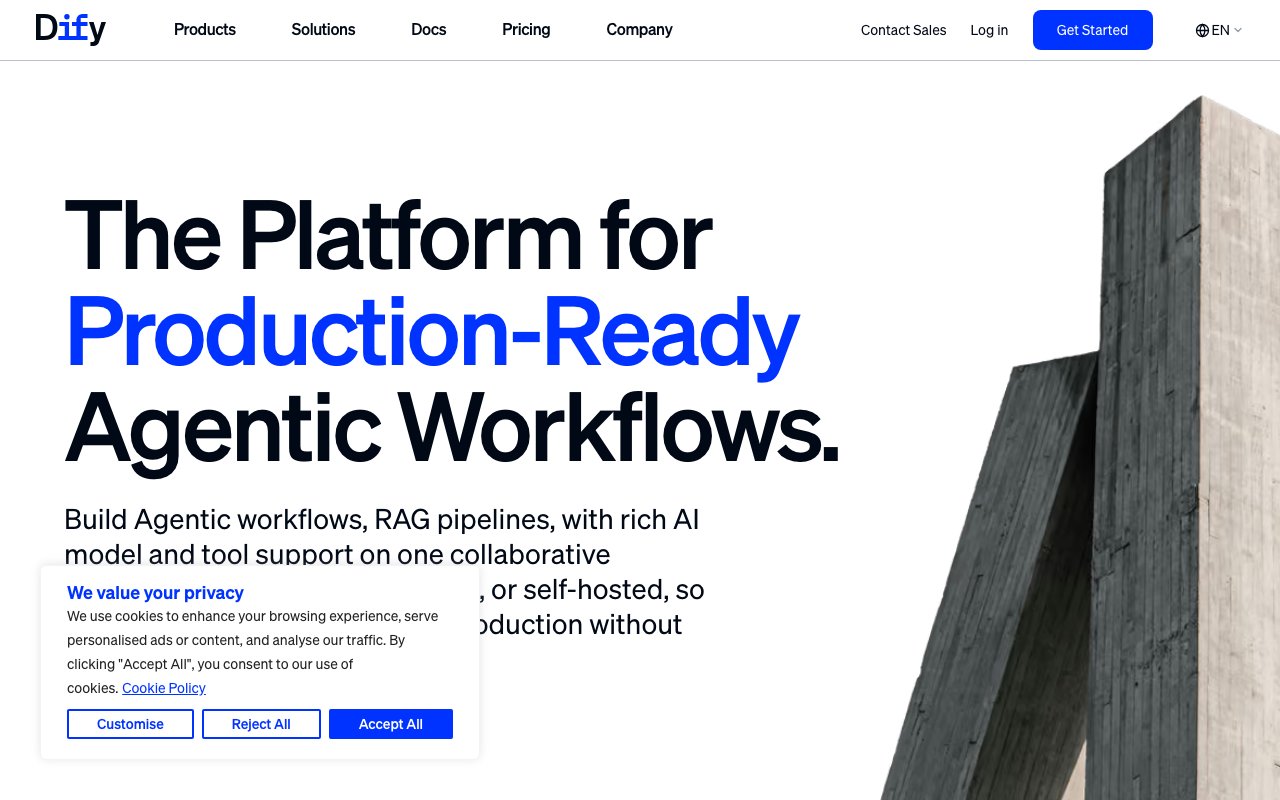
Dify is an open-source platform for building, deploying, and managing AI applications. It provides a unified workspace where teams can create agentic workflows, retrieval-augmented generation pipelines, and AI agents without rebuilding their infrastructure from scratch. The project has accumulated over 151,000 stars on GitHub and serves organizations across manufacturing, financial services, healthcare, logistics, and education. The platform positions itself as democratizing agent development, which means both technical developers and non-technical builders can participate in creating AI applications without needing to write code for every piece of the system.
The problem Dify goes after is the fragmentation of modern AI tooling. If you want to build a production-grade AI application today, you typically need separate tools for prompt management, vector storage, agent orchestration, model routing, and deployment. Each tool has its own interface, its own authentication, and its own way of doing things. Keeping them in sync becomes a project in itself. Dify consolidates all of that into a single interface. You define how your application thinks, retrieves data, makes decisions, and uses external tools, then publish it as a web app, an API, an embed, or an MCP-compatible tool, all from the same project. There's no need to piece together half a dozen services and figure out how to make them talk to each other. The value is in having one place that does all of it.
The core of the platform is Workflow Studio, a visual builder where you connect blocks and prompts to define application logic. You lay out the flow of how an application should handle a request, from receiving input through reasoning steps to producing output. The visual approach means you can see the entire flow at once, which helps with debugging and with explaining the system to stakeholders who don't read code. Alongside that sits an agent framework for building agents with reasoning capabilities, tool access, context retention, and operational boundaries. You can give agents access to specific tools and define what they can and cannot do, which matters when you need predictable behavior in production. There's a knowledge pipeline for processing files, websites, and documents through extraction, cleaning, chunking, and indexing. That pipeline turns raw content into a knowledge base your application can retrieve from. A plugin marketplace provides integrations with model providers, tools, and data sources that you can reuse across projects. Once you've built something, the publishing and monitoring layer lets you deploy it in multiple formats and track analytics to see how it's being used.
The target audience splits between technical developers who want a faster path from prototype to production and non-technical builders who need the visual interface to participate in AI development at all. The platform explicitly positions itself as accessible to people who don't write code, though developers can drop into code when they need to. Teams that span multiple skill levels can collaborate in the same workspace, with each person contributing at their level of comfort. Product managers can adjust prompts while engineers handle the integrations.
What distinguishes Dify from piecing together separate LLM tools is the unified model and tool integration. You can swap between model providers, connect to different data sources, and publish the same logic in different formats without rewriting anything. If you want to try a different model, you change a dropdown instead of rewriting your integration layer. The collaborative workspace means multiple team members can work on the same project, which matters for organizations where AI development isn't a solo effort. Version control and commenting features let teams iterate together without stepping on each other's work. The system keeps a history of changes so you can roll back if something breaks.
Dify offers three deployment options to fit different organizational needs. The cloud version starts with a free sandbox tier that lets you experiment without paying anything, then moves to Professional at 59 dollars per month and Team at 159 dollars per month for higher usage limits and collaboration features. For organizations that need to self-host, there's an enterprise edition with SSO, SAML, role-based access control, and SOC 2 Type II compliance. That option lets you run everything on your own infrastructure with the governance features enterprise security teams require. The community edition is fully open source and can be deployed with Docker, which makes it accessible to teams that want to run everything on their own infrastructure without licensing fees. You can start with the community edition, build your application, and move to a paid tier only when you need the additional features or support. The path from free to paid is smooth enough that teams can start small and scale up as their needs grow.
Key Features
- Visual drag-and-drop workflow builder with branching, iteration, and parallel steps
- Built-in RAG pipeline covering ingestion, chunking, embedding, retrieval, and reranking
- Agents using LLM Function Calling or ReAct with 50+ built-in tools
- Integrates hundreds of models across 100+ proprietary and open-source providers
- Self-hostable via Docker Compose alongside a managed cloud option
- Observability, prompt testing, and logging baked into the app stack
Pros & Cons
What we like
- Genuinely open source under a license based on Apache 2.0, so you can self-host for free
- One canvas covers workflows, RAG, and agents instead of stitching several tools together
- Broad model support means you are not locked to a single LLM vendor
- Large active community with 140k-plus GitHub stars and frequent releases
Room for improvement
- Self-hosting needs Docker plus your own model API keys and ongoing maintenance
- Embedding Dify inside a SaaS you sell requires a separate commercial license
- Cloud message credits are capped per tier and can run out on heavy workloads
- Complex multi-branch workflows still take real effort to design and debug
Frequently Asked Questions
What is Dify?
Is Dify open source and free?
Who is Dify best for?
Can Dify run with local or open models?
Best For
Featured in
Alternatives to Dify
Flowise
Open-source low-code platform to build LLM apps and AI agents visually with drag-and-drop chatflows and agentflows

LangChain
Open-source framework plus LangGraph and LangSmith for building, orchestrating, and observing LLM agents

Stack AI
No-code platform for building and deploying enterprise AI agents and workflows on a visual canvas
Gumloop
No-code canvas for building AI agents and automated workflows by connecting drag-and-drop nodes
Reviews (11)
Recommended without reservation
Dify solves a real problem for me without making a fuss about it. The output quality holds up better than I expected.
Worth the price of admission
Dify has quietly become part of my daily flow. Their take on broad model support means you are not locked to a single llm vendor is genuinely good. Nothing flashy, it simply pulls its weight every day. Mostly using it for prototyping and deploying agentic workflows that call tools and apis. Would sign up again without thinking twice.
Recommended without reservation
Almost a year on Dify now, no plans to leave. Where it really wins is integrates hundreds of models across 100+ proprietary and open-source providers. Would sign up again without thinking twice.
Best decision this quarter
Hadn't planned on switching, but Dify was hard to ignore. Real selling point for me was self-hostable via docker compose alongside a managed cloud option. It handles the boring parts so I can focus on the work that matters. Mostly using it for building rag search over pdfs, slides, and knowledge bases. Would sign up again without thinking twice.
Powerful once it clicks
Tried Dify on a side project first, then rolled it out everywhere. Where it really wins is agents using llm function calling or react with 50+ built-in tools. It has shaved real time off my week. My only gripe is cloud message credits are capped per tier and can run out on heavy workloads. Worth the price for what I get out of it.
Worth the price of admission
Three months of Dify later, here is what holds up. Real selling point for me was self-hostable via docker compose alongside a managed cloud option. It is the rare tool that got better the more I used it. It has been a fit for self-hosting a private llm app stack to keep data in your own infrastructure. Hard to imagine going back to my old setup.
Genuinely impressed
Tried Dify on a side project first, then rolled it out everywhere. It just works, day after day, without surprises. It handles the boring parts so I can focus on the work that matters. Glad I made the switch.
Pulled its weight from week one
Dify solves a real problem for me without making a fuss about it. Their take on self-hostable via docker compose alongside a managed cloud option is genuinely good. Performance has been steady even when I lean on it hard.
Best decision this quarter
Onboarded the whole team to Dify in an afternoon. The interface stays out of my way, which I appreciate. It has been a fit for building rag search over pdfs, slides, and knowledge bases. Hard to imagine going back to my old setup.
It just works
Have been running Dify for a while, here is where I land. The thing I keep coming back to is how reliable it is. Mostly using it for shipping internal ai assistants and chatbots grounded in company documents. Hard to imagine going back to my old setup.
Quietly excellent
Three months of Dify later, here is what holds up. What stands out is how it handles observability, prompt testing, and logging baked into the app stack. It earns its place in my stack.
Badge builder
Add Dify to your website
Choose a badge style and size, preview it here, then copy the generated HTML. Badge images are self-contained SVGs and do not require an external script.

<a href="https://toolindex.net/tools/dify?ref=badge" target="_blank" rel="noopener">
  <img src="https://toolindex.net/badge/dify/medium.svg" alt="Dify - Listed on Tool Index" width="180" height="50" />
</a>How to use the badge
- 1. Pick the style, size, and theme that fit your layout.
- 2. Copy the generated HTML from the code block.
- 3. Paste it into your footer, homepage, or press page.
Standard badge available
The standard listing badge is available now. Score and circle badges are limited to tools currently ranked in the top 10 of a category.
Badge clicks return visitors to this profile with a referral tag so the source remains identifiable.
Related Tools

OpenBenchmarks
Public, externally validated benchmarks that help agents pick SaaS APIs

Almanac
A hosted, source-cited wiki that turns your files into context your AI agents can use

Wizard
Self-extending Rust terminal AI agent that works with any model

Chariot
Elastic cloud infrastructure for deploying and scaling AI agent fleets with persistent storage
Work on Dify? Request listing access or correction