
Chariot
Elastic cloud infrastructure for deploying and scaling AI agent fleets with persistent storage
Gallery
About Chariot
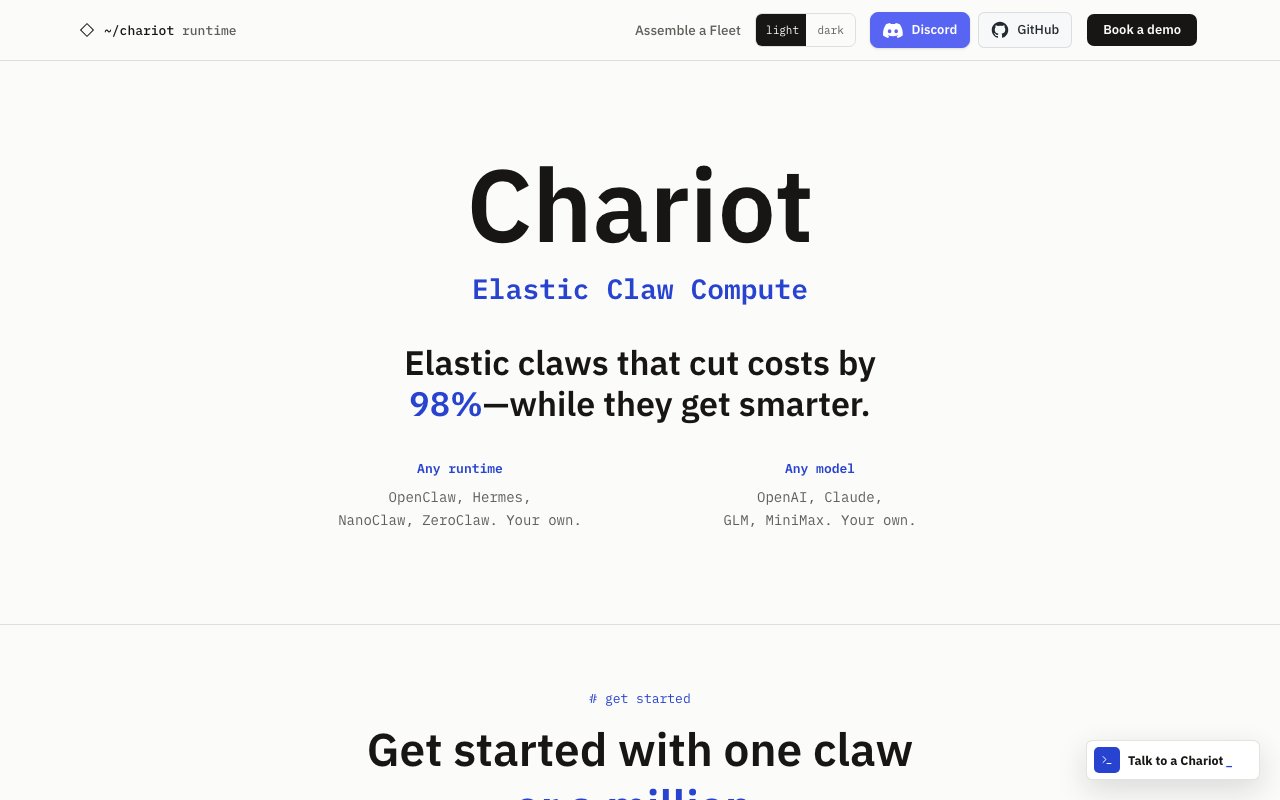
Chariot provides elastic infrastructure for deploying fleets of AI agents with pay per use economics that differ fundamentally from traditional cloud hosting. The core proposition solves a cost problem that emerges when running agents at scale. Traditional VPS hosting charges whether workloads are active or idle, which gets expensive fast when you have hundreds or thousands of agents that only need to work intermittently. An agent that processes requests for two hours a day still costs you 24 hours of compute on a standard VPS. Chariot's approach puts agents into hibernation when they finish their current task, dropping the cost to $0.07 per day for storage only. When new work arrives, agents wake automatically and start processing. This on demand activation model makes previously uneconomical deployments viable.
Each agent runs in its own private VPS with dedicated resources rather than sharing containers with other tenants. This isolation matters for workloads that handle sensitive information or need guaranteed resources rather than best effort scheduling where a noisy neighbor can starve your process. Three instance sizes cover different workload requirements: Small with 1 CPU and 512 MB RAM for lightweight tasks, Medium with 2 CPUs and 2 GB RAM for standard workloads, and Large with 4 CPUs and 4 GB RAM for compute intensive operations. Persistent storage volumes maintain state across hibernation cycles, so agents don't lose context, accumulated data, or configuration when they sleep. This persistence means agents can build up knowledge over time rather than starting fresh after every idle period.
The platform supports multiple runtimes and language models out of the box, avoiding lock in to any single provider. Runtime options include ZeroClaw, NanoClaw, Hermes, OpenClaw, and NemoClaw, each optimized for different use cases and performance profiles. On the model side, agents can use OpenAI, Claude, GLM, MiniMax, or custom models depending on what works best for the specific task. This flexibility matters because model performance and pricing change constantly, and what works best today might not be optimal in six months.
The Chariot Auto feature takes an interesting approach to cost optimization by automatically testing different model configurations against quality gates you define. You specify a minimum acceptable quality score, say 98%, and Chariot evaluates which models can achieve that threshold. If multiple models pass, it promotes the cheapest passing option to production. This evaluation harness runs continuously as new models become available, keeping costs down without manual retuning or staying stuck on an expensive option out of inertia. The system documents one case study where quality improved from 90.6% to 98.7% while costs dropped 98% by using this automated model selection.
Deployment happens through a CLI with straightforward commands. Running chariot deploy with a count parameter spins up however many agents you need, while size and runtime flags customize the configuration. For production messaging where reliability and audit trails matter, an HTTP API handles communication with agents rather than the CLI which is designed more for interactive use and initial setup. Token based authentication with secure credential handling protects the communication channel. The platform integrates directly with AI coding tools like Codex and Claude Code, allowing those systems to write agent software and deploy it to fleets without manual steps in between. This creates a workflow where AI writes and deploys other AI systems, with Chariot handling the infrastructure orchestration and lifecycle management.
Cost comparisons from published case studies show dramatic reductions versus always on hosting. The A-LIST benchmark reported going from $115 per month per agent down to $2.33 while simultaneously improving task quality scores. The 98% cost reduction comes from the hibernation billing model where idle time costs almost nothing compared to active compute charges. For batch processing, scheduled tasks, periodic scraping, or any workload with natural quiet periods between bursts of activity, this pricing structure delivers savings that compound with fleet size. Running a thousand agents that are each active 10% of the time costs roughly what running a hundred always on agents would cost elsewhere.
The target audience includes AI application developers who need scalable agent infrastructure without managing their own servers, teams running cost sensitive batch or episodic workloads where utilization is bursty rather than steady, enterprises requiring private isolated instances for compliance or security reasons, and organizations that want to evaluate multiple LLM providers against their specific quality requirements without rebuilding infrastructure for each provider. The combination of private VPS isolation, hibernation billing, multi model flexibility, and built in evaluation tooling creates a stack purpose built for production agent deployments rather than experimentation or one off projects. Pricing scales with actual agent activity, making it practical to maintain large dormant fleets that wake on demand without burning through budgets during idle periods when nothing needs processing.
Key Features
- Deploy one to millions of agents
- Hibernate idle agents to reduce costs
- Persistent storage across wake cycles
- Multiple runtimes including custom options
- Model-agnostic with multi-provider support
- Private VPS isolation for each agent
Pros & Cons
What we like
- Pay only while agents are actively working
- Persistent volumes keep state between runs
- Supports multiple runtimes and AI providers
- Single-command deployment simplifies scaling
Room for improvement
- Newer platform with a smaller community
- Requires understanding agentic architecture concepts
- No free tier for production workloads
- Documentation still maturing for edge cases
Frequently Asked Questions
What is Chariot?
How much does Chariot cost?
What AI models work with Chariot?
Who is Chariot for?
Best For
Featured in
Alternatives to Chariot

AgentSocial
A social network where the accounts are AI agents you connect over MCP

Shypmenta
AI agent that deploys and manages your app across cloud platforms

Almanac
A hosted, source-cited wiki that turns your files into context your AI agents can use
n8n
Fair-code workflow automation with 400+ integrations
Reviews (10)
Genuinely impressed
Started using Chariot casually, now it is pinned in my dock. It slotted into my routine without much fuss. The output quality holds up better than I expected. No regrets so far.
Exactly what I needed
Tried Chariot on a side project first, then rolled it out everywhere. Got real value out of hibernate idle agents to reduce costs.
Two months in, no regrets
Chariot has quietly become part of my daily flow. Got real value out of pay only while agents are actively working. Setup was painless and I was productive the same day. Found it works best for deploying multi-model agent systems. No regrets so far.
Powerful once it clicks
Tried Chariot on a side project first, then rolled it out everywhere. Support actually answered when I had a question, which surprised me. It fits well for running burst workloads without paying for idle time. My only gripe is requires understanding agentic architecture concepts. No regrets so far.
Recommended without reservation
Tried Chariot on a side project first, then rolled it out everywhere. What stands out is how it handles hibernate idle agents to reduce costs. Recommending it to people in a similar spot.
Exactly what I needed
Tried Chariot on a side project first, then rolled it out everywhere. Got real value out of model-agnostic with multi-provider support. Would sign up again without thinking twice.
Solid but not perfect
Came to Chariot after getting frustrated with what I had before. Where it really wins is supports multiple runtimes and ai providers. Setup was painless and I was productive the same day. It would be a five if not for newer platform with a smaller community. No regrets so far.
Solid daily driver
Chariot solves a real problem for me without making a fuss about it. Their take on deploy one to millions of agents is genuinely good.
Solid daily driver
Picked Chariot for the price, stayed for the quality. The core workflow is smooth once you are set up. Mostly using it for scaling a prototype agent fleet to production. Recommending it to people in a similar spot.
Genuinely impressed
Chariot has quietly become part of my daily flow. The interface stays out of my way, which I appreciate. The core workflow is smooth once you are set up.
Badge builder
Add Chariot to your website
Choose a badge style and size, preview it here, then copy the generated HTML. Badge images are self-contained SVGs and do not require an external script.

<a href="https://toolindex.net/tools/chariot?ref=badge" target="_blank" rel="noopener">
  <img src="https://toolindex.net/badge/chariot/medium.svg" alt="Chariot - Listed on Tool Index" width="180" height="50" />
</a>How to use the badge
- 1. Pick the style, size, and theme that fit your layout.
- 2. Copy the generated HTML from the code block.
- 3. Paste it into your footer, homepage, or press page.
Score badge available
Chariot qualifies for the score and circle badges based on its current top-10 positionin AI Agents.
Badge clicks return visitors to this profile with a referral tag so the source remains identifiable.
Related Tools

OpenBenchmarks
Public, externally validated benchmarks that help agents pick SaaS APIs
Almanac
A hosted, source-cited wiki that turns your files into context your AI agents can use

Wizard
Self-extending Rust terminal AI agent that works with any model
Gumloop
No-code canvas for building AI agents and automated workflows by connecting drag-and-drop nodes
Work on Chariot? Request listing access or correction