
LangChain
Open-source framework plus LangGraph and LangSmith for building, orchestrating, and observing LLM agents
Gallery
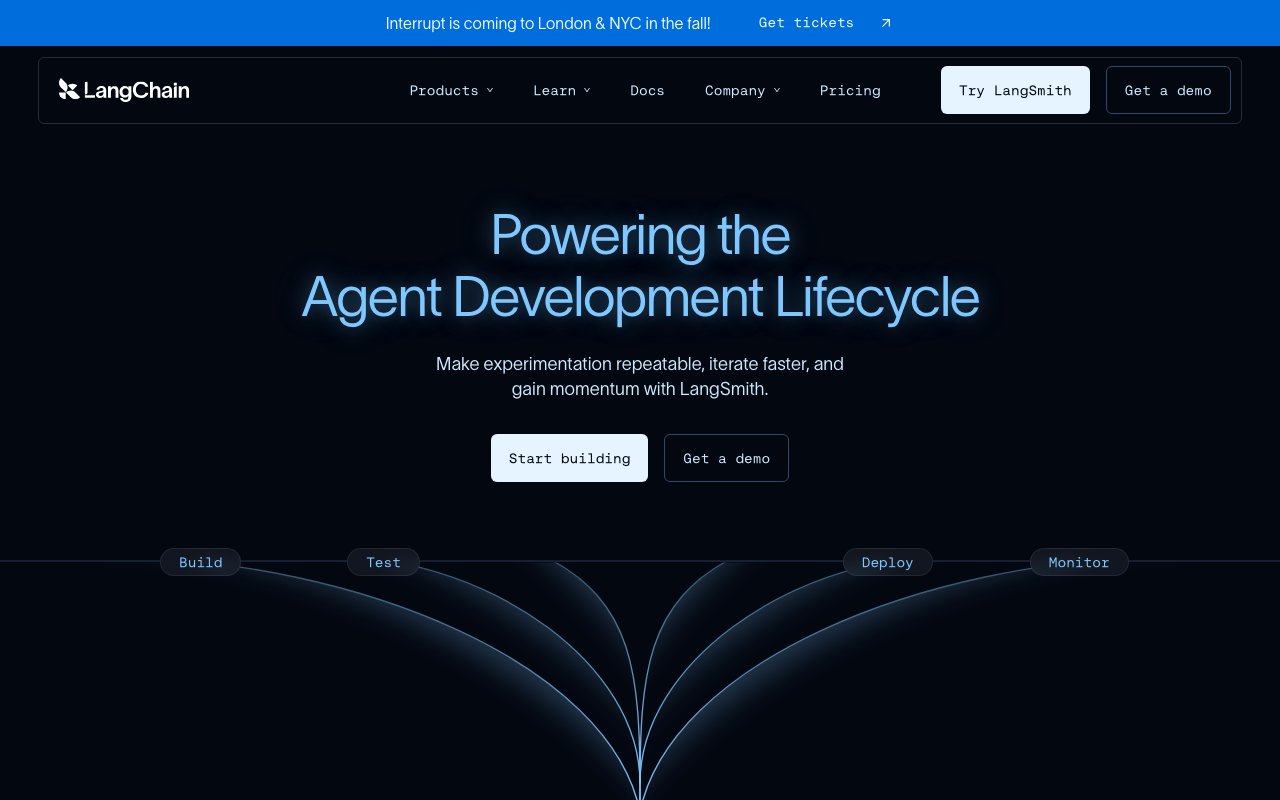
About LangChain
LangChain is an open source framework for building applications powered by large language models. It started as a Python library for chaining LLM calls together with tools, retrieval systems, and memory, and has since expanded into a full platform for developing, testing, deploying, and monitoring AI agents in production. The project sees over 100 million downloads monthly and has become something close to a de facto standard for teams building LLM applications that go beyond simple chat interfaces into more complex agent architectures.
The open source side consists of three frameworks at different levels of abstraction serving different use cases. The main langchain package provides high level templates and components for fast prototyping. It includes pre built chains for common patterns like retrieval augmented generation, document question answering, and conversational agents. LangGraph sits at a lower level, offering explicit control for production agents that need reliable state management. It handles message threading for multi turn conversations, durable checkpointing so agents can recover from failures, and type safe streaming for real time output. DeepAgents is the newest addition, designed for autonomous agents that run over extended periods handling complex multi step tasks with less human supervision than typical chatbot interactions.
LangSmith is the commercial managed platform built on top of these open source frameworks. It addresses the operational challenges that surface when you move agents from prototype to production. The observability module provides structured tracing that shows exactly what happens at each step of an agent's execution. You can see which tools were called, what prompts were sent to which models, what responses came back, and where failures occurred in the chain. This visibility is essential for debugging agents that make multiple LLM calls and tool invocations before producing a final output, since errors can originate anywhere in the sequence.
Evaluation tools let you score agent performance systematically rather than relying on manual spot checking. You can set up LLM based judges that grade outputs against criteria you define, collect human feedback through annotation interfaces, and run automated test suites against datasets of expected inputs and outputs. Both online evaluation of live traffic and offline evaluation of test sets are supported. This matters because agent quality tends to degrade in ways that are hard to detect without systematic measurement, especially as prompts and models get updated over time.
The Engine feature is designed for teams running agents at scale where manual log review isn't practical. It automatically identifies production failures, clusters similar issues together based on root cause, diagnoses what went wrong, and proposes fixes. Instead of an engineer scrolling through thousands of trace logs looking for patterns, Engine surfaces the problems proactively and groups them into actionable categories. Fleet extends the platform to business users who aren't developers. It lets non technical team members create simple automation agents by describing what they want in plain language rather than writing code.
Integration breadth is a core strength and a main reason for LangChain's adoption. The framework works with every major LLM provider including OpenAI, Anthropic, Google, Mistral, Cohere, and open source models through Ollama, Hugging Face, or direct integration. Retrieval augmented generation connects to vector databases like Pinecone, Weaviate, Chroma, Milvus, and Postgres with pgvector. Tool integrations cover web search, code execution in sandboxed environments, file operations, database queries, and custom APIs. SDKs are available for Python, TypeScript, Go, and Java. OpenTelemetry support means tracing can export to existing observability stacks.
Pricing for LangSmith starts with a free Developer tier that includes 5000 traced runs per month and one seat. This is enough to build and test a prototype but not enough for production traffic. The Plus tier at $39 per seat per month increases the trace allowance to 10000 per month, adds deployment capabilities with one free serverless deployment included, enables Engine and Fleet access, and provides email plus Slack support. Beyond the base trace allowances, usage is metered through two unit types. LangChain Compute Units at $1.50 per unit cover processing for Engine analysis, Fleet agents, deployments, and sandboxed code execution. LangChain Storage Units at $1.00 per unit cover data retention for traces and datasets. Enterprise pricing is custom and includes self hosted or hybrid deployment options, SSO integration, advanced access controls with role based and attribute based permissions, and dedicated support with SLAs.
The typical LangChain user is a developer or engineering team building something more complex than a single prompt chatbot. Common applications include research assistants that search multiple sources and synthesize answers with citations, customer support agents that access internal documentation and can take actions in backend systems, compliance tools that review documents against regulatory requirements, and code generation systems that plan, implement, and verify solutions. Five Fortune 10 companies use LangSmith according to LangChain, alongside over 6000 smaller active customers. A startup program offers discounted rates and up to $10,000 in credits for VC backed companies.
Key Features
- Open-source LangChain core libraries in Python and TypeScript
- LangGraph orchestration for stateful, durable, long-running agents
- LangSmith tracing and observability into every agent step
- Built-in and custom evaluations to score and improve agents
- Hundreds of integrations for models, vector stores, and tools
- Managed deployment plus human-in-the-loop and Fleet agent runs
Pros & Cons
What we like
- Open-source core is free and framework-agnostic via LangSmith SDKs
- Largest integration ecosystem across models and data sources
- LangGraph gives real control over complex multi-step agents
- LangSmith makes agent debugging and evaluation far less painful
Room for improvement
- Steep learning curve, especially moving into LangGraph
- Frequent abstraction churn breaks code across versions
- Heavy abstractions can feel like overkill for simple LLM calls
- LangSmith trace and seat costs add up at production scale
Frequently Asked Questions
What is LangChain?
Is LangChain free and open source?
Who is LangChain best for?
What is the difference between LangChain, LangGraph, and LangSmith?
Best For
Featured in
Alternatives to LangChain
CrewAI
Open-source Python framework for orchestrating role-playing multi-agent AI teams, with an enterprise platform

Dify
Open-source platform for building LLM apps and AI agents with visual workflows, RAG, and 100+ model providers
Flowise
Open-source low-code platform to build LLM apps and AI agents visually with drag-and-drop chatflows and agentflows

Relevance AI
No-code platform for building AI agents and multi-agent teams that run sales, support, and ops tasks
Reviews (12)
Best decision this quarter
LangChain has quietly become part of my daily flow. Real selling point for me was langgraph gives real control over complex multi-step agents. Easy yes for anyone weighing the same trade offs.
Solid daily driver
Picked LangChain for the price, stayed for the quality. It is the rare tool that got better the more I used it. It fits well for retrieval-augmented generation pipelines over private data. Recommending it to people in a similar spot.
Powerful once it clicks
Started using LangChain casually, now it is pinned in my dock. It handles the boring parts so I can focus on the work that matters. One thing that bugs me is steep learning curve, especially moving into langgraph.
Bought it for one feature, stayed for ten
Picked LangChain for the price, stayed for the quality. Got real value out of managed deployment plus human-in-the-loop and fleet agent runs. The core workflow is smooth once you are set up. Mostly using it for building production ai agents with durable state and human review. Glad I made the switch.
The kind of tool you forget you are paying for
Hadn't planned on switching, but LangChain was hard to ignore. The thing I keep coming back to is how reliable it is. The interface stays out of my way, which I appreciate. Easy yes for anyone weighing the same trade offs.
Solid daily driver
Have been running LangChain for a while, here is where I land. What stands out is how it handles open-source langchain core libraries in python and typescript. Performance has been steady even when I lean on it hard. Found it works best for building production ai agents with durable state and human review. Recommending it to people in a similar spot.
The kind of tool you forget you are paying for
Hadn't planned on switching, but LangChain was hard to ignore. Where it really wins is langsmith makes agent debugging and evaluation far less painful. The thing I keep coming back to is how reliable it is. Easy yes for anyone weighing the same trade offs.
Quietly excellent
Tried LangChain on a side project first, then rolled it out everywhere. What stands out is how it handles open-source core is free and framework-agnostic via langsmith sdks. Glad I made the switch.
Decent with some rough edges
Found LangChain on a Reddit thread and I am glad I clicked. It handles the boring parts so I can focus on the work that matters. Support actually answered when I had a question, which surprised me. Found it works best for building production ai agents with durable state and human review. My only gripe is langsmith trace and seat costs add up at production scale. It earns its place in my stack.
Good, with a few caveats
Found LangChain on a Reddit thread and I am glad I clicked. Real selling point for me was managed deployment plus human-in-the-loop and fleet agent runs. What stands out is how little babysitting it needs. It would be a five if not for steep learning curve, especially moving into langgraph.
Exactly what I needed
Hadn't planned on switching, but LangChain was hard to ignore. The langsmith tracing and observability into every agent step is more useful than I expected.
The kind of tool you forget you are paying for
LangChain solves a real problem for me without making a fuss about it. Real selling point for me was managed deployment plus human-in-the-loop and fleet agent runs. Found it works best for retrieval-augmented generation pipelines over private data. Hard to imagine going back to my old setup.
Badge builder
Add LangChain to your website
Choose a badge style and size, preview it here, then copy the generated HTML. Badge images are self-contained SVGs and do not require an external script.

<a href="https://toolindex.net/tools/langchain?ref=badge" target="_blank" rel="noopener">
  <img src="https://toolindex.net/badge/langchain/medium.svg" alt="LangChain - Listed on Tool Index" width="180" height="50" />
</a>How to use the badge
- 1. Pick the style, size, and theme that fit your layout.
- 2. Copy the generated HTML from the code block.
- 3. Paste it into your footer, homepage, or press page.
Standard badge available
The standard listing badge is available now. Score and circle badges are limited to tools currently ranked in the top 10 of a category.
Badge clicks return visitors to this profile with a referral tag so the source remains identifiable.
Related Tools

OpenBenchmarks
Public, externally validated benchmarks that help agents pick SaaS APIs
Almanac
A hosted, source-cited wiki that turns your files into context your AI agents can use

Wizard
Self-extending Rust terminal AI agent that works with any model

Chariot
Elastic cloud infrastructure for deploying and scaling AI agent fleets with persistent storage
Work on LangChain? Request listing access or correction