CrewAI
Open-source Python framework for orchestrating role-playing multi-agent AI teams, with an enterprise platform
Gallery
About CrewAI
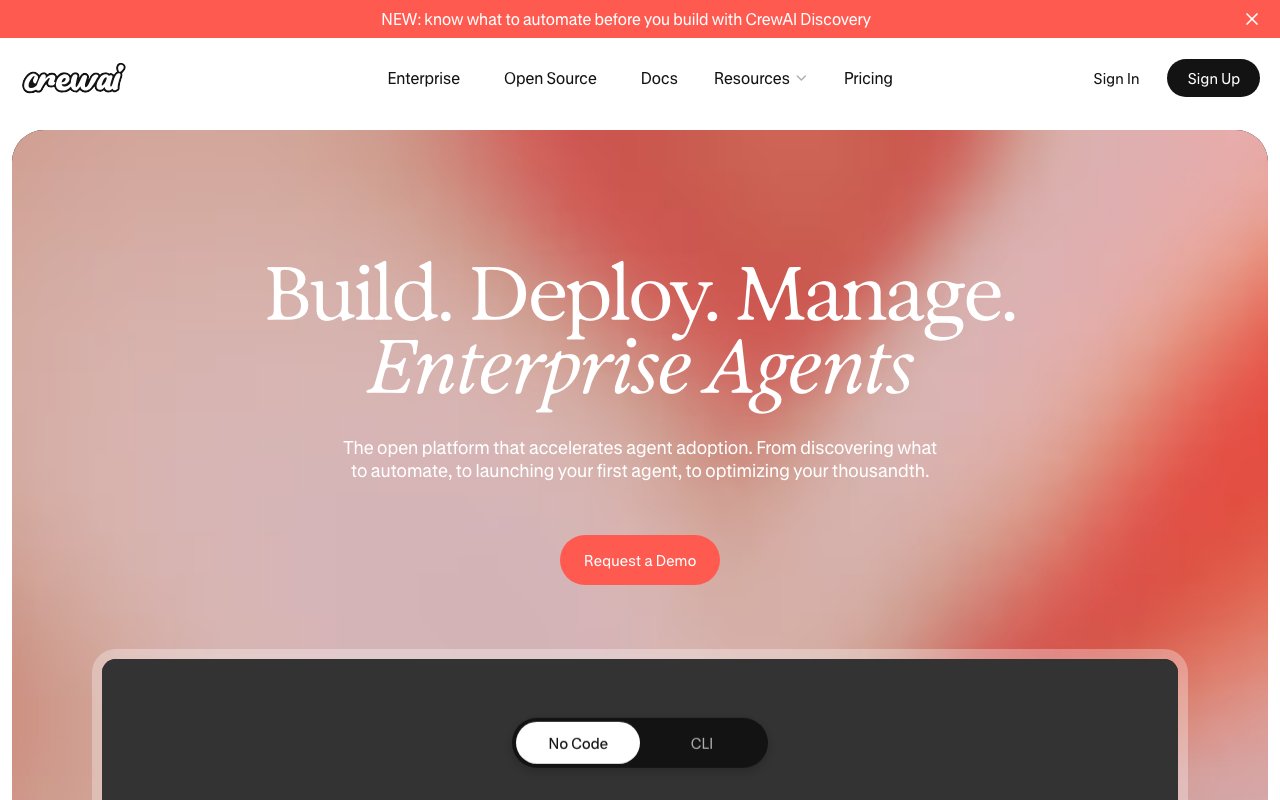
CrewAI is an enterprise platform for building and running AI agents at scale. It gives both business teams and engineers a unified environment to create agentic workflows, deploy them across an organization, and keep everything under central governance. The platform handles more than 450 million agentic workflows per month and sees about 4,000 new signups every week, with roughly 65 percent of the Fortune 500 already using it in some capacity. The core idea is that agents work better when they collaborate, so instead of building isolated bots, you build crews of agents that hand off tasks, share context, and work toward a common goal. Each agent in a crew has a defined role, and the orchestration layer manages how they interact.
The problem it addresses is the gap between prototyping an agent and actually running it in production across a large organization. Individual developers can spin up an agent with a handful of scripts, but getting that agent to operate reliably, interact with other agents, and stay within enterprise compliance rules is a different challenge entirely. Most open-source agent frameworks do well at the experimentation stage but leave you on your own for deployment, security, and organizational management. CrewAI sits in that space, providing the build tools alongside the runtime infrastructure so teams don't have to glue together separate systems for development, deployment, and monitoring. Platform teams get the governance controls they need, and builders get an environment that doesn't slow them down with bureaucratic overhead.
Under the hood, the platform lets you define agents with specific roles, goals, and backstories, then orchestrate them into crews that collaborate on tasks. You can set up sequential processes where agents hand off to each other in order, or hierarchical setups where a manager agent delegates to specialists and aggregates their outputs. The framework supports memory so agents retain context across interactions, which matters when a conversation or workflow spans multiple steps. Integration with external tools happens through a plugin system, so agents can pull data from APIs, query databases, or trigger actions in other software. Everything runs on infrastructure designed for enterprise scale, meaning you get logging, observability, and the audit trails that compliance teams require. When something goes wrong, you can trace back through the workflow to see which agent did what and why.
The audience is organizations that need more than a single chatbot. Product teams building customer-facing assistants, operations groups automating internal workflows, and platform engineers standing up agent infrastructure for the rest of the company are the primary users. The value shows up when you have multiple agents that need to coordinate, not when you have one agent doing one thing. If your use case is a standalone bot answering questions from a knowledge base, simpler tools will do the job. If you're orchestrating a crew that researches, drafts, reviews, and publishes content while checking against brand guidelines, CrewAI's design starts to make sense. Organizations using it report results like 90 percent reduction in development time, 75 percent faster lead contact, and 95 percent accuracy in customer support workflows, though your outcomes will depend on how well the use case fits the crew model.
What sets CrewAI apart from other agent frameworks is its focus on production governance. The dual emphasis on empowering builders while giving platform teams central control is the design principle that runs through everything it offers. You can let business teams create agents without worrying that they'll deploy something ungoverned, because the platform enforces guardrails at the organizational level. Role-based access, deployment policies, and centralized monitoring mean the platform team doesn't have to chase down every agent to understand what it's doing. That governance layer is the feature that matters most to enterprises, even if it's less exciting than the agent capabilities themselves. The platform gives visibility into what agents are running, what they're accessing, and how they're performing.
Access follows an enterprise sales model. The company works with large organizations on custom deployments, and pricing is not published on the website. There is an open-source version of the core framework available on GitHub, which lets smaller teams experiment without a sales conversation. You can build and run crews locally, test workflows, and get a feel for how the system works before committing to the enterprise offering. The full platform with governance, scale, and support comes through direct engagement with the sales team. Organizations that need SLAs, dedicated support, and deep integration with existing infrastructure go the enterprise route, while individual developers and startups can build quite a lot on the open-source foundation. The open-source community is active, with contributions and examples that help new users get started without needing enterprise resources.
Key Features
- Role-based Crews where each agent has a role, goal, and backstory
- Flows for event-driven orchestration via start, listen, and router decorators
- Sequential and hierarchical (manager-led) task processes
- Built entirely from scratch, independent of LangChain
- Hundreds of built-in tools plus first-class MCP support
- Hosted enterprise platform to deploy, monitor, and manage agents
Pros & Cons
What we like
- MIT-licensed open source with 50k-plus GitHub stars and a large community
- Lightweight and fast, with no LangChain dependency
- Clear mental model of agents, tasks, crews, and flows
- Works with most LLMs including OpenAI, Anthropic, Gemini, and local models via Ollama
Room for improvement
- Code-first, so you need to write and structure Python yourself
- Requires comfort with Python and LLM concepts to be productive
- Enterprise platform pricing is usage-based and can get expensive at scale
- Multi-agent debugging and non-determinism can be hard to reason about
Frequently Asked Questions
What is CrewAI?
Is CrewAI open source and free?
Who is CrewAI best for?
How is CrewAI different from LangChain?
Best For
Featured in
Alternatives to CrewAI

LangChain
Open-source framework plus LangGraph and LangSmith for building, orchestrating, and observing LLM agents

Relevance AI
No-code platform for building AI agents and multi-agent teams that run sales, support, and ops tasks

Manus
A general autonomous AI agent that plans, browses, codes, and finishes multi-step tasks on its own
Flowise
Open-source low-code platform to build LLM apps and AI agents visually with drag-and-drop chatflows and agentflows
Reviews (14)
Finally something that fits
Tried CrewAI on a side project first, then rolled it out everywhere. It slotted into my routine without much fuss. Mostly using it for building research crews that gather, analyze, and summarize information. Glad I made the switch.
The kind of tool you forget you are paying for
CrewAI has quietly become part of my daily flow. Genuine strength is that it gets out of the way and lets me work. It just works, day after day, without surprises. It has been a fit for deploying production agent workflows on the hosted enterprise platform. Worth the price for what I get out of it.
Quietly excellent
Onboarded the whole team to CrewAI in an afternoon. It has shaved real time off my week. Worth the price for what I get out of it.
Does the job, a few gripes
Found CrewAI on a Reddit thread and I am glad I clicked. Their take on sequential and hierarchical (manager-led) task processes is genuinely good. Nothing flashy, it simply pulls its weight every day. Mostly using it for automating content and marketing pipelines with collaborating agents. My only gripe is multi-agent debugging and non-determinism can be hard to reason about. Recommending it to people in a similar spot.
Best decision this quarter
Found CrewAI on a Reddit thread and I am glad I clicked. Real selling point for me was lightweight and fast, with no langchain dependency. The interface stays out of my way, which I appreciate. It earns its place in my stack.
Onboarded the team in a day
Started using CrewAI casually, now it is pinned in my dock. The defaults are sensible, so I was not fighting settings on day one. I expected to churn off it in a week and I am still here. Mostly using it for lead enrichment and sales workflows that hand off between agents. Worth the price for what I get out of it.
Powerful once it clicks
Almost a year on CrewAI now, no plans to leave. Their take on role-based crews where each agent has a role, goal, and backstory is genuinely good. Support actually answered when I had a question, which surprised me. It has been a fit for building research crews that gather, analyze, and summarize information. My only gripe is requires comfort with python and llm concepts to be productive. Recommending it to people in a similar spot.
Two months in, no regrets
Hadn't planned on switching, but CrewAI was hard to ignore. It is the rare tool that got better the more I used it. What stands out is how little babysitting it needs. Would sign up again without thinking twice.
Onboarded the team in a day
Started using CrewAI casually, now it is pinned in my dock. It handles the boring parts so I can focus on the work that matters. Mostly using it for automating content and marketing pipelines with collaborating agents.
Powerful once it clicks
Hadn't planned on switching, but CrewAI was hard to ignore. Got real value out of hundreds of built-in tools plus first-class mcp support. It would be a five if not for enterprise platform pricing is usage-based and can get expensive at scale.
Powerful once it clicks
Picked CrewAI for the price, stayed for the quality. What stands out is how it handles hundreds of built-in tools plus first-class mcp support. Mostly using it for lead enrichment and sales workflows that hand off between agents. My only gripe is enterprise platform pricing is usage-based and can get expensive at scale. Hard to imagine going back to my old setup.
Genuinely impressed
CrewAI has quietly become part of my daily flow. What stands out is how it handles role-based crews where each agent has a role, goal, and backstory. It fits well for lead enrichment and sales workflows that hand off between agents. Easy yes for anyone weighing the same trade offs.
Onboarded the team in a day
Onboarded the whole team to CrewAI in an afternoon. It slotted into my routine without much fuss. It does what it says, which is rarer than it should be. It fits well for building research crews that gather, analyze, and summarize information.
Recommended without reservation
Hadn't planned on switching, but CrewAI was hard to ignore. Where it really wins is flows for event-driven orchestration via start, listen, and router decorators. Mostly using it for deploying production agent workflows on the hosted enterprise platform. Glad I made the switch.
Badge builder
Add CrewAI to your website
Choose a badge style and size, preview it here, then copy the generated HTML. Badge images are self-contained SVGs and do not require an external script.

<a href="https://toolindex.net/tools/crewai?ref=badge" target="_blank" rel="noopener">
  <img src="https://toolindex.net/badge/crewai/medium.svg" alt="CrewAI - Listed on Tool Index" width="180" height="50" />
</a>How to use the badge
- 1. Pick the style, size, and theme that fit your layout.
- 2. Copy the generated HTML from the code block.
- 3. Paste it into your footer, homepage, or press page.
Standard badge available
The standard listing badge is available now. Score and circle badges are limited to tools currently ranked in the top 10 of a category.
Badge clicks return visitors to this profile with a referral tag so the source remains identifiable.
Related Tools

OpenBenchmarks
Public, externally validated benchmarks that help agents pick SaaS APIs

Almanac
A hosted, source-cited wiki that turns your files into context your AI agents can use

Wizard
Self-extending Rust terminal AI agent that works with any model

Chariot
Elastic cloud infrastructure for deploying and scaling AI agent fleets with persistent storage
Work on CrewAI? Request listing access or correction