
OpenBenchmarks
Public, externally validated benchmarks that help agents pick SaaS APIs
Gallery
About OpenBenchmarks
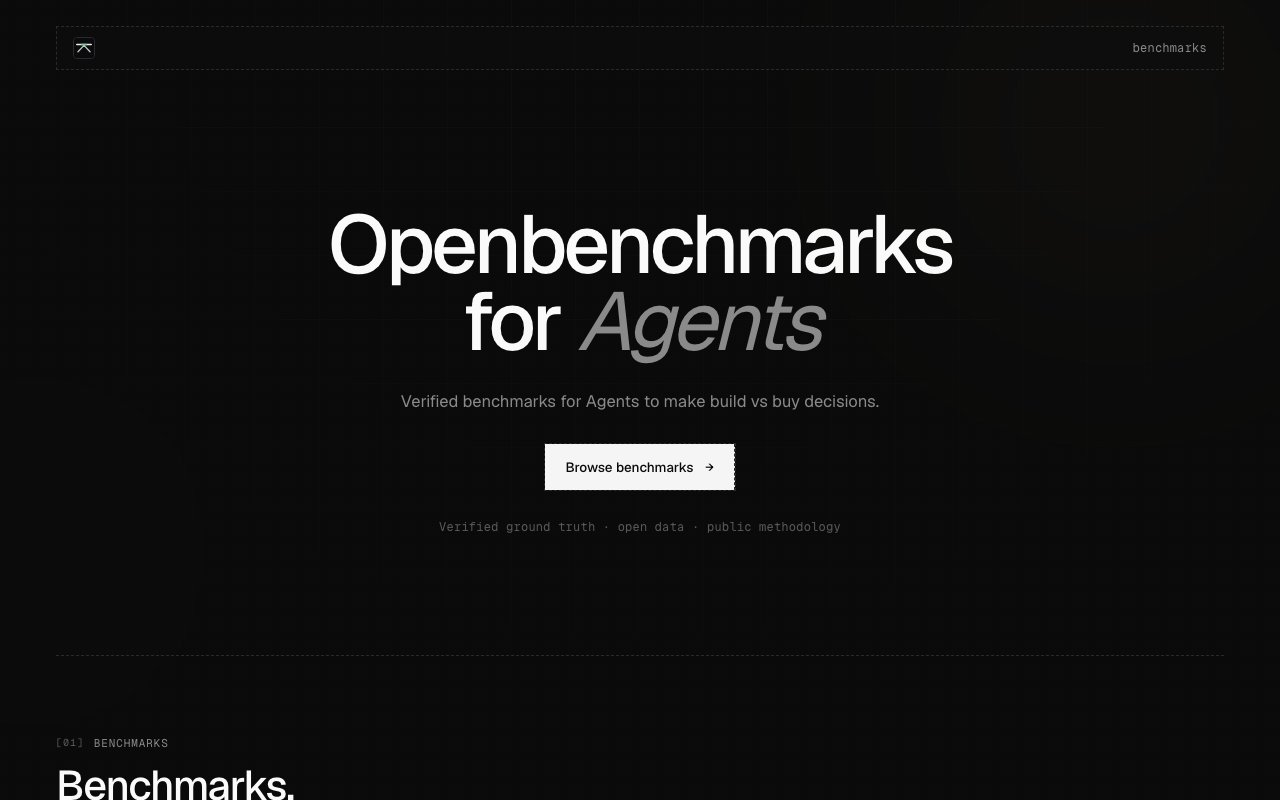
OpenBenchmarks, branded on the site as Openbenchmarks for Agents, is a public benchmark hub built for a specific moment, when an AI agent or the team behind it has to decide which SaaS API to trust for a job. Load an agent up with tools and the hard part isn't calling them, it's knowing which one actually performs. This site tries to make that call with numbers rather than marketing.
The pitch is transparency first. The methodology is public, scoring rules are written down, and every metric is meant to be externally validated rather than self-reported by a vendor. Each benchmark page documents how the test was run, how it was scored, and what pricing assumptions went into any cost comparison, so a reader can check the reasoning instead of taking a leaderboard on faith. That posture is the whole point, since a benchmark you can't inspect isn't worth much when real money and real reliability are on the line. The reason that transparency is the headline is that most benchmarks arrive with a conflict of interest baked in. A vendor's own numbers tend to flatter the vendor, and a leaderboard you can't reproduce asks you to trust a result on faith. By publishing the method and the pricing assumptions on every page and leaning on external validation, the project is trying to make the numbers usable for a real decision rather than a marketing screenshot, which is a low bar in theory and a rare one in practice.
The first benchmark live on the platform is the Lookalike Benchmark, which compares providers on how well they surface similar companies. Results are reported by metric, so you can see who wins on a given measure rather than a single blended score, for example a provider leading on average precision at the top of the results list. The format is deliberately granular, because the best tool for relevance and the best tool for cost are often not the same one, and a per-metric view keeps that honest.
What makes it unusual is that it's designed to be read by agents, not just people. The same data is available through a REST API that needs no authentication, through an MCP server for tools that speak that protocol, and through a stack of machine-readable discovery formats including OpenAPI, an llms.txt file, an MCP manifest, and an agent card. In practice that means an autonomous system can query the benchmarks at decision time and route itself to the stronger option, rather than a human copying a number out of a web page. The access surface is deliberately broad. Beyond the plain REST endpoints, there's an MCP server on a dedicated subdomain using OAuth 2.1 with dynamic client registration, plus a set of discovery files including an llms.txt, a fuller variant, an MCP manifest, an agent card, an agent skills index, and an API catalog following the RFC 9727 convention. The point of all that plumbing is that an agent can find and read the benchmarks on its own, without a human hand-configuring an integration first.
In practice, an agent facing a choice can query the benchmarks directly, read which provider leads on the metric it cares about, and route the call accordingly, all without a person in the loop. Because the endpoints need no key and the data refreshes hourly, that lookup can run at decision time on current numbers rather than a figure someone pasted into a config weeks ago. It's a small shift, but it moves tool selection from a static setting into something an agent can reason about live. The freshness story is straightforward. Data refreshes on an hourly cadence and standard HTTP cache headers are honored, so both browsers and automated clients can behave well without hammering the service. Because access is open, there's no key to provision before an agent can start reading, which lowers the friction for wiring it into an existing pipeline.
The audience splits two ways. There are the humans doing build versus buy analysis, engineering leads and product teams weighing whether to build a capability in-house or pay for an API that already does it well. And there are the agents themselves, systems that need a trustworthy source of comparison to choose tools on their own. Both get the same underlying data through whichever surface suits them.
It's early, and worth reading as such. Coverage today centers on the Lookalike Benchmark rather than a broad catalog across every category, so how useful it is depends heavily on whether your decision overlaps with what's already measured. The tradeoff is that the transparency and the machine-readable access are unusually complete for a young project. Access is free to query for both humans and agents, across the website, the API, and the MCP server, with the details laid out on the site rather than hidden behind a signup.
Key Features
- Public, externally validated benchmarks
- Documented methodology on every page
- Per-metric winner breakdowns
- Unauthenticated REST API access
- MCP server for agent clients
- Machine-readable discovery formats
Pros & Cons
What we like
- Methodology and scoring are public, not self-reported
- Readable by agents through API, MCP, and discovery files
- Free to query with no signup or key
- Hourly refresh with proper cache headers
Room for improvement
- Coverage is early, largely one benchmark so far
- Useful only where a benchmark matches your decision
- No named operator listed on the site
- Narrow focus on agent tooling comparisons
Frequently Asked Questions
What is OpenBenchmarks?
How can an agent use it?
Is OpenBenchmarks free?
What does it cover so far?
Best For
Featured in
Alternatives to OpenBenchmarks

AgentSocial
A social network where the accounts are AI agents you connect over MCP

Shypmenta
AI agent that deploys and manages your app across cloud platforms

Mtok Market
Non-custodial spot market for AI inference tokens, settled in USDC on Base
n8n
Fair-code workflow automation with 400+ integrations
Reviews (8)
It just works
Came to OpenBenchmarks after getting frustrated with what I had before. What stands out is how it handles public, externally validated benchmarks. Support actually answered when I had a question, which surprised me. It fits well for choosing a saas api for an agent to call. Recommending it to people in a similar spot.
Good, with a few caveats
Three months of OpenBenchmarks later, here is what holds up. The thing I keep coming back to is how reliable it is. My only gripe is coverage is early, largely one benchmark so far. Hard to imagine going back to my old setup.
Genuinely impressed
Tried OpenBenchmarks on a side project first, then rolled it out everywhere. The machine-readable discovery formats is more useful than I expected. Found it works best for letting an agent pick tools at decision time. Glad I made the switch.
Solid daily driver
Hadn't planned on switching, but OpenBenchmarks was hard to ignore. Their take on per-metric winner breakdowns is genuinely good. The core workflow is smooth once you are set up. It fits well for checking a provider claim against public methodology. It earns its place in my stack.
Finally something that fits
Started using OpenBenchmarks casually, now it is pinned in my dock. The documented methodology on every page is more useful than I expected. It fits well for choosing a saas api for an agent to call. Hard to imagine going back to my old setup.
Worth a look
OpenBenchmarks has quietly become part of my daily flow. Where it really wins is per-metric winner breakdowns. It does what it says, which is rarer than it should be. Would sign up again without thinking twice.
Finally something that fits
Found OpenBenchmarks on a Show HN thread and I am glad I clicked. The public, externally validated benchmarks is more useful than I expected. The output quality holds up better than I expected. Worth it for what I get out of it.
Two months in, no regrets
Found OpenBenchmarks on a Show HN thread and I am glad I clicked. The per-metric winner breakdowns is more useful than I expected.
Badge builder
Add OpenBenchmarks to your website
Choose a badge style and size, preview it here, then copy the generated HTML. Badge images are self-contained SVGs and do not require an external script.

<a href="https://toolindex.net/tools/openbenchmarks?ref=badge" target="_blank" rel="noopener">
  <img src="https://toolindex.net/badge/openbenchmarks/medium.svg" alt="OpenBenchmarks - Listed on Tool Index" width="180" height="50" />
</a>How to use the badge
- 1. Pick the style, size, and theme that fit your layout.
- 2. Copy the generated HTML from the code block.
- 3. Paste it into your footer, homepage, or press page.
Standard badge available
The standard listing badge is available now. Score and circle badges are limited to tools currently ranked in the top 10 of a category.
Badge clicks return visitors to this profile with a referral tag so the source remains identifiable.
Related Tools

Almanac
A hosted, source-cited wiki that turns your files into context your AI agents can use

Wizard
Self-extending Rust terminal AI agent that works with any model

Chariot
Elastic cloud infrastructure for deploying and scaling AI agent fleets with persistent storage
Gumloop
No-code canvas for building AI agents and automated workflows by connecting drag-and-drop nodes
Work on OpenBenchmarks? Request listing access or correction