
Wizard
Self-extending Rust terminal AI agent that works with any model
Gallery
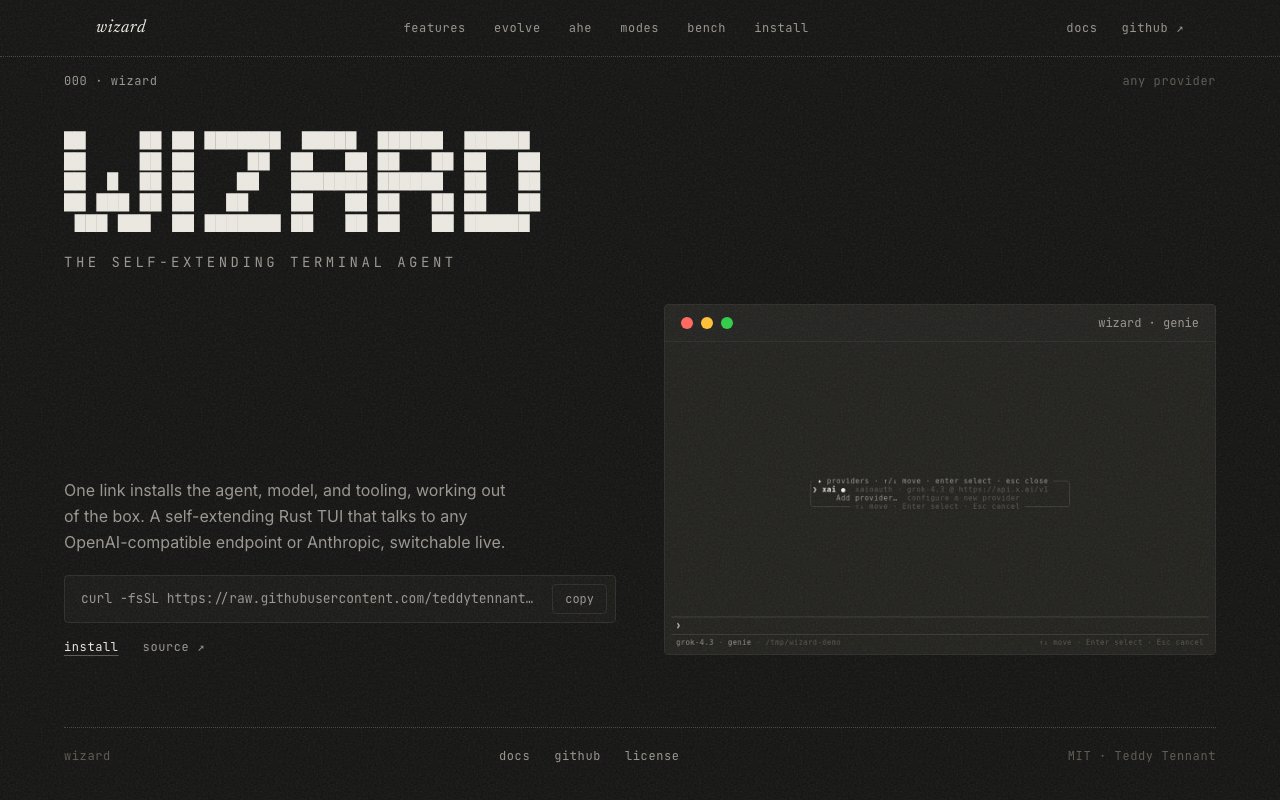
About Wizard
Wizard is a self-extending terminal AI agent that ships as a single Rust binary. The whole pitch fits in a line, one command installs the agent, a model, and its tooling, and it works out of the box. From there it runs as a TUI in your terminal and talks to whatever model you point it at, whether that's an OpenAI-compatible endpoint, Anthropic, xAI, Groq, or a local model through llama.cpp. You can switch the live agent between providers on the fly with a command, so you're never locked to one vendor. The install is a single curl script, and the source lives on GitHub under a permissive MIT license.
The word that defines Wizard is self-extending. Through its evolve command, the agent can add new skills, MCP servers, scripted tools, and subagents to itself, and it does this by writing plain files that go live after a reload. Crucially, those changes are gated. A new capability only sticks if the project still compiles and passes smoke tests, and if something breaks the agent can roll back and log what happened. That turns the scary idea of an AI editing its own tooling into something with guardrails, because a bad change fails the build instead of silently corrupting your setup. It means the agent can grow to fit a task rather than being frozen at whatever its author shipped.
Beyond extension, Wizard has a few tricks that set it apart from a plain chat-in-the-terminal tool. Its fusion command runs a panel of your configured providers as a kind of debate and synthesizes a single tool-capable answer, which tends to beat any one model on its own. It supports the Model Context Protocol at runtime, so both stdio and HTTP MCP servers merge into its tool registry without a rebuild. There's a built-in benchmarking harness through the bench command that records and replays tasks, and a messaging gateway that can drive the agent from a Telegram bot. Project-level configuration and custom commands round out the day-to-day ergonomics. Local inference is a first-class option rather than an afterthought. Wizard can run models through llama.cpp and sizes GGUF files automatically, and it ships alternative install paths for Nix, minimal setups, and bring-your-own-model configurations. That flexibility is the point. You can start with a hosted frontier model when you want the best quality, then fall back to something local when you'd rather not send data out or pay per token, all without switching tools or relearning the workflow.
Wizard runs in a few distinct modes depending on how much autonomy you want to hand it. Genie is the interactive TUI for hands-on work where you stay in the loop. Sovereign is a headless, self-directing mode for when you want it to just go. Continuous is a perpetual mission that compacts its own context as it runs and self-heals through outages, so a long-running job doesn't fall over the first time a provider hiccups. For heavier setups, it can even fan work out across a fleet using git worktrees, which is a nod toward running several agent instances in parallel on the same project.
This is a tool for developers who are comfortable in a terminal and want an agent they actually control. If you've found hosted coding assistants too locked down, or you want to bring your own model and keep the whole thing on your machine, Wizard leans hard in that direction. The bring-any-model stance and local inference support make it appealing to people who care about cost, privacy, or simply not being tied to a single API. It rewards tinkering, since the extension model invites you to shape the agent around your own workflow rather than the other way around.
The project is honest about its limits, which is a good sign. Small local models are plainly worse than frontier models, so the bring-your-own-model freedom comes with the trade-off that a tiny local model won't match a hosted flagship. There's no execution sandbox, meaning tools run with your own privileges, so you're trusting the agent with real access to your machine. Windows users need WSL2 rather than a native build. It's also a young project with a small community so far, which shows in the star count, though it's under active development with frequent releases.
On access, Wizard is open source and free to install and run under its MIT license, and there's no paid tier for the software itself. Whatever you spend goes to the model providers you choose, or nothing at all if you run everything locally. For someone who wants a hackable, provider-agnostic agent that lives in the terminal and can grow new abilities on demand, it's an unusually ambitious take on what a personal coding agent can be, and the one-line install lowers the bar to trying it.
Key Features
- One-line install script
- Any OpenAI-compatible or Anthropic model
- Self-extension via the evolve command
- Model fusion across multiple providers
- Runtime MCP server support
- Genie, Sovereign, and Continuous modes
Pros & Cons
What we like
- Installs the agent, a model, and tooling from a single command
- Switches between providers live without a restart
- Adds skills and tools as plain files that reload instantly
- Open source under a permissive MIT license
Room for improvement
- No execution sandbox, so tools run with your privileges
- Small local models trail frontier models in quality
- Windows support requires WSL2
- Young project with a small community so far
Frequently Asked Questions
What is Wizard?
Is Wizard open source?
Which models does Wizard support?
What does self-extending mean?
Best For
Featured in
Alternatives to Wizard

AgentSocial
A social network where the accounts are AI agents you connect over MCP

Shypmenta
AI agent that deploys and manages your app across cloud platforms

Mtok Market
Non-custodial spot market for AI inference tokens, settled in USDC on Base
n8n
Fair-code workflow automation with 400+ integrations
Reviews (9)
Two months in, no regrets
Three months of Wizard later, here is what holds up. The core workflow is smooth once you are set up. Mostly using it for comparing providers by fusing their answers. Hard to imagine going back to my old setup.
Good, with a few caveats
Wizard solves a real problem for me without making a fuss about it. It slotted into my routine without much fuss. Mostly using it for running an autonomous coding agent in the terminal. My only gripe is no execution sandbox, so tools run with your privileges. Would sign up again without thinking twice.
Quietly excellent
Hadn't planned on switching, but Wizard was hard to ignore. Their take on switches between providers live without a restart is genuinely good. It just works, day after day, without surprises. No regrets so far.
Exactly what I needed
Have been running Wizard for a while, here is where I land. What stands out is how it handles genie, sovereign, and continuous modes. It does what it says, which is rarer than it should be.
Finally something that fits
Tried Wizard on a side project first, then rolled it out everywhere. Setup was painless and I was productive the same day. The interface stays out of my way, which I appreciate. Hard to imagine going back to my old setup.
Finally something that fits
Hadn't planned on switching, but Wizard was hard to ignore. The core workflow is smooth once you are set up. The output quality holds up better than I expected. Recommending it to people in a similar spot.
It just works
Three months of Wizard later, here is what holds up. The adds skills and tools as plain files that reload instantly is more useful than I expected. Setup was painless and I was productive the same day. It earns its place in my stack.
Does the job, a few gripes
Found Wizard on a Show HN thread and I am glad I clicked. What stands out is how it handles model fusion across multiple providers. One thing that bugs me is small local models trail frontier models in quality. No regrets so far.
Genuinely impressed
Wizard has quietly become part of my daily flow. What stands out is how it handles adds skills and tools as plain files that reload instantly. It does what it says, which is rarer than it should be. It earns its place in my stack.
Badge builder
Add Wizard to your website
Choose a badge style and size, preview it here, then copy the generated HTML. Badge images are self-contained SVGs and do not require an external script.

<a href="https://toolindex.net/tools/wizard?ref=badge" target="_blank" rel="noopener">
  <img src="https://toolindex.net/badge/wizard/medium.svg" alt="Wizard - Listed on Tool Index" width="180" height="50" />
</a>How to use the badge
- 1. Pick the style, size, and theme that fit your layout.
- 2. Copy the generated HTML from the code block.
- 3. Paste it into your footer, homepage, or press page.
Standard badge available
The standard listing badge is available now. Score and circle badges are limited to tools currently ranked in the top 10 of a category.
Badge clicks return visitors to this profile with a referral tag so the source remains identifiable.
Related Tools

OpenBenchmarks
Public, externally validated benchmarks that help agents pick SaaS APIs

Almanac
A hosted, source-cited wiki that turns your files into context your AI agents can use

Chariot
Elastic cloud infrastructure for deploying and scaling AI agent fleets with persistent storage
Gumloop
No-code canvas for building AI agents and automated workflows by connecting drag-and-drop nodes
Work on Wizard? Request listing access or correction