
Aether
Run Claude Code, Codex, or OpenCode in cloud devboxes you can watch and steer
Gallery
About Aether
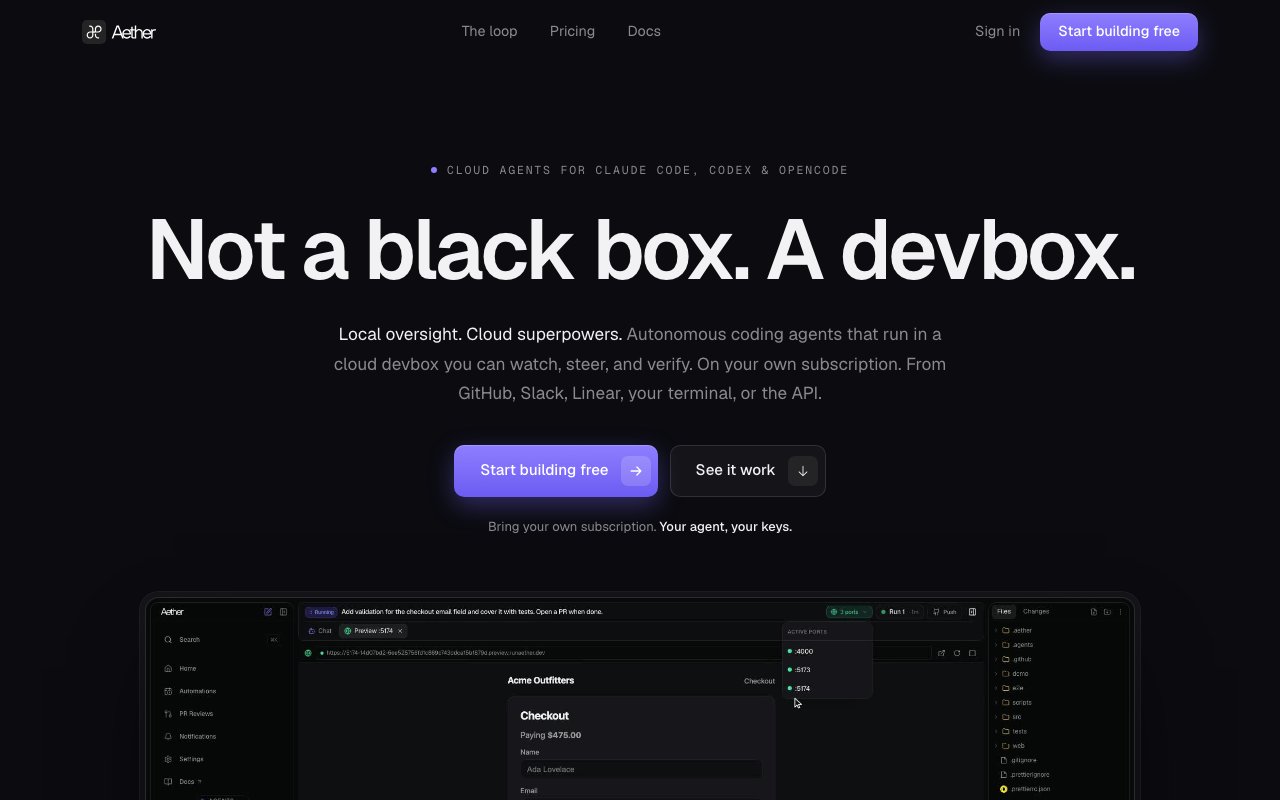
Aether runs autonomous AI coding agents inside cloud development environments you can actually watch. The problem it goes after is trust. A lot of AI coding services are black boxes, so you hand off a task, wait, and hope the result is right, often while paying a markup on the model doing the work. Aether flips that by putting the whole workspace on screen. You see the terminal, the file changes, and a live preview, and you can step in mid-run instead of waiting to be surprised by a pull request at the end.
The core unit is a devbox, an isolated Firecracker microVM where a single task runs and then gets destroyed when it's done. Instead of bundling its own model at a marked-up rate, Aether lets you bring your own subscription to Claude Code, Codex, or OpenCode, with access to a wide range of models through OpenCode. Each task gets its own clean machine, so runs stay separated and reproducible, and there's nothing left lying around afterward. While an agent works you watch live terminal output, file diffs, and port previews, and you can steer it, pause it, or take full control at any point.
In practice teams point it at the kind of work that eats engineering time. It can fix failing tests, review pull requests, triage backlog items, and respond to production errors. Pull request review runs as an iterative feedback loop, and a multi-agent review pass can vet the code before it ships, so a second set of eyes checks the first agent's work rather than trusting it outright. When a change is visual, Aether can attach video proof of what actually happened in the browser, so a reviewer isn't left guessing whether the screenshot matches the diff. The point throughout is oversight, so the agent stays accountable rather than opaque, and the person merging can see the reasoning instead of a summary someone hopes is accurate. That observability is really the core of the pitch. Where a black-box service asks you to trust the output, Aether shows the terminal, the file diffs, and the running app as the work happens, and it does that inside a machine that gets thrown away when the task ends. Because each run lives in its own short-lived microVM, a mistake stays contained to that box, and nothing an agent does bleeds into the next task or lingers on shared infrastructure. For teams that have hesitated to let an agent touch a real repo, that combination of visibility and isolation is meant to make the whole thing feel safe enough to actually use.
It's built to fit into a real workflow rather than live in a separate tab. Runs can be scheduled to fire hourly, nightly, or weekly, which suits recurring chores like dependency bumps or nightly test triage. It connects to Slack for live updates and steering through replies, Linear for issue assignment and status sync, Sentry for auto-fixing when a production error fires, and GitHub for pull request review and push triggers. A skills system lets you encode repo-specific conventions so the agent follows your house style instead of relearning your patterns on every run, and there are CLI, REST, and WebSocket APIs when you want to script it or wire it into something you already run. Because the integrations reach into the tools where issues and errors already live, work can be assigned from Linear or triggered by a Sentry alert without anyone opening a separate console.
The audience is software engineers and development teams who want autonomous coding help but not vendor lock-in or pricing they can't see through. Because you bring your own agent subscription, you keep the model relationship you already have and avoid paying a premium on top of inference. The watch-and-steer design is aimed at people who have been burned by agents that go off the rails unseen, and who would rather keep a hand on the wheel than trust a summary after the fact. If you have wanted to let an agent grind through a backlog overnight but never felt safe doing it blind, this is the gap it tries to close.
Getting started leans on tooling engineers already use. There's a CLI you install and drive with a run command, plus REST and WebSocket APIs for automation and live status. Since devboxes are ephemeral and one-per-task, you can fan out several runs without them stepping on each other, and warm slots keep environments ready so a run starts quickly instead of cold every time.
Access is freemium. A free plan gives you a monthly pool of credits and a single warm slot so you can try the workflow at no cost, and paid plans add more credits and more warm slots as you scale, moving through Starter, Pro, and Max tiers. Credits meter only active runtime, roughly six minutes of a medium devbox per credit, and idle time is free, so you're paying for work done rather than machines sitting around. Combined with bring-your-own model, the pricing is meant to stay legible instead of hiding a markup you can't inspect.
Key Features
- Firecracker microVM devboxes, one per task
- Bring-your-own agent (Claude Code, Codex, OpenCode)
- Live terminal, file, and port oversight
- Automated pull request review loop
- Scheduled hourly, nightly, or weekly runs
- Slack, Linear, Sentry, and GitHub integrations
Pros & Cons
What we like
- Full visibility into what the agent does, with mid-run steering
- Bring your own model subscription, so no inference markup
- Isolated, destroyed-after-use VMs keep runs clean and separated
- Scriptable through CLI, REST, and WebSocket APIs
Room for improvement
- You need your own Claude Code, Codex, or OpenCode subscription
- Aimed at engineers, so there's a technical setup step
- Credit metering means heavy usage needs a paid plan
- Younger product with a smaller community so far
Frequently Asked Questions
What is Aether?
Do I need my own AI coding subscription?
Can I watch and control the agent while it works?
Is Aether free?
Best For
Featured in
Alternatives to Aether


Reviews (10)
Genuinely impressed
Started using Aether casually, now it is pinned in my dock. It slotted into my routine without much fuss. The output quality holds up better than I expected. No regrets so far.
Exactly what I needed
Tried Aether on a side project first, then rolled it out everywhere. Got real value out of bring-your-own agent (claude code, codex, opencode).
Two months in, no regrets
Aether has quietly become part of my daily flow. Got real value out of full visibility into what the agent does, with mid-run steering. Setup was painless and I was productive the same day. Found it works best for auto-responding to production errors from sentry. No regrets so far.
Powerful once it clicks
Tried Aether on a side project first, then rolled it out everywhere. Support actually answered when I had a question, which surprised me. It fits well for running automated pull request review before merge. My only gripe is aimed at engineers, so there's a technical setup step. No regrets so far.
Recommended without reservation
Tried Aether on a side project first, then rolled it out everywhere. What stands out is how it handles bring-your-own agent (claude code, codex, opencode). Recommending it to people in a similar spot.
Exactly what I needed
Tried Aether on a side project first, then rolled it out everywhere. Got real value out of scheduled hourly, nightly, or weekly runs. Would sign up again without thinking twice.
Good, with a few caveats
Hadn't planned on switching, but Aether was hard to ignore. Their take on automated pull request review loop is genuinely good. Mostly using it for fixing failing tests without babysitting a black box. It would be a five if not for younger product with a smaller community so far.
Good, with a few caveats
Aether has quietly become part of my daily flow. The thing I keep coming back to is how reliable it is. My only gripe is aimed at engineers, so there's a technical setup step.
Solid daily driver
Picked Aether for the price, stayed for the quality. The core workflow is smooth once you are set up. Mostly using it for fixing failing tests without babysitting a black box. Recommending it to people in a similar spot.
Genuinely impressed
Aether has quietly become part of my daily flow. The interface stays out of my way, which I appreciate. The core workflow is smooth once you are set up.
Badge builder
Add Aether to your website
Choose a badge style and size, preview it here, then copy the generated HTML. Badge images are self-contained SVGs and do not require an external script.

<a href="https://toolindex.net/tools/aether?ref=badge" target="_blank" rel="noopener">
  <img src="https://toolindex.net/badge/aether/medium.svg" alt="Aether - Listed on Tool Index" width="180" height="50" />
</a>How to use the badge
- 1. Pick the style, size, and theme that fit your layout.
- 2. Copy the generated HTML from the code block.
- 3. Paste it into your footer, homepage, or press page.
Standard badge available
The standard listing badge is available now. Score and circle badges are limited to tools currently ranked in the top 10 of a category.
Badge clicks return visitors to this profile with a referral tag so the source remains identifiable.
Related Tools

Bolt.new
Prompt-to-deployed full-stack app inside the browser

Tabnine
Privacy-first enterprise AI code assistant you control, with SaaS, VPC, on-prem, or fully air-gapped deployment
Cursor
VS Code fork built around an AI pair-programmer

Skeezo
Agent-native macOS IDE for coordinating Claude Code and AI agents
Work on Aether? Request listing access or correction