
BigCommerce
Open-architecture e-commerce platform for mid-market and B2B brands
Gallery
About BigCommerce
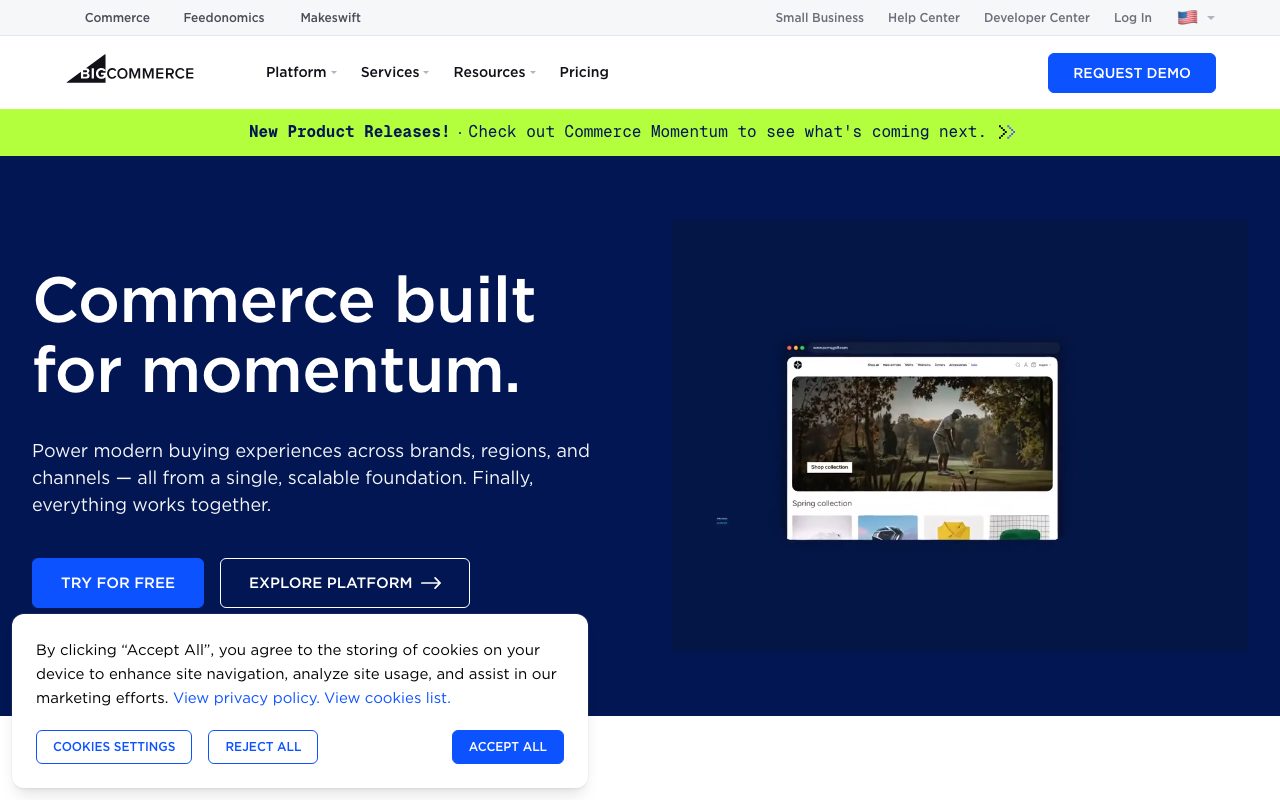
BigCommerce is the e-commerce platform that grew up courting brands too big for a starter plan but too sane to build their own checkout from scratch. It's been around long enough to have real opinions about how stores should run.
The pitch has shifted over the years. These days BigCommerce leans hard into the open architecture story, which is fancy talk for "we won't lock you into one frontend, one payment provider, or one app ecosystem."
If you've shopped Shopify and walked away wanting more flexibility on the developer side, BigCommerce is usually the next stop. It's also where a lot of mid-market and B2B teams land after outgrowing simpler stacks.
What BigCommerce actually does
BigCommerce hosts your store, processes orders, manages inventory, and exposes a deep API for everything else. The platform handles SaaS upkeep so you don't patch servers, but it gives you headless options if you want a custom frontend.
It supports multi-storefront setups out of the box, which matters once you're selling in multiple regions or running both DTC and B2B. Most platforms force you into separate accounts. BigCommerce keeps it under one roof.
Built-in features that aren't add-ons
Things like product reviews, faceted search, and abandoned cart emails ship with the platform. With some competitors, those are paid apps. BigCommerce's pitch is fewer monthly app fees stacking up.
Who BigCommerce is for
Mid-market merchants doing a few million in revenue and up. B2B brands that need quote workflows, customer-specific pricing, and net-30 terms. Multi-brand companies running several storefronts off one backend.
It's overkill for someone selling 10 candles a month. But if you've got SKUs in the thousands or you're moving from a custom Magento setup, BigCommerce starts looking efficient.
The B2B angle
BigCommerce has invested heavily in B2B Edition. Quote requests, customer groups, custom catalogs, and bulk pricing all live natively. This is genuinely rare in SaaS commerce platforms.
Pricing breakdown
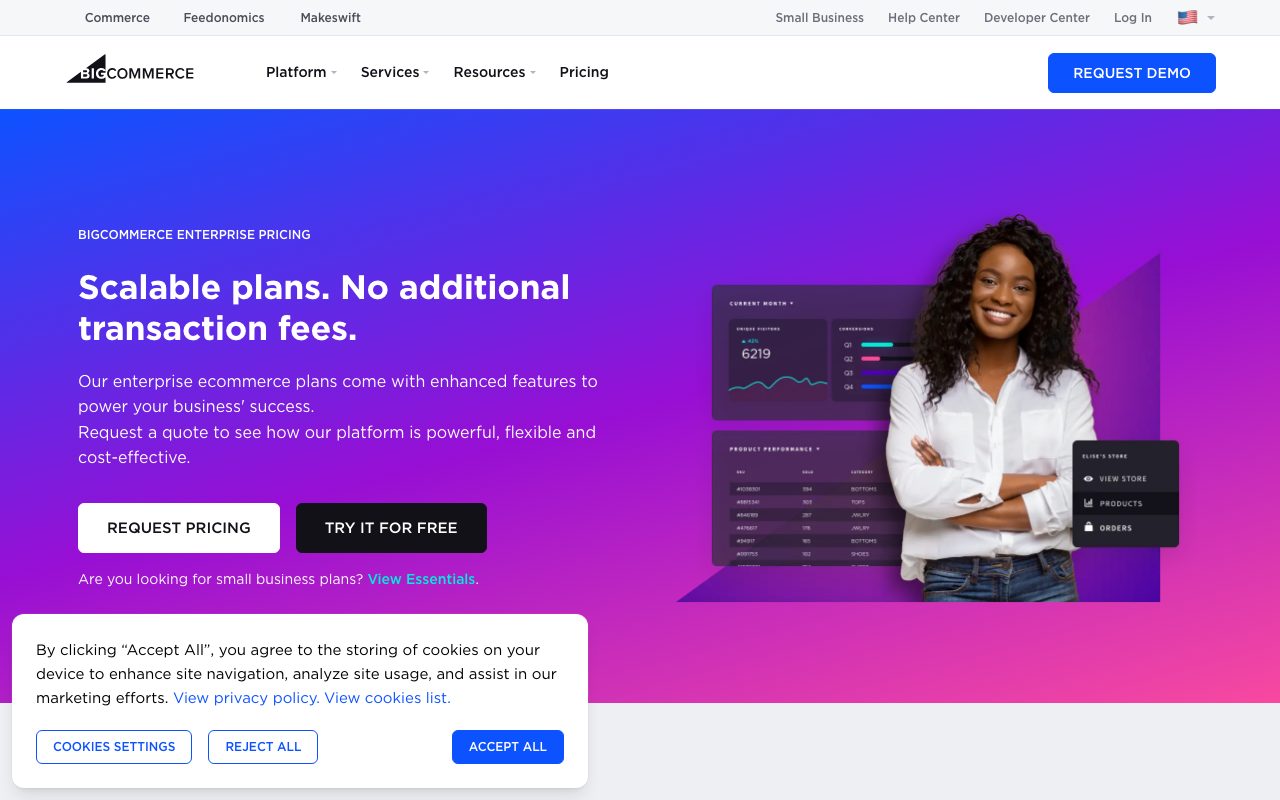
Plans run from Standard up through Enterprise, with revenue thresholds that bump you to the next tier. Standard starts in the low double digits per month and Enterprise is custom.
The big difference from Shopify is the no-extra-transaction-fee policy. BigCommerce doesn't tax you for using your preferred payment processor. You still pay gateway fees, but BigCommerce isn't piling on top.
What pushes you to higher tiers
Annual sales volume. Past a threshold, you're auto-promoted, which can feel sudden if you weren't watching. Plan for it as part of growth budgeting.
Standout features of BigCommerce
Headless support is a real strength. You can run BigCommerce as the commerce engine and put a Next.js, Gatsby, or whatever frontend on top. The API is robust enough that this isn't a hack.
The catalog model is also more flexible than most. Variants, modifiers, and price lists give you room to model weird products without contorting the data layer.
Channel integrations
Selling on Amazon, eBay, Walmart, Google, Meta, and TikTok ships as channel connectors. You manage inventory once and push to multiple marketplaces.
Honest tradeoffs with BigCommerce
The theme ecosystem is smaller than Shopify's. If you're picking a template off the shelf, your visual options are narrower. Most serious merchants end up customizing anyway, so this matters less than it sounds.
The admin UI feels older in spots. It's functional but doesn't have the polish that Shopify has refined over a decade. You'll find clunky moments.
BigCommerce is the platform you pick when you want SaaS reliability without losing the ability to customize the parts that make your store yours.
BigCommerce vs alternatives
BigCommerce vs Shopify is the eternal comparison. Shopify wins on theme polish, app ecosystem size, and brand recognition. BigCommerce wins on built-in features, no extra transaction fees, and B2B depth.
BigCommerce vs WooCommerce is a different conversation. Woo is open-source and self-hosted. BigCommerce is SaaS. The tradeoff is control versus operational overhead.
For broader context, see the best ecommerce platforms guide or compare directly with BigCommerce vs Shopify.
When BigCommerce wins
You're B2B. You want headless without rebuilding from scratch. You hate per-app monthly creep. You're hitting Shopify's transaction fee wall.
Bottom line on BigCommerce
BigCommerce isn't the trendy pick, and it doesn't try to be. It's the practical, technically capable option for stores that have outgrown simpler platforms but haven't gone fully custom.
If you're a small shop just starting, look elsewhere. If you're scaling past a few million in revenue or your B2B requirements are getting nasty, BigCommerce deserves a serious evaluation. See related tools for ecommerce managers.
BigCommerce for B2B specifically
The B2B feature set is genuinely deep. Quote workflows let your sales reps generate custom quotes inside the platform. Customer groups let you set pricing, tax, and visibility per buyer segment. Net terms work natively without a third-party plugin.
That last point is huge for industries like wholesale, manufacturing, and trade. Most consumer-grade platforms force you into Stripe-only credit card flows. BigCommerce treats invoiced orders as first-class citizens.
The migration path
If you're moving from Magento, BigCommerce has invested in migration tooling. You won't get a one-click move because your data is too custom, but the path is documented and several agencies specialize in it.
BigCommerce's developer story
The API is comprehensive. Storefront API for headless setups. Admin API for backend operations. Webhooks for real-time events. GraphQL for modern frontends.
This matters because complex stores end up needing custom logic somewhere. BigCommerce gives you escape hatches that don't require leaving the platform. Compare that to Shopify, where deep customization often means going headless and paying enterprise fees.
App ecosystem reality check
Smaller than Shopify's. Most major SaaS tools (Klaviyo, Yotpo, Gorgias, ShipStation) integrate. The long tail of niche apps is thinner. Verify before assuming an integration exists.
Common BigCommerce questions
Is BigCommerce SEO-friendly? Yes, with sane URLs, sitemap generation, and metadata controls baked in. Does BigCommerce support multi-currency? Yes, on appropriate tiers. How does BigCommerce handle subscriptions? Native subscription tools exist plus app-based options.
For the broader picture, see tools for B2B merchants and best headless commerce platforms.
Final take on BigCommerce
BigCommerce is the practical, capable, slightly underdog choice in SaaS commerce. It rewards merchants who care about features more than aesthetics and want flexibility without operational overhead. For the right team, it's a quietly excellent decision.
BigCommerce checkout customization
Checkout is where conversions live or die. BigCommerce gives you a default optimized checkout that performs well out of the box. For teams with deeper requirements, the Open Checkout option lets you customize the checkout entirely.
That flexibility is rare in SaaS commerce. Shopify gates checkout customization behind Plus pricing. BigCommerce makes it accessible at lower tiers, with proper engineering effort. For B2B and complex catalogs, this matters.
The tradeoff is responsibility. If you customize checkout, you're now responsible for keeping it working as the platform evolves. Most teams stick with the default and only customize specific elements.
Subscription and recurring orders
BigCommerce supports subscriptions natively or via apps like Recharge. The native option works for simple recurring orders. The app route gives you more control over pause, swap, and dunning logic. Pick based on subscription complexity.
BigCommerce performance considerations
Stock store performance is solid. Page load times are competitive with other major platforms. The CDN is fast globally. Where performance can lag is on heavily customized stores with too many apps loading scripts on every page.
The recommendation: audit your apps quarterly. Each Power-Up-style app adds a script. Five apps is fine. Twenty apps slows your site noticeably. Pruning matters.
BigCommerce in different store sizes
For early-stage stores under a million in revenue, BigCommerce works but Shopify's brand and theme advantage usually wins. For mid-market stores from one to fifty million, BigCommerce shines. For enterprise stores past fifty million, you're often comparing BigCommerce Enterprise to commerce solutions like Salesforce Commerce Cloud or Magento Commerce.
The sweet spot is the middle. Stores in that range get the best return on BigCommerce's feature set without overpaying for capabilities they won't use.
The renewal calculus
If you're renewing on Shopify Plus and the bill is climbing past what you'd pay on BigCommerce Enterprise, run the numbers. Migration is a real project but for some merchants the recurring savings justify it. Don't migrate for fashion. Migrate for math.
BigCommerce wrap-up considerations
The platform has been quietly reliable for over a decade. Its bet on open architecture, headless support, and B2B depth has aged well. As the commerce stack continues to fragment into specialized tools, BigCommerce's positioning as the flexible engine in the middle remains strategic.
For merchants evaluating it today, the practical advice is to map your specific requirements and check them against current tier inclusions. The pricing model and feature gates shift regularly. What was on a higher tier last year may be standard this year, and vice versa. Run a free trial against a test catalog to see how the platform feels with your actual data shape.
The headless story is worth a separate evaluation if your team has frontend talent. Combining BigCommerce with Next.js or Gatsby produces a fast, flexible storefront that competes with custom-built solutions at a fraction of the operational cost. For teams without frontend talent, the standard storefront is fine and gets you live faster.
Tutorial / Demo
Key Features
- Hosted storefronts with theme customization
- Strong native B2B and wholesale features
- Headless commerce via open APIs
- Multi-storefront support
- No transaction fees on top of payment processor
- Integrations with major ERPs and PIMs
Pros & Cons
What we like
- Better B2B/wholesale story than vanilla Shopify
- API-first design suits headless builds
- Predictable pricing without per-transaction fees
Room for improvement
- App marketplace is smaller than Shopify's
- Higher-tier features sit behind sales conversations
- Fewer themes than competitors
Frequently Asked Questions
How much does BigCommerce cost?
BigCommerce vs Shopify, which is better?
Is BigCommerce open architecture?
Does BigCommerce have transaction fees?
Is BigCommerce overkill for a small store?
Best For
Featured in
Tags
Alternatives to BigCommerce
View all
Shopify
Hosted commerce platform for storefronts of every size

Webflow
Visual website builder that produces clean, semantic HTML and CSS, with a CMS, e-commerce, and a Webflow-hosted CDN.

Supliful
Private-label dropshipping for supplements, skincare, coffee, and pet products with no inventory

Kajabi
All-in-one platform for selling online courses, memberships, and coaching
Our take
Tool Index Editorial · May 2026· 4.8/5
BigCommerce sits in a crowded category, differentiating itself as open-architecture e-commerce platform for mid-market and b2b brands.
Where it wins: Better B2B/wholesale story than vanilla Shopify, API-first design suits headless builds, and Predictable pricing without per-transaction fees. Less impressive: App marketplace is smaller than Shopify's and Higher-tier features sit behind sales conversations.
Verdict: BigCommerce comfortably earns its spot in the category — a smart default when you need mid-market brands needing strong B2B features.
Editorial opinion from the Tool Index team, written from the public product pages. Not a user review.
Reviews (6)
BigCommerce, better than expected
BigCommerce solves a real problem for me, but it's not magic. Honestly impressed by how predictable pricing without per-transaction fees. Found it works best for catalog-heavy stores with thousands of SKUs. Would buy again without thinking twice.
Pros
- Predictable pricing without per-transaction fees
- Better B2B/wholesale story than vanilla Shopify
- API-first design suits headless builds
Did exactly what I needed
BigCommerce has quietly become part of my daily flow. Genuine strength: better B2B/wholesale story than vanilla Shopify. Mostly using it for catalog-heavy stores with thousands of SKUs.
Easy 5 from me
BigCommerce solves a real problem for me, but it's not magic. What stands out is how predictable pricing without per-transaction fees. Worth the price for what I get out of it.
Surprised how much we use this
Have been using BigCommerce for a while, here's where I land. The thing I keep coming back to: API-first design suits headless builds. No transaction fees on top of payment processor works the way you'd hope. Mostly using it for mid-market brands needing strong B2B features. Sticking with BigCommerce.
Pros
- API-first design suits headless builds
- Better B2B/wholesale story than vanilla Shopify
Recommended without reservation
Started using BigCommerce casually, now it's pinned in my dock. What stands out is how API-first design suits headless builds. Worth calling out the integrations with major ERPs and PIMs too. Main use case: mid-market brands needing strong B2B features. Honest gripe: higher-tier features sit behind sales conversations.
Cons
- Fewer themes than competitors
- Higher-tier features sit behind sales conversations
Easy 5 from me
Came to BigCommerce after frustration with what I had before. Real selling point: better B2B/wholesale story than vanilla Shopify. Their take on headless commerce via open APIs is solid. Found it works best for headless commerce builds with custom frontends.
Pros
- Better B2B/wholesale story than vanilla Shopify
- Predictable pricing without per-transaction fees
Badge builder
Add BigCommerce to your website
Choose a badge style and size, preview it here, then copy the generated HTML. Badge images are self-contained SVGs and do not require an external script.

<a href="https://toolindex.net/tools/bigcommerce?ref=badge" target="_blank" rel="noopener">
  <img src="https://toolindex.net/badge/bigcommerce/medium.svg" alt="BigCommerce - Listed on Tool Index" width="180" height="50" />
</a>How to use the badge
- 1. Pick the style, size, and theme that fit your layout.
- 2. Copy the generated HTML from the code block.
- 3. Paste it into your footer, homepage, or press page.
Score badge available
BigCommerce qualifies for the score and circle badges based on its current top-10 positionin E-commerce.
Badge clicks return visitors to this profile with a referral tag so the source remains identifiable.
Related Tools

Stripe
Payment infrastructure for the internet

Klaviyo
Email and SMS platform purpose-built for ecommerce, with deep Shopify integration and revenue-attributed flows.

Chancey
Shopify app for selling gacha-style blind boxes with real inventory and transparent odds
Kajabi
All-in-one platform for selling online courses, memberships, and coaching
Work on BigCommerce? Request listing access or correction