
Klaviyo
Email and SMS platform purpose-built for ecommerce, with deep Shopify integration and revenue-attributed flows.
Gallery
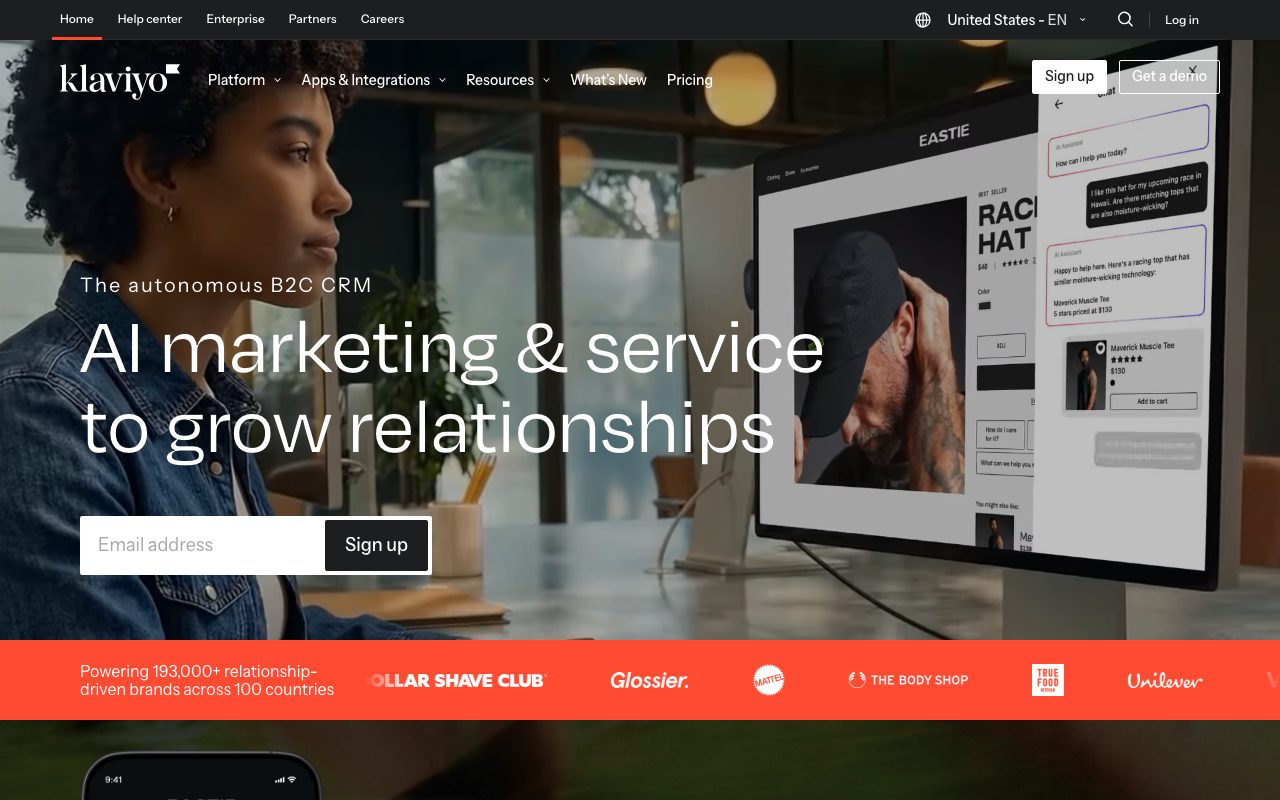
About Klaviyo
Klaviyo is the email and SMS platform that ate Mailchimp's lunch in ecommerce. The Shopify integration is so deep that for most DTC brands, Klaviyo isn't a marketing tool, it's the marketing tool. Revenue attribution per email is the headline reason.
If you're running a Shopify store and you want to know which abandoned-cart flow drove how much revenue last week, Klaviyo answers in two clicks. Mailchimp will tell you opens and clicks. Klaviyo tells you dollars.
What Klaviyo does
Klaviyo is built for ecommerce from the schema up. The data model includes customers, orders, products, and events out of the box. When Shopify creates an order, Klaviyo knows. When that customer opens an email three days later, Klaviyo links the open back to the order.
The product covers email campaigns, automated flows, SMS, push notifications, predictive analytics, and reviews. The flows are visual builders with conditions, splits, time delays, and revenue tracking on every step. Most teams live in the flow editor.
The integration moat
Klaviyo has direct integrations with Shopify, BigCommerce, WooCommerce, and most ecommerce platforms. The integrations sync customers, orders, products, and events bi-directionally. That's the moat. Sending email is commodity. Knowing what every customer just bought, viewed, or returned in real time is not.
Who Klaviyo is for
Klaviyo fits any ecommerce brand from $50K a year to nine figures of revenue. Below $50K, the price-to-value ratio is harder to justify since you can use Shopify Email or Mailchimp's free tier. Above $1M, Klaviyo's tools start paying for themselves through better segmentation and timing.
Klaviyo isn't built for B2B. The data model assumes a transactional ecommerce relationship. B2B teams should look at HubSpot, ActiveCampaign, or Customer.io instead.
Klaviyo pricing
Klaviyo has a free tier up to 250 contacts and 500 email sends per month, useful for testing. Paid plans scale by contact count. At 1,000 contacts, you'll pay around $30 per month for email. SMS is priced separately by message volume.
The pricing escalates at higher contact counts and can get expensive past 100,000 active subscribers. Brands at that scale often negotiate annual contracts. The total cost includes both contacts and message volume, which can surprise you in busy quarters.
Klaviyo features that matter
Flows are the core feature. The pre-built flow library covers welcome series, abandoned cart, browse abandonment, post-purchase, win-back, and several others. Each flow is editable, splits A/B testing on the fly, and reports revenue per recipient.
Segmentation in Klaviyo is genuinely powerful. You can build a segment of "customers who bought product X in the last 30 days, opened an email about product Y, and have lifetime value over $200." That kind of slice is impossible in most email tools without exporting to a warehouse.
Predictive analytics
Klaviyo's predictive analytics estimates customer lifetime value, churn risk, and next-purchase date for every contact. Those values become segment criteria. It's not magic, the underlying models are basic, but having them inline saves the data team a project.
Tradeoffs
Klaviyo's UX has aged. The campaign editor feels heavy compared to newer tools. Loading times can be slow on large accounts. Some workflows that should take two clicks take five. None of this kills the value, but it's noticeable.
The pricing scales aggressively past mid-size, and the support tier you get at smaller plans is community-driven. Once you're spending five figures a year, you get real account management. Below that, you're on your own with documentation.
Klaviyo is the right answer for any DTC brand on Shopify. The integration depth and revenue attribution justify the cost over generic email tools.
Klaviyo vs alternatives
Compared to Mailchimp, Klaviyo is dramatically better for ecommerce and roughly equivalent for general newsletters. Mailchimp wins on simplicity for non-technical users. Klaviyo wins on every ecommerce-specific dimension.
Compared to Omnisend, Klaviyo is more powerful but more complex. Omnisend is a strong choice for smaller brands that want flows without the learning curve. Compared to Customer.io, Klaviyo is ecommerce-shaped while Customer.io is product-event-shaped. See our best ecommerce email tools guide and Mailchimp alternatives roundup.
Bottom line on Klaviyo
Klaviyo is the default for serious DTC brands and there's no real reason to fight it. The integration, the data model, and the flows compound into measurable revenue once you put in the work. Most brands see flows alone drive 20 to 40 percent of email revenue.
The price escalator is the main thing to watch as you scale. Some brands move to a self-hosted setup or to Customer.io once contact counts get into the millions. Until then, Klaviyo is the safe and correct choice for ecommerce email and SMS.
Klaviyo flows that drive revenue
The flows that consistently drive the most revenue across most ecommerce stores are predictable. Welcome series for new subscribers, abandoned cart, browse abandonment, post-purchase, win-back for lapsed customers, and replenishment reminders for consumable products. These six cover 80 percent of automated email revenue for most brands.
The advanced flows that separate sophisticated brands from basic ones include predictive next-purchase, segment-specific welcome series based on first purchase, post-purchase upsell sequences calibrated by product, and high-value customer retention flows. These take more setup but the per-email revenue is significantly higher.
Segmentation that actually works
The mistake most brands make is segmenting by demographics. Better segments come from behavior. "Customers who bought in the last 30 days" is a more useful segment than "women aged 25 to 34". "Customers with high lifetime value who haven't ordered in 60 days" beats both.
Klaviyo's behavioral segmentation supports this kind of slice. Build segments around recent activity, purchase patterns, predicted churn, and product affinity. The flows you target at these segments outperform broad demographic blasts by an order of magnitude.
Klaviyo SMS integration
The SMS product within Klaviyo shares the same data model and segmentation as email. The killer feature is cross-channel flows where one step is email and the next is SMS based on whether the email was opened. That coordination is hard to build with separate email and SMS tools.
SMS pricing is separate and per-message. For US sends, a typical campaign runs 1 to 3 cents per message. The marginal cost can add up fast on large lists. SMS works best for time-sensitive campaigns: order confirmations, shipping updates, flash sales, and abandoned cart reminders within hours of the cart event.
Common Klaviyo questions
How does Klaviyo handle deliverability? Reasonably well by default. Klaviyo manages a shared sending infrastructure that maintains good sender reputation across all customers. For high-volume senders, dedicated IPs are available on higher tiers. Most brands don't need dedicated IPs until they're sending millions of emails monthly.
Can I migrate from Mailchimp to Klaviyo? Yes, and many brands do. Klaviyo provides a Mailchimp import that brings in subscribers and basic segments. Flows have to be rebuilt manually since the underlying data models differ. The migration takes a week or two for a typical brand. The revenue uplift after migration usually pays back the effort within a quarter.
What's the predictive analytics actually based on? Klaviyo's predictive models use historical purchase data to estimate CLV, churn risk, and next purchase date. The models work best on stores with at least a year of order history and enough volume for the patterns to be statistically meaningful. New stores will see weaker predictions until enough data accumulates.
Klaviyo at scale
Brands sending to millions of subscribers monthly run into pricing and operational considerations Klaviyo handles but doesn't make easy. The contact-based pricing escalates aggressively. Some larger brands negotiate custom pricing or move to enterprise email infrastructure like SendGrid or AWS SES with a custom application layer.
The trade-off is clear: Klaviyo handles ecommerce-specific complexity that custom infrastructure would require months to recreate. Even at higher costs, brands often stay because the engineering investment to replace Klaviyo is larger than the differential cost. The exit point is when ecommerce-specific features stop being the core need, which usually happens at very large scale or when expanding into non-ecommerce channels.
Final take on Klaviyo
Klaviyo's dominance in ecommerce email is well-earned and seems durable. The Shopify integration depth is hard to replicate. The data model fits ecommerce perfectly. The flow library accelerates teams that don't have email expertise. The revenue attribution makes the value visible to founders and CFOs in ways traditional email tools can't match.
The competitive pressure is real. Omnisend competes effectively in the SMB segment. Customer.io captures sophisticated brands that need event-driven flexibility. Shopify Email exists for the smallest stores. None of these have displaced Klaviyo from the core mid-market ecommerce position, but they've prevented Klaviyo from being the only viable choice.
For DTC brands serious about email and SMS in 2026, Klaviyo remains the default. The cost structure is the main thing to manage as you scale. The features keep evolving. The integration depth keeps deepening. The team has done a good job of staying ahead despite the increasing competition. Most ecommerce brands will find that Klaviyo pays for itself within the first quarter of properly configured flows.
Tutorial / Demo
Key Features
- Native ecommerce data model for orders and products
- Pre-built ecommerce flows and templates
- Email and SMS in a single subscription
- Predicted lifetime value and churn risk segments
- Revenue attribution for every campaign and flow
- Deep Shopify, WooCommerce, and BigCommerce integrations
Pros & Cons
What we like
- Best-in-class for ecommerce segmentation and attribution
- Pre-built flows pay for themselves quickly
- Strong, well-documented integrations with the ecommerce stack
Room for improvement
- Pricing rises fast as your list grows
- Overpowered and pricey if you are not running an online store
Frequently Asked Questions
What is Klaviyo used for?
Is Klaviyo free to use?
What are the pros and cons of Klaviyo?
Who should use Klaviyo?
Best For
Featured in
Tags
Alternatives to Klaviyo

Buttondown
Minimalist newsletter tool built for writers who prefer Markdown, plain text, and quietly powerful tooling under the hood.

Loops
Modern email platform built for SaaS teams, combining transactional, marketing, and lifecycle messages with a clean API.

ActiveCampaign
Email marketing, automation, and CRM in one platform aimed at SMBs that need branching, conditional customer journeys.
Brevo
Marketing platform combining email, SMS, WhatsApp, transactional sending, and a basic CRM under volume-based pricing.
Our take
Tool Index Editorial · May 2026· 4.8/5
If you're evaluating Klaviyo, the headline is simple: email and sms platform purpose-built for ecommerce, with deep shopify integration and revenue-attributed flows, and most teams will get value out of the box.
Where it wins: Best-in-class for ecommerce segmentation and attribution, Pre-built flows pay for themselves quickly, and Strong, well-documented integrations with the ecommerce stack. Honest gripes: Pricing rises fast as your list grows and Overpowered and pricey if you are not running an online store.
Verdict: Klaviyo comfortably earns its spot in the category — a smart default when you need welcome and abandoned cart flows for ecommerce stores.
Editorial opinion from the Tool Index team, written from the public product pages. Not a user review.
Reviews (7)
Surprised how much we use this
The pitch for Klaviyo sounded too good to be true. Mostly true. Where it really wins is pre-built flows pay for themselves quickly. Worth calling out the pre-built ecommerce flows and templates too.
Pros
- Strong, well-documented integrations with the ecommerce stack
- Best-in-class for ecommerce segmentation and attribution
- Pre-built flows pay for themselves quickly
Mixed feelings, but mostly positive
Klaviyo is one of those tools you stop noticing because it just works. Where it really wins is best-in-class for ecommerce segmentation and attribution. Worth calling out the email and SMS in a single subscription too. That said, overpowered and pricey if you are not running an online store is a real gripe. Not perfect but better than the alternatives I tried.
Pros
- Pre-built flows pay for themselves quickly
- Best-in-class for ecommerce segmentation and attribution
Underrated honestly
Hadn't planned on switching, but Klaviyo was hard to ignore. Real selling point: best-in-class for ecommerce segmentation and attribution. Mostly using it for predictive segmentation by lifetime value. Easy yes for anyone weighing the same trade-offs.
Cons
- Pricing rises fast as your list grows
Worth the price of admission
Tried Klaviyo on a side project first. Honestly impressed by how best-in-class for ecommerce segmentation and attribution. Main use case: predictive segmentation by lifetime value.
Pros
- Pre-built flows pay for themselves quickly
Hit the Klaviyo sweet spot
Tried half a dozen options before landing on Klaviyo. Real selling point: strong, well-documented integrations with the ecommerce stack. Worth calling out the pre-built ecommerce flows and templates too. Mostly using it for welcome and abandoned cart flows for ecommerce stores.
Pros
- Best-in-class for ecommerce segmentation and attribution
It just works
First impression of Klaviyo was 'huh, this is actually thought through.' Honestly impressed by how pre-built flows pay for themselves quickly.
Pros
- Pre-built flows pay for themselves quickly
Works, but I expected more polish
Started using Klaviyo casually, now it's pinned in my dock. The biggest win has been pre-built flows pay for themselves quickly. The predicted lifetime value and churn risk segments is more useful than I expected. Mostly using it for post-purchase replenishment and win-back campaigns. Wish they'd address how overpowered and pricey if you are not running an online store.
Pros
- Best-in-class for ecommerce segmentation and attribution
Cons
- Pricing rises fast as your list grows
Badge builder
Add Klaviyo to your website
Choose a badge style and size, preview it here, then copy the generated HTML. Badge images are self-contained SVGs and do not require an external script.

<a href="https://toolindex.net/tools/klaviyo?ref=badge" target="_blank" rel="noopener">
  <img src="https://toolindex.net/badge/klaviyo/medium.svg" alt="Klaviyo - Listed on Tool Index" width="180" height="50" />
</a>How to use the badge
- 1. Pick the style, size, and theme that fit your layout.
- 2. Copy the generated HTML from the code block.
- 3. Paste it into your footer, homepage, or press page.
Score badge available
Klaviyo qualifies for the score and circle badges based on its current top-10 positionin E-commerce.
Badge clicks return visitors to this profile with a referral tag so the source remains identifiable.
Related Tools

Apatero AI
The creator studio for AI image, video, audio, 3D, and avatars, now at apatero.ai.

SEObot
Autonomous AI SEO agent that runs your blog and link building on autopilot

Substack
Hosted newsletter and publication platform with built-in payments, recommendations, and an audience network for writers.

MailerLite
Friendly, affordable email marketing tool with newsletters, automations, landing pages, and a growing creator toolkit.
Work on Klaviyo? Request listing access or correction