Clause
AI scanner that flags risky freelance contract clauses and rewrites them fairer
Gallery
About Clause
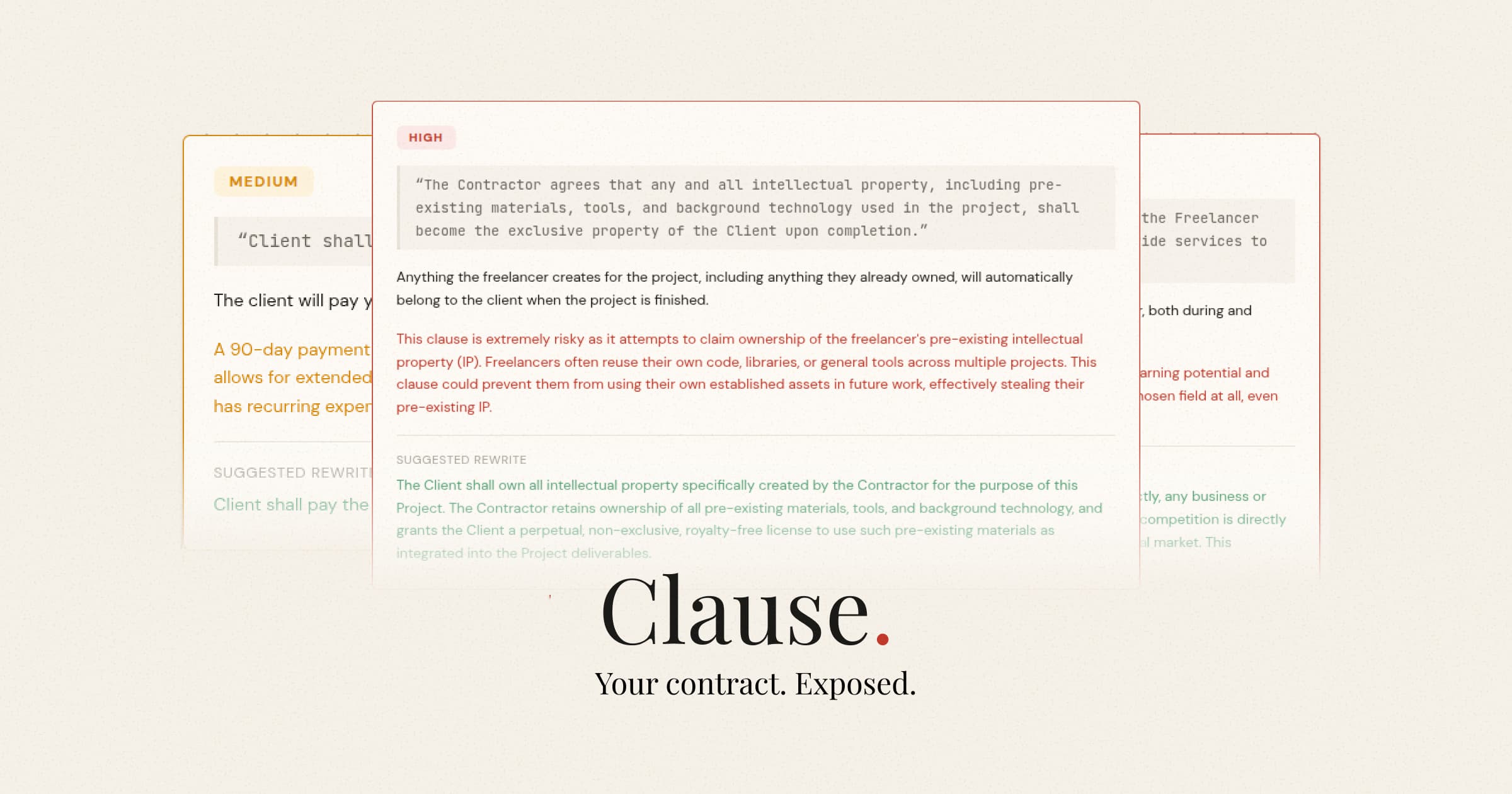
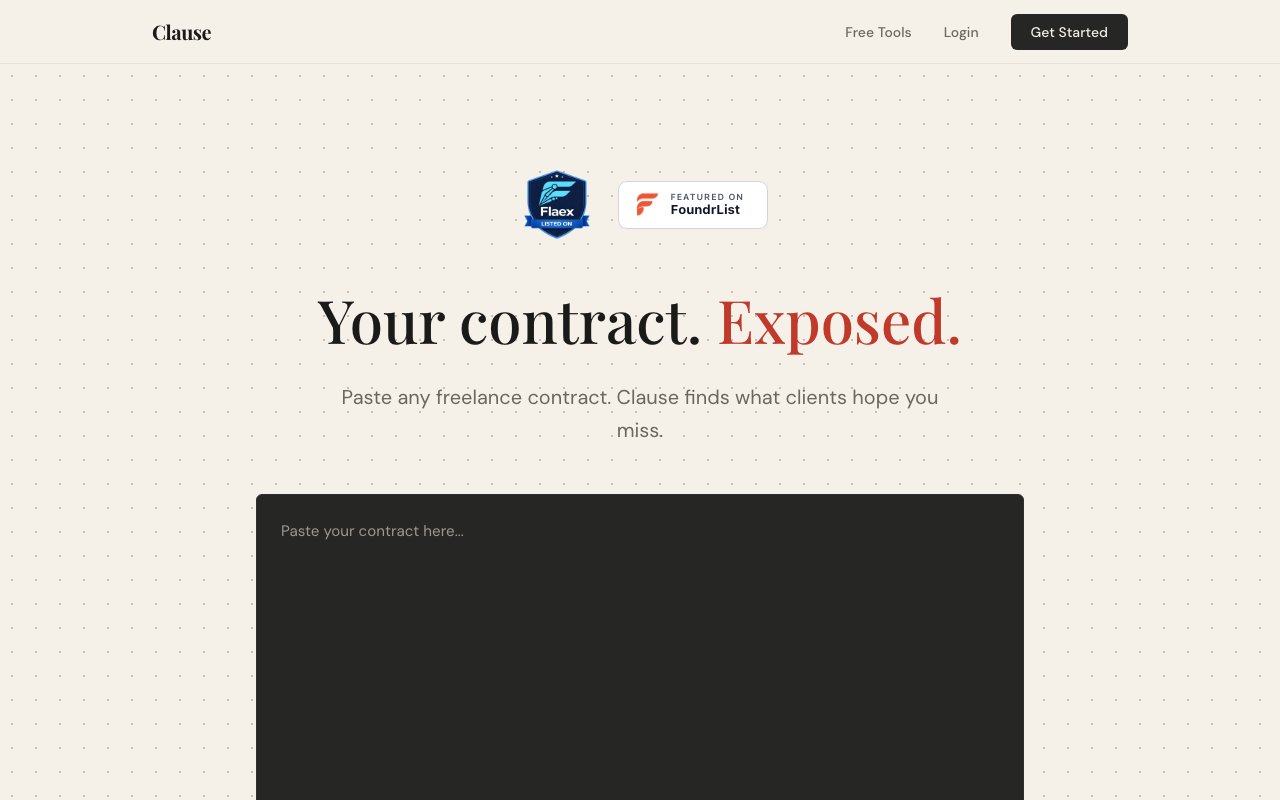
Clause is an AI contract scanner built for freelancers who sign agreements without a lawyer looking over their shoulder. You paste in the text of a contract, and it reviews the wording for terms that are stacked against you, flags the risky ones, explains in plain English why each is a problem, and suggests fairer language you can send back to the client. The goal is to catch a bad clause before you sign it rather than after it bites, when your only options are to eat the loss or pay a lawyer to unwind it.
The problem is one nearly every freelancer runs into. Clients send over contracts full of dense legal language, and reading them properly takes time and a level of legal literacy most solo workers don't have. So people skim, sign, and hope, and the one-sided terms only surface later when a payment is withheld, ownership of the work is disputed, or a non-compete blocks the next gig. Clause exists to make the risky parts obvious in the moment, without a lawyer's bill attached to the reading, so a freelancer can push back before the ink is dry instead of discovering the trap months into a project. The stakes are real, since a single bad clause can end up costing a freelancer far more than the project was ever worth.
It's tuned to spot six specific traps. It flags IP ownership grabs that hand your code and pre-existing work to the client, perpetual non-competes that bar you from working with competitors forever or on vaguely defined terms, and unlimited liability clauses that make you personally responsible for damages with no cap, all marked as high severity. It also flags hidden payment traps like ninety-day terms or discretionary withholding, one-sided termination where a client can cancel anytime with no pay for work already completed, and moral rights waivers that sign away your right to be credited as the creator of your own work, each marked medium severity. Putting a severity level on every finding helps you tell a genuine deal-breaker apart from something that's merely worth negotiating.
The workflow is three steps. You paste the contract text, the AI scans it for risks, and you get back the flagged clauses with plain-English explanations and rewritten versions. The rewrites are the part that turns it from a warning into something useful, because instead of just telling you a clause is bad it hands you wording you can actually propose in return, which is often the hardest part when you don't have a legal background. Knowing a clause is unfair is one thing, but knowing how to phrase the fairer version in a way a client will accept is another, and that's where the tool tries to do the heavy lifting.
Clause also ships a free statement of work generator as a separate tool. It walks through a short multi-step form covering the client and freelancer names, the project title, the start date, and further details across several steps, and produces a statement of work with protective terms built in. That serves the same audience from the other direction, helping a freelancer set up a fair scope document at the start of a project rather than only reacting to a client's paperwork after the fact. Between the scanner and the generator, the product covers both sides of a contract, checking what a client sends and helping you draft what you send back.
The intended user is a freelance developer handling their own contracts, though the same risks apply to plenty of other independent workers who sign client agreements alone. What makes Clause different from a general-purpose assistant is that it's built around the specific clauses freelancers get burned by, with severity levels and concrete rewrites rather than a vague summary that leaves you to figure out the fix. It's a focused tool, not a general legal chatbot, and it's upfront that it doesn't replace a real lawyer for anything genuinely high-stakes, where professional advice is still worth the cost.
Access is freemium. The first contract scan is free and doesn't require signing up, so you can run it on a real contract before committing to anything, and the statement of work generator is free to use as well. Getting the full rewrite features means creating an account. For a freelancer weighing a single questionable contract, the free scan is enough to see what the tool flags and how it grades the risk, and the account tier is there for anyone who wants to lean on it regularly as part of how they take on new work. Either way, nothing about the tool assumes you already know contract law, which is the whole reason a freelancer would reach for it instead of parsing the fine print alone.
Key Features
- AI scanning of freelance contracts
- Detection of six risky clause types
- Plain-English explanations of each risk
- Rewritten fairer clause suggestions
- Severity flags on flagged clauses
- Free statement of work generator
Pros & Cons
What we like
- First contract scan is free with no signup
- Explains legal risks in plain language
- Suggests fairer wording to send back to clients
- Built around the traps freelancers actually hit
Room for improvement
- Full rewrites require creating an account
- Aimed at freelance developers specifically
- Not a substitute for a real lawyer
- Younger product with a narrow focus
Frequently Asked Questions
What is Clause?
Is Clause free?
What does Clause catch?
Who is Clause for?
Best For
Featured in
Alternatives to Clause

Reviews (8)
Pulled its weight from week one
Hadn't planned on switching, but Clause was hard to ignore. The suggests fairer wording to send back to clients is more useful than I expected. Performance has been steady even when I lean on it hard. It fits well for rewriting an unfair clause to send back. It earns its place in my stack.
Worth a look
Found Clause on a Show HN thread and I am glad I clicked. It just works, day after day, without surprises. It fits well for understanding a confusing legal term in plain english. No regrets so far.
Exactly what I needed
Started using Clause casually, now it is pinned in my dock. Their take on free statement of work generator is genuinely good. The thing I keep coming back to is how reliable it is. Found it works best for generating a statement of work for a new project. Hard to imagine going back to my old setup.
Pulled its weight from week one
Picked Clause for the price, stayed for the quality. Support actually answered when I had a question, which surprised me. Recommending it to people in a similar spot.
Finally something that fits
Three months of Clause later, here is what holds up. Where it really wins is built around the traps freelancers actually hit. It slotted into my routine without much fuss. It fits well for rewriting an unfair clause to send back. No regrets so far.
It just works
Started using Clause casually, now it is pinned in my dock. Setup was painless and I was productive the same day. Mostly using it for understanding a confusing legal term in plain english. Easy yes for anyone weighing the same trade offs.
Powerful once it clicks
Found Clause on a Show HN thread and I am glad I clicked. It slotted into my routine without much fuss. The catch is younger product with a narrow focus. Worth it for what I get out of it.
Two months in, no regrets
Clause solves a real problem for me without making a fuss about it. Got real value out of severity flags on flagged clauses. Found it works best for generating a statement of work for a new project. Easy yes for anyone weighing the same trade offs.
Badge builder
Add Clause to your website
Choose a badge style and size, preview it here, then copy the generated HTML. Badge images are self-contained SVGs and do not require an external script.

<a href="https://toolindex.net/tools/clause?ref=badge" target="_blank" rel="noopener">
  <img src="https://toolindex.net/badge/clause/medium.svg" alt="Clause - Listed on Tool Index" width="180" height="50" />
</a>How to use the badge
- 1. Pick the style, size, and theme that fit your layout.
- 2. Copy the generated HTML from the code block.
- 3. Paste it into your footer, homepage, or press page.
Standard badge available
The standard listing badge is available now. Score and circle badges are limited to tools currently ranked in the top 10 of a category.
Badge clicks return visitors to this profile with a referral tag so the source remains identifiable.
Related Tools

Apatero AI
The creator studio for AI image, video, audio, 3D, and avatars, now at apatero.ai.
Kevin Gabeci Toolkits
Seven AI toolkits for writing books, making music, cutting video, and building agents.

Warp
The modern terminal reimagined with AI and collaboration

Bolt.new
Prompt-to-deployed full-stack app inside the browser
Work on Clause? Request listing access or correction