
Clixad
Terminal AI coding agent funded by optional ads and surveys instead of a subscription
Gallery
About Clixad
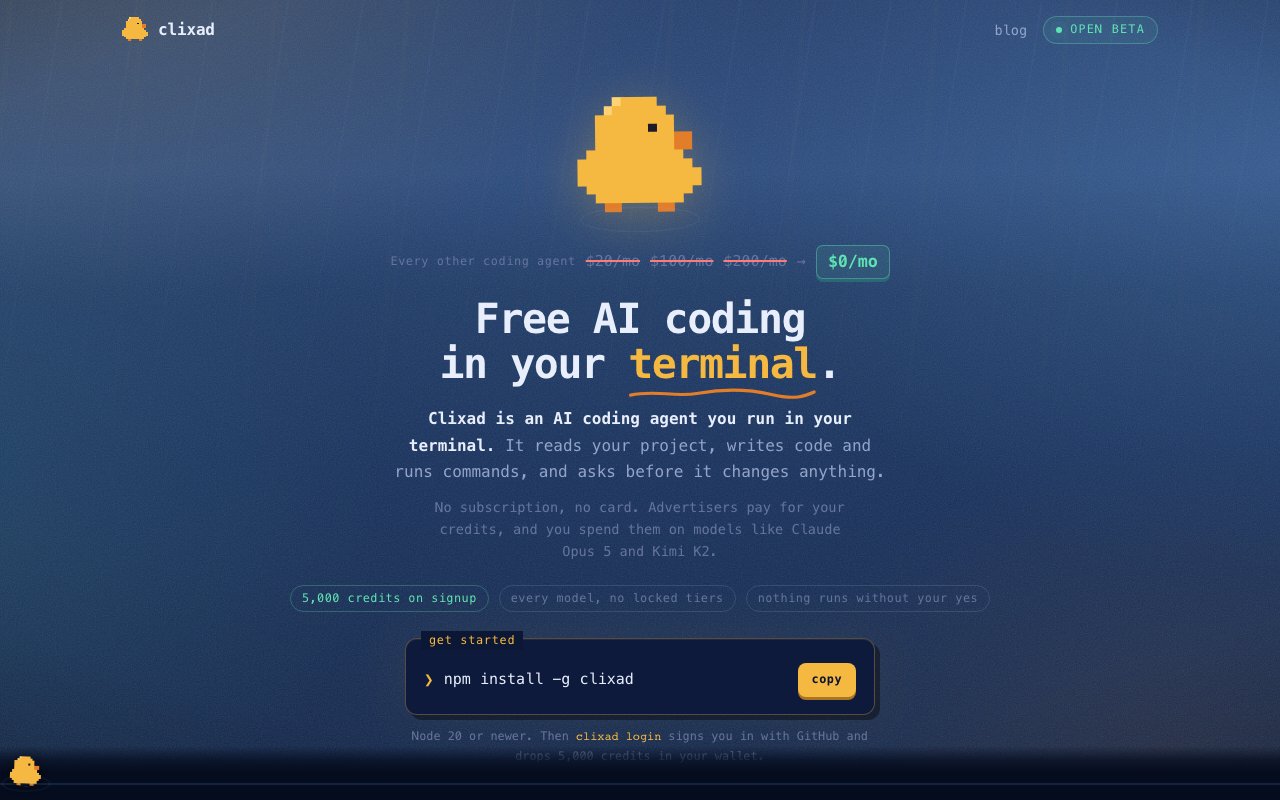
Clixad is an AI coding agent that runs in your terminal, and its twist is the business model rather than the agent itself. The pitch of a genuinely free coding agent sounds too good right up until you see how the money flows. Instead of charging a monthly subscription, it funds the model costs through an offerwall. You can earn credits by filling out short advertiser forms or surveys, and those credits pay for your coding turns. Advertisers pay Clixad, most of that revenue flows back to users as credits, and the result is a coding agent you can genuinely use without ever paying money for it.
The agent itself works the way you'd expect a modern terminal agent to work. It reads and searches your project files, writes and edits code, and runs commands like your test suite. The important safety property is that it never applies anything silently. Every change it wants to make is shown as a diff, and it waits for your approval before touching a file, so you stay in the loop on everything that lands in your codebase. Point it at a repo and it behaves like the category leaders in miniature, exploring the project to build context, proposing edits, and running your tests to check its own work, with you signing off on each step that touches disk.
Model access is where Clixad avoids the usual tiering games. There are no locked plans. Every user can pick from the same lineup, which currently spans Gemini 2.5 Flash-Lite, Kimi K2, Claude Haiku 4.5, Claude Sonnet 5, and Claude Opus 5. Stronger models simply cost more credits per turn, from 390 credits for a Gemini Flash-Lite turn up to 20,625 for Claude Opus 5. That makes the tradeoff concrete. A quick refactor can run on a cheap fast model while a gnarly architectural change gets the expensive one, and you decide per task rather than per plan. The visible numbers also make model pricing legible in a way flat subscriptions hide. When a Sonnet turn plainly costs about twenty times a Flash-Lite turn, you develop an instinct for which tasks deserve which model, and that instinct transfers to whatever tool you use next.
The economics are laid out plainly on the site. A form takes around three minutes and earns roughly forty cents worth of credits, surveys run six to sixteen minutes and pay between $0.45 and $3.00, and a single form typically funds anywhere from ten to over a hundred coding turns depending on which model you choose. New accounts start with 5,000 signup credits, enough to try the agent before deciding whether the earn-credits loop suits you. There's also an optional sponsored line that generates a small trickle of credits while you code, and buying credits with money is possible but never required.
Privacy gets a direct answer, which matters for anything ad-funded touching a codebase. The site states that your code, your prompts, and the name of your project are never sent to an advertiser. The advertising side sees the offerwall interactions you choose to complete, not your work, which keeps the two halves of the product cleanly separated. Setup is a standard npm install of the clixad package with Node.js 20 or later, sign-in happens through GitHub, and it runs on macOS, Linux, and Windows. There's no waitlist and no sales call, just an install command and a login.
An ad-funded coding tool earns skepticism by default, and Clixad seems to know it. The site reads like it was written to preempt the obvious objections, with the credit economics broken down to the cent, a demo of the agent actually working, and imprint and privacy pages where throwaway projects usually have none. None of that guarantees the funding model survives long term, but it's the presentation of a product that expects to be examined closely, not a bait page hoping you won't look.
The natural audience is developers who want agentic coding without another subscription on the pile. Students, hobbyists, and people in places where a $20 monthly plan is a real expense get the most from the earn-credits model, while anyone can use it as a zero-commitment way to try frontier models on real work. It's an unusual bargain, trading a few minutes of attention for model time, and Clixad is upfront about exactly what each side of that trade costs. The obvious worry, running dry mid-task, has a built-in answer. Spend a few minutes on the offerwall, drop to a cheaper model, or buy credits if your time is worth more than a form. There's no plan to expire and no tier to fall off, because there is no plan. As a free-first path into serious coding agents, there isn't much else structured like it.
Key Features
- Terminal agent that reads, edits, and runs code
- Diff review and approval before every change
- Five models from Gemini Flash-Lite to Claude Opus 5
- Credits earned through forms and surveys
- 5,000 signup credits to start
- Runs on macOS, Linux, and Windows via npm
Pros & Cons
What we like
- Usable for free with no subscription at all
- Every model available to every user, no locked tiers
- Nothing changes in your codebase without approval
- Code, prompts, and project names never reach advertisers
Room for improvement
- Earning credits takes real minutes of forms or surveys
- Top models burn credits quickly per turn
- Terminal-only, no editor integration
- Younger product with an unproven funding model
Frequently Asked Questions
What is Clixad?
Is Clixad really free?
Which models does Clixad support?
Does Clixad share my code with advertisers?
Best For
Featured in
Alternatives to Clixad
Cursor
VS Code fork built around an AI pair-programmer

Replit
Browser IDE plus Replit Agent that builds and deploys apps from a prompt
Windsurf
Codeium's AI editor with Cascade agent and deep IDE integration

Vibe Built
Building real apps with agentic AI. What worked, what broke, what shipped.
Reviews (0)
Badge builder
Add Clixad to your website
Choose a badge style and size, preview it here, then copy the generated HTML. Badge images are self-contained SVGs and do not require an external script.

<a href="https://toolindex.net/tools/clixad?ref=badge" target="_blank" rel="noopener">
  <img src="https://toolindex.net/badge/clixad/medium.svg" alt="Clixad - Listed on Tool Index" width="180" height="50" />
</a>How to use the badge
- 1. Pick the style, size, and theme that fit your layout.
- 2. Copy the generated HTML from the code block.
- 3. Paste it into your footer, homepage, or press page.
Standard badge available
The standard listing badge is available now. Score and circle badges are limited to tools currently ranked in the top 10 of a category.
Badge clicks return visitors to this profile with a referral tag so the source remains identifiable.
Related Tools

Bolt.new
Prompt-to-deployed full-stack app inside the browser

Tabnine
Privacy-first enterprise AI code assistant you control, with SaaS, VPC, on-prem, or fully air-gapped deployment
Cursor
VS Code fork built around an AI pair-programmer

Skeezo
Agent-native macOS IDE for coordinating Claude Code and AI agents
Work on Clixad? Request listing access or correction