
Crawlie Search
Fast site search built from your existing crawl data, priced far under hosted incumbents
Gallery
About Crawlie Search
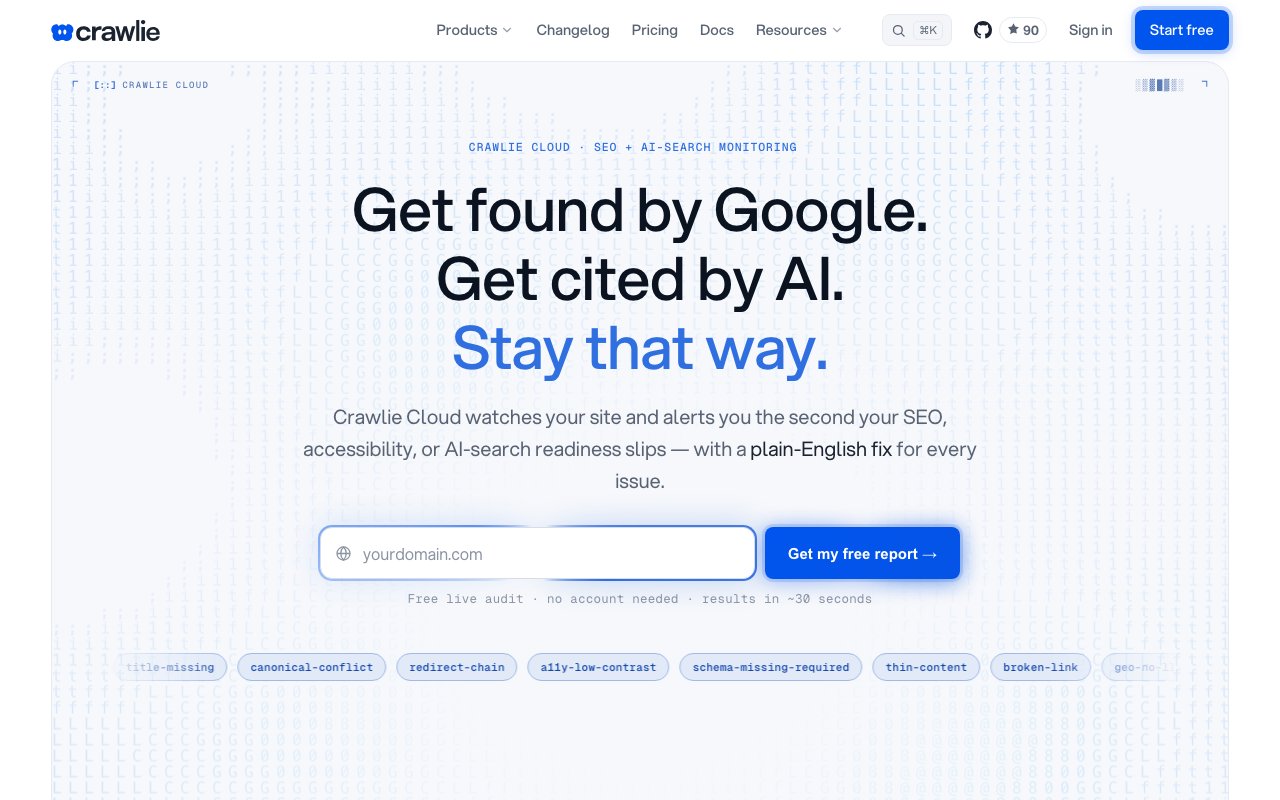
Crawlie Search is a hosted site-search product that builds its index straight from web crawls you've already run. It's one piece of Crawlie Cloud, a broader platform that crawls a site once and turns that data into several products, and Search is the part that gives visitors a fast way to find things on your pages. The pitch is plain, blazing-fast site search without the cost, set up in minutes. The problem it targets is the price and plumbing of traditional hosted search. Tools in that space often charge per record and per index operation, and they expect you to build and maintain a separate pipeline that pushes your content into their service. Crawlie skips that step because the crawl it already ran is the source, so there's no extra ingestion job to stand up or keep in sync.
The search itself is hybrid. It combines exact-match queries with semantic matching, so a visitor can type a precise term or ask a natural-language question and still land on the right page. Ranking uses BM25, a well-understood relevance model, and it handles typo tolerance and phrase queries so small mistakes and quoted strings both behave the way people expect. Because the index comes from the same crawl that powers the rest of the platform, the content stays consistent with what Crawlie already knows about the site. You aren't maintaining two versions of your data, one for monitoring and one for search, which is part of the appeal of doing the crawl once and reusing it everywhere.
Getting it onto a site is deliberately light. Paste a single script tag and you get a polished command-K style search dialog, the familiar keyboard-driven overlay, with keyboard controls, dark mode, and mobile handling already built in. If you'd rather own the interface, you can skip the widget and query a public JSON API directly, wiring results into your own front end. It's also agent-native. A hosted MCP endpoint lets Claude, Cursor, and any other MCP client query the same index, and there's a REST API alongside it, so the search that serves human visitors can also answer questions coming from AI tools without a second setup.
On top of serving queries, Crawlie Search reports on them. An analytics dashboard shows the top queries people are running and, more usefully, the content gaps where searches came back with nothing. That second view is a quiet content-strategy tool. If visitors keep searching for something the site doesn't cover, the dashboard makes that demand visible so a team can decide whether to write the page. It turns the search box into a feedback channel about what an audience actually wants, rather than just a way to move people around existing pages, and because it's tied to the crawl data the platform already holds, the picture stays current as the site changes.
Price is where Crawlie leans hardest on the comparison. It puts its own cost next to Algolia directly, and for 250,000 monthly searches it frames Algolia Grow at around $120 a month against its own figure of nothing during beta and roughly $6 at general availability. It's blunt that there are no per-record or indexing fees, ever, which is the charge that tends to inflate bills on record-priced search services. That makes it a natural fit for developers, side-project owners, and small teams who want real search on a site without an enterprise-sized invoice, especially anyone who already needed a crawler for SEO or monitoring and would rather not pay a second vendor for search.
On access, the product is free during beta, with searches and cited answers both carrying no charge while it's in that phase. At general availability the plan is usage-based rather than seat-based, with somewhere between 10,000 and 1,000,000 included monthly searches depending on the tier, overage billed at four cents per thousand searches, and cited answers priced at one dollar per thousand generations drawn from a prepaid wallet. The wider Crawlie Cloud platform it belongs to runs its own tiered plans, from a free Hobby level up through paid Pro, Business, and Scale plans, so a team can adopt search on its own or alongside the crawling, SEO, and monitoring pieces. The crawler engine underneath is open-source, published under an MIT license and installable from npm, with a command-line tool and a desktop app for people who want to run crawls locally before pushing anything to the hosted service, and it scales to as much as a million pages in a single crawl. Custom plans are available for larger deployments, and the same crawl feeds all of it.
Key Features
- Search index built from crawl data
- Hybrid exact and semantic matching
- BM25 ranking with typo tolerance
- One-script-tag search widget
- Public JSON query API
- Hosted MCP endpoint for AI clients
Pros & Cons
What we like
- No per-record or indexing fees
- Drops in with a single script tag
- Reuses existing crawl data, no separate pipeline
- Analytics surface top queries and content gaps
Room for improvement
- General-availability pricing still being finalized
- Search quality depends on crawl coverage
- Younger product tied to the broader Crawlie platform
- Cited answers cost extra beyond plain search
Frequently Asked Questions
What is Crawlie Search?
How much does Crawlie Search cost?
How does it compare to Algolia?
How do I add it to my site?
Best For
Featured in
Alternatives to Crawlie Search
View all
1Lookup
Real-time data verification API for phone, email, IP, and domain validation to fight fraud

Kevin Gabeci
Solo developer building web apps, cozy browser games, and AI creator toolkits.

Codedex
A gamified, story-driven platform that teaches Python, web dev, and more like an RPG quest
Hack2hire
Practice real SDE interview questions from top tech companies with expert worked solutions
Reviews (10)
Decent with some rough edges
Tried Crawlie Search on a side project first, then rolled it out everywhere. The interface stays out of my way, which I appreciate. My only gripe is search quality depends on crawl coverage. Hard to imagine going back to my old setup.
Pulled its weight from week one
Three months of Crawlie Search later, here is what holds up. Their take on search index built from crawl data is genuinely good. Mostly using it for replacing a pricey hosted search bill. Worth it for what I get out of it.
It just works
Tried Crawlie Search on a side project first, then rolled it out everywhere. Got real value out of no per-record or indexing fees. Mostly using it for letting ai clients query a site over mcp.
Solid but not perfect
Found Crawlie Search on a Show HN thread and I am glad I clicked. Got real value out of no per-record or indexing fees. Found it works best for spotting content gaps from real search queries. My only gripe is cited answers cost extra beyond plain search. Recommending it to people in a similar spot.
Solid daily driver
Picked Crawlie Search for the price, stayed for the quality. What stands out is how it handles bm25 ranking with typo tolerance.
Quietly excellent
Crawlie Search has quietly become part of my daily flow. Where it really wins is no per-record or indexing fees. Recommending it to people in a similar spot.
Finally something that fits
Picked Crawlie Search for the price, stayed for the quality. The one-script-tag search widget is more useful than I expected. It fits well for spotting content gaps from real search queries. Easy yes for anyone weighing the same trade offs.
Pulled its weight from week one
Started using Crawlie Search casually, now it is pinned in my dock. Got real value out of hosted mcp endpoint for ai clients. The interface stays out of my way, which I appreciate. No regrets so far.
Good, with a few caveats
Came to Crawlie Search after getting frustrated with what I had before. Got real value out of one-script-tag search widget. The output quality holds up better than I expected. One thing that bugs me is cited answers cost extra beyond plain search. It earns its place in my stack.
Genuinely impressed
Crawlie Search has quietly become part of my daily flow. The one-script-tag search widget is more useful than I expected. The defaults are sensible, so I was not fighting settings on day one. It fits well for spotting content gaps from real search queries. Worth it for what I get out of it.
Badge builder
Add Crawlie Search to your website
Choose a badge style and size, preview it here, then copy the generated HTML. Badge images are self-contained SVGs and do not require an external script.

<a href="https://toolindex.net/tools/crawlie-search?ref=badge" target="_blank" rel="noopener">
  <img src="https://toolindex.net/badge/crawlie-search/medium.svg" alt="Crawlie Search - Listed on Tool Index" width="180" height="50" />
</a>How to use the badge
- 1. Pick the style, size, and theme that fit your layout.
- 2. Copy the generated HTML from the code block.
- 3. Paste it into your footer, homepage, or press page.
Standard badge available
The standard listing badge is available now. Score and circle badges are limited to tools currently ranked in the top 10 of a category.
Badge clicks return visitors to this profile with a referral tag so the source remains identifiable.
Related Tools
Kevin Gabeci
Solo developer building web apps, cozy browser games, and AI creator toolkits.

Coolify
Self-hostable, open source alternative to Heroku and Netlify

Warp
The modern terminal reimagined with AI and collaboration

Bolt.new
Prompt-to-deployed full-stack app inside the browser
Work on Crawlie Search? Request listing access or correction