
Deft
AI writing built on distribution fine-tuning so drafts read like human prose, not LLM slop
Gallery
About Deft
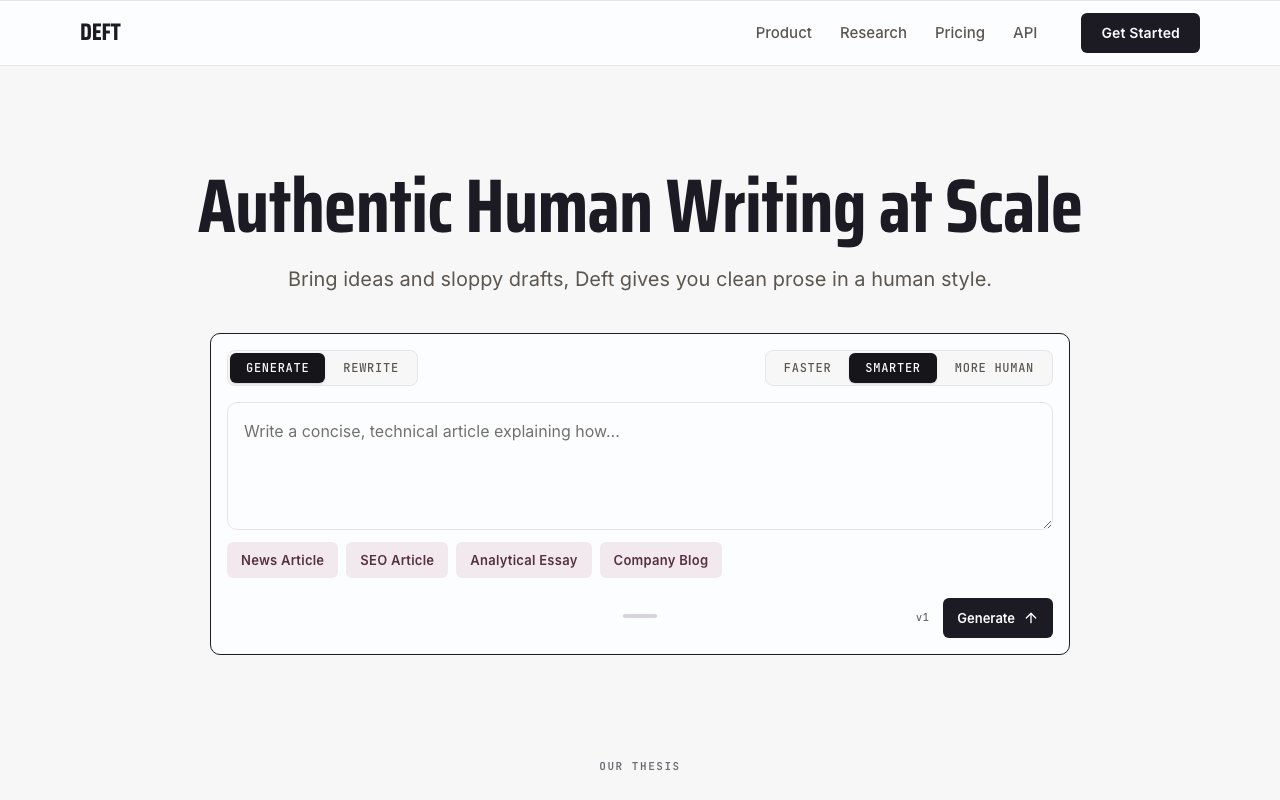
Deft is an AI writing tool built on a technique its team calls distribution fine-tuning, a training method aimed at one specific failure of large language models, the fact that their prose sounds like a machine wrote it. Instead of wrapping a general-purpose model in clever prompts and style instructions, Deft trains on human prose so that what comes out reads like writing instead of what the company bluntly calls LLM slop. The workflow is simple to state. You bring ideas, notes, or sloppy drafts, and Deft gives you back clean prose in a human style, without the tics that make AI text so easy to spot at a glance. The name of the technique is doing real work here, the tool's whole identity is a training method, and the company's pitch is that this is what it actually takes to make AI writing publishable.
The problem it targets will be familiar to anyone who publishes with AI in the loop. Off-the-shelf models produce text with a recognizable statistical fingerprint, the same rhythms, the same hedges, the same tidy transitions in every paragraph, and readers have learned to smell it. Editing that voice out by hand often takes as long as writing from scratch, which defeats the point of using the tool at all. Deft's position is that this problem lives inside the model itself and has to be fixed at training time. No amount of prompting fixes a distribution problem, so the company built a model where the distribution is the product.
That model is DFT v1, trained on the distribution of real human writing, and the team has published research on the method in a paper titled Fixing LLM Writing with Distribution Fine-Tuning. The stated goal is authentic human writing at scale, meaning systems that amplify human thought without introducing hallucinations, distorting the author's intent, or flattening the author's voice. Those three failure modes cover most of what goes wrong when professionals try to hand real work to a language model, so it's a sensible list to build against, and it's refreshing that the company names them outright instead of promising magic.
In practice you work through the Console, a writing surface where you submit ideas or rough drafts and get finished prose back. The Console keeps a generation history so you can return to earlier outputs, supports public share links for passing a draft to a colleague, and includes a bad-output reporting flow so you can flag results that miss the mark, which feeds back into the lab's training work. The reporting loop is a small thing, but it signals how the lab operates, output quality is treated as a research problem with a feedback channel rather than a settled feature. For teams that want Deft inside their own products or pipelines there's a token-priced API, plus two prebuilt agents, an SEO Agent for search-focused content and a Rewriter Agent that turns existing drafts into cleaner prose.
The audience is anyone who knows what they want to say but doesn't want to spend hours sanding AI output into something publishable. That covers solo writers and professionals turning hard-won expertise into articles and essays, and it extends to content marketers and publishers building bespoke workflows that pair AI generation with human judgment. If you've ever pasted a chatbot draft into a document and then rewritten most of it by hand, you're exactly the person this tool is aimed at. It also fits teams that already have a voice on the page and don't want a tool that sands it off.
What separates Deft from the crowd of AI writing assistants is that it isn't a prompt wrapper. Most tools in this category sit on top of the same handful of foundation models and try to fix the writing problem downstream with tone sliders and brand-voice settings. Deft's bet is more fundamental, and it's backed by published research rather than marketing copy, which gives you something concrete to evaluate before you pay for anything. It's a young product from a small lab, but it's taking the problem more seriously at a technical level than most of its competitors do.
Pricing is freemium with a genuinely usable free tier. You get two requests per day at no cost with no card required, enough to judge the output quality on your own material before committing. Paid plans start at $15 a month for 200 generations, move to $49 for 800 on the Pro plan, and top out at $99 for 2,000 generations a month, with every paid tier including commercial use of the web app. API access is metered at $2.50 per million input tokens and $12 per million output and thinking tokens, and failed generations aren't charged. Enterprise buyers can book a call to discuss API access at scale, custom model tuning, and tailored DFT systems built around their own content.
Key Features
- DFT v1 human-prose model
- Writing Console with generation history
- Token-priced developer API
- SEO Agent for search content
- Rewriter Agent for existing drafts
- Public share links and output reporting
Pros & Cons
What we like
- Trained specifically against the AI-sounding prose problem
- Published research paper backs the method
- Free tier needs no card to try
- API and agents make it embeddable in real pipelines
Room for improvement
- Young product from a small lab
- Free tier is capped at two requests per day
- No published support email, enterprise contact runs through a booking call
- Generation caps on paid plans rather than unlimited use
Frequently Asked Questions
What is Deft?
Is Deft free?
How is Deft different from other AI writing tools?
Who is Deft for?
Best For
Featured in
Alternatives to Deft

Wordtune
AI rewriting and editing assistant by AI21 Labs that rephrases, adjusts tone, and shortens or expands your text

QuillBot
AI paraphraser, grammar checker, summarizer, and citation suite in one writing workspace
Rytr
Budget-friendly AI writing assistant with 40+ use cases, 20+ tones, and a free tier built for fast, affordable copy

Prompt Larder
A small shelf of prompts that were actually run, labelled with the model and the reason they work.
Reviews (0)
Badge builder
Add Deft to your website
Choose a badge style and size, preview it here, then copy the generated HTML. Badge images are self-contained SVGs and do not require an external script.

<a href="https://toolindex.net/tools/deft?ref=badge" target="_blank" rel="noopener">
  <img src="https://toolindex.net/badge/deft/medium.svg" alt="Deft - Listed on Tool Index" width="180" height="50" />
</a>How to use the badge
- 1. Pick the style, size, and theme that fit your layout.
- 2. Copy the generated HTML from the code block.
- 3. Paste it into your footer, homepage, or press page.
Standard badge available
The standard listing badge is available now. Score and circle badges are limited to tools currently ranked in the top 10 of a category.
Badge clicks return visitors to this profile with a referral tag so the source remains identifiable.
Related Tools
Rytr
Budget-friendly AI writing assistant with 40+ use cases, 20+ tones, and a free tier built for fast, affordable copy
Prompt Larder
A small shelf of prompts that were actually run, labelled with the model and the reason they work.
QuillBot
AI paraphraser, grammar checker, summarizer, and citation suite in one writing workspace
Wordtune
AI rewriting and editing assistant by AI21 Labs that rephrases, adjusts tone, and shortens or expands your text
Work on Deft? Request listing access or correction