
Episko
Native desktop app for managing multiple Claude Code AI agent sessions with real terminals and live telemetry
Gallery
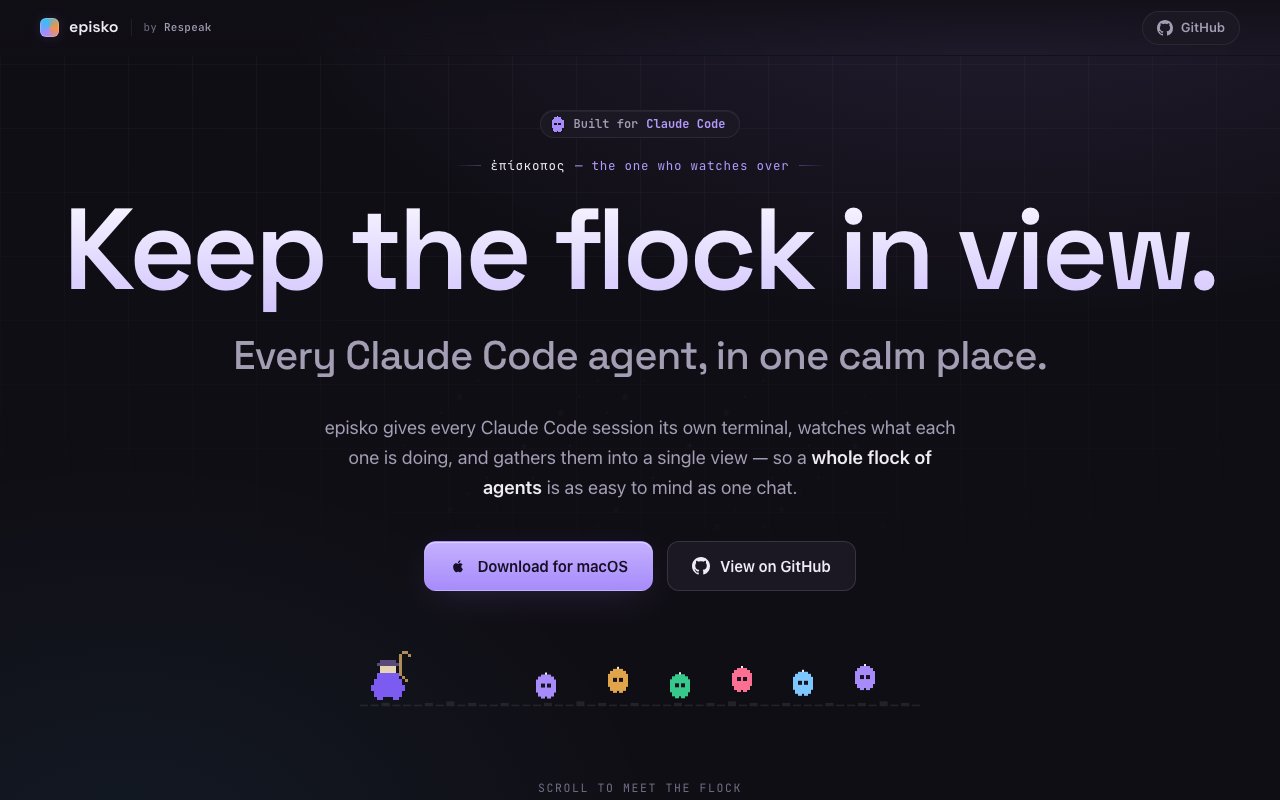
About Episko
Episko is a native desktop application built specifically for developers who run multiple Claude Code sessions at the same time. It solves a real problem that emerges once you start relying on AI coding agents for serious work. Without something like this, juggling several Claude Code instances means flipping between terminal windows, losing track of what each agent is doing, and having no unified view of how much you're spending or how close you are to hitting usage limits. Episko wraps all of that into a single interface where every session appears in one dashboard with live telemetry showing model, context window usage, cost, and duration for each running agent.
The application works by launching the actual Claude Code CLI under the hood, so each session runs in a genuine interactive terminal rather than some stripped down reimplementation or recording playback. Users can choose between an embedded terminal view or external options like Ghostty, Terminal.app, or iTerm2 on macOS. What makes this especially useful is the permission prompt handling. When Claude Code asks for approval to run a tool or access a file, developers can allow or deny the request directly inside Episko without switching contexts or hunting for the right terminal window. This alone saves significant friction when multiple agents are requesting permissions simultaneously across different projects, which happens constantly during complex refactoring or multi-repository work.
Beyond session supervision, Episko integrates task running so you can execute VS Code tasks, justfile commands, package.json scripts, Taskfile entries, mise tasks, Makefiles, or Cargo commands in the same panes where agents work. These tasks receive the same status tracking and telemetry as Claude Code sessions, which means everything about a project's active work lives in one place rather than scattered across terminals and editor windows. The command palette accessible via Cmd+K lets developers jump between sessions instantly and launch new projects without navigating menus. Git worktree awareness means the app understands when you're working across multiple branches of the same repository and keeps those sessions organized accordingly.
The analytics dashboard provides visibility into spending and usage patterns that Anthropic's own interface doesn't surface at the session level. Developers see a daily spend heatmap showing when they're most actively using AI assistance, tokens broken down by model so you know whether Opus or Sonnet is eating your budget, and cost aggregated per project for tracking which codebases consume the most resources. There's also five hour and weekly usage limit tracking with pace forecasting, so anyone on a capped plan can see whether they're burning through their allocation too fast and need to throttle back or wait for the limit to reset.
Session discovery works even for Claude Code instances started outside the app. If you launch Claude Code from a terminal or another tool, Episko detects it and surfaces the session in its dashboard automatically. This means you can adopt the app gradually without changing your existing workflow, and stray sessions don't disappear from your monitoring view just because they weren't started through the Episko interface. Session restoration works through Claude Code's own transcripts, meaning work isn't lost if the app restarts or crashes mid-session. The transcript contains everything needed to resume where you left off.
On the technical side, Episko runs entirely locally with no telemetry sent to any external server. State lives on the user's machine and stays there. The app is built on Tauri using Rust and TypeScript, combining native performance with modern web UI patterns. It ships under the MIT license as open source, developed by Respeak GmbH based in Karlsruhe, Germany. This is an independent project with no affiliation to Anthropic despite being purpose built for Claude Code integration. There's no fixed limit on concurrent sessions beyond what the machine's resources and Anthropic's usage caps allow. For teams that split work across multiple agents tackling different parts of a codebase simultaneously, this means running as many instances as practical without artificial restrictions.
Platform support currently covers macOS on Apple silicon along with Windows 10 and 11. Linux packaging isn't available yet but given the open source nature of the project that could change based on community contributions. The application itself is free with no subscription or payment required. Users need an existing Claude Code subscription or API access from Anthropic since Episko is a wrapper and orchestration layer rather than a replacement for the underlying AI service. For developers already paying for Claude Code who want centralized control over their agent fleet, usage tracking across projects, and streamlined permission handling, Episko adds that coordination layer without any additional cost.
Key Features
- Multi session Claude Code management
- Real PTY terminals via xterm.js or external apps
- Live telemetry for tokens, costs, and context usage
- In app permission prompt handling
- Usage forecasting for rate limit awareness
- Git worktree aware session launching
Pros & Cons
What we like
- Runs real terminals instead of log replays
- Centralizes permission prompts across parallel agents
- Usage tracking helps avoid hitting rate limits
- Open source and runs entirely locally
Room for improvement
- Requires your own Claude Code access from Anthropic
- Linux builds not yet available
- Apple silicon only on macOS, no Intel support
- Newer tool with a smaller user community
Frequently Asked Questions
What is Episko?
Is Episko free?
What platforms does Episko support?
Does Episko send data to external servers?
Best For
Featured in
Alternatives to Episko
Cursor
VS Code fork built around an AI pair-programmer

Replit
Browser IDE plus Replit Agent that builds and deploys apps from a prompt
Windsurf
Codeium's AI editor with Cascade agent and deep IDE integration

Vibe Built
Building real apps with agentic AI. What worked, what broke, what shipped.
Reviews (0)
Badge builder
Add Episko to your website
Choose a badge style and size, preview it here, then copy the generated HTML. Badge images are self-contained SVGs and do not require an external script.

<a href="https://toolindex.net/tools/episko?ref=badge" target="_blank" rel="noopener">
  <img src="https://toolindex.net/badge/episko/medium.svg" alt="Episko - Listed on Tool Index" width="180" height="50" />
</a>How to use the badge
- 1. Pick the style, size, and theme that fit your layout.
- 2. Copy the generated HTML from the code block.
- 3. Paste it into your footer, homepage, or press page.
Standard badge available
The standard listing badge is available now. Score and circle badges are limited to tools currently ranked in the top 10 of a category.
Badge clicks return visitors to this profile with a referral tag so the source remains identifiable.
Related Tools

Bolt.new
Prompt-to-deployed full-stack app inside the browser

Tabnine
Privacy-first enterprise AI code assistant you control, with SaaS, VPC, on-prem, or fully air-gapped deployment
Cursor
VS Code fork built around an AI pair-programmer

Skeezo
Agent-native macOS IDE for coordinating Claude Code and AI agents
Work on Episko? Request listing access or correction