
FlexInference
Deadline-aware LLM router that finds cheaper inference inside the time you allow
Gallery
About FlexInference
FlexInference is a deadline-aware router for large language model requests. It sits between an application and the model providers it already calls, then tries to run the exact same request on a cheaper tier whenever there's enough time to pull it off. The site puts it plainly, "we find you cheaper inference within the time you provide." The problem it goes after is that inference bills grow with usage and most teams have very few levers to pull. You can downgrade to a weaker model, trim prompts, or cut output budgets, and all three cost you quality. FlexInference takes a different angle by leaving the request completely alone and changing only the tier that serves it. Your chosen model, output budget, thinking configuration, and tool use all stay exactly as you set them.
The mechanism is one new field called start_within. Set it to default, priority, auto, or a duration between five seconds and ten minutes, and FlexInference races a cheaper flex tier against the standard one inside that window. If flex can start in time, you get the same answer for less. If it can't, the request escalates to the standard tier before flex writes a single output token, so there's no half-finished response to pay for and no commission on the miss. Requests sent without a time budget skip the race entirely and go straight to standard at standard cost, which makes this something you opt into per request rather than a global behavior change you have to reason about later.
The demos on the site give a decent sense of where the trade actually lands. A Gemini image classification workload came out 38.9 percent cheaper for 20.2 percent more latency. An OpenAI deep research run landed 44.8 percent cheaper and, oddly enough, 30.1 percent faster. A browser agent came in 51.5 percent cheaper for 9.7 percent more latency. The pattern is that work which tolerates a short wait, meaning batch jobs, background agents, and research pipelines, benefits most, while anything a user is actively watching load is a poorer fit for a long deadline.
You bring your own provider key, so the provider still bills you directly and your credits, discounts, negotiated rates, and API tiers stay yours. The API is OpenAI-compatible, which means existing clients work by pointing the base URL at FlexInference and passing a FlexInference key. It covers OpenAI, Gemini, and Anthropic, though Anthropic is proxy-only and doesn't get the flex race or the savings that come with it. You can still call any Claude model through the unified endpoint or use the Anthropic Messages format directly, and you draw down your own Anthropic credits either way. Python and TypeScript SDKs exist for teams that want strict types, but they're optional rather than required.
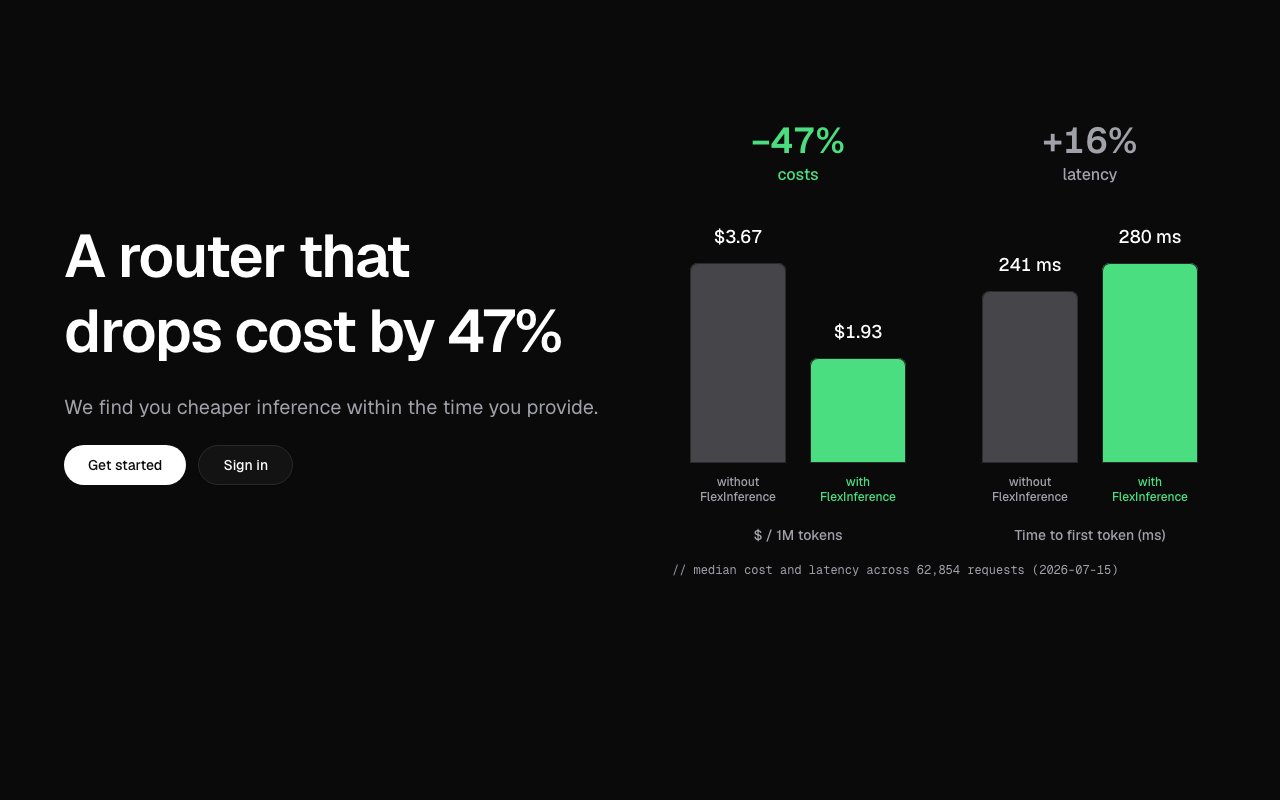
The published numbers are specific enough to argue with. Median cost across 62,854 requests came in roughly 47 percent lower with about 16 percent more time to first token, and an earlier 10,000-request benchmark from June 2026 put blended savings at 40 to 50 percent for under 10 percent added latency. Routing runs on Cloudflare Workers across 300 or so cities and adds one to five milliseconds on a cold start. Prompts and replies pass through without being stored or read, and provider keys are envelope-encrypted with AES-256-GCM and locked to a single org and provider slot, so a key that won't decrypt gets treated as missing rather than quietly reused somewhere it shouldn't be.
Several design choices are aimed squarely at people who've been burned by other proxies. FlexInference fails fast and loud rather than silently stripping a parameter you set to force a request through, and provider rejections come back with the real status code attached so you debug against your actual intent. Errors arrive in the shape of the SDK you called and carry a machine-readable code, the exact fix, and a doc_url, which means an agent can often correct itself on the first try. There's an MCP server too, letting Claude, Cursor, and other MCP clients search the docs, look up error codes, and manage keys over OAuth without leaving the editor. It never runs inference and never takes a raw provider key. Optional upstream retries run from one to five attempts with exponential or linear backoff plus jitter, honor a provider's Retry-After header, and only fire before the response commits.
Pricing is unusual and worth understanding before wiring it in. Standard, priority, and auto routing carry no fee at all, and neither do Anthropic proxy requests, so there's no seat count, no tier, and no trial to get past. When a flex request actually beats the standard price, FlexInference keeps 20 percent of what it saved you, which the site illustrates as a $10 request dropping to $5 for a $1 fee and a $6 bill. Commission accrues per request and gets billed monthly once your balance passes $20, with smaller balances carried forward and settled at least every three months. If a payment goes past due, priced flex pauses and returns a 402 while free routing keeps working. Lexical caching and retries work today, while semantic caching, fallback providers, and automatic model selection are all listed as coming soon.
Key Features
- Deadline-aware flex tier racing
- OpenAI-compatible drop-in base URL
- Bring your own provider key
- Edge routing on Cloudflare Workers
- MCP server for docs and keys
- Machine-readable errors with fix guidance
Pros & Cons
What we like
- Standard requests stay free, so routing costs nothing by default
- Never swaps your model, rewrites your prompt, or alters the output
- Existing OpenAI, Gemini, and Anthropic clients work unchanged
- Commission only applies when a request actually saves money
Room for improvement
- Anthropic is proxy-only and gets no flex savings
- Savings depend on how long a deadline you can afford to set
- Semantic caching, fallbacks, and auto model selection aren't shipped yet
- Flex routing adds a modest latency penalty on routed requests
Frequently Asked Questions
What is FlexInference?
How much does FlexInference save?
Is FlexInference free?
Does FlexInference change my model or prompt?
Best For
Featured in
Alternatives to FlexInference

1Lookup
Real-time data verification API for phone, email, IP, and domain validation to fight fraud

Kevin Gabeci
Solo developer building web apps, cozy browser games, and AI creator toolkits.

Codedex
A gamified, story-driven platform that teaches Python, web dev, and more like an RPG quest
Hack2hire
Practice real SDE interview questions from top tech companies with expert worked solutions
Reviews (9)
It just works
Have been running FlexInference for a while, here is where I land. Their take on openai-compatible drop-in base url is genuinely good. Glad I made the switch.
Exactly what I needed
Started using FlexInference casually, now it is pinned in my dock. The openai-compatible drop-in base url is more useful than I expected. It does what it says, which is rarer than it should be. Found it works best for keeping provider credits and negotiated rates while lowering bills. Glad I made the switch.
Pulled its weight from week one
FlexInference solves a real problem for me without making a fuss about it. What stands out is how it handles commission only applies when a request actually saves money.
Genuinely impressed
Hadn't planned on switching, but FlexInference was hard to ignore. Performance has been steady even when I lean on it hard. Would sign up again without thinking twice.
Recommended without reservation
Tried FlexInference on a side project first, then rolled it out everywhere. Got real value out of bring your own provider key. It just works, day after day, without surprises. Mostly using it for trimming costs on deep research and classification pipelines. It earns its place in my stack.
It just works
Found FlexInference on a Show HN thread and I am glad I clicked. Where it really wins is deadline-aware flex tier racing. Mostly using it for trimming costs on deep research and classification pipelines. Glad I made the switch.
Pulled its weight from week one
FlexInference has quietly become part of my daily flow. Got real value out of standard requests stay free, so routing costs nothing by default. It does what it says, which is rarer than it should be. Found it works best for trimming costs on deep research and classification pipelines. Hard to imagine going back to my old setup.
Genuinely impressed
Tried FlexInference on a side project first, then rolled it out everywhere. Where it really wins is bring your own provider key. It slotted into my routine without much fuss. Found it works best for routing background agent work that can wait a few minutes.
It just works
Picked FlexInference for the price, stayed for the quality. Their take on bring your own provider key is genuinely good. Support actually answered when I had a question, which surprised me. Mostly using it for routing background agent work that can wait a few minutes.
Badge builder
Add FlexInference to your website
Choose a badge style and size, preview it here, then copy the generated HTML. Badge images are self-contained SVGs and do not require an external script.

<a href="https://toolindex.net/tools/flexinference?ref=badge" target="_blank" rel="noopener">
  <img src="https://toolindex.net/badge/flexinference/medium.svg" alt="FlexInference - Listed on Tool Index" width="180" height="50" />
</a>How to use the badge
- 1. Pick the style, size, and theme that fit your layout.
- 2. Copy the generated HTML from the code block.
- 3. Paste it into your footer, homepage, or press page.
Standard badge available
The standard listing badge is available now. Score and circle badges are limited to tools currently ranked in the top 10 of a category.
Badge clicks return visitors to this profile with a referral tag so the source remains identifiable.
Related Tools
Kevin Gabeci
Solo developer building web apps, cozy browser games, and AI creator toolkits.

Coolify
Self-hostable, open source alternative to Heroku and Netlify

Warp
The modern terminal reimagined with AI and collaboration

Bolt.new
Prompt-to-deployed full-stack app inside the browser
Work on FlexInference? Request listing access or correction