
Gusto
Payroll, benefits, and HR for US small businesses
Gallery
About Gusto
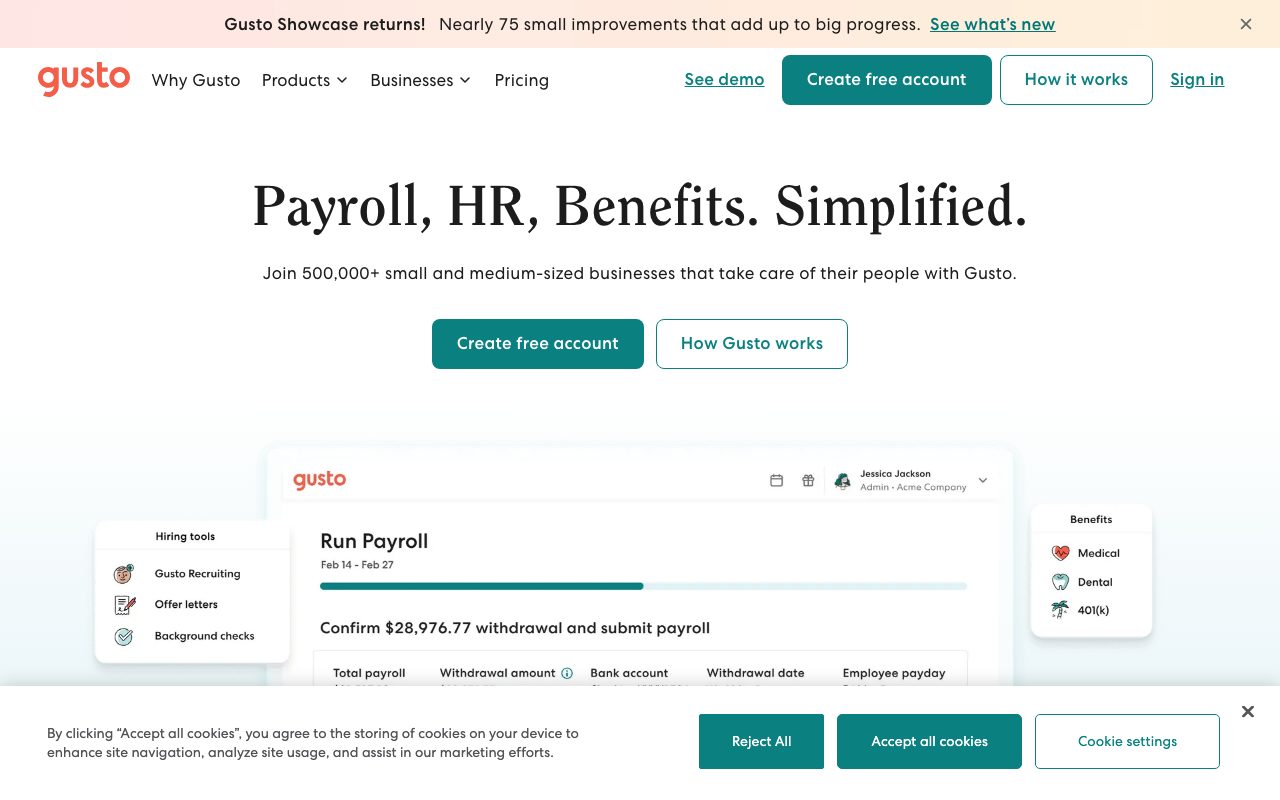
Gusto is the payroll provider that small businesses actually look forward to running. You set up direct deposit. You add your team. Gusto files the taxes, sends the W-2s, and handles the new hire reporting in every state. The whole thing takes minutes per pay cycle.
The pitch is friendlier than ADP and cleaner than QuickBooks Payroll. Gusto is the modern small business payroll default. Plenty of accountants tell their clients to switch to Gusto on day one.
It's not without quirks. Multi state payroll has rough edges. Customer support gets mixed reviews. But for most US small businesses under 200 employees, Gusto remains the easy answer.
What Gusto does
At its core, Gusto runs payroll. You add employees and contractors. Set their pay rates. Run a pay cycle by clicking a button. Gusto withholds federal, state, and local taxes, sends the net pay to bank accounts, and files all the required reports.
Beyond payroll, Gusto bundles HR features. Onboarding flows for new hires. Time tracking integrations. PTO policies. Health benefits administration. 401k and commuter benefits.
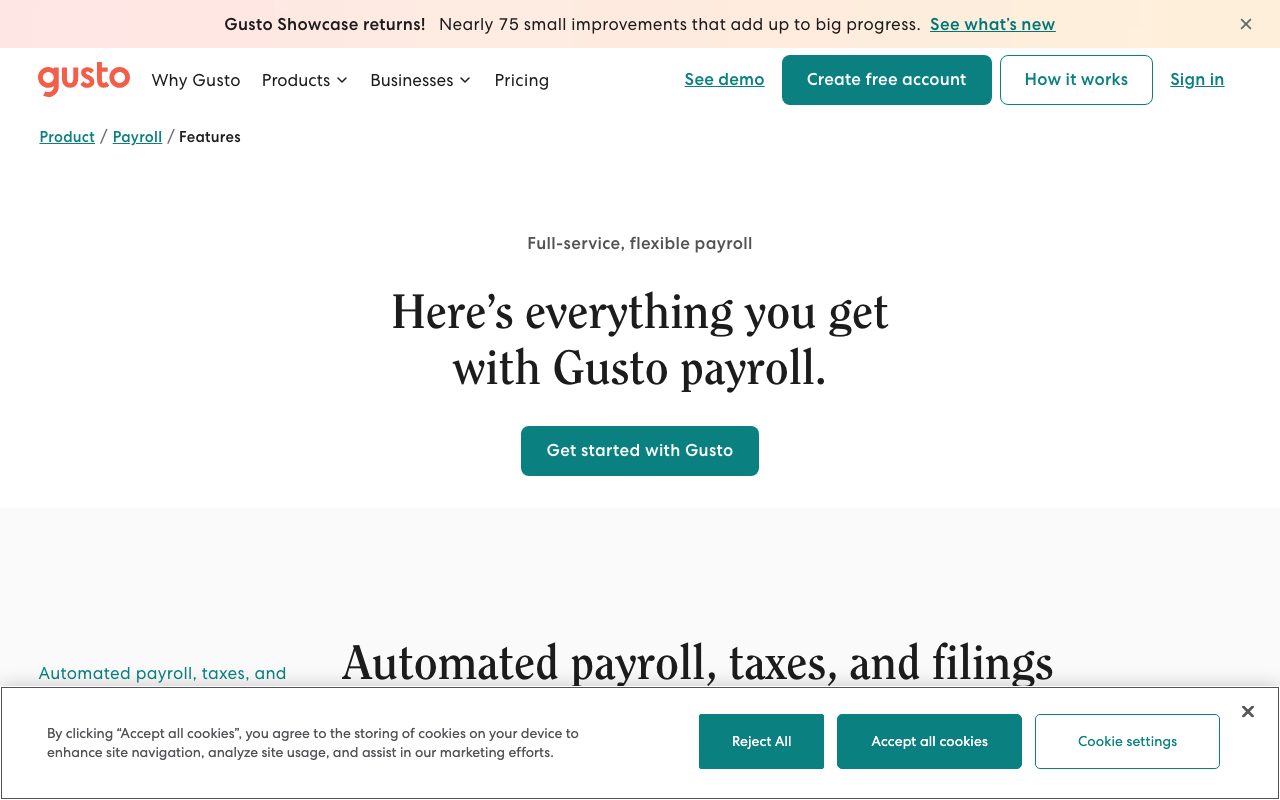
The tax filing is the killer feature. Gusto handles federal 941s and 940s, state withholding, state unemployment, and most local jurisdictions. You don't think about tax forms. You verify them.
Who Gusto is for
US based small businesses with 1 to 200 employees. That's the meat of the market. Solo founders pay contractors. Five person agencies run weekly payroll. Hundred person SaaS startups handle benefits and equity.
Restaurants, retail, professional services, agencies, and tech startups are all common. Gusto handles hourly time tracking, tipped employees, and salaried staff in one product.
If you're outside the US, Gusto isn't for you. Look at Deel, Remote, or local providers for international payroll.
Pricing in 2026
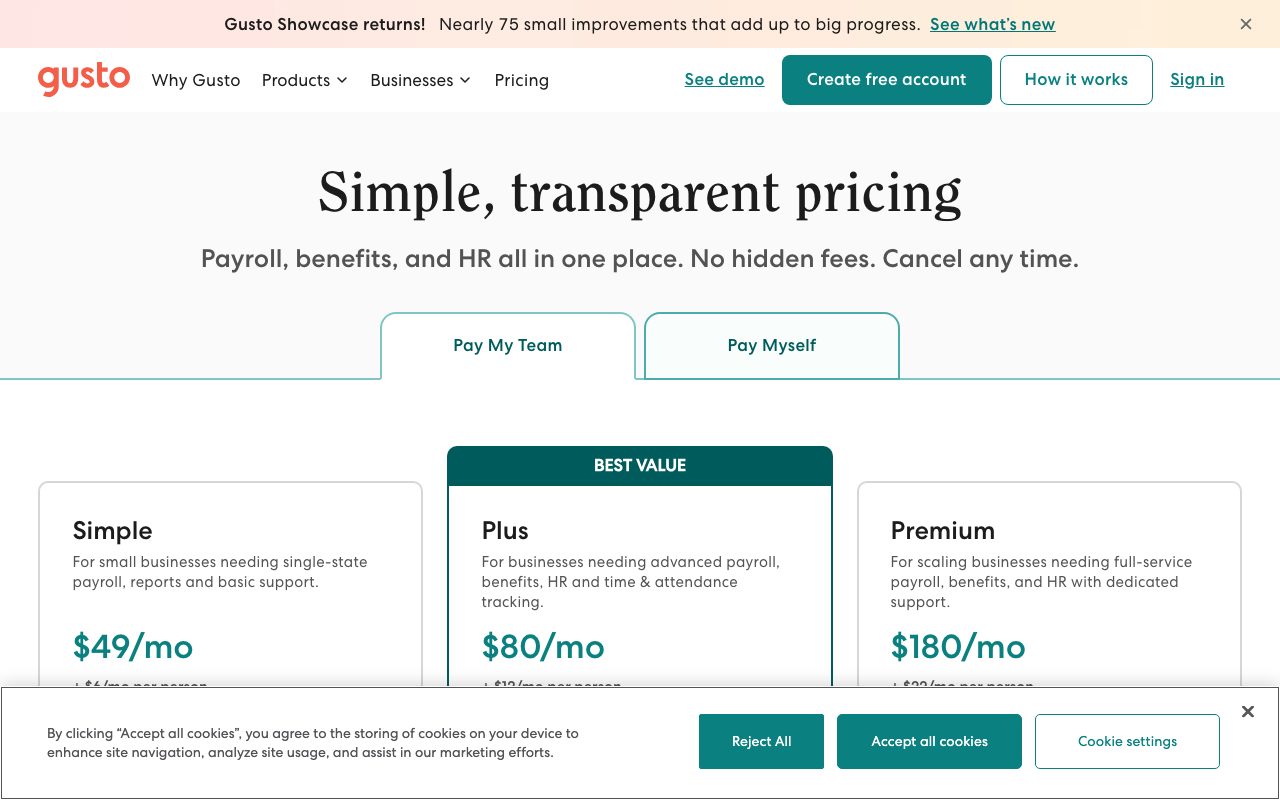
Simple plan starts at $40 per month plus $6 per person. That's the basic payroll plan with full state tax filing and contractor payments included.
Plus jumps to $80 per month plus $12 per person and adds time tracking, PTO management, and project tracking. Premium is custom pricing and adds compliance support, dedicated CSM, and HR resources.
Contractor only plans drop to $35 per month plus $6 per contractor. Useful if you don't have W-2 employees yet.
Features that small businesses lean on
Auto pilot lets recurring payroll run without you clicking each cycle. Salaried teams with no changes get paid automatically. You only step in for adjustments.
The benefits broker side is real. Gusto can be your health insurance broker in many states. The plans show up in the dashboard. Employees enroll via the same login.
The employee app is good. People see their paystubs, request PTO, change their tax withholdings, and update direct deposit themselves. HR doesn't get the email asking for last month's pay stub.
Where Gusto trips
Multi state payroll gets complicated. Gusto handles it but you'll spend time setting up new state registrations the first time. Some states are slow to confirm, which delays your first payroll there.
Customer support quality has slipped according to many recent reviews. Long hold times. Sometimes inconsistent answers. Premium plan customers get better treatment.
The integrations with accounting tools work but require maintenance. Gusto syncs with QuickBooks Online and Xero. Custom mappings need an annual sanity check.
Gusto vs the alternatives
Rippling is the modern challenger. Bigger product, more enterprise oriented, IT plus HR plus payroll. Pricier and overkill for small teams. We compare them in Gusto vs Rippling.
QuickBooks Payroll is cheaper if you already use QuickBooks. The HR side is thinner. Browse best payroll software for context.
ADP and Paychex are the legacy giants. They work. They feel old. The fees aren't always transparent. See Gusto alternatives for more.
If you're a US founder and you're still running payroll through ADP because you set it up in 2017, switching to Gusto will save you a Tuesday afternoon every other week. The migration takes one full day and one cycle of double checking.
Common Gusto questions
Does Gusto handle 1099 contractors? Yes, on every plan. Even the contractor only plan covers them well.
Can Gusto run international payroll? Not really. They added some international contractor pay but for global teams use Deel or Remote. Browse payroll tools for related options.
Does Gusto support equity and stock options? Limited. There's basic reporting. Full equity management lives in Carta or Pulley.
The bottom line on Gusto
Gusto is the small business payroll default in 2026. Fair pricing. Friendly UX. Tax filing that actually works. The feature set scales as you grow.
If you're starting a US company and need payroll tomorrow, sign up for Gusto. You'll be running your first payroll within a few hours and the tax filing will be handled correctly.
The category is competitive but Gusto's positioning hasn't really been broken. Solid product, fair price, and the small business niche knows them by name. Browse the toolindex catalog for the surrounding ops stack.
Gusto onboarding for new employees
The new hire receives an email with a Gusto account invite. They complete I-9, W-4, direct deposit, and emergency contact info in the portal. HR sees the status update in real time.
The flow takes the new hire about 15 minutes. Compare to the old paper packet that took 45 minutes and got lost. The friction reduction is real.
Set up document e-signature for offer letters and handbook acknowledgments. The audit trail satisfies most compliance asks without you maintaining a folder system.
Gusto for benefits administration
Gusto can be your health insurance broker in many US states. You shop plans through Gusto, employees enroll through their portal, and the deductions flow into payroll automatically.
For 401k, Gusto integrates with Guideline, Human Interest, and others. The contributions sync each pay cycle. Compliance reporting is handled.
Commuter benefits, HSA, FSA, and other pre tax accounts add through partners. The breadth covers most small business needs without you piecing together five vendors.
Gusto reporting that's actually useful
The payroll register shows every payment with full breakdown. Useful for finance reconciliation and audits.
The tax liability report tells you what you've paid and what's coming. Useful for cash flow planning. Quarterly filing season feels different when you can see the numbers in advance.
The custom report builder is decent. You can pull headcount changes, compensation by department, or anniversary lists. Not as deep as a real HR analytics tool but enough for most small business needs.
When Gusto isn't enough
Above 200 employees, you'll start hitting limits. Performance management is light. ATS is missing. Compliance for highly regulated industries needs more.
The migration off Gusto usually goes to Rippling or a midmarket suite. Plan for it as you scale. The data export is clean so the migration isn't traumatic.
Until that point, Gusto plus a few add ons (BambooHR for HR, Carta for equity, Lattice for performance) covers most growing companies fine.
Gusto integrations worth wiring
QuickBooks Online and Xero. Payroll journals sync. Saves the bookkeeper a few hours every payroll cycle.
Time tracking apps like Clockshark, Homebase, or Tsheets. Hours flow into Gusto for hourly employees. The accuracy beats manual entry.
Slack integration for announcements and approvals. New hire announcements post to a channel. Approval requests flow to managers.
Gusto and contractor heavy companies
Many agencies and SaaS companies have more contractors than employees. The contractor only plan fits this case.
1099 NEC forms get filed at year end automatically. The contractor portal lets contractors download their own forms. Less back and forth in January.
International contractors use a separate flow with limited features. For volume international payments, Deel or Remote handles it better.
Gusto for benefits compliance
ACA reporting is handled. The 1094 and 1095 forms get filed. For applicable large employers (50+ FTE), this avoids real penalties.
State specific compliance varies. Some states have paid family leave, paid sick leave, or specific reporting. Gusto handles the common ones in covered states.
For multi state operations, expect setup work for each new state. New tax registrations, new policy variations, new local quirks.
Gusto support quality
Standard support is via chat and phone. Premium customers get a dedicated CSM with deeper response times.
The community Q&A is searchable. Many questions have answers from years of accumulated tickets.
For complex tax issues, work with a CPA who knows Gusto. The tool handles execution. The advice is human.
Gusto and the small business stack
The typical stack for a 20 person US SaaS: Gusto for payroll and benefits. Carta for cap table and equity. QuickBooks or Xero for accounting. Notion or Airtable for HR docs.
Gusto sits at the center of the people ops side. Payroll touches everything. The integrations into accounting and benefits make it a natural hub.
For larger companies, the stack consolidates into Rippling or a similar all in one. The Gusto era has a natural lifespan that ends around 200 to 300 employees.
Gusto onboarding done right
Send the welcome email a week before start. The new hire fills out forms before day one.
Pre stage the IT setup, the manager intro, and the first week schedule. Gusto handles compliance. Manager makes the human side work.
Day one feels coordinated when the prep is done. Gusto is one piece. The manager is the other. Both matter.
Tutorial / Demo
Key Features
- Automated payroll with tax filing
- Health, dental, and 401(k) benefits administration
- Contractor payments and 1099 filings
- Onboarding workflows
- Time tracking and PTO
- Integrations with QuickBooks, Xero, and accounting platforms
Pros & Cons
What we like
- Simple enough for founders to run themselves
- Strong benefits brokerage in supported states
- Clear pricing tiers
Room for improvement
- US-only
- Higher-tier features (HR support, surveys) cost more
- Customer support quality varies
Frequently Asked Questions
How much does Gusto cost?
Gusto vs Rippling vs ADP?
Does Gusto handle multi-state payroll?
Can Gusto pay international contractors?
Is Gusto worth it for a one-person business?
Best For
Featured in
Alternatives to Gusto
View allOur take
Tool Index Editorial · May 2026· 4.6/5
Gusto sits in a crowded category, differentiating itself as payroll, benefits, and hr for us small businesses.
What it actually does well: Simple enough for founders to run themselves, Strong benefits brokerage in supported states, and Clear pricing tiers. Where it stumbles: US-only and Higher-tier features (HR support, surveys) cost more.
In short: Gusto is a strong pick when you need uS startups running their first payroll, and a harder sell if uS-only would be a dealbreaker.
Editorial opinion from the Tool Index team, written from the public product pages. Not a user review.
Reviews (6)
Onboarded the team in a day
The pitch for Gusto sounded too good to be true. Mostly true. Honestly impressed by how clear pricing tiers. Automated payroll with tax filing works the way you'd hope. Found it works best for US startups running their first payroll. Still recommending it to people in similar setups.
Underrated honestly
Found Gusto on a Reddit thread, glad I clicked. What stands out is how strong benefits brokerage in supported states. The onboarding workflows is more useful than I expected. Easy yes for anyone weighing the same trade-offs.
Pros
- Simple enough for founders to run themselves
- Strong benefits brokerage in supported states
- Clear pricing tiers
Trade offs worth knowing about
Skeptical at first because Gusto looked too simple. It's not. Genuine strength: strong benefits brokerage in supported states. Their take on health, dental, and 401(k) benefits administration is solid. Wish they'd address how higher-tier features (HR support, surveys) cost more.
Pros
- Simple enough for founders to run themselves
- Clear pricing tiers
- Strong benefits brokerage in supported states
Cons
- US-only
- Customer support quality varies
Genuinely impressed
Skeptical at first because Gusto looked too simple. It's not. Real selling point: clear pricing tiers. The contractor payments and 1099 filings is more useful than I expected. Would buy again without thinking twice.
Surprised how much we use this
Started using Gusto casually, now it's pinned in my dock. The thing I keep coming back to: simple enough for founders to run themselves. The onboarding workflows is more useful than I expected. Mostly using it for SMBs offering health benefits without an HR team.
Pros
- Clear pricing tiers
- Simple enough for founders to run themselves
Honest take after the past sprint cycle
The pitch for Gusto sounded too good to be true. Mostly true. The biggest win has been strong benefits brokerage in supported states. It would be a 5 if not for higher-tier features (HR support, surveys) cost more. Still recommending it to people in similar setups.
Cons
- Customer support quality varies
Badge builder
Add Gusto to your website
Choose a badge style and size, preview it here, then copy the generated HTML. Badge images are self-contained SVGs and do not require an external script.

<a href="https://toolindex.net/tools/gusto?ref=badge" target="_blank" rel="noopener">
  <img src="https://toolindex.net/badge/gusto/medium.svg" alt="Gusto - Listed on Tool Index" width="180" height="50" />
</a>How to use the badge
- 1. Pick the style, size, and theme that fit your layout.
- 2. Copy the generated HTML from the code block.
- 3. Paste it into your footer, homepage, or press page.
Score badge available
Gusto qualifies for the score and circle badges based on its current top-10 positionin HR & Recruiting.
Badge clicks return visitors to this profile with a referral tag so the source remains identifiable.
Related Tools
Deel
Global payroll, contractor, and EOR platform

Rippling
Workforce platform unifying HR, IT, and finance

Lattice
People management platform for performance, engagement, and growth

OfferFlow AI
AI email tool that detects recruiter messages and drafts professional replies
Work on Gusto? Request listing access or correction