
Ashby
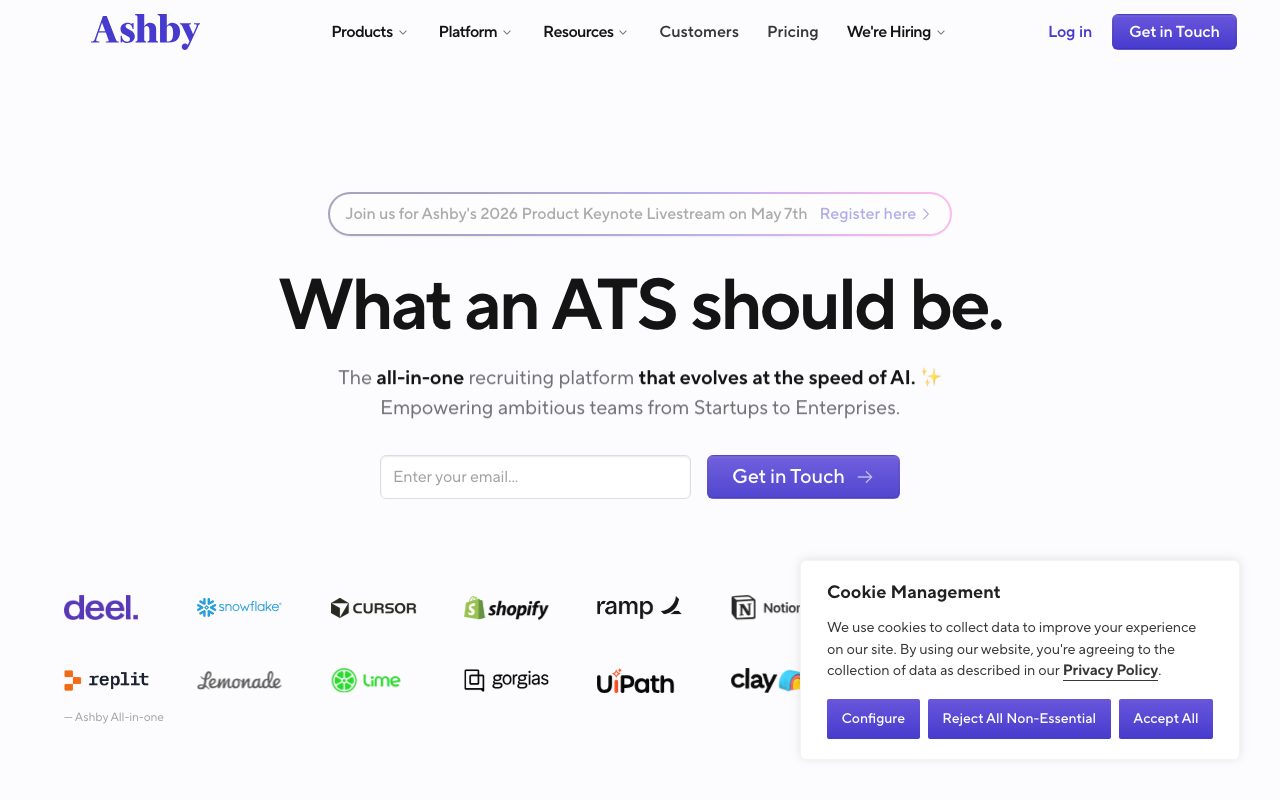
All-in-one ATS, CRM, and analytics for modern hiring teams
Gallery
About Ashby
Ashby is the ATS that recruiters at series-B startups won't shut up about. And honestly, they have a point. The product fixed a genuine problem with how legacy ATS tools handle data and reporting.
Founded in 2018 by Benji Encz (formerly at Lookout) and Shahed Khan (Loom), Ashby raised $30M from Y Combinator, Elad Gil, and Lachy Groom. It's not the cheapest hiring tool. It's also not trying to be.
If you're evaluating Greenhouse, Lever, or Workable today, Ashby deserves a spot on your shortlist. Here's why.
What Ashby actually does
Ashby combines four products into one platform: an applicant tracking system, a sourcing CRM, scheduling automation, and a reporting layer. Most ATS competitors do one or two of these well. Ashby's bet is that integrated data beats best-of-breed.
The ATS handles the standard pipeline: roles, candidates, interviews, scorecards, offers. What's different is how every piece of data flows into a unified analytics warehouse, available to query without exporting CSVs.
The sourcing CRM lets recruiters track passive candidates separately from active applicants. Sequences, email templates, and LinkedIn integrations work the way you'd expect. Scheduling pulls calendar availability across multiple interviewers and books slots automatically.
Who Ashby is for
Ashby's sweet spot is companies between 50 and 1,000 employees that take hiring seriously. If you're hiring fewer than 5 people a year, Ashby is overkill. If you're at 5,000 employees, Workday or SmartRecruiters probably fit better.
Tech companies are the obvious customer base. The pricing, the analytics emphasis, and the API-first design all skew engineering-friendly. Ashby publicly lists customers like Notion, Ramp, and Modern Health.
It also works well for hiring teams that have outgrown Lever or Greenhouse but don't want to commit to enterprise procurement cycles. Onboarding takes weeks, not quarters.
Pricing breakdown
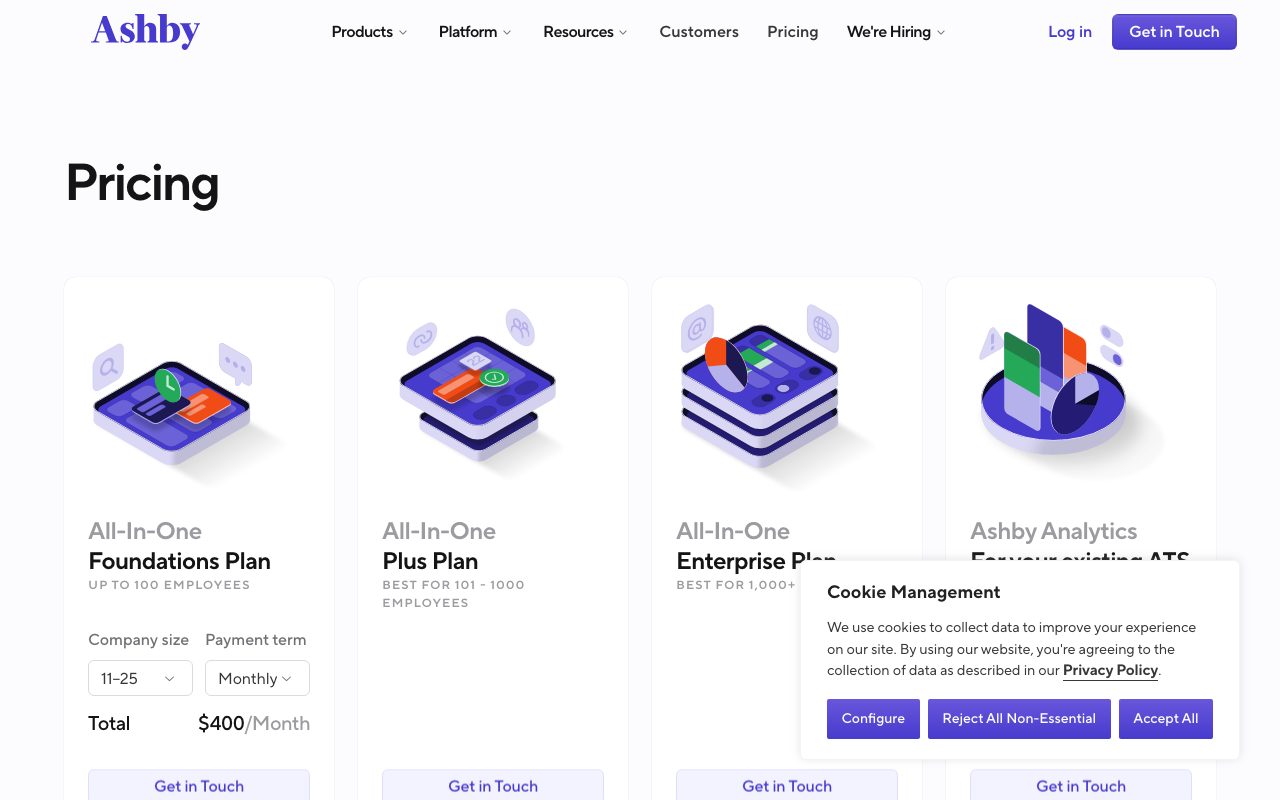
Ashby's pricing isn't published on the website. They quote based on company size and product mix. Customers report base pricing in the $400 to $700 per month range for small teams.
The bundled pricing model means you don't pay separately for sourcing, scheduling, and analytics. Greenhouse charges add-ons for each. That's part of how Ashby's TCO comes in lower despite a higher per-seat sticker price.
Expect to do a discovery call. Ashby's sales team is responsive and not pushy, which is rare for HR tech. They'll typically run a custom demo within a week.
Standout features
Analytics that actually work
This is the headline feature. You can build any funnel report you want without exporting data. Time-to-fill by source, offer accept rate by recruiter, pipeline conversion by department, all of it queryable in the UI.
The analytics module rivals dedicated tools like Charthop. If your CFO asks "why is engineering hiring slipping?", you can answer in five clicks.
Scheduling that doesn't break
Ashby's scheduling automation handles complex interview loops better than any standalone tool I've used. It manages debriefs, lunch slots, and timezone math. GoodTime and Modern Loop do this too, but Ashby's is built in.
API and webhooks
Every object in Ashby is accessible via REST API. Webhooks fire on candidate stage changes, interview events, and offer activity. This makes custom integrations with Slack, BambooHR, or your own data warehouse straightforward.
Honest tradeoffs
The UI density is high. Ashby exposes every knob, which is great for power users but overwhelming for casual hiring managers. Expect training sessions during rollout.
The sourcing CRM is solid but not the main attraction. If your recruiting motion is heavily outbound, Gem or hireEZ might do that piece better. You can integrate them with Ashby, but it's another tool.
Ashby's biggest weakness is the same as its strength: it assumes you care about hiring data. If your team treats hiring as a checkbox, the analytics depth is wasted.
Mobile experience is functional but not great. Most recruiters live on desktop, so this matters less than you'd think. Hiring managers who only check candidates from their phone might grumble.
Ashby vs alternatives
Versus Greenhouse: Greenhouse is the incumbent at series-C and beyond. It has a deeper ecosystem of integrations and a known-quantity reputation. Ashby is faster, more modern, and cheaper at typical pricing. Greenhouse wins on procurement comfort. Ashby wins on product.
Versus Lever: Lever has the better sourcing CRM out of the box. Ashby has the better ATS and analytics. If you're sourcing-led, evaluate Lever first. If you're inbound-heavy, Ashby is the call.
Versus Workable or BambooHR: These are SMB-focused tools with simpler UIs and lower price points. They lack Ashby's analytics depth. Right answer for companies under 50 employees, wrong answer once you start measuring hiring metrics seriously.
For broader options, see best ATS tools or tools for recruiters.
Bottom line
Ashby is the modern ATS that startups actually want to use. The analytics layer alone justifies the switching cost from Greenhouse, assuming you have a Head of Talent who reads dashboards.
It's not for everyone. If you hire one engineer a quarter, stick with Workable. If you hire 50 a quarter and need to know why your senior pipeline is slipping, Ashby is hard to beat. The competitive moat here is the analytics integration, and that's not a moat anyone else has copied yet.
Worth a demo if your current ATS makes you export CSVs to answer hiring questions.
Implementation experience
Migrating to Ashby from Greenhouse or Lever takes 2-4 weeks for most teams. The Ashby implementation team handles data migration, custom field mapping, and integration setup. They're responsive and competent.
Roles, candidates, interview kits, and historical data come over cleanly. Custom fields require some manual mapping. Email templates need rebuilding (different syntax). Job board postings re-link with minor fixes.
The biggest implementation risk is change management, not technical migration. Recruiters who've used Greenhouse for years have to relearn workflows. Plan training sessions and don't underestimate the human element.
Integrations and ecosystem
Ashby integrates with the standard tools: LinkedIn Recruiter, Gem, GoodTime, Codility, HackerRank, Slack, BambooHR, Workday HRIS. The catalog is smaller than Greenhouse's but covers 80% of common needs.
The API and webhooks fill most gaps. Engineering teams can build custom integrations with their data warehouse, internal tools, or unique HRIS. The developer documentation is well-written.
Worth noting: Ashby ships native LinkedIn integration that pulls candidate profiles directly. This used to require a separate Crelate or Gem subscription. One less tool, one less bill.
Reporting and analytics deep-dive
This is where Ashby genuinely shines. The analytics module sits on top of the same data that powers the ATS. No exports, no warehouse syncs, no third-party BI tool required.
Pre-built dashboards cover the standard hiring funnels: applications by source, time-to-fill by role, offer accept rates, diversity metrics, recruiter performance. Custom dashboards take 10 minutes to build.
The query builder supports filtering by any field, grouping by any combination, and time-window comparisons. CFOs love being able to ask "show me time-to-fill for engineering roles in Q2 vs Q3" and get an answer in 30 seconds.
Common analytics questions Ashby answers well
"What's our offer accept rate for senior engineers?" Filter by role level, group by offer state, done. Three clicks.
"Which sources convert best to hires?" Source attribution, conversion funnel, weighted by interview-to-offer rates. Pre-built dashboard.
"Why did time-to-fill increase last quarter?" Compare quarter-over-quarter funnel stages, identify the slowdown stage, drill into specific roles. Five clicks.
Common Ashby questions
Is Ashby a good fit for first-time hiring teams?
Probably not. Ashby's depth assumes you already have processes to optimize. First-time teams should start with Workable or BambooHR Hiring (cheaper, simpler) and migrate to Ashby once you have the volume to justify the investment.
How does Ashby handle high-volume hiring?
Well, but with caveats. Ashby is built for quality-focused hiring, not transactional roles. If you're hiring 1,000 retail associates a month, Greenhouse Recruiting (with their Onboarding extension) or specialized tools like Fountain fit better.
For 50-200 hires/year of skilled roles, Ashby is excellent. The bulk action features and templated workflows handle volume without sacrificing the analytics depth.
What about referrals?
Ashby has a built-in referral portal. Employees submit candidates, track status, and see when bonuses pay out. It's solid but not as feature-rich as standalone tools like Erin or RolePoint.
Most companies find Ashby's built-in referrals sufficient. If your referral program is core to hiring strategy and needs sophisticated incentive logic, consider integrating a dedicated tool.
For more on hiring stack, see best recruiting tools or tools for people ops.
Final thoughts on choosing
The "right" password manager is the one your team will actually use. Tools that go unused don't protect anything. 1Password's polish makes adoption easier than alternatives that look like 2010-era enterprise software.
If you're a one-person operation testing tools, run a 14-day trial of 1Password and Bitwarden in parallel. Use both for two weeks of real work. Pick the one you reached for first when you needed to look something up.
Most people end up choosing 1Password and don't regret it. Some choose Bitwarden and don't regret it either. Both are good products solving slightly different problems.
For broader security tool research, browse tools for developers.
Choosing the right hiring stack
Ashby alone isn't a complete hiring stack. You'll still want a sourcing tool (Gem or hireEZ for outbound), a coding-test platform (Codility, HackerRank, or CoderPad), and possibly a video-interview platform (HireVue, SparkHire).
The ecosystem question is whether to bundle (Greenhouse + add-ons) or specialize (Ashby + best-of-breed). For under 200 employees, Ashby + Gem covers most needs. For larger organizations, more tools usually help.
Hiring software is sticky. Switching costs include data migration, retraining, and process disruption. Choose carefully and commit for at least 2-3 years to amortize the implementation.
For deeper analysis, see best recruiting tools.
Tutorial / Demo
Key Features
- Applicant tracking and structured interviewing
- Built-in sourcing CRM
- Interview scheduling and self-service candidate booking
- In-depth analytics and dashboards
- Approvals and offer workflows
- Integrations with HRIS, sourcing tools, and assessments
Pros & Cons
What we like
- Analytics is best-in-class without a separate BI tool
- One product replaces an ATS plus scheduler plus CRM
- Modern UI compared to legacy ATSes
Room for improvement
- Pricing not publicly listed
- Newer player than Greenhouse or Lever
- Smaller integration ecosystem, though growing fast
Frequently Asked Questions
How much does Ashby cost?
Ashby vs Greenhouse, which is better?
Is Ashby a good fit for early-stage startups?
Does Ashby integrate with HRIS and assessment tools?
Does Ashby handle scheduling?
Best For
Featured in
Alternatives to Ashby
View all
Our take
Tool Index Editorial · May 2026· 4.6/5
Ashby positions itself as all-in-one ats, crm, and analytics for modern hiring teams, and on the whole it earns the framing.
Worth highlighting: Analytics is best-in-class without a separate BI tool, One product replaces an ATS plus scheduler plus CRM, and Modern UI compared to legacy ATSes. What to watch for: Pricing not publicly listed and Newer player than Greenhouse or Lever.
Recommendation: this is a strong default when you need high-growth startups scaling recruiting. If pricing not publicly listed would be a dealbreaker, the alternatives section below is worth a scroll.
Editorial opinion from the Tool Index team, written from the public product pages. Not a user review.
Reviews (4)
Two months in, no regrets
Tried half a dozen options before landing on Ashby. Real selling point: analytics is best-in-class without a separate BI tool. Worth calling out the approvals and offer workflows too. Hard to imagine going back to my previous setup.
Pros
- Modern UI compared to legacy ATSes
- Analytics is best-in-class without a separate BI tool
- One product replaces an ATS plus scheduler plus CRM
Surprised how much we use this
Took a few weeks for Ashby to click, then it stuck. The biggest win has been analytics is best-in-class without a separate BI tool. Mostly using it for talent ops leaders who want analytics without a Looker bill. Worth the price for what I get out of it.
Finally something that fits
About half a year of using Ashby, here's what holds up. The thing I keep coming back to: modern UI compared to legacy ATSes. Sticking with Ashby.
Pros
- One product replaces an ATS plus scheduler plus CRM
- Modern UI compared to legacy ATSes
Hit the Ashby sweet spot
Hadn't planned on switching, but Ashby was hard to ignore. The biggest win has been analytics is best-in-class without a separate BI tool. Built-in sourcing crm works the way you'd hope. That said, newer player than Greenhouse or Lever is a real gripe.
Cons
- Smaller integration ecosystem, though growing fast
Badge builder
Add Ashby to your website
Choose a badge style and size, preview it here, then copy the generated HTML. Badge images are self-contained SVGs and do not require an external script.

<a href="https://toolindex.net/tools/ashby?ref=badge" target="_blank" rel="noopener">
  <img src="https://toolindex.net/badge/ashby/medium.svg" alt="Ashby - Listed on Tool Index" width="180" height="50" />
</a>How to use the badge
- 1. Pick the style, size, and theme that fit your layout.
- 2. Copy the generated HTML from the code block.
- 3. Paste it into your footer, homepage, or press page.
Score badge available
Ashby qualifies for the score and circle badges based on its current top-10 positionin HR & Recruiting.
Badge clicks return visitors to this profile with a referral tag so the source remains identifiable.
Related Tools
Deel
Global payroll, contractor, and EOR platform

Rippling
Workforce platform unifying HR, IT, and finance

Lattice
People management platform for performance, engagement, and growth

OfferFlow AI
AI email tool that detects recruiter messages and drafts professional replies
Work on Ashby? Request listing access or correction