
Greenhouse
Applicant tracking system for structured, scalable hiring
Gallery
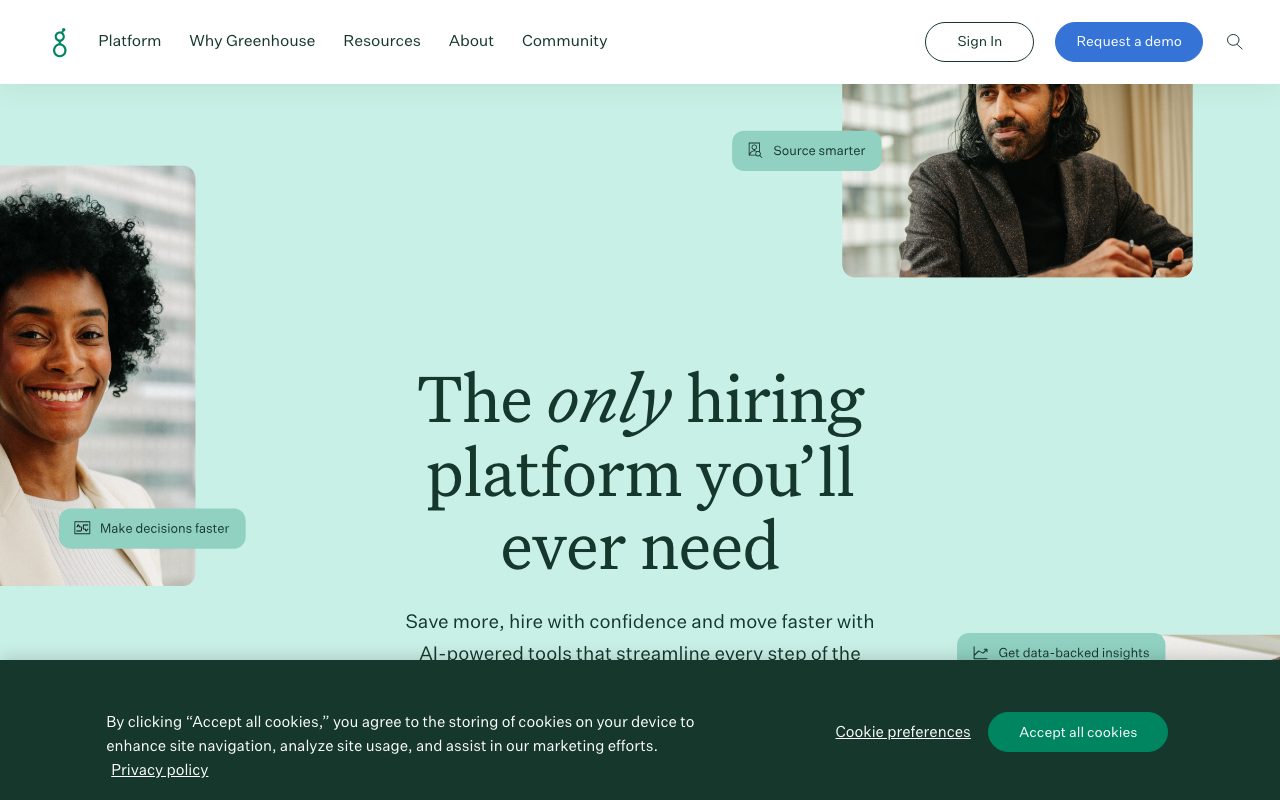
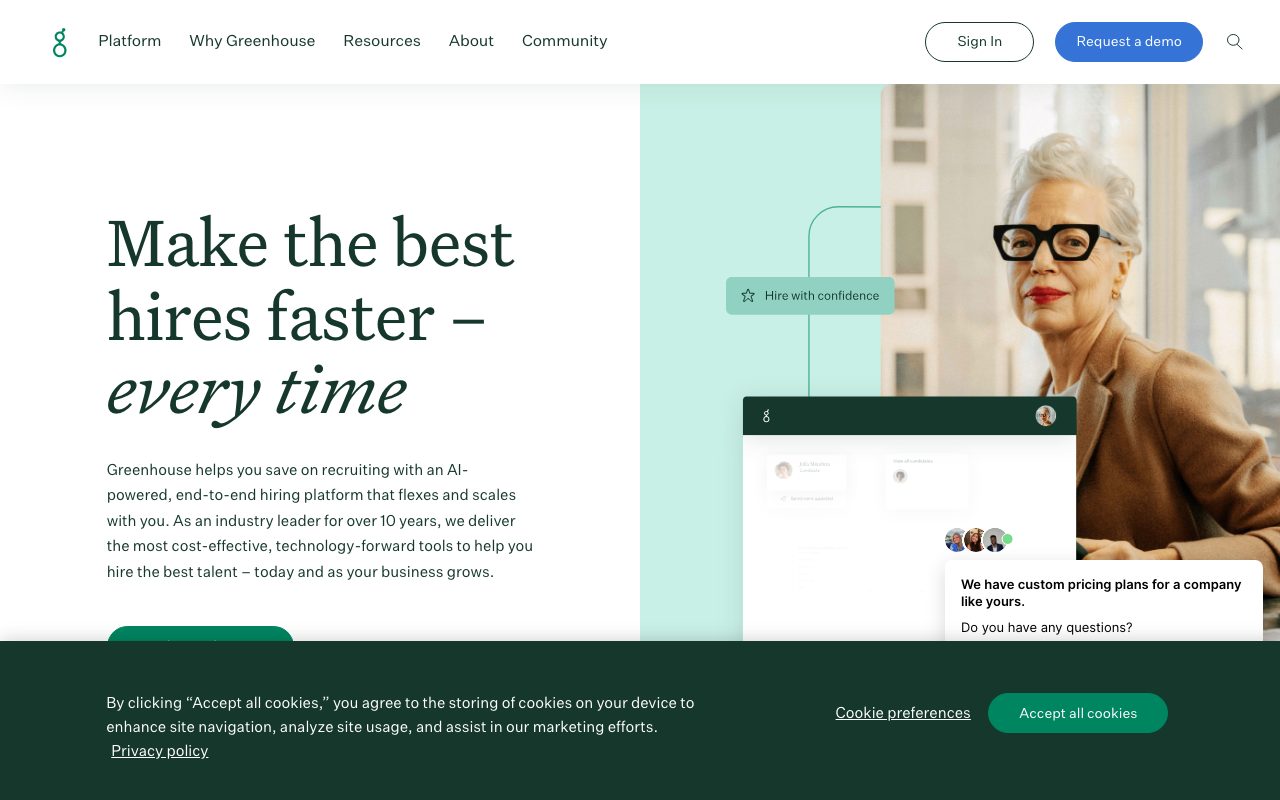
About Greenhouse
Greenhouse is the applicant tracking system that turned structured hiring into a category. The pitch isn't fancy. Use a real ATS, run real interview kits, score candidates consistently, and your hiring outcomes improve. Companies that take hiring seriously have leaned on Greenhouse for over a decade.
It's not the cheapest option. It's not the lightest. For organizations that hire 30 or more people a year, it's usually the right call.
The competitors have caught up on individual features. Greenhouse keeps winning on the integrated story: structured interviews, fairness tooling, deep reporting, and the integration ecosystem.
What Greenhouse actually does
It's a full applicant tracking system. Job postings sync to job boards. Candidates apply, land in your pipeline, move through stages, and ideally turn into hires. The whole funnel sits in one place.
Structured interview kits are the heart of the product. For each role, you define the rubric. Each interviewer gets a scorecard with the specific competencies to evaluate. Hire/no-hire decisions tie back to evidence, not vibes.
Approval workflows handle headcount, offers, and compensation bands. Reporting goes deep on funnel metrics, source quality, time to hire, and DEI dashboards. Talent leaders can answer real questions with real data.
Who Greenhouse is for
Scaling hiring teams past the ad-hoc Google Doc phase. Once you're hiring more than two roles a quarter, the cost of a real ATS pays back fast.
Companies that care about structured, fair interviewing. The interview-kit model is genuinely better than free-form interviewing for both candidate experience and hire quality.
Talent leaders who need to report on the funnel to executives. Greenhouse's reporting wins more talent leadership offsites than the marketing team probably realizes.
If you're a 10-person startup hiring two engineers a year, this is overkill. Try Ashby or Lever first.
Pricing breakdown
Greenhouse pricing is gated behind a sales call. There's no transparent published price page. That's a real friction point for buyers.
Anecdotal numbers suggest entry-tier plans land in the $6,500 to $9,000 per year range for small teams. Mid-tier and Expert tiers scale into low to mid five figures annually.
Pricing scales with employee count and feature tier. Compared to the cost of a single bad hire, Greenhouse pays back quickly. That's the argument the sales team will make. They're not wrong.
Standout features in Greenhouse
Interview kits and scorecards. Each role gets a rubric, each interview gets a scoped set of competencies, each candidate gets evaluated consistently across the panel. The quality of the hiring conversation rises measurably.
Approval workflows handle the political layer of hiring. Headcount approvals, offer approvals, compensation calibration. The audit trail is excellent for finance and HR partners.
Reporting and analytics are deep. Funnel conversion by stage, source-of-hire quality, time-to-hire trends, and DEI metrics. Talent leaders can answer "is our pipeline healthy" with data, not anecdotes.
Integrations
Greenhouse has hundreds of integrations across job boards, sourcing tools, assessment platforms, background check vendors, and HRIS systems. The ecosystem is one of the deepest in the ATS category.
Honest tradeoffs
The opaque pricing is annoying. Buyers want a price page. Greenhouse buyers grit their teeth through procurement.
Implementation takes meaningful time. Plan three to six weeks for a real rollout including training, integration setup, and process design. It's not the kind of tool you turn on and use the next day.
The UI feels dated to teams used to modern SaaS polish. Ashby looks crisper. Greenhouse compensates with depth, but the first impression matters.
Greenhouse is the ATS for companies that treat hiring as a real function, not a side task. Smaller teams should test lighter alternatives before committing.
Greenhouse vs alternatives
Versus Ashby, Greenhouse wins on integration breadth and enterprise track record. Ashby wins on UX polish and built-in analytics. Both are excellent in 2026. See the comparison.
Versus Lever, Greenhouse wins on structured interviewing and reporting depth. Lever wins on CRM-style sourcing workflows.
Versus Workable and BambooHR's ATS, Greenhouse is the more serious ATS. Workable is lighter and cheaper. BambooHR is HRIS-first with an ATS bolted on.
For more options, see the best applicant tracking systems and Greenhouse alternatives.
Bottom line
Greenhouse is the right ATS for companies hiring at meaningful scale who care about doing it well. The structured interview model alone justifies the cost for most organizations past the early-stage phase.
Budget for the implementation work. Train your interviewers on the scorecard model. The tool only works as well as the process you build on top of it. Invest in both and Greenhouse pays back many times over.
Implementing Greenhouse well
Don't try to migrate everything in week one. Start with one department or one role family, learn the platform's conventions, then expand.
Build interview kits before you build job posts. The kit defines the rubric; the job post is the marketing layer on top. Reversing the order leads to scorecards that don't match what you're actually testing for.
Train interviewers explicitly. The structured-interview model only works if interviewers buy into it. Plan time for the cultural shift, not just the tool rollout.
Reporting that actually drives decisions
Funnel reporting shows where candidates drop off. Use it to find stages that are too long, too vague, or culturally wrong.
Source-of-hire reporting shows which channels actually produce hires. Reallocate budget based on the data, not the loudest recruiter's opinion.
Time-to-hire trends warn you before things break. Watch them weekly; act when they spike.
Greenhouse and DEI
Greenhouse's DEI features include anonymized review options, structured rubrics that reduce bias, and dashboards tracking representation through the funnel.
The features alone don't fix culture. Pair them with explicit hiring goals, calibrated interviewers, and leadership commitment. Without those, the dashboards mostly highlight the gap rather than close it.
Most companies serious about DEI hiring use Greenhouse's reporting layer as one input among several. It's necessary, not sufficient.
Common Greenhouse questions
How long does Greenhouse implementation take? Plan four to eight weeks for a real rollout. Compressed timelines lead to half-baked process design and rework later.
Does Greenhouse work for non-engineering hiring? Yes. The platform is role-agnostic. Sales, marketing, HR, and operations teams use it routinely.
Can Greenhouse integrate with our HRIS? Almost certainly. Greenhouse integrates with Workday, BambooHR, ADP, Rippling, and most major HRIS platforms.
Browse more at tools for hiring.
Running great interviews on Greenhouse
Define competencies before defining interview kits. The competencies are the "what we're looking for" statement; the kits are the implementation. Reverse the order and your kits drift from what you actually care about.
Calibrate interviewers regularly. Run debrief sessions where multiple interviewers compare notes on the same candidate. Calibration is what makes the structured-interview model actually fair.
Use the scorecards even when they feel awkward. Free-form notes feel natural and produce inconsistent hiring outcomes. Scorecards feel mechanical and produce better outcomes. The trade is worth it.
Greenhouse and the broader hiring stack
Sourcing tools (Gem, hireEZ, LinkedIn Recruiter) feed candidates into Greenhouse. Assessment platforms (Codility, HackerRank, Karat) integrate at the appropriate stage.
Background check vendors (Checkr, GoodHire) run automatically once an offer is accepted. The integration removes a manual step and speeds time-to-start.
HRIS integration (Workday, BambooHR, Rippling) carries the new hire's data forward without manual reentry. Greenhouse-to-HRIS is one of the cleaner integration stories in the talent stack.
DEI reporting in practice
Track representation through every funnel stage, not just at the offer stage. Drop-offs at specific stages reveal where bias might be operating.
Pair quantitative dashboards with qualitative interviewer training. Tools surface gaps; humans close them.
Final thoughts on Greenhouse
Greenhouse is one of those tools that pays back the discipline you bring to it. Half-hearted adoption produces mediocre results; serious investment in process design and interviewer training produces measurably better hires.
The price tag is reasonable for organizations that take hiring seriously. For organizations that don't, no ATS will fix the underlying problem.
Browse other options at the best ATS tools and recruiting tools.
Quick recap
Greenhouse fits scaling hiring teams, structured-interview cultures, and organizations that take talent seriously enough to fund the implementation work.
It struggles for tiny teams who can run their hiring through a Google Doc and a spreadsheet. The platform's depth doesn't pay back at low hiring volume.
Plan four to eight weeks for a real rollout. Train interviewers explicitly on the scorecard model. The tool only works as well as the process you build on top of it.
Browse more options at the best recruiting tools, the talent category, and Greenhouse alternatives.
Tutorial / Demo
Key Features
- Job posting, sourcing, and candidate CRM
- Structured interview kits and scorecards
- Approval workflows for offers and headcount
- Reporting on funnel, source, and time-to-hire
- DEI dashboards and anonymized review options
- Hundreds of integrations across the hiring stack
Pros & Cons
What we like
- Strong reputation for structured, fair hiring
- Deep integrations across ATS-adjacent tooling
- Robust reporting for talent leadership
Room for improvement
- Pricing is gated behind a sales call
- Heavier than necessary for sub-50-person teams
- Configuration takes meaningful upfront time
Frequently Asked Questions
Is Greenhouse worth it for small startups?
Greenhouse vs Lever, which is better?
Does Greenhouse integrate with HRIS systems?
Can Greenhouse handle agency submissions and referrals?
Is there a free trial for Greenhouse?
Best For
Featured in
Alternatives to Greenhouse
View all
Our take
Tool Index Editorial · May 2026· 4.6/5
What Greenhouse is really selling — beyond the marketing copy — is applicant tracking system for structured, scalable hiring.
Worth highlighting: Strong reputation for structured, fair hiring, Deep integrations across ATS-adjacent tooling, and Robust reporting for talent leadership. What to watch for: Pricing is gated behind a sales call and Heavier than necessary for sub-50-person teams.
Recommendation: this is a strong default when you need scaling hiring teams past ad-hoc Google Doc workflows. If pricing is gated behind a sales call would be a dealbreaker, the alternatives section below is worth a scroll.
Editorial opinion from the Tool Index team, written from the public product pages. Not a user review.
Reviews (4)
Solid daily driver
About half a year of using Greenhouse, here's what holds up. What stands out is how robust reporting for talent leadership. Main use case: companies focused on structured interviewing. That said, configuration takes meaningful upfront time is a real gripe.
Greenhouse, better than expected
Got Greenhouse on the recommendation of someone I trust. Genuine strength: strong reputation for structured, fair hiring. Got real value out of approval workflows for offers and headcount. Easy yes for anyone weighing the same trade-offs.
Onboarded the team in a day
Almost a year of using Greenhouse, here's what holds up. Honestly impressed by how strong reputation for structured, fair hiring. Got real value out of job posting, sourcing, and candidate CRM. Found it works best for talent leaders needing real funnel reporting. Wish they'd address how heavier than necessary for sub-50-person teams. Sticking with Greenhouse.
Pros
- Deep integrations across ATS-adjacent tooling
- Robust reporting for talent leadership
- Strong reputation for structured, fair hiring
Quietly excellent
Greenhouse has quietly become part of my daily flow. Honestly impressed by how robust reporting for talent leadership. Got real value out of hundreds of integrations across the hiring stack. Main use case: companies focused on structured interviewing. Not perfect: pricing is gated behind a sales call. Worth the price for what I get out of it.
Pros
- Deep integrations across ATS-adjacent tooling
- Strong reputation for structured, fair hiring
- Robust reporting for talent leadership
Cons
- Configuration takes meaningful upfront time
Badge builder
Add Greenhouse to your website
Choose a badge style and size, preview it here, then copy the generated HTML. Badge images are self-contained SVGs and do not require an external script.

<a href="https://toolindex.net/tools/greenhouse?ref=badge" target="_blank" rel="noopener">
  <img src="https://toolindex.net/badge/greenhouse/medium.svg" alt="Greenhouse - Listed on Tool Index" width="180" height="50" />
</a>How to use the badge
- 1. Pick the style, size, and theme that fit your layout.
- 2. Copy the generated HTML from the code block.
- 3. Paste it into your footer, homepage, or press page.
Score badge available
Greenhouse qualifies for the score and circle badges based on its current top-10 positionin HR & Recruiting.
Badge clicks return visitors to this profile with a referral tag so the source remains identifiable.
Related Tools
Deel
Global payroll, contractor, and EOR platform

Rippling
Workforce platform unifying HR, IT, and finance

Lattice
People management platform for performance, engagement, and growth

OfferFlow AI
AI email tool that detects recruiter messages and drafts professional replies
Work on Greenhouse? Request listing access or correction