Lattice
People management platform for performance, engagement, and growth
Gallery
About Lattice
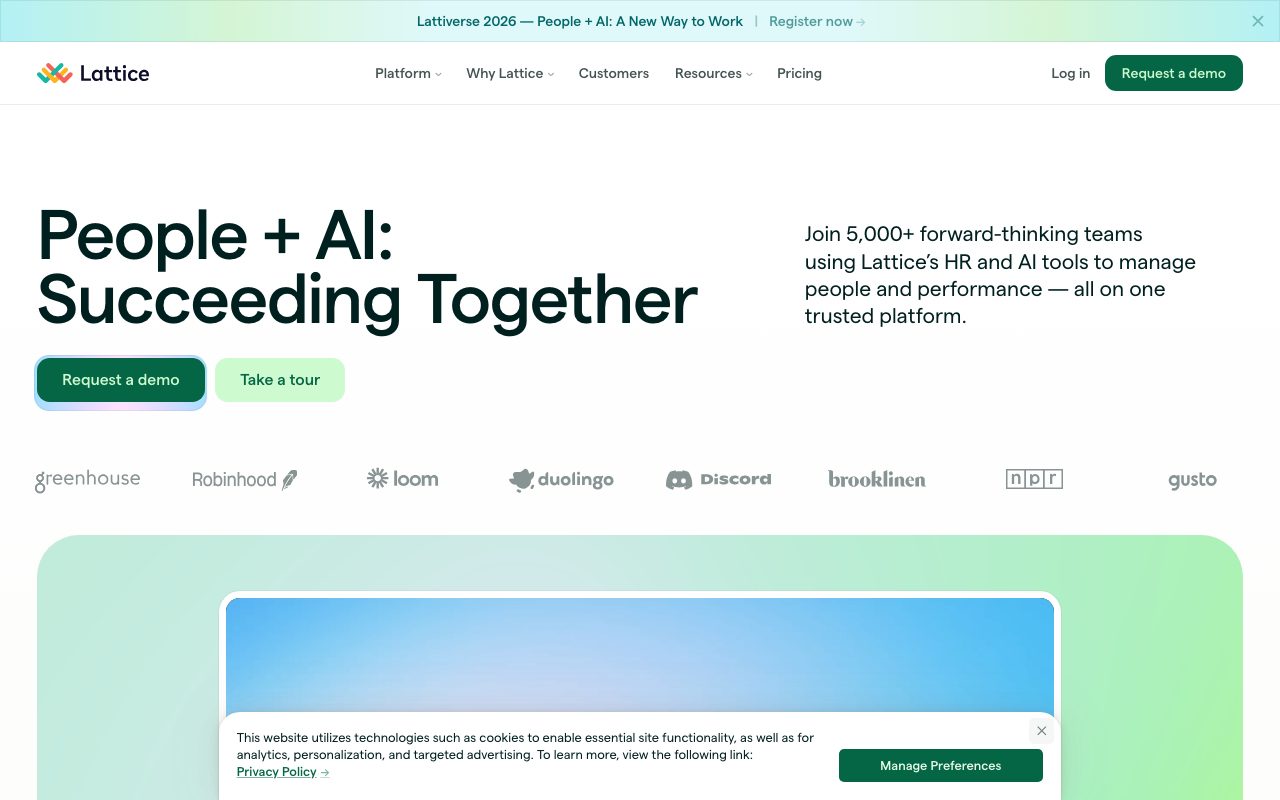
Lattice is the people-success platform built around performance reviews, goals, 1:1s, and engagement surveys. It's the modern alternative to clipboard-style HR tools that make annual reviews dreaded.
Managers run weekly 1:1s, set OKRs, and track praise. Employees write self-reviews, get peer feedback, and see how they're doing against goals. HR gets analytics on engagement and retention.
Customers include Reddit, Slack, Robinhood, and Asana. Lattice is the people-ops default for tech-forward companies of 50 to 5,000.
What Lattice actually does
Lattice ships modular products that share a single people graph. Performance handles reviews and competency frameworks. Goals manages OKRs. 1:1s gives managers structured agenda templates.
Engagement runs eNPS and pulse surveys with sentiment analysis. Compensation ties pay decisions to performance data. Grow handles career paths and growth plans.
The new Lattice AI layer drafts review summaries, surfaces themes from feedback, and recommends action items. It's a real productivity boost for managers buried in review cycles.
Who Lattice is for
People ops leaders at growing tech companies are the core audience. Once you're past 50 employees, ad-hoc spreadsheet reviews stop scaling.
Managers benefit most from the 1:1s and Goals modules. Engineers, designers, and ICs get a clean self-review experience that doesn't waste their day.
If you're under 30 employees, Lattice can feel heavy. Tools like 15Five or Leapsome (or even Notion templates) are friendlier at that size.
Pricing breakdown
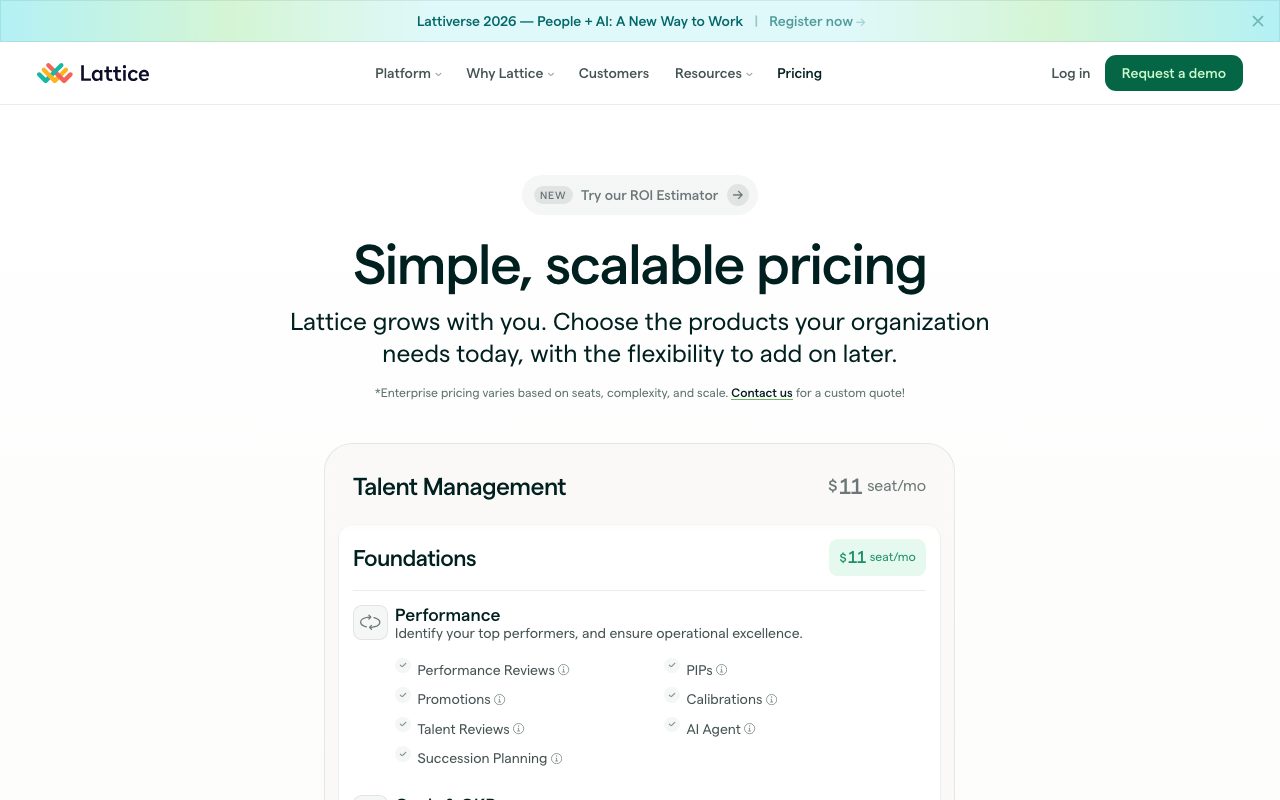
Lattice prices per employee per month. Performance and Engagement modules start around $11/user/month. Bundling Performance, Engagement, and Grow runs higher.
Annual contracts are the norm. There's no free tier. Demos and pilots happen through sales.
For a 200-person company, expect Lattice to land in the $30K-$60K/year range depending on modules. That's standard people-ops platform pricing.
Standout features
The 1:1 agenda templates are loved by managers. Topics carry over week to week, action items get tracked, and shared notes stop the "what did we discuss" deja vu.
Goal trees show how every IC's OKRs ladder up to company strategy. That cascade view is gold during planning.
Lattice AI summarizes peer reviews into a coherent narrative. It still needs human editing, but it cuts manager prep time noticeably.
Honest tradeoffs
The UI has gotten busier as Lattice added modules. New users sometimes get lost in nav. Onboarding sessions help.
Compensation module is solid but not as deep as dedicated comp tools like Pave or Figures. Big orgs sometimes pair Lattice with one of those.
Pricing creeps up fast as you add modules. Stack three or four hubs and you'll feel it on the renewal call.
Lattice doesn't make performance reviews fun. It makes them tractable, which is the highest you can ask of any review tool.
Lattice vs 15Five vs Leapsome
15Five is lighter weight and friendlier for smaller teams. Leapsome is Lattice's closest peer in scope, popular in Europe. Lattice has the largest US tech-company footprint and the deepest module suite.
See best performance management tools and Lattice alternatives. Our Lattice vs 15Five comparison covers the trade-offs.
Other Lattice alternatives: Culture Amp (engagement-first), Workhuman, and Officevibe. Each one over-indexes on a different slice of the people-ops puzzle.
Bottom line on Lattice
Lattice is the modern people-success platform that makes performance reviews bearable. It's not cheap, but it's the right stack for fast-growing tech companies.
Browse tools for HR teams and the 15Five profile. Performance management is one of those categories where the right tool actually shifts company culture.
Run a pilot on one team first. The ROI shows up in retention numbers six months later.
Performance review cycles in Lattice
Lattice's performance module supports semi-annual, annual, and continuous review models. You configure cycle dates, review types (self, manager, peer, upward), and competency frameworks.
The review experience for ICs is genuinely clean. Self-reviews use guided prompts. Peer reviews are anonymized by default. Manager reviews aggregate everything into a final summary with calibration support.
Calibration sessions live inside Lattice now. Managers and HRBPs can compare ratings across teams and adjust for consistency before final submission. That feature alone earns Lattice's keep at scale.
OKRs and goal cascading
Lattice Goals supports company, team, department, and individual OKRs. The cascade view shows how every IC goal ladders up to a company priority.
Updates happen weekly or monthly via check-ins. ICs mark progress, share blockers, and tag the right manager. Leaders get a live dashboard of strategic execution.
For companies that take OKRs seriously, this view replaces a confluence page that no one reads. Adoption is the key. Lattice Goals only works if leadership actually uses it.
Engagement and pulse surveys
Engagement runs eNPS, pulse, and onboarding surveys. Sentiment analysis surfaces themes from open-text answers. Trends over time tell you whether engagement is improving.
The survey templates are pre-built and research-backed. You don't need a People Science PhD to run a quarterly engagement survey. Most companies start with the defaults and customize over time.
Action plans tie back to results. After a survey shows a problem, managers can draft action plans inside Lattice and track them publicly. That accountability loop is the whole point.
Final word on Lattice
Lattice is the people-success platform that fast-growing tech companies pick by default. The depth, modularity, and AI features make it a real ROI investment.
Run a 90-day pilot on one team before company-wide rollout. The change management matters more than the tool features.
Lattice for compensation planning
Compensation Hub ties pay decisions to performance ratings. Managers see ranges, internal benchmarks, and pay equity flags during cycle planning.
The integration with Carta, Pave, and other comp benchmark sources brings external market data into the conversation. Less argument, more data.
Pay equity reporting flags potential disparities by gender, ethnicity, role, or tenure. Surfacing these issues during planning beats discovering them in an annual audit.
The compensation module isn't as deep as dedicated comp platforms. For complex equity refresh cycles or global pay structures, you might still need Pave or Figures.
For most growth-stage tech companies, Lattice's compensation tools cover the basics well. Adoption is the hard part. The tool gets out of the way.
Lattice also added career frameworks recently. Defining career paths with clear competencies helps ICs see growth opportunities, which improves retention.
Browse best performance management tools and the 15Five profile for more options.
Lattice FAQ
Is Lattice worth it for a 50-person company? For most growing tech companies, yes. The 50-person mark is roughly when ad-hoc spreadsheet reviews stop scaling. Lattice's structure pays off quickly at that size.
How long does Lattice take to roll out? Plan for 4-8 weeks for a thoughtful rollout including admin setup, manager training, and pilot cycles. Companies that rush get adoption problems they regret later.
Does Lattice integrate with HRIS systems? Yes. Native integrations with Workday, BambooHR, Rippling, Justworks, Gusto, and others keep employee data synced automatically. SSO via SAML is supported.
Can I customize review templates? Extensively. Custom competencies, role-specific frameworks, and tailored question sets are all possible. The defaults are solid, and customization is straightforward.
How is the AI Assist feature? Improving steadily. It drafts review summaries, surfaces themes from peer feedback, and suggests action items. Still requires human editing, but it cuts manager prep time meaningfully.
Lattice has become the people-success default for fast-growing tech companies. The depth, integrations, and AI features all matter. For HR teams shifting from clipboard-style processes to modern continuous performance, Lattice delivers on its pitch.
Lattice rollout best practices
Pilot with one team for 90 days before company-wide rollout. The change management lessons from a pilot save weeks of mistakes during full deployment.
Train managers first. Self-paced training works for ICs. Managers benefit from live sessions on running 1:1s, writing reviews, and navigating the calibration process.
Customize competency frameworks for your roles. The defaults are decent. The customized frameworks reflect your company's actual values and skill expectations.
Run engagement surveys quarterly, not annually. The trend data is more actionable. Pulse surveys are faster than full annual studies and signal action faster.
Tie compensation to performance ratings consistently. Without the link, performance reviews become a game ICs play to satisfy managers. With the link, ratings carry real weight.
Audit who gets feedback and from whom. Without intentional choices, peer feedback skews toward whoever speaks up. Lattice's tools help you balance feedback sources.
Browse our best performance management tools and 15Five profile for additional context.
Closing thoughts on Lattice in 2026
Lattice has become the default people success platform for fast-growing tech companies. The combination of performance reviews, OKRs, 1:1s, engagement, and compensation in one shared people graph delivers real value.
The AI Assist features have matured significantly. Drafting review summaries, surfacing themes from peer feedback, and recommending action items all save manager time meaningfully.
The integration story with HRIS systems (Workday, BambooHR, Rippling, etc.) keeps employee data in sync without manual maintenance. The friction of running multiple HR systems goes way down.
For HR leaders evaluating people success platforms today, Lattice should be on the shortlist alongside 15Five, Leapsome, and Culture Amp. Each has strengths. Lattice's breadth is the differentiator.
The pricing reflects the value. For 200-person companies and up, Lattice's costs are reasonable for what you get. For smaller teams, lighter alternatives like 15Five or Notion templates often fit better.
Browse our best performance management tools roundup, our Lattice alternatives page, and the Lattice vs 15Five guide for additional context.
Run a 90-day pilot before committing company-wide. The change management lessons from a focused pilot save weeks of mistakes during full rollout.
Tutorial / Demo
Key Features
- Performance reviews and 360 feedback
- OKRs and goal tracking
- Engagement and pulse surveys
- Career-development frameworks
- One-on-one agendas and notes
- Compensation review workflows
Pros & Cons
What we like
- Replaces several point tools for people ops
- Solid analytics for engagement and performance
- Friendly UI for managers and employees alike
Room for improvement
- No payroll or core HRIS, integrates with one
- Per-seat pricing across multiple modules
- Implementation needs an HR-side champion
Frequently Asked Questions
How much does Lattice cost?
Lattice vs Culture Amp, which is better?
Does Lattice integrate with Slack?
Is Lattice overkill for under 50 people?
Can Lattice handle compensation reviews?
Best For
Featured in
Alternatives to Lattice
View all
Our take
Tool Index Editorial · May 2026· 4.6/5
If you're evaluating Lattice, the headline is simple: people management platform for performance, engagement, and growth, and most teams will get value out of the box.
Worth highlighting: Replaces several point tools for people ops, Solid analytics for engagement and performance, and Friendly UI for managers and employees alike. What to watch for: No payroll or core HRIS, integrates with one and Per-seat pricing across multiple modules.
Bottom line: pick Lattice when you need companies running their first formal review cycle; look elsewhere if no payroll or core HRIS, integrates with one would be a dealbreaker.
Editorial opinion from the Tool Index team, written from the public product pages. Not a user review.
Reviews (4)
Solid daily driver
Adopted Lattice for one project, ended up using it for more. The thing I keep coming back to: solid analytics for engagement and performance. Worth calling out the compensation review workflows too. It fits well for people teams launching engagement surveys.
Quietly excellent
The pitch for Lattice sounded too good to be true. Mostly true. The thing I keep coming back to: replaces several point tools for people ops. Engagement and pulse surveys works the way you'd hope. Main use case: people teams launching engagement surveys. Would buy again without thinking twice.
Pros
- Friendly UI for managers and employees alike
- Replaces several point tools for people ops
- Solid analytics for engagement and performance
Pulled its weight from week one
Tried half a dozen options before landing on Lattice. Honestly impressed by how solid analytics for engagement and performance. Mostly using it for companies running their first formal review cycle. Sticking with Lattice.
Pros
- Solid analytics for engagement and performance
- Replaces several point tools for people ops
Worth the price of admission
Been using Lattice for six months now. The thing I keep coming back to: solid analytics for engagement and performance. It fits well for managers running structured one-on-ones at scale. One thing that bugs me: per-seat pricing across multiple modules. Glad I made the switch.
Badge builder
Add Lattice to your website
Choose a badge style and size, preview it here, then copy the generated HTML. Badge images are self-contained SVGs and do not require an external script.

<a href="https://toolindex.net/tools/lattice?ref=badge" target="_blank" rel="noopener">
  <img src="https://toolindex.net/badge/lattice/medium.svg" alt="Lattice - Listed on Tool Index" width="180" height="50" />
</a>How to use the badge
- 1. Pick the style, size, and theme that fit your layout.
- 2. Copy the generated HTML from the code block.
- 3. Paste it into your footer, homepage, or press page.
Score badge available
Lattice qualifies for the score and circle badges based on its current top-10 positionin HR & Recruiting.
Badge clicks return visitors to this profile with a referral tag so the source remains identifiable.
Related Tools
Deel
Global payroll, contractor, and EOR platform

Rippling
Workforce platform unifying HR, IT, and finance

OfferFlow AI
AI email tool that detects recruiter messages and drafts professional replies

Ashby
All-in-one ATS, CRM, and analytics for modern hiring teams
Work on Lattice? Request listing access or correction