Deel
Global payroll, contractor, and EOR platform
Gallery
About Deel
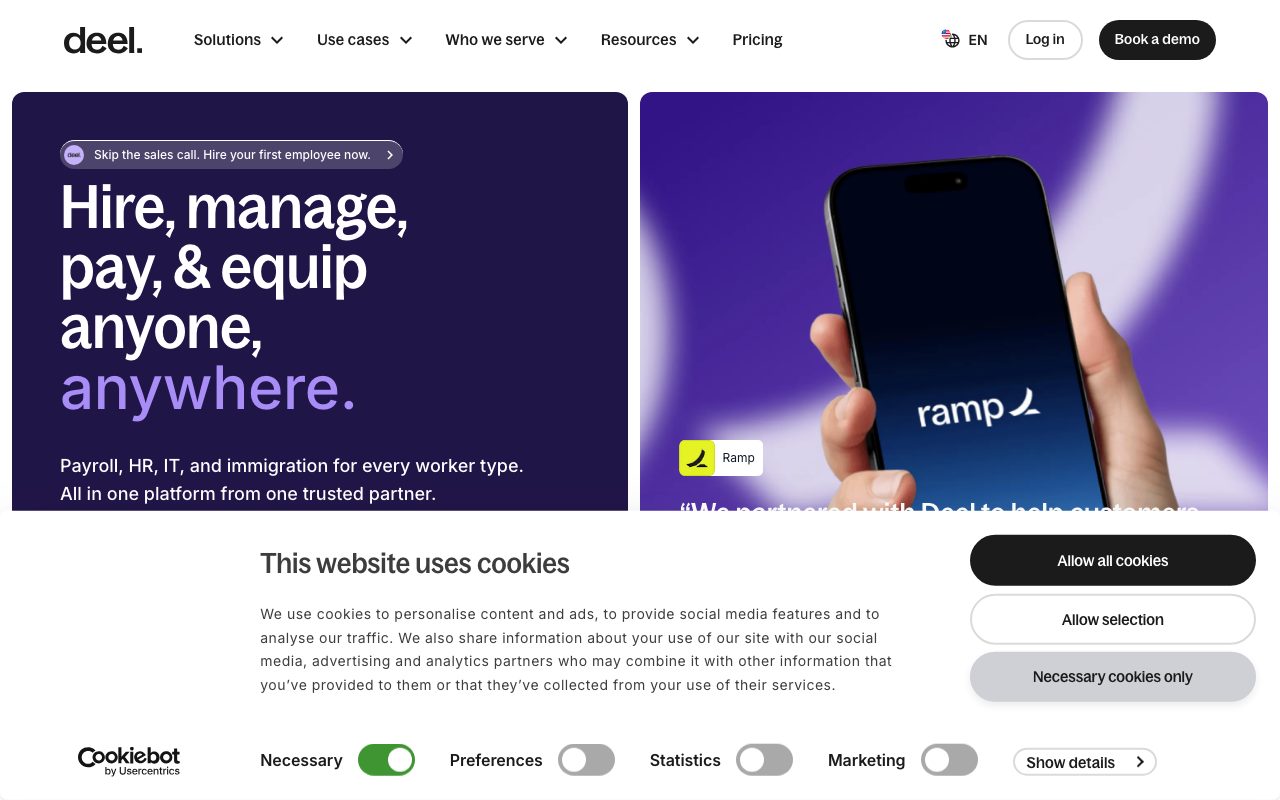
Deel is the platform that turned global hiring from a legal nightmare into a checkout flow. Founded in 2019, it scaled fast on the remote-work wave. Now it's the default answer when a US founder asks "how do I hire someone in Brazil legally?"
The product covers contractors, employer-of-record (EOR) employees, and global payroll. Few competitors do all three credibly.
What Deel actually does
Three core motions live inside Deel. Contractor agreements with global payments. EOR services where Deel becomes the legal employer in 100-plus countries. And payroll for owned entities where you've got a registered business locally.
You hire a contractor in Argentina, send them a Deel-generated agreement, and pay them monthly in pesos. Deel handles compliance, invoices, and tax forms. The contractor gets paid in Wise, crypto, or local bank transfer.
For full-time employees abroad, EOR is the magic trick. Deel employs the person in their country. You pay Deel a monthly fee. The employee gets local benefits, payslips, and tax compliance without you registering an entity.
Who Deel is for
Remote-first companies hiring globally. Startups expanding into a new country before they've set up a legal entity there. Larger companies centralizing payroll across regions where they already have entities.
It's overkill if you only hire in one or two countries with simple contractor relationships. You can self-serve those with templates and Wise. Deel earns its fee at scale.
Deel pricing breakdown
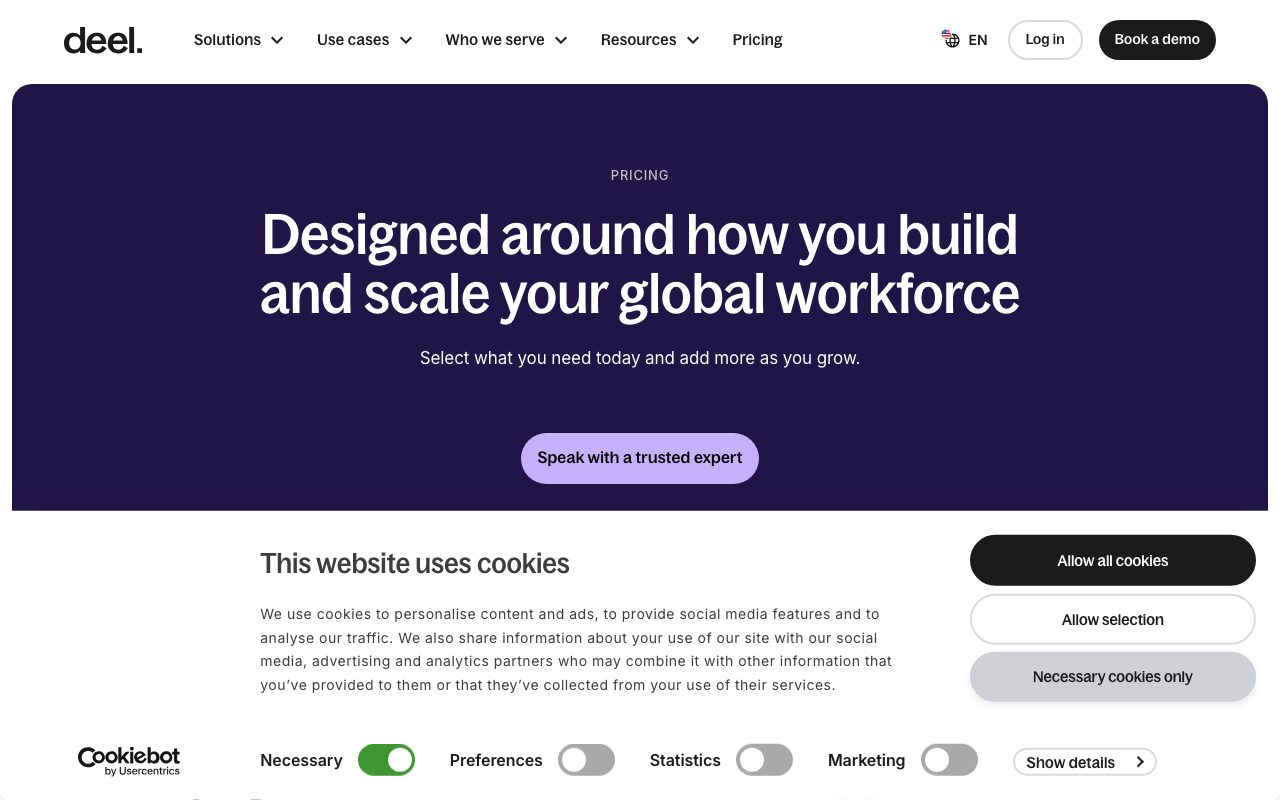
Contractor management starts at $49 per contractor per month. EOR services start around $599 per employee per month, varying by country.
Global payroll for owned entities is custom-quoted. Most multi-region payroll deals run into the thousands monthly.
Add-ons include background checks, equity, equipment provisioning, and immigration support. Each is billed separately. The bills add up but stay predictable.
Standout Deel features
The country coverage is the headline. Hiring in Vietnam, Nigeria, or Estonia is roughly as easy as hiring in Germany. That breadth is hard for smaller competitors to match.
Compliance automation actually works. Deel handles tax forms, local payroll calculations, and benefits enrollment by country. You don't need a local accountant in every market.
HRIS features have grown fast. Deel acquired and built features for onboarding, time tracking, equity, and even immigration. It's a real HR platform now, not just a payment tool.
Honest tradeoffs
EOR fees are meaningful. $599 per month per employee adds up at twenty hires. Some teams set up local entities once they hit critical mass in a country to save money.
Contract templates need legal review for high-stakes hires. The defaults are reasonable but they're defaults. Senior engineering or executive contracts deserve a real lawyer.
Country support varies in depth. Tier-one countries like the US, UK, and Germany are well-served. Smaller markets sometimes have fewer benefit options or slower onboarding.
Deel turned a year of legal work into a one-day onboarding. That's worth the fee for any global hire that matters.
Deel vs the alternatives
The biggest peer is Remote. Remote and Deel are functionally similar with comparable pricing. Picking between them often comes down to pricing for your specific country mix.
Oyster and Papaya Global are the next tier. They cover similar ground but with different country strengths and pricing models.
For US-only hiring, Gusto and Rippling are stronger and cheaper. Deel only earns its keep when you cross borders.
Worth comparing best global payroll platforms, Deel alternatives, and Deel vs Remote.
Bottom line on Deel
Deel is the safe bet for global hiring. The country breadth, the compliance automation, and the integrated payroll make it the obvious first call. It's not the cheapest option for any single country, but it's the simplest for many.
If you're a remote-first company hiring across borders, you'll end up here eventually. Most teams find it cheaper to start than to migrate later.
Deel for contractors specifically
Most teams start with Deel for contractor management before adopting EOR. The pitch is straightforward. Generate a localized contract, send it for digital signature, and pay the contractor in their preferred currency monthly.
Tax forms get handled. 1099-NEC for US contractors. Country-specific equivalents for international ones. The compliance load shifts from you to Deel.
Contractor-only management runs around $49 per month per contractor. That's the cheapest path into Deel. Many companies stay there for years before needing EOR.
Deel for full-time international hires
EOR is where the magic shows up. Deel becomes the legal employer in the contractor's country. They get a real local payslip, real benefits, real tax withholding. You don't register an entity.
The fee is significant. $599 per month per employee, plus the actual salary, plus statutory benefits. Compare that to setting up your own entity in Mexico ($30,000 in legal and accounting fees) and paying a local payroll vendor monthly. EOR wins until you hit ten or twenty employees in a country.
The tipping point varies. High-cost countries with lots of statutory benefits favor EOR longer. Low-cost countries with simple payroll favor own-entity sooner.
Deel common questions
"How does Deel make money?" Subscription fees on contractors and EOR employees, plus payment processing fees on transfers.
"Is Deel safe for compliance?" Generally yes. They have local legal teams in supported countries. Always have a real lawyer review high-stakes contracts.
"Can Deel handle equity and stock options?" Yes in supported countries. The tax handling is one of Deel's strongest differentiators.
"Does Deel work for visa sponsorship?" Limited support depending on country. Immigration features are growing but not the core product.
Final word on Deel
Deel is the safe, expensive, well-resourced bet for global hiring. The country breadth is unmatched. The compliance automation works.
If you're hiring across borders and you don't have an in-house global mobility team, you'll end up here. Most teams find it cheaper to start with Deel than to migrate to it later.
Deel for early-stage startups
Early-stage startups hire their first international engineer through Deel. The pattern is consistent. Founders find a great candidate in Argentina or Vietnam. They don't want to set up a local entity. Deel takes the legal and tax complexity.
The cost feels high for cash-strapped early stage. $599 per month per EOR employee plus salary. Founders sometimes try contractor relationships instead, which works for some roles and creates risk for others.
The right rule of thumb: contractors for short-term project work, EOR for long-term full-time employees. The legal distinction matters in most countries and Deel reflects it accurately.
Deel for scaling companies
Companies in the 50-to-500-employee range typically expand internationally with Deel. The country breadth means you can hire wherever the talent is, not where you happen to have an entity.
The HRIS layer scales decently. Onboarding flows, time tracking, equity grants, performance reviews all live inside Deel. Some larger companies still pair Deel with a dedicated HRIS like Rippling or Bamboo, treating Deel as the global payroll layer.
The compliance reporting matters at this stage. Auditors and investors expect proper documentation. Deel's audit trails generally hold up well.
Deel migration story
Coming from Remote: similar feature set, similar pricing. Migration mostly means re-papering contracts in Deel's templates. Plan a quarter for the transition.
Coming from local payroll vendors in each country: Deel consolidates everything into one platform. The savings come from no longer juggling five different vendors.
Coming from contractor-only setups: Deel's EOR upgrade is meaningful. Convert your top contractors to EOR employees with proper benefits and tax compliance.
Coming from in-house international entities: harder. Deel can complement your entities or replace them. The economics depend on country and headcount.
Deel competitive landscape
Deel competes with Remote, Oyster, Papaya Global, and several smaller players in the global employment space. The market has consolidated around three or four leaders.
Each has slight country strengths. Deel is strongest in the Americas and English-speaking markets. Remote is strong in Europe. Some smaller players win specific regions.
Pricing is broadly similar across the leaders. EOR fees cluster in the $500 to $700 per month per employee range. Contractor management runs $40 to $80 per month per contractor.
Differentiation comes from product depth (HRIS features, equity, immigration support) and country coverage. The leaders all have decent product depth at this point.
For most teams, the right pick is whichever vendor handles your priority countries best at the price you can stomach. Run a pricing comparison for your specific country mix and headcount projection.
Deel implementation tips
Set up your account before you have an urgent hire. Onboarding takes a week or two for the legal entity verification. Don't wait until you have a candidate ready to start.
Loop in your finance team early. Deel changes how international payments hit your books. Bank reconciliation patterns shift. Plan accordingly.
Read the contract templates carefully. Defaults are reasonable but not perfect for every situation. Senior hires deserve a real legal review.
Use the HRIS features once they're worth it. Don't bolt on Deel's onboarding tools if you have better ones already. Start with payroll and add layers as needed.
Tutorial / Demo
Key Features
- Contractor agreements and global payments
- Employer of Record in 100+ countries
- Global payroll for owned entities
- Equity and benefits in supported countries
- Compliance and tax-form automation
- Background checks and IT/equipment provisioning
Pros & Cons
What we like
- Single platform for contractors, EOR, and payroll
- Wide country coverage
- Active product investment in HRIS features
Room for improvement
- EOR fees are a meaningful cost per employee
- Contract templates need legal review for high-stakes hires
- Some country support is shallower than others
Frequently Asked Questions
How much does Deel cost?
Deel vs Remote vs Rippling, who wins?
Does Deel handle tax and compliance?
Can contractors get paid in their local currency?
What about US payroll?
Best For
Featured in
Alternatives to Deel
View all


Our take
Tool Index Editorial · May 2026· 4.6/5
Deel positions itself as global payroll, contractor, and eor platform, and on the whole it earns the framing.
What it actually does well: Single platform for contractors, EOR, and payroll, Wide country coverage, and Active product investment in HRIS features. Less impressive: EOR fees are a meaningful cost per employee and Contract templates need legal review for high-stakes hires.
In short: Deel is a strong pick when you need hiring contractors or employees abroad without local entities, and a harder sell if eOR fees are a meaningful cost per employee would be a dealbreaker.
Editorial opinion from the Tool Index team, written from the public product pages. Not a user review.
Reviews (4)
Recommended without reservation
Skeptical at first because Deel looked too simple. It's not. What stands out is how single platform for contractors, EOR, and payroll. Main use case: hiring contractors or employees abroad without local entities. Easy yes for anyone weighing the same trade-offs.
Pros
- Single platform for contractors, EOR, and payroll
- Wide country coverage
Stuck the landing for our team
Found Deel on a Reddit thread, glad I clicked. Where it really wins is single platform for contractors, EOR, and payroll. Their take on equity and benefits in supported countries is solid. It fits well for hiring contractors or employees abroad without local entities. Easy yes for anyone weighing the same trade-offs.
Cons
- EOR fees are a meaningful cost per employee
- Some country support is shallower than others
Hoped for more honestly
Been using Deel for the last quarter now. Honestly impressed by how active product investment in HRIS features. Not perfect: contract templates need legal review for high-stakes hires.
Pros
- Wide country coverage
The kind of tool you forget you're paying for
Honest take: Deel delivers most of what the marketing promises. The biggest win has been wide country coverage. Got real value out of contractor agreements and global payments. Mostly using it for centralizing compliance across multiple regions. Glad I made the switch.
Pros
- Wide country coverage
- Active product investment in HRIS features
- Single platform for contractors, EOR, and payroll
Badge builder
Add Deel to your website
Choose a badge style and size, preview it here, then copy the generated HTML. Badge images are self-contained SVGs and do not require an external script.

<a href="https://toolindex.net/tools/deel?ref=badge" target="_blank" rel="noopener">
  <img src="https://toolindex.net/badge/deel/medium.svg" alt="Deel - Listed on Tool Index" width="180" height="50" />
</a>How to use the badge
- 1. Pick the style, size, and theme that fit your layout.
- 2. Copy the generated HTML from the code block.
- 3. Paste it into your footer, homepage, or press page.
Score badge available
Deel qualifies for the score and circle badges based on its current top-10 positionin HR & Recruiting.
Badge clicks return visitors to this profile with a referral tag so the source remains identifiable.
Related Tools
Simple RMD
Calculate, aggregate, and manage your annual IRA required minimum distributions.
FreshBooks
Cloud accounting designed for service-based small businesses and freelancers
Chargebee
Subscription billing and revenue management for B2B SaaS

Rippling
Workforce platform unifying HR, IT, and finance
Work on Deel? Request listing access or correction