
Meetless
Governance layer for AI coding agents that enforces human-approved decisions
Gallery
About Meetless
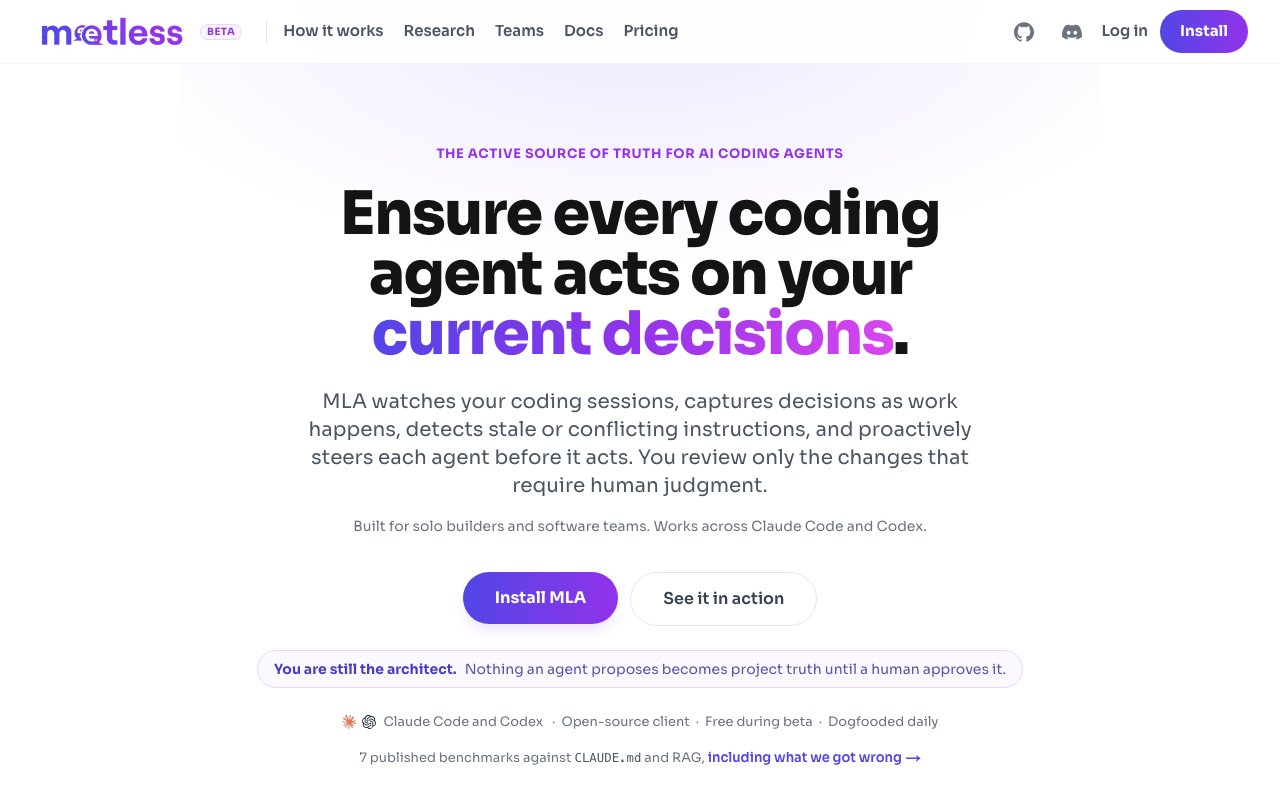
Meetless provides a governance layer for AI coding agents like Claude Code and OpenAI Codex. The product addresses what the team calls context rot, the problem where agents encounter conflicting or outdated instructions that all appear equally authoritative. Their thesis is that expanding context windows makes this problem worse, not better, because more context means more opportunities for contradiction without any mechanism to resolve which instruction is current. Meetless establishes clear decision authority so agents know which information humans actually approved and when that approval happened.
The core argument is that the problem isn't memory but authority. AI agents are confident and fast. They produce well formatted code that passes tests and reads cleanly. But that doesn't mean they're following the decisions your team actually made. When an agent encounters two conflicting pieces of guidance, it picks one without flagging the conflict or asking for clarification. When it generates a new approach, it might promote its own proposal into the project's de facto standard just by using it consistently across sessions. Over time, the agent's assumptions start driving architecture decisions that humans never explicitly reviewed or approved. Meetless intercepts this by storing confirmed team decisions in a knowledge graph that agents can query, with clear boundaries between what humans approved and what the agent invented on its own.
The workflow operates through four stages that build on each other. Capture observes your coding sessions and identifies decisions worth preserving. Not every line of code represents a decision worth tracking, so this stage filters for the choices that actually matter to the project's direction. Approve requires humans to review captured material before it becomes project truth. Nothing enters the trusted knowledge store without explicit human approval, which prevents the agent from gradually rewriting your standards or conventions without anyone noticing. Reconcile tracks decision history and flags unresolved conflicts for human review instead of letting the model settle the dispute by picking a winner. Steer injects approved decisions directly into agent prompts before the agent acts, so the right context is present when it matters most.
The system explicitly prevents agents from self promoting their own conclusions into trusted knowledge. When an agent proposes something new, that proposal stays tagged as agent generated until a human elevates it to approved status. When conflicts arise between different instructions or decisions, they route to humans rather than back to the agent for resolution. This matters most on long running projects where decisions accumulate over months and the agent's context window only sees a slice of that history at any given time. Without this governance layer, what the agent saw last week might contradict what it sees today, and it has no mechanism to determine which version is authoritative.
Technically, Meetless operates through an open source CLI called MLA, licensed under Apache 2.0. The prompt injection happens locally without a network call on every prompt, which keeps latency low and lets you inspect exactly what's being injected into your agent's context. You can read the source code at every decision point if you want to verify what's happening under the hood. Telemetry can be disabled entirely with an environment variable if you prefer not to send any usage data. The open source model means the tool is auditable in a way that proprietary alternatives simply can't match for security conscious teams.
The product currently supports Claude Code and OpenAI Codex as the two main agent targets. Rather than treating these as competing systems that need separate configurations, Meetless handles them as siblings that share the same governance logic. If your team uses both agents depending on the task at hand, you don't need to maintain separate decision stores or approval workflows for each. The knowledge graph and approval workflow apply uniformly across both, so decisions approved while using Claude Code are available when someone switches to Codex later. This cross session continuity matters for teams where different engineers prefer different tools or where a single engineer switches between agents depending on what they're working on.
The company published preliminary research showing their approach outperformed static files and retrieval only methods in identifying which decisions are current versus outdated. They made their methodology transparent and published corrections when tests failed, which suggests an honest approach to benchmarking even if the sample sizes remain limited. This kind of transparency is unusual for products in this space and indicates the team is thinking carefully about the claims they make.
Access is free during the beta period with no credit card required, no seat limit, and no invite code needed. The company hasn't finalized pricing for when beta ends, but they've committed to announcing any changes on their pricing page with advance notice so users aren't surprised. For teams, there's dedicated guidance on their teams page for collaborative setups where multiple engineers need to share a decision store. Solo builders can start immediately without any coordination overhead or approval from teammates.
Key Features
- Decision capture from coding sessions
- Human approval workflow
- Conflict reconciliation routing
- Context injection into agent prompts
- Open source CLI under Apache-2.0
- Claude Code and Codex connectors
Pros & Cons
What we like
- Prevents agents from self-promoting their own conclusions
- Open source client is auditable
- Local prompt injection keeps latency low
- Free during beta with no seat limits
Room for improvement
- Currently in beta, so features may change
- Requires workflow changes to capture and approve decisions
- Only supports Claude Code and Codex for now
- Future pricing not yet defined
Frequently Asked Questions
What is Meetless?
Is Meetless free?
What agents does Meetless support?
How does Meetless inject context?
Best For
Featured in
Alternatives to Meetless
View allCursor
VS Code fork built around an AI pair-programmer

Replit
Browser IDE plus Replit Agent that builds and deploys apps from a prompt
Windsurf
Codeium's AI editor with Cascade agent and deep IDE integration
Vibe Built
Building real apps with agentic AI. What worked, what broke, what shipped.
Reviews (0)
Badge builder
Add Meetless to your website
Choose a badge style and size, preview it here, then copy the generated HTML. Badge images are self-contained SVGs and do not require an external script.

<a href="https://toolindex.net/tools/meetless?ref=badge" target="_blank" rel="noopener">
  <img src="https://toolindex.net/badge/meetless/medium.svg" alt="Meetless - Listed on Tool Index" width="180" height="50" />
</a>How to use the badge
- 1. Pick the style, size, and theme that fit your layout.
- 2. Copy the generated HTML from the code block.
- 3. Paste it into your footer, homepage, or press page.
Standard badge available
The standard listing badge is available now. Score and circle badges are limited to tools currently ranked in the top 10 of a category.
Badge clicks return visitors to this profile with a referral tag so the source remains identifiable.
Related Tools

Bolt.new
Prompt-to-deployed full-stack app inside the browser

Tabnine
Privacy-first enterprise AI code assistant you control, with SaaS, VPC, on-prem, or fully air-gapped deployment
Cursor
VS Code fork built around an AI pair-programmer

Skeezo
Agent-native macOS IDE for coordinating Claude Code and AI agents
Work on Meetless? Request listing access or correction