Memcode
Terminal coding agent with persistent memory that gets sharper the longer it works in your repo
Gallery
About Memcode
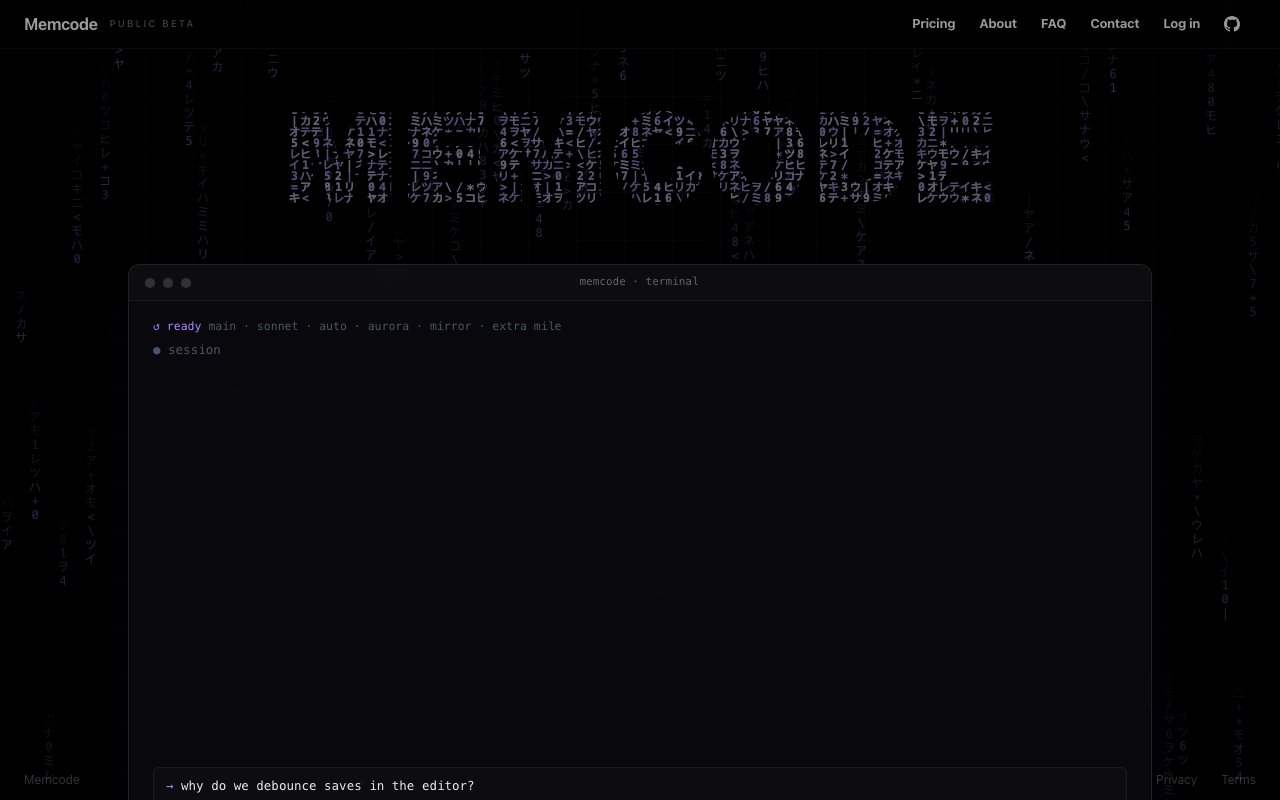
Memcode is a terminal based AI coding agent that builds and maintains a persistent memory model of your codebase. Instead of starting fresh every session, forgetting everything it learned about your project the moment you close the window, Memcode accumulates knowledge over time. It remembers your architecture decisions, understands how your modules connect, and carries context forward into every future conversation. The result is an agent that actually gets more useful the longer you work with it, learning the shape of your repository through repeated interactions rather than treating each session as a blank slate. This persistent memory is the central feature that distinguishes it from stateless assistants that reset the moment you close the chat window.
The problem it tackles is one that anyone who has used AI coding assistants knows well. You explain your codebase to the model, it helps you ship something, and then the next day you start over. Context windows reset, and all that careful explanation vanishes. Memcode treats your codebase as a living picture, tracking not just the code but the reasoning behind it, so you spend less time re-explaining and more time building. The memory system watches your repos automatically as you commit and edit, building its understanding passively without requiring you to manually sync or upload anything. When you return to a project after days or weeks away, the agent picks up where you left off. It knows which files matter, which patterns you prefer, and which decisions you already made, all without you having to restate them.
It runs as a single static binary with a fast terminal user interface. There is no Electron wrapper, no browser tab, no IDE plugin to configure. You install it with a single curl command and you are working in seconds. The TUI starts instantly because there is no heavy runtime to spin up, just a lightweight binary that connects to your choice of frontier models. Under the hood it supports multiple providers including OpenAI (GPT 5.6 Sol, Terra, Luna), Anthropic (Claude Fable 5, Opus 5, Sonnet 5, Haiku 4.5), Google (Gemini 3.1 Pro, 3.6 Flash), xAI Grok 4.5, and open weight models via Fireworks. Context windows range from 200K to over a million tokens depending on the model, so you can feed substantial codebases into a single conversation. The ability to switch providers without changing your workflow means you can chase the best price or capability for a given task.
Beyond the core coding agent, Memcode bundles additional features that extend its utility past code generation. There is a chat interface grounded in your team documentation through DataHub, which lets you upload and organize internal knowledge so the agent can answer questions about your own processes and systems. Custom agents can be configured for research, monitoring, and reports, running on schedules rather than requiring manual triggers. A website builder generates sites from prompts, handling the scaffolding so you can iterate on design without starting from a blank file. These peripheral tools turn Memcode into something closer to a development platform than a single purpose assistant. The combination of persistent memory plus scheduled automation means tasks that would otherwise require human attention can run in the background and surface results when they are ready.
The audience is software engineers and development teams who want contextual awareness across sessions, not just one off code generation. It fits anyone who has tried other coding assistants and found themselves frustrated by how much setup each session requires, re-explaining the same architectural context every time the window opens. For teams, the shared memory means new members can tap into institutional knowledge the agent has accumulated, shortening onboarding and reducing repeated explanations. Developers working on multiple repositories will appreciate that each repo maintains its own memory, so switching projects does not mean losing context.
Memcode is currently in public beta, which means active development, occasional rough edges, and a product that evolves quickly. You can use either Memcode credits or bring your own API keys, with direct billing at provider costs and no markup on token usage. The product works on macOS, Linux, and Windows, installed through a one liner that drops the binary in your path. For developers comfortable in the terminal who want their AI assistant to actually remember what they worked on last week, Memcode offers a model of interaction that stateless chat interfaces simply cannot match. The persistent memory, the fast startup, and the model flexibility combine into a tool that rewards continued use rather than punishing you for closing the window.
Key Features
- Persistent codebase memory across sessions
- Single binary terminal user interface
- Multi model support with automatic routing
- Scheduled autonomous agents for research
- Team documentation chat interface
- Bring your own API key option
Pros & Cons
What we like
- Context accumulates over time instead of resetting every session
- No Electron or browser overhead, just a fast terminal interface
- Supports Claude, GPT, Gemini, Grok, and open weight models
- Transparent credits system with no token markup
Room for improvement
- No free tier, starts at one hundred dollars per month
- Still in public beta with occasional rough edges
- Requires comfort with terminal workflows
- Memory quality depends on how well it parses your specific codebase
Frequently Asked Questions
What is Memcode?
Is Memcode free?
Which AI models does Memcode support?
Who is Memcode for?
Best For
Featured in
Alternatives to Memcode
Cursor
VS Code fork built around an AI pair-programmer

Replit
Browser IDE plus Replit Agent that builds and deploys apps from a prompt
Windsurf
Codeium's AI editor with Cascade agent and deep IDE integration

Vibe Built
Building real apps with agentic AI. What worked, what broke, what shipped.
Reviews (0)
Badge builder
Add Memcode to your website
Choose a badge style and size, preview it here, then copy the generated HTML. Badge images are self-contained SVGs and do not require an external script.

<a href="https://toolindex.net/tools/memcode?ref=badge" target="_blank" rel="noopener">
  <img src="https://toolindex.net/badge/memcode/medium.svg" alt="Memcode - Listed on Tool Index" width="180" height="50" />
</a>How to use the badge
- 1. Pick the style, size, and theme that fit your layout.
- 2. Copy the generated HTML from the code block.
- 3. Paste it into your footer, homepage, or press page.
Standard badge available
The standard listing badge is available now. Score and circle badges are limited to tools currently ranked in the top 10 of a category.
Badge clicks return visitors to this profile with a referral tag so the source remains identifiable.
Related Tools

Bolt.new
Prompt-to-deployed full-stack app inside the browser

Tabnine
Privacy-first enterprise AI code assistant you control, with SaaS, VPC, on-prem, or fully air-gapped deployment
Cursor
VS Code fork built around an AI pair-programmer

Skeezo
Agent-native macOS IDE for coordinating Claude Code and AI agents
Work on Memcode? Request listing access or correction