
Microphone
Talk through a startup idea and let an AI agent test it with real Meta ads
Gallery
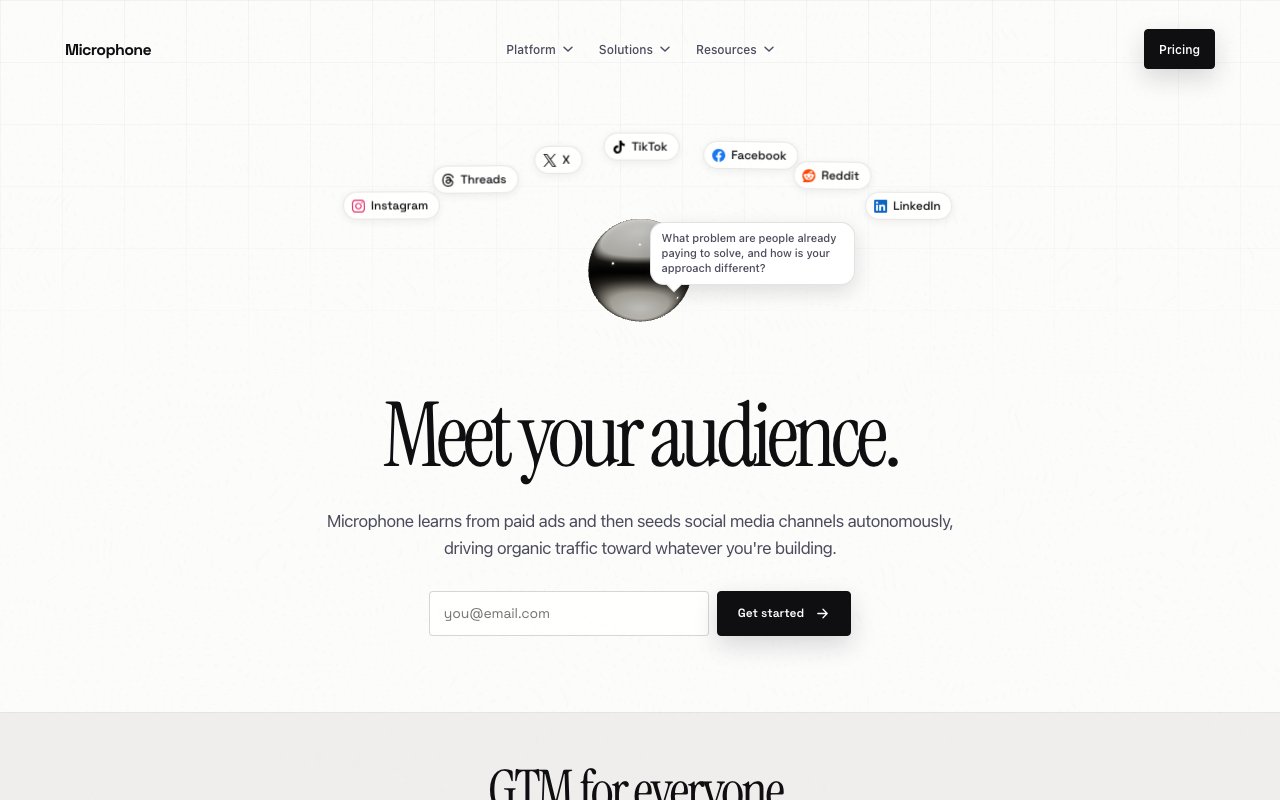
About Microphone
Microphone is an iOS app from GEISTS, LLC that helps founders validate a startup idea with real paid advertising before they build anything. Instead of typing a brief into a form, you talk. You describe the idea out loud to a real-time voice agent, and Microphone turns that conversation into a problem statement, ad angles, and a small Meta campaign designed to measure whether anyone actually cares. The company describes the product as a voice agent that learns from paid ads, then puts that conviction to work seeding organic channels through social media subagents, which is a fair summary of the two halves of what it does.
The problem it goes after is the classic founder trap of building first and validating never. Running a proper ad test normally means having a Meta ad account, some marketing instinct, finished creative, and the patience to set up campaigns and interpret the results afterward. Most early-stage founders have none of that, so they skip the test entirely and spend months on a product nobody asked for. Microphone compresses the whole loop into something one person can run from a phone, and it enforces the discipline that makes a test meaningful in the first place, one problem, one audience, one offer, and success criteria written down before the campaign ever goes live.
The flow is deliberately structured. You articulate the problem, audience, and offer, then discuss the concept with the voice agent, which sharpens the framing the way a conversation does and a blank form never will. Microphone drafts the problem statement and ad angles, generates the ad concepts and copy, and launches a narrow audience test on Facebook and Instagram over a fixed period. While the test runs it tracks clicks, engagement, and sign-ups, and when the window closes it evaluates the numbers against the criteria you set before launch, then recommends next steps based on what the data actually shows rather than how attached you've become to the idea.
Capture is built around how ideas actually arrive. Voice memos recorded during the day and notes kept in Apple Notes feed straight into the system, so a half-formed thought from a commute can become campaign material later without retyping anything. Automated research fills in background on the market before the agent starts drafting, so the ad angles rest on more than just your own description of the space. The point isn't that this replaces talking to customers, it's that the test runs against a sharper hypothesis than the one you started with, and the fixed test window keeps you from letting a mediocre campaign limp along for weeks while you wait for a verdict that already arrived.
The more unusual part is what happens after validation. Once a test shows signal, social media subagents identify relevant communities and start working organic distribution on the idea's behalf. The privacy posture here is genuinely different from most AI tools, because the subagents run on your own hardware via a Raspberry Pi rather than on someone else's cloud servers. Your growth automation lives in your house, not in a data center, which is both a real privacy stance and a slightly eccentric one, and it tells you something about who built this.
It fits founders without marketing experience, ad accounts, or finished creative who want a cheap, fast answer to the only question that matters early on, which is whether strangers respond to the pitch. If you've half-built three products this year without showing any of them to a paying audience, this is aimed squarely at you. It's less useful for teams that already employ a performance marketer, since the value is in replacing that skill set rather than augmenting it, and Android founders are out of luck for now since it ships as an iOS app.
Pricing is subscription plus credits, with no free tier visible on the site. Plus runs $29.99 a month with 500 platform credits, voice memos, Apple Notes integration, the real-time voice agent, automated research, ad generation, and campaign creation. Pro is $64.99 a month with 1,200 credits and a 10% discount on extra credits, and it adds the social media subagents and routines. Ultra is $119.99 a month with 2,500 credits, a 20% credit discount, and MCP access on top of everything in Pro, which opens the platform to anyone wiring it into their own agent tooling. Top-up packs range from $29.99 for 500 credits to $129.99 for 3,000, and purchased credits never expire, so occasional testers can stock up without watching a meter reset each month. Keep in mind that ad spend on Meta is a separate cost you control, so budget for both the subscription and whatever you put behind the test campaigns.
Key Features
- Voice agent that drafts campaigns from conversation
- Automated Meta ad creation and launch
- Click, engagement, and sign-up tracking
- Social media subagents for organic seeding
- Self-hosted agents on Raspberry Pi hardware
- Voice memo and Apple Notes capture
Pros & Cons
What we like
- Turns idea validation into a structured, repeatable loop
- No marketing experience or existing ad account needed
- Subagents run on your own hardware instead of the cloud
- Pre-launch criteria keep results honest instead of vibes-based
Room for improvement
- No free tier or trial mentioned on the site
- iOS only, so Android founders are out
- Meta ad spend is an extra cost on top of the subscription
- Younger product with an unconventional hardware component
Frequently Asked Questions
What is Microphone?
Is Microphone free?
What are the social media subagents?
Who is Microphone for?
Best For
Featured in
Alternatives to Microphone
View all
Apatero AI
The creator studio for AI image, video, audio, 3D, and avatars, now at apatero.ai.

Prompted Income
Make money with AI, documented with the receipts instead of the screenshots.

Sellsmithy
The workshop side of selling digital products. Built first, fees counted, duds included.

Postdex
An exclusive marketplace for finished, human-made articles. Every piece sells once.
Our take
Tool Index Editorial · Oct 2026· 2.5/5
Microphone currently presents itself as a conversational growth service that runs paid audience tests, surfaces responsive segments, and offers autonomous social seeding. Founders can start over iMessage, SMS, or WhatsApp, fund an advertising wallet at a self-chosen level, and add hosted landing pages for $20 a month. Growth consulting is listed as free, while Autoseed is usage based.
The appeal is direct access to a guided testing loop without first learning an ad manager. The captured site, however, does not support many details in the submitted listing, including an iOS app, fixed subscription tiers, Raspberry Pi agents, or the stated credit packages. It also leaves the total cost of paid tests and Autoseed unclear. We would treat this as a hands-on growth service, ask exactly what actions are automated, and set strict spend and account permissions before connecting social or ad accounts.
Editorial opinion from the Tool Index team, written from the public product pages. Not a user review.
Reviews (0)
Badge builder
Add Microphone to your website
Choose a badge style and size, preview it here, then copy the generated HTML. Badge images are self-contained SVGs and do not require an external script.

<a href="https://toolindex.net/tools/microphone-computer?ref=badge" target="_blank" rel="noopener">
  <img src="https://toolindex.net/badge/microphone-computer/medium.svg" alt="Microphone - Listed on Tool Index" width="180" height="50" />
</a>How to use the badge
- 1. Pick the style, size, and theme that fit your layout.
- 2. Copy the generated HTML from the code block.
- 3. Paste it into your footer, homepage, or press page.
Standard badge available
The standard listing badge is available now. Score and circle badges are limited to tools currently ranked in the top 10 of a category.
Badge clicks return visitors to this profile with a referral tag so the source remains identifiable.
Related Tools
Apatero AI
The creator studio for AI image, video, audio, 3D, and avatars, now at apatero.ai.

SEObot
Autonomous AI SEO agent that runs your blog and link building on autopilot

Substack
Hosted newsletter and publication platform with built-in payments, recommendations, and an audience network for writers.

MailerLite
Friendly, affordable email marketing tool with newsletters, automations, landing pages, and a growing creator toolkit.
Work on Microphone? Request listing access or correction