
MXValidation
Test email authentication, spam signals, and delivery configuration
Gallery
About MXValidation
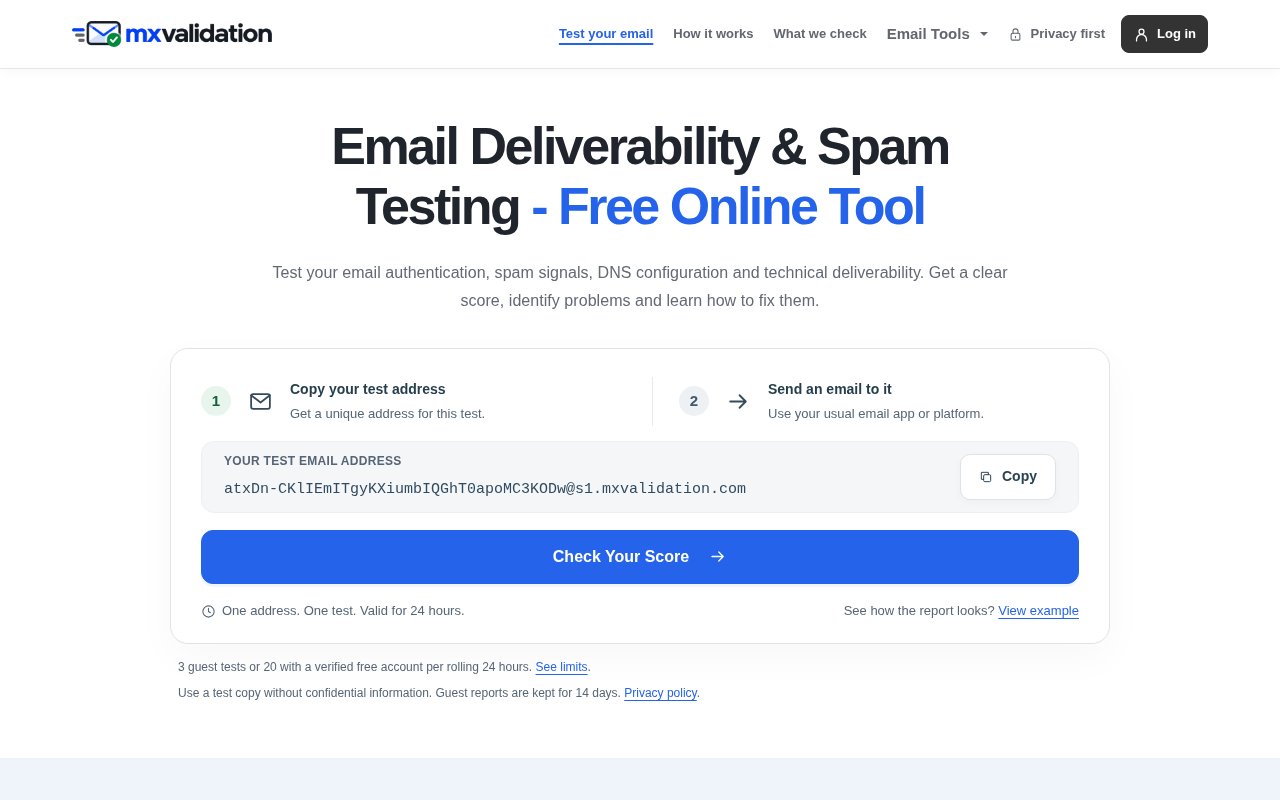
MXValidation is a free online diagnostic service for testing the technical health of an email before it reaches a real campaign or production workflow. It brings authentication, sending infrastructure, spam signals, message structure, and delivery details into one report with a score out of ten. The point isn't to promise a place in the inbox. It is to show what happened during one observed delivery and explain the evidence behind warnings or failures. That gives developers, marketers, and mail administrators a concrete place to start when an email behaves differently from what its DNS settings or sending platform suggest.
The workflow uses the same route as a normal message. MXValidation creates a unique test address that accepts one email for 24 hours. The user sends a representative copy from the email client, application, or campaign platform they actually want to evaluate, then opens the report as the analyses finish. That distinction matters because a message sent through a different provider tests that provider's delivery path. Each new attempt needs a new address, which keeps the report tied to a single delivery. The site recommends removing confidential information and using a test copy rather than forwarding a sensitive real message.
The main report evaluates ten areas. It checks SPF authorization, DKIM signatures, DMARC policy and alignment, SpamAssassin findings, configured DNS blocklists for the sending IP, reverse DNS and hostname consistency, email headers, HTML and MIME structure, extracted links, and TLS observed on the incoming SMTP connection. Checks can pass, warn, fail, remain pending, or be marked unknown when reliable evidence isn't available. Missing and unknown results don't quietly receive credit, and the report shows coverage beside the weighted score. Each finding includes an explanation and a practical next step instead of leaving the user with a bare number.
That detail makes the product useful across different email jobs. An application developer can inspect transactional notifications and account messages. A newsletter or marketing team can test a representative campaign before a send. A domain administrator can compare authentication behavior after changing SPF, DKIM, or DMARC. The report also exposes content and structural clues, including plain-text alternatives, active HTML, risky attachment extensions, header fields, visible URL mismatches, and link DNS. It doesn't open link destinations, scan attachments as an antivirus, validate mailing lists, or verify whether individual recipient mailboxes exist.
MXValidation also provides standalone tools when a full message test would be unnecessary. There are checkers for SPF, DKIM, DMARC, BIMI, MX, MTA-STS, TLS-RPT, and public IP blocklists. An EML and EMLX viewer opens a saved email and lets the user inspect headers and attachments locally in the browser. That local viewer doesn't upload the email contents. The domain and IP tools do send the submitted public identifier to the server and use Google Public DNS over HTTPS, while published MTA-STS policies and BIMI logos are fetched with limits. These utilities don't consume the email report allowance.
The service is candid about what the score can and can't establish. A high result reflects the configured technical checks for that message, but Gmail, Outlook, and other providers use additional reputation, engagement, filtering, and policy signals. The IP reputation section covers only the configured public blocklists, not every reputation network. A TLS pass describes the connection to MXValidation rather than all future deliveries or end-to-end encryption. This restraint makes the report more useful because unknown evidence stays unknown, and the user can separate a confirmed authentication problem from a broader inbox placement question.
Privacy requires some care because a full test deliberately sends a message to the service. Anonymous report details are available for 14 days, while account-owned results remain until the user deletes the test or account. Original SMTP spool files have a separate retention period of about 30 days after successful synchronization. Guest report links act as access keys and should remain private. HTML previews disable active content, and external images are blocked unless the user explicitly loads them. The service says it doesn't sell test messages, but users should still remove credentials, personal data, and confidential attachments that the analysis doesn't need.
Access is free rather than freemium on the published site. Guests can view three distinct tests per rolling 24 hours, and a verified free account has a default allowance of 20 new reports in that period. Shared networks and From domains can affect guest limits, and abuse prevention limits apply to the standalone tools. There is no paid plan presented. MXValidation is therefore easy to try and unusually detailed for occasional troubleshooting, though high volume continuous monitoring isn't its stated model. It works best as an evidence-driven checkpoint before a send or after a configuration change.
Key Features
- Ten-part deliverability report
- SPF DKIM DMARC analysis
- SpamAssassin signal breakdown
- Sending IP reputation checks
- Standalone email DNS tools
- Local EML and EMLX viewer
Pros & Cons
What we like
- Tests a real delivery from the chosen platform
- Explains evidence and practical next steps
- Marks unavailable checks as unknown
- Offers useful standalone tools for free
Room for improvement
- Doesn't test placement in provider inboxes
- Guest usage is limited to three daily tests
- Full tests require sending message content
- IP reputation covers only configured blocklists
Frequently Asked Questions
What is MXValidation?
Is MXValidation free?
Does a high score guarantee inbox placement?
How does MXValidation handle test emails?
Best For
Featured in
Alternatives to MXValidation
View all
Apatero AI
The creator studio for AI image, video, audio, 3D, and avatars, now at apatero.ai.

Prompted Income
Make money with AI, documented with the receipts instead of the screenshots.

Sellsmithy
The workshop side of selling digital products. Built first, fees counted, duds included.

Postdex
An exclusive marketplace for finished, human-made articles. Every piece sells once.
Reviews (0)
Badge builder
Add MXValidation to your website
Choose a badge style and size, preview it here, then copy the generated HTML. Badge images are self-contained SVGs and do not require an external script.

<a href="https://toolindex.net/tools/mxvalidation?ref=badge" target="_blank" rel="noopener">
  <img src="https://toolindex.net/badge/mxvalidation/medium.svg" alt="MXValidation - Listed on Tool Index" width="180" height="50" />
</a>How to use the badge
- 1. Pick the style, size, and theme that fit your layout.
- 2. Copy the generated HTML from the code block.
- 3. Paste it into your footer, homepage, or press page.
Standard badge available
The standard listing badge is available now. Score and circle badges are limited to tools currently ranked in the top 10 of a category.
Badge clicks return visitors to this profile with a referral tag so the source remains identifiable.
Related Tools
Apatero AI
The creator studio for AI image, video, audio, 3D, and avatars, now at apatero.ai.

SEObot
Autonomous AI SEO agent that runs your blog and link building on autopilot

Substack
Hosted newsletter and publication platform with built-in payments, recommendations, and an audience network for writers.

MailerLite
Friendly, affordable email marketing tool with newsletters, automations, landing pages, and a growing creator toolkit.
Work on MXValidation? Request listing access or correction