Paddle
Merchant-of-record billing built for software companies
Gallery

About Paddle
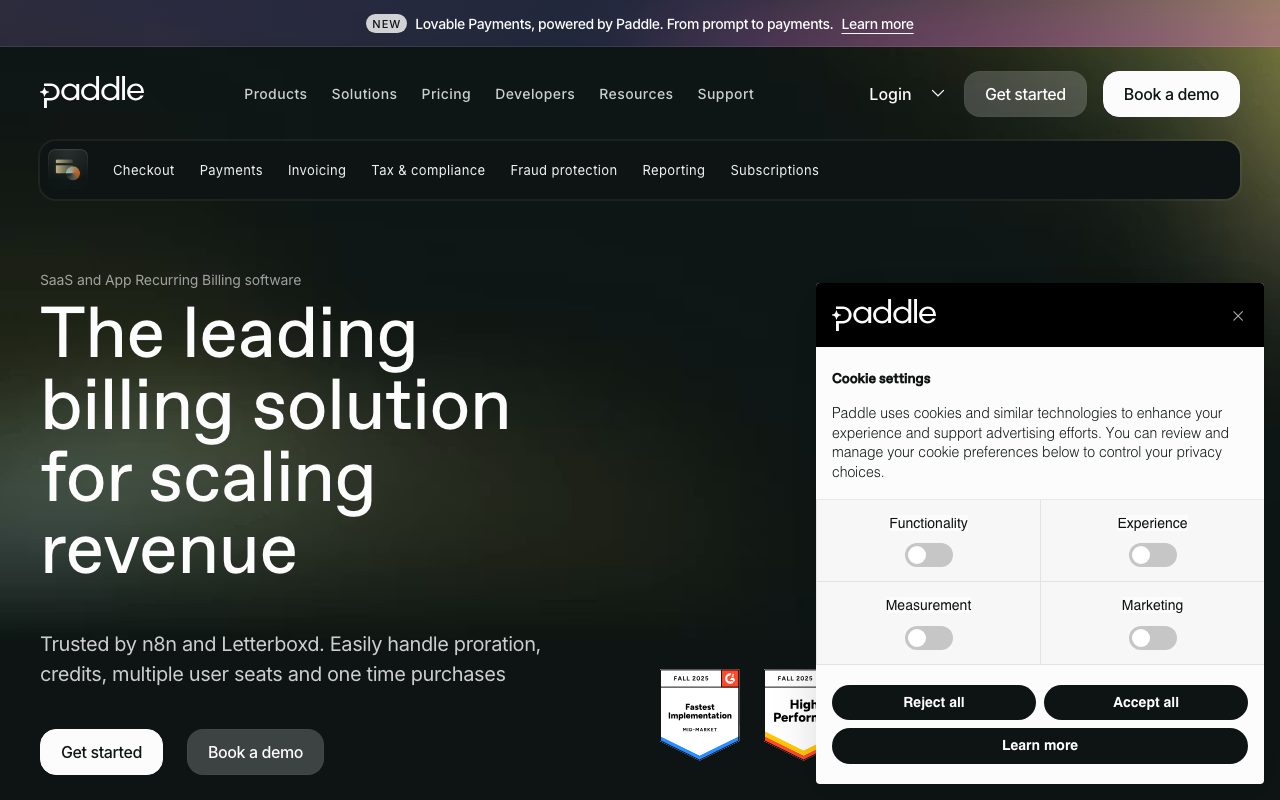
Paddle is a Merchant of Record (MoR) payments platform built for software companies. It handles checkout, subscriptions, sales tax, VAT, fraud, and chargebacks. You ship product, Paddle ships compliance.
The MoR model means Paddle is the legal seller of record. They collect taxes, file returns, and handle global compliance. You receive payouts net of all that mess.
SaaS companies, indie developers, and AI tool makers use Paddle to skip building international tax handling. Notable customers include Avast, Pluralsight, and many bootstrapped startups.
What Paddle actually does
Paddle gives you hosted checkout pages, subscription management, in-app upgrades, and a billing API. Your customer pays Paddle. Paddle pays you minus fees and taxes.
The big value is the Merchant of Record handling. Paddle is registered for VAT, GST, and sales tax in 100+ jurisdictions. They calculate, collect, file, and remit. You get a single global stream of revenue.
The new Paddle Billing replaces the old Classic system with a more flexible API, better webhooks, and tighter Stripe-style developer ergonomics.
Who Paddle is for
SaaS startups selling globally are Paddle's sweet spot. If you've ever stared at EU VAT rules and considered changing careers, Paddle exists for you.
Indie developers and small teams without a finance department love offloading compliance. The cost is higher fees, but the cost-saving on accounting hours is real.
Large enterprises with a dedicated tax team often run Stripe direct and handle their own filings. The economics flip at scale.
Pricing breakdown
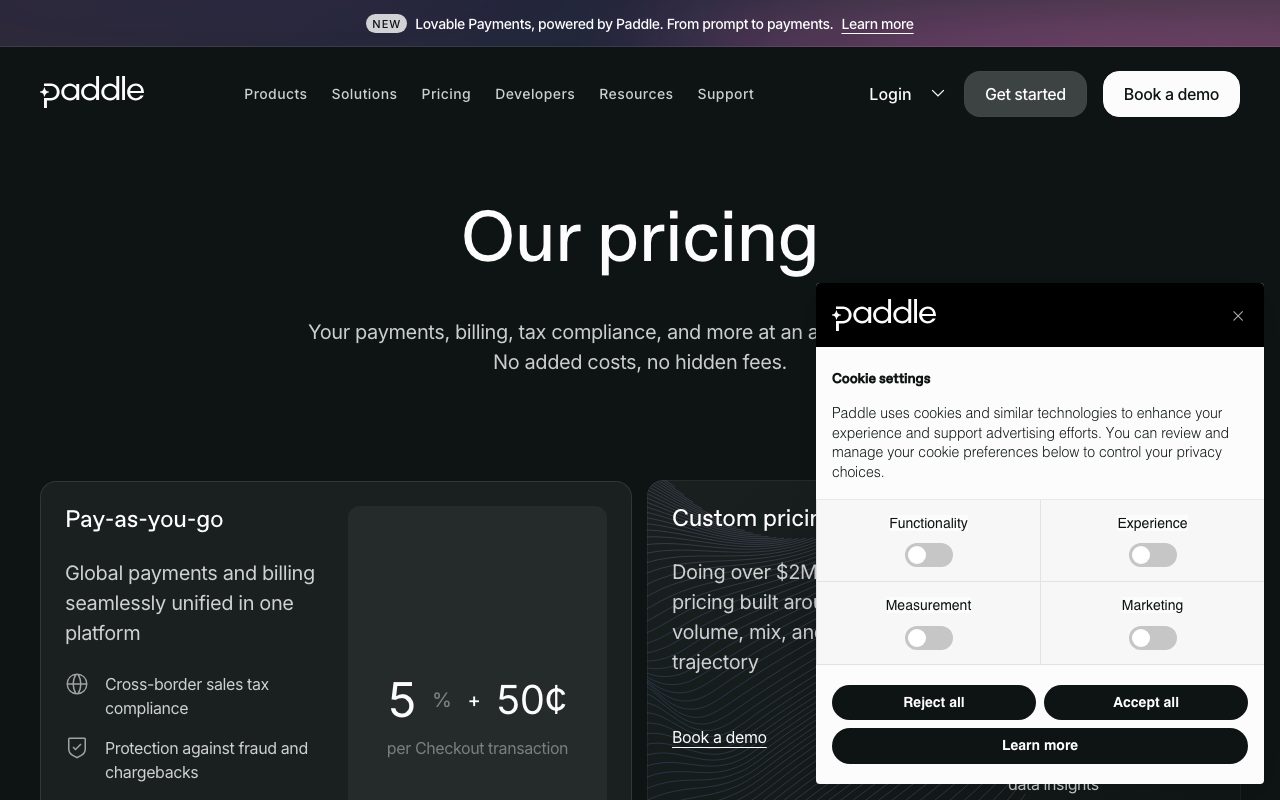
Paddle's standard pricing is around 5% plus $0.50 per transaction. Higher volume customers can negotiate down. There are no monthly platform fees.
That 5% includes the MoR service. Compared to Stripe (around 2.9% + $0.30) plus a tax service like TaxJar plus your accountant's hours, the math often favors Paddle for sub-$5M ARR.
Beyond a few million in ARR, you can usually save by going direct on Stripe and hiring proper tax support. The crossover point depends on your geography mix.
Standout features
Sales tax automation is the killer feature. EU VAT, UK VAT, US sales tax, GST in Australia, all calculated, collected, and filed by Paddle.
Subscription management covers proration, upgrades, downgrades, and cancellation flows. The API is clean enough for modern dev teams.
Paddle Retain helps reduce churn from failed payments via dunning, smart retry logic, and recovery flows. That's revenue you would have lost.
Honest tradeoffs
Fees are higher than Stripe direct. That's the cost of MoR. You're paying for compliance.
The product has a steeper learning curve than pure Stripe Checkout. The MoR model adds concepts (chargeback liability, payout schedules) that don't exist in DIY setups.
If you sell physical products, Paddle isn't the right fit. They're software-only by design.
Paddle is the "I want to ship globally and not deal with tax forms" payment platform. That premium is worth real money for solo SaaS founders.
Paddle vs Stripe vs Lemon Squeezy
Stripe is direct payment processing with the deepest API but no MoR by default. Lemon Squeezy is a newer MoR competitor with simpler pricing and a similar pitch. Paddle is the established MoR player with the most mature global compliance footprint.
See best payment processors and Paddle alternatives. Our Paddle vs Stripe guide is a frequent stop for founders.
Other Paddle alternatives: FastSpring, 2Checkout, Cleverbridge, and Lemon Squeezy. Each one positions slightly differently on fees, APIs, and supported regions.
Bottom line on Paddle
Paddle is the right choice when you want global SaaS revenue without becoming a tax expert. The fees are real but cheaper than the alternative for most early-stage teams.
Browse tools for SaaS founders and the Lemon Squeezy profile. Payments are core infrastructure. Pick once and migrate only with very good reason.
For most software businesses under $5M ARR, Paddle's MoR is a great trade.
Paddle Billing API for developers
The new Paddle Billing API is a clean rewrite of the older Classic system. RESTful endpoints, predictable webhooks, and SDKs in JavaScript, Python, and PHP make integration straightforward.
Subscriptions support proration, custom billing intervals, free trials, coupons, and per-customer pricing. Quotes (for sales-led deals) are first-class objects in the API.
Webhooks for every meaningful event mean your app stays in sync with Paddle in near-real time. Idempotency keys protect against duplicate processing during retries.
Tax handling around the world
Paddle calculates and collects sales tax, VAT, and GST in 100+ jurisdictions. EU, UK, Norway, Switzerland, US states, India, Australia, Japan, Canada, and many more.
The Merchant of Record model means Paddle is on the hook for filing those taxes, not you. You receive a clean payout and a quarterly tax report.
For solo SaaS founders, this single feature saves hundreds of accountant hours per year. The 5% fee starts to look cheap when you compare it to international tax filings.
Paddle Retain and churn recovery
Paddle Retain handles failed payment recovery, dunning emails, and smart retry logic. It's a separate product layered on Paddle Billing.
For subscription businesses, recovered revenue from Retain often pays for itself. A 5% involuntary churn reduction at $1M ARR is $50K/year saved.
The customer-facing portal lets users update payment methods themselves, reducing support tickets and improving recovery rates.
Final word on Paddle
Paddle is the right pick for software businesses selling globally without a tax team. The MoR model is a real, valuable simplification.
For teams over $5M ARR with dedicated finance staff, the math may flip toward direct Stripe plus your own tax stack. Until then, Paddle is hard to beat.
Paddle's Stripe partnership and underlying processors
Paddle is built on top of Stripe and other underlying processors. The Merchant of Record layer sits in front, but the actual card processing happens through Stripe in many flows.
This means you get Stripe's reliability and global card network coverage without managing the Stripe account yourself. Paddle abstracts away the integration headaches.
The tradeoff is layered fees and one extra party in the chargeback process. For solo founders, that's a fair trade. For finance-led teams, it's a layer of indirection to manage.
Paddle supports Apple Pay, Google Pay, PayPal, ACH, SEPA, iDEAL, and most local payment methods. Customers get the checkout option familiar to their region without you doing the integration work.
Quotes (sales-led deals) are first-class in Paddle Billing. Sales reps can generate a quote, send it to the customer, and close the deal with a Paddle-managed signature flow.
For high-volume B2B SaaS, this is a real differentiator. Stripe's quoting tools have improved but Paddle's are more mature for enterprise sales motions.
Browse our best payment processors roundup and Stripe profile for the broader landscape.
Paddle FAQ
Is Paddle a Stripe alternative? Not exactly. Paddle is a Merchant of Record built on top of payment processors (including Stripe in many flows). Stripe is direct payment processing. Paddle handles tax filing and compliance for you.
What countries does Paddle support? Paddle handles transactions in 200+ markets, with tax registration and filing in 100+ jurisdictions. EU, UK, US, Canada, Australia, Japan, India, and many more are fully supported.
How long do payouts take? Standard payouts happen on a weekly or biweekly schedule depending on your region and account history. Newer accounts have a hold period before payouts begin.
Can I use Paddle and Stripe together? Some teams do, segmenting customers by region or use case. For most software businesses, picking one and committing is simpler operationally.
What about chargebacks? As Merchant of Record, Paddle handles the chargeback process. You provide evidence, Paddle disputes on your behalf. The win rate is comparable to direct Stripe disputes.
Paddle is the right call for SaaS founders who want global revenue without becoming a tax expert. The fees are real but cheaper than the alternatives for most early and mid-stage teams.
Paddle pricing strategies for SaaS founders
Use the Merchant of Record model to your advantage. International expansion becomes much easier when you don't need to register for VAT in every EU country yourself.
Bundle pricing tiers thoughtfully. Annual plans, lifetime deals, and team upgrades all work in Paddle. Test pricing structures before committing.
Leverage Paddle's currency localization. Customers see prices in their local currency, which improves conversion meaningfully versus showing only USD.
Use Paddle Retain to recover involuntary churn. A 5 percent reduction in failed payments at $1M ARR is $50K saved annually. The product pays for itself.
For sales-led deals, use Paddle's quoting features. Generate professional quotes, send to customers, and close with built-in signature flows.
Set up subscription updates carefully. Plan changes mid-period need clear UX. Customers should understand exactly what's happening with prorations and renewals.
Browse our best payment processors roundup and Stripe and Lemon Squeezy profiles for additional options.
Tutorial / Demo
Key Features
- Merchant of record with global tax compliance
- Subscriptions, trials, and usage-based billing
- Hosted checkout and self-serve customer portal
- Localized pricing and currencies
- Revenue analytics and retention reports
- Compliance with PCI, SOC 2, and EU rules
Pros & Cons
What we like
- Mature option for serious SaaS revenue
- Handles tax in a hundred-plus jurisdictions
- Strong subscription lifecycle features
Room for improvement
- Higher fees than Stripe direct
- Onboarding includes a manual review
- Heavier than needed for simple one-product checkouts
Frequently Asked Questions
What does merchant of record mean for Paddle?
Paddle vs Stripe, which should I pick?
What does Paddle charge?
Can Paddle handle subscriptions?
Does Paddle work for solo indie hackers?
Best For
Featured in
Alternatives to Paddle
View all


Our take
Tool Index Editorial · May 2026· 4.6/5
What Paddle is really selling — beyond the marketing copy — is merchant-of-record billing built for software companies.
Worth highlighting: Mature option for serious SaaS revenue, Handles tax in a hundred-plus jurisdictions, and Strong subscription lifecycle features. What to watch for: Higher fees than Stripe direct and Onboarding includes a manual review.
Bottom line: pick Paddle when you need mid-market and growth-stage SaaS billing; look elsewhere if higher fees than Stripe direct would be a dealbreaker.
Editorial opinion from the Tool Index team, written from the public product pages. Not a user review.
Reviews (6)
Paddle, better than expected
Have been using Paddle for a while, here's where I land. Real selling point: handles tax in a hundred-plus jurisdictions. The compliance with PCI, SOC 2, and EU rules is more useful than I expected. Mostly using it for mid-market and growth-stage SaaS billing.
Pros
- Mature option for serious SaaS revenue
Stuck the landing for our team
Found Paddle on a Reddit thread, glad I clicked. Real selling point: strong subscription lifecycle features. It fits well for replacing in-house tax and dunning logic.
Pros
- Mature option for serious SaaS revenue
Hit the Paddle sweet spot
Paddle has quietly become part of my daily flow. The biggest win has been mature option for serious SaaS revenue. Worth calling out the revenue analytics and retention reports too. Would buy again without thinking twice.
Pros
- Handles tax in a hundred-plus jurisdictions
Cons
- Higher fees than Stripe direct
- Onboarding includes a manual review
Solid daily driver
Paddle is one of those tools you stop noticing because it just works. What stands out is how strong subscription lifecycle features. Subscriptions, trials, and usage-based billing works the way you'd hope. It fits well for mid-market and growth-stage SaaS billing. That said, higher fees than Stripe direct is a real gripe. Hard to imagine going back to my previous setup.
Genuinely impressed
Almost a year of using Paddle, here's what holds up. The biggest win has been strong subscription lifecycle features. Got real value out of hosted checkout and self-serve customer portal. Honest gripe: higher fees than Stripe direct. Easy yes for anyone weighing the same trade-offs.
Solid product, even better support
Picked Paddle for the lower price, stayed for the actual quality. Where it really wins is strong subscription lifecycle features.
Badge builder
Add Paddle to your website
Choose a badge style and size, preview it here, then copy the generated HTML. Badge images are self-contained SVGs and do not require an external script.

<a href="https://toolindex.net/tools/paddle?ref=badge" target="_blank" rel="noopener">
  <img src="https://toolindex.net/badge/paddle/medium.svg" alt="Paddle - Listed on Tool Index" width="180" height="50" />
</a>How to use the badge
- 1. Pick the style, size, and theme that fit your layout.
- 2. Copy the generated HTML from the code block.
- 3. Paste it into your footer, homepage, or press page.
Standard badge available
The standard listing badge is available now. Score and circle badges are limited to tools currently ranked in the top 10 of a category.
Badge clicks return visitors to this profile with a referral tag so the source remains identifiable.
Related Tools

Simple RMD
Calculate, aggregate, and manage your annual IRA required minimum distributions.
FreshBooks
Cloud accounting designed for service-based small businesses and freelancers
Deel
Global payroll, contractor, and EOR platform
Chargebee
Subscription billing and revenue management for B2B SaaS
Work on Paddle? Request listing access or correction