Ramp
Corporate cards and spend management built around saving money
Gallery
About Ramp
Ramp is the corporate card and spend management platform that built its identity around helping companies save money. Cards, expense automation, bill pay, and SaaS-spend insights, all bundled into a free core product. For VC-backed startups and growth-stage finance teams, Ramp became the default in roughly five years.
The pitch is unusual. Most spend platforms charge for the privilege of helping you spend. Ramp's core suite is free, and the company makes money on interchange and add-ons. The alignment with your finance team's incentives is sharper than the competition.
If you're a US-based company hiring 10 to 500 people, Ramp is on the shortlist alongside Brex and Mercury. The choice often comes down to which feature set fits your stage.
What Ramp actually does
Corporate cards with category controls, vendor-specific limits, and instant virtual cards for SaaS. Employees swipe, transactions land in the platform, and expense management is largely automatic.
Receipt matching uses OCR and email parsing. Forwards from Gmail, scans from the mobile app, automatic syncing from common merchants. The "manual expense report" workflow shrinks dramatically.
Bill pay handles ACH, wire, check, and international transfers. Approval workflows route invoices through finance, leadership, or department heads as configured.
SaaS visibility tools surface every subscription you're paying for, flag duplicates, and recommend cancellation candidates. The savings argument is real for mid-size companies; everyone over-buys SaaS.
Who Ramp is for
VC-backed startups standardizing card spend across a growing team. Ramp scales from 10 to 1,000 employees without major platform switches.
Finance teams replacing manual expense reports. The automation around receipt capture, coding, and approval saves real headcount-equivalent hours every month.
Companies looking to cut SaaS waste. Ramp's spend visibility surfaces redundant tools, inactive seats, and renewal traps you'd otherwise miss.
If you're a sole proprietor or a five-person business, Ramp works but feels heavier than necessary. Mercury or simple business cards may fit better.
Pricing breakdown
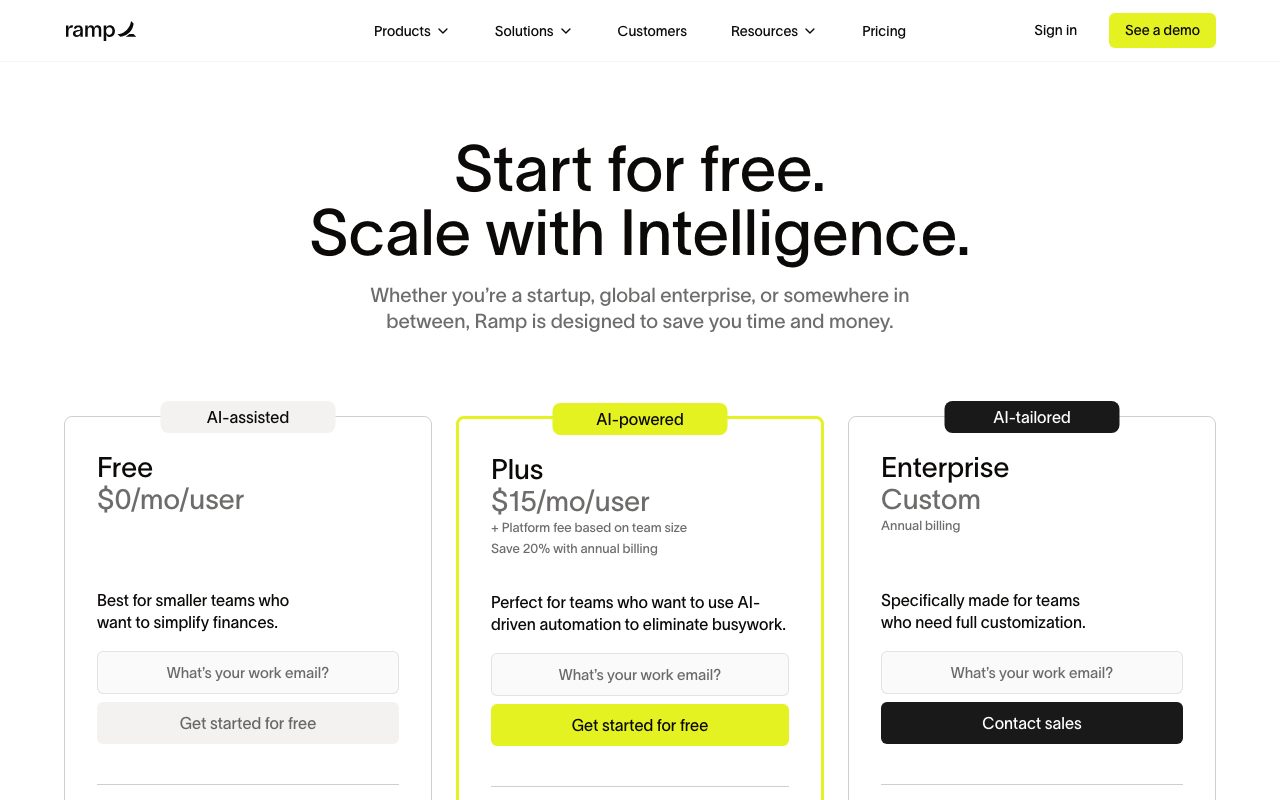
Ramp's core platform is free. Cards, expense management, bill pay, and reporting all included with no monthly fee. The company makes money on interchange and optional premium tiers.
Ramp Plus runs $15 per user per month for advanced controls, custom approval workflows, and deeper accounting integrations. Useful for finance teams managing complex policies.
Travel booking and reimbursements come bundled. International payment fees apply on cross-border transfers.
Standout features in Ramp
Automated expense management actually delivers. Set up a category-based policy once, and Ramp does the heavy lifting on most transactions. The "did Sarah submit her expense report" Slack ritual fades.
SaaS spend insights are genuinely useful. The platform sees what you're paying for, flags redundancies, and recommends savings. We've seen teams cut six-figure annual spend after a Ramp audit.
Accounting integrations with QuickBooks, Xero, NetSuite, and Sage Intacct are deep. Transactions sync with the right GL codes, classes, and locations. Your accounting team stops manual coding.
Bill pay
Ramp's bill pay handles approvals, payments, and reconciliation in one workflow. Compared to bouncing between Bill.com and your accounting tool, the unified flow is meaningfully nicer.
Honest tradeoffs
US-only for the corporate card. International teams need workarounds or Brex's globally-issued cards. This is the biggest limitation for many growing companies.
Underwriting depends on bank balances rather than credit history. Early-stage companies with low cash balances may get small initial limits. Growth tends to lift them; the early experience can frustrate.
Premium features behind Ramp Plus add up. The free tier is generous, but power users hit ceilings on approval-workflow complexity and policy granularity.
Ramp's core product being free is the unusual selling point. Once you've used it for a quarter, going back to a paid alternative feels strange.
Ramp vs alternatives
Versus Brex, Ramp wins on free pricing and SaaS-spend insights. Brex wins on international card issuance and rewards programs. See the comparison.
Versus Mercury, Ramp is spend management and Mercury is banking. Many startups use both; they complement rather than compete directly.
Versus Expensify and SAP Concur, Ramp wins on price and modern UX. The legacy expense tools survive on enterprise contracts and inertia.
For more options, see the best spend management tools and Ramp alternatives.
Bottom line
Ramp is the spend management default for US-based startups in 2026. The free core, automation depth, and SaaS visibility make the value proposition unusually clean.
If you're not US-only, evaluate Brex carefully. If you're tiny, the workflow may feel heavier than needed. For the vast middle, Ramp earns its place fast and keeps it.
Onboarding to Ramp
The application is fast for most US-based companies. Underwriting completes in days, not weeks. Have your bank statements and basic company docs ready.
Set up your accounting integration first. The cleaner the GL mapping at the start, the less manual coding your team does as transactions accumulate.
Roll out cards in waves. Pilot with one department, learn the policies that work for your culture, then expand. Mass rollouts with weak policies create cleanup work.
Policy design that scales
Set spending categories, not just amounts. "$50 for client meals" is meaningful in a way "$50 for anything" isn't.
Use vendor-specific virtual cards for SaaS subscriptions. Cancel a card and the SaaS bill stops; reissue a card if you need to renew. The control is much better than recurring physical-card subscriptions.
Pre-approve travel categories before trips. Reduces post-trip approval overhead and catches policy violations earlier.
Ramp's SaaS visibility in practice
The first month of Ramp surfaces shocking facts. Subscriptions you forgot. Multiple seats for tools no one uses. Renewals that auto-billed at higher rates.
Plan a quarterly SaaS audit using Ramp's reports. Cancel duplicates, renegotiate inflated renewals, eliminate unused seats. Most companies save thousands annually doing this.
The savings often pay for the manual labor of a fractional finance person several times over. Ramp Plus is worth it for many teams just for these reports.
Common Ramp questions
Can Ramp work for non-US companies? The card product is US-only. International teams use other tools (often Brex or Mercury) for cards but might still use Ramp's bill pay.
How does Ramp determine card limits? Bank balance based, not credit score. Higher balances unlock higher limits.
Does Ramp integrate with my accounting software? Almost certainly. QuickBooks, Xero, NetSuite, Sage Intacct, and most major systems are supported.
Browse more at tools for finance.
Ramp for finance teams replacing Concur
The migration story is good. Bulk-issue Ramp cards, freeze the old corporate cards, run both for a month, then cut over.
Train employees on the receipt-capture flow. The mobile app's email forwarding and photo capture make compliance easier; employees still need to know the workflow.
Auto-coding rules reduce manual work but don't eliminate it. Plan for some review-and-correct overhead, especially in the first few months while rules tune themselves.
Ramp's bill pay vs Bill.com
Ramp's bill pay is solid for AP needs that aren't enterprise-scale. Approval workflows, vendor management, ACH and wire payments all work cleanly.
Bill.com is more mature in vendor management, payment options, and finance-tool integrations at the high end. Many companies eventually have both: Bill.com for AP, Ramp for cards and policy.
For early-stage and growth-stage companies, Ramp's all-in-one model is usually cleaner than maintaining separate tools. The crossover happens at company scale, not at startup stage.
Ramp's customer success
The product-led free model is paired with surprisingly strong customer support. Issues resolve quickly; account managers are reachable for larger accounts.
Final thoughts on Ramp
Ramp's free core is the unusual selling point that keeps mattering. Once your team has used it for a quarter, going back to a paid alternative feels strange.
The growth from card-and-spend to broader finance operations has been deliberate. Bill pay, accounting integration, SaaS visibility. The platform keeps expanding without losing its core "save you money" identity.
Browse other options at the best expense management tools and business banking tools.
Quick recap
Ramp fits US-based startups and growth-stage companies who want corporate cards, expense management, and SaaS visibility in one platform. The free core and SaaS-spend insights are the standout reasons to start there.
It struggles for international teams. The card product is US-only; international companies need Brex or other alternatives.
Pair Ramp with a cleanly mapped accounting integration. The automation only delivers when the GL coding works correctly from the start.
Browse more options at the best corporate cards, the finance operations category, and Ramp alternatives.
Ramp closing notes
The product team has shipped consistently for years. Bill pay, accounting integrations, SaaS visibility, and now travel. The platform's expansion has been deliberate without losing the core "save you money" identity.
For finance teams running multiple tools (cards, expense reports, AP, SaaS management), Ramp's consolidation is a real productivity win. Fewer tools, fewer integrations, fewer reconciliation headaches.
Watch the Ramp Plus features carefully. Some are genuinely useful at scale; others are mostly polish. Pilot before paying.
Browse more finance options at the best finance tools and the broader expense tracking category.
Tutorial / Demo
Key Features
- Corporate cards with category controls
- Automated expense management and receipt matching
- Bill pay and ACH/check payments
- SaaS spend visibility and savings insights
- Integrations with QuickBooks, Xero, NetSuite, and Sage Intacct
- Travel booking and reimbursements
Pros & Cons
What we like
- Core card and AP features are free
- Strong automation around expense policies
- Genuinely useful SaaS-spend insights
Room for improvement
- US-only for the corporate card
- Underwriting depends on bank balances, not credit history
- Premium tier and add-ons cost extra
Frequently Asked Questions
Is Ramp really free?
Ramp vs Brex, which one?
Do I qualify for a Ramp card?
Does Ramp integrate with QuickBooks and NetSuite?
What about non-US businesses?
Best For
Featured in
Alternatives to Ramp
View all


Our take
Tool Index Editorial · May 2026· 4.6/5
Ramp sits in a crowded category, differentiating itself as corporate cards and spend management built around saving money.
Worth highlighting: Core card and AP features are free, Strong automation around expense policies, and Genuinely useful SaaS-spend insights. The friction points: US-only for the corporate card and Underwriting depends on bank balances, not credit history.
Bottom line: pick Ramp when you need vC-backed startups standardizing card spend; look elsewhere if uS-only for the corporate card would be a dealbreaker.
Editorial opinion from the Tool Index team, written from the public product pages. Not a user review.
Reviews (6)
Genuinely impressed
The pitch for Ramp sounded too good to be true. Mostly true. What stands out is how genuinely useful SaaS-spend insights. Would buy again without thinking twice.
Pros
- Genuinely useful SaaS-spend insights
- Core card and AP features are free
- Strong automation around expense policies
Underrated honestly
Have been using Ramp for a while, here's where I land. Honestly impressed by how strong automation around expense policies. Worth calling out the automated expense management and receipt matching too.
Pros
- Core card and AP features are free
Genuinely impressed
Got Ramp on the recommendation of someone I trust. Real selling point: core card and AP features are free. The saaS spend visibility and savings insights is more useful than I expected.
Stuck the landing for our team
Ramp is one of those tools you stop noticing because it just works. Genuine strength: strong automation around expense policies. Mostly using it for companies looking to cut SaaS waste. Sticking with Ramp.
Hit the Ramp sweet spot
Honest take: Ramp delivers most of what the marketing promises. Genuine strength: strong automation around expense policies. Worth the price for what I get out of it.
Pros
- Strong automation around expense policies
Not for us, but might suit others
Have been using Ramp for a while, here's where I land. Genuine strength: core card and AP features are free. That said, US-only for the corporate card is a real gripe. Probably better for someone with different needs.
Pros
- Genuinely useful SaaS-spend insights
- Core card and AP features are free
- Strong automation around expense policies
Cons
- US-only for the corporate card
Badge builder
Add Ramp to your website
Choose a badge style and size, preview it here, then copy the generated HTML. Badge images are self-contained SVGs and do not require an external script.

<a href="https://toolindex.net/tools/ramp?ref=badge" target="_blank" rel="noopener">
  <img src="https://toolindex.net/badge/ramp/medium.svg" alt="Ramp - Listed on Tool Index" width="180" height="50" />
</a>How to use the badge
- 1. Pick the style, size, and theme that fit your layout.
- 2. Copy the generated HTML from the code block.
- 3. Paste it into your footer, homepage, or press page.
Score badge available
Ramp qualifies for the score and circle badges based on its current top-10 positionin Finance.
Badge clicks return visitors to this profile with a referral tag so the source remains identifiable.
Related Tools

Simple RMD
Calculate, aggregate, and manage your annual IRA required minimum distributions.
FreshBooks
Cloud accounting designed for service-based small businesses and freelancers
Deel
Global payroll, contractor, and EOR platform
Chargebee
Subscription billing and revenue management for B2B SaaS
Work on Ramp? Request listing access or correction