
Reletter
Find, qualify, and monitor newsletters for outreach and sponsorships
Gallery
About Reletter
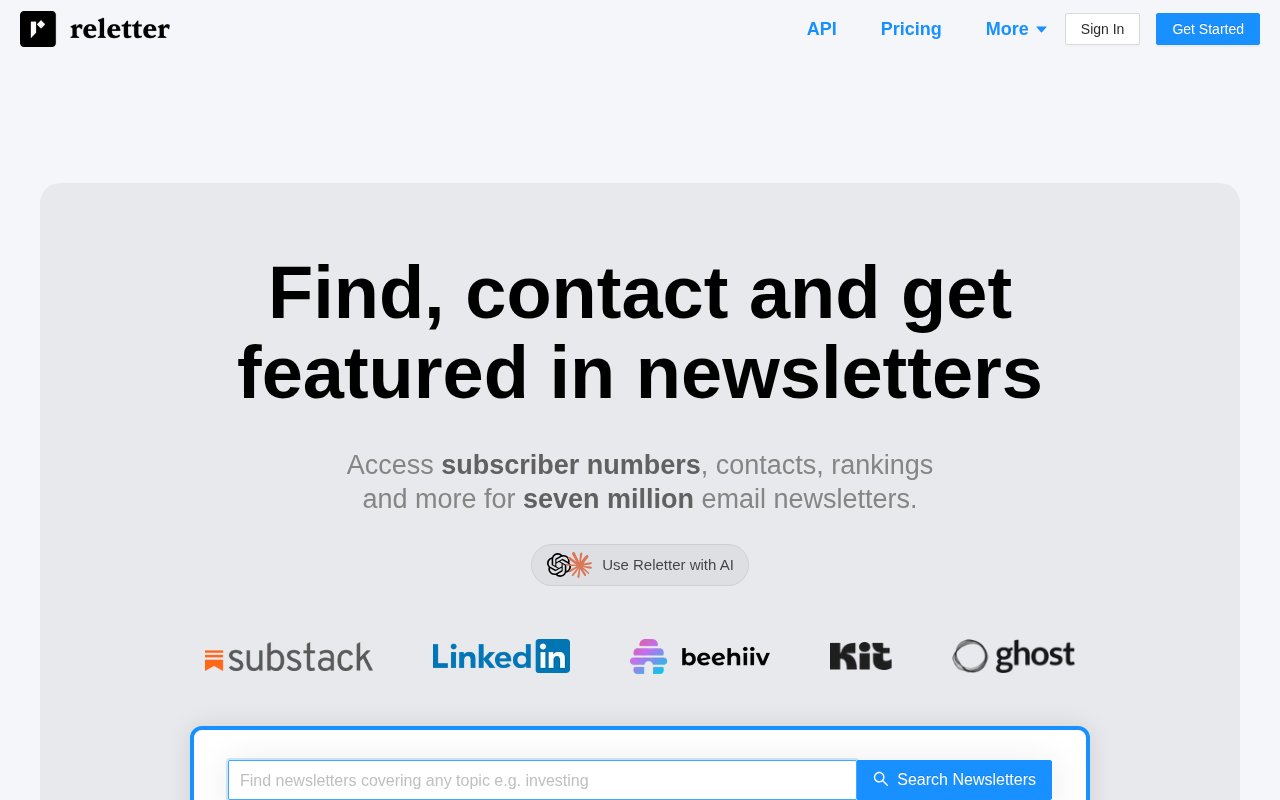
Reletter is a research and outreach platform built around a large index of email newsletters. It helps marketers, public relations teams, authors, agencies, and founders find publications that cover a particular subject, understand their reach, and identify the people behind them. Instead of piecing together a target list from web searches and scattered media databases, a user can search one catalog spanning more than seven million newsletters. Reletter says that catalog includes publications from Substack, LinkedIn, Ghost, Beehiiv, and Kit. The central job is practical and narrow, finding the newsletters that fit a campaign well enough to merit a pitch, sponsorship inquiry, or partnership conversation.
The search engine is the starting point. A user enters a topic or niche, then works through matching publications with data such as subscriber numbers, engagement, language, country, traffic estimates, and chart rankings where those fields are available. Searches can focus on publication topics, titles, or authors, while the developer interface adds filters for audience size, platform, activity, and other indexed metadata. Reletter also surfaces contact details and social accounts for newsletter writers, which turns discovery into a usable outreach list. Lists can be assembled inside the product, shared with a team, and exported for use in a customer relationship management system. That flow is useful when a campaign needs more discipline than a spreadsheet but doesn't justify a broad media intelligence suite. Reletter keeps the research focused on newsletters rather than mixing them with podcasts, newspapers, and unrelated creator channels.
Monitoring covers the other side of the workflow. Teams can create alerts for a keyword, brand, person, or topic and receive an email when it appears in a newly indexed newsletter issue. That can support brand tracking, client reporting, competitive research, or finding writers who are already discussing a relevant market. Because Reletter indexes full issue text, a search can look past publication descriptions and into what writers have actually covered. The public Newsletter Graph offers another way to explore the index. It connects newsletters when they link to the same pages, making clusters of overlapping attention visible. The graph is an exploratory view rather than the whole product, while the paid workspace handles the recurring work of search, qualification, list building, contact discovery, and mention monitoring.
Reletter also exposes its data to developers. Its API can search publications and full newsletter issues, fetch publication metadata and contacts, retrieve chart rankings, and support recent keyword monitoring. A typed Python client and command line interface cover scripts and notebooks, while a remote MCP server lets compatible AI clients query Reletter with an API key. The developer offering is useful for teams that want newsletter data inside an internal research tool, an enrichment process, or a retrieval pipeline instead of relying only on the web interface. Reletter publishes Markdown references for language models as well, so an agent can work from structured product documentation. API access is sold as an add-on to a base plan, with quotas that start at 5,000 requests per month.
The product is best suited to teams that actively pitch newsletters, buy sponsorships, arrange cross-promotions, or track coverage for clients. Its advantage is specialization. General search can locate well-known publications, but it rarely provides a consistent combination of audience estimates, rankings, contacts, issue text, and exportable lists. Reletter puts those pieces in one workflow and covers several major newsletter platforms. That focus is also the main boundary. It isn't a general email marketing system, campaign sender, or newsletter publishing platform, and teams looking for television, print, or podcast contacts will need another database alongside it.
Access is paid, with a seven-day trial that requires a card. The Light plan starts at $49 per month and includes one user, 100 searches per month, three lists, alerts, and exports. Standard and Business plans raise user, search, list, and alert limits, with Business adding priority support. Annual billing includes two months free, according to the pricing page. The separate API add-on starts at $59 per month for 5,000 requests and still requires a base Reletter plan. Higher API quotas are published for teams that need more frequent access. That makes Reletter easiest to justify for repeat outreach or monitoring work, not an occasional one-off search, but its published tiers make the cost and capacity straightforward to evaluate before a team commits.
Key Features
- Newsletter topic search
- Audience and ranking data
- Writer contact discovery
- Shared outreach lists
- Keyword mention alerts
- API, CLI, and MCP access
Pros & Cons
What we like
- Indexes newsletters across five major publishing platforms
- Combines discovery, contacts, lists, and monitoring
- Exports target lists into existing outreach workflows
- Offers programmatic access for apps and agents
Room for improvement
- No permanent free tier beyond the trial
- Entry plan is limited to 100 monthly searches
- API access costs extra on top of a base plan
- Coverage is focused on newsletters rather than broader media
Frequently Asked Questions
What is Reletter?
Which newsletter platforms does Reletter cover?
Is Reletter free?
Can developers use Reletter data in their own tools?
Best For
Featured in
Alternatives to Reletter

Apatero AI
The creator studio for AI image, video, audio, 3D, and avatars, now at apatero.ai.

Prompted Income
Make money with AI, documented with the receipts instead of the screenshots.

Sellsmithy
The workshop side of selling digital products. Built first, fees counted, duds included.

Postdex
An exclusive marketplace for finished, human-made articles. Every piece sells once.
Reviews (0)
Badge builder
Add Reletter to your website
Choose a badge style and size, preview it here, then copy the generated HTML. Badge images are self-contained SVGs and do not require an external script.

<a href="https://toolindex.net/tools/reletter?ref=badge" target="_blank" rel="noopener">
  <img src="https://toolindex.net/badge/reletter/medium.svg" alt="Reletter - Listed on Tool Index" width="180" height="50" />
</a>How to use the badge
- 1. Pick the style, size, and theme that fit your layout.
- 2. Copy the generated HTML from the code block.
- 3. Paste it into your footer, homepage, or press page.
Standard badge available
The standard listing badge is available now. Score and circle badges are limited to tools currently ranked in the top 10 of a category.
Badge clicks return visitors to this profile with a referral tag so the source remains identifiable.
Related Tools
Apatero AI
The creator studio for AI image, video, audio, 3D, and avatars, now at apatero.ai.

SEObot
Autonomous AI SEO agent that runs your blog and link building on autopilot

Substack
Hosted newsletter and publication platform with built-in payments, recommendations, and an audience network for writers.

MailerLite
Friendly, affordable email marketing tool with newsletters, automations, landing pages, and a growing creator toolkit.
Work on Reletter? Request listing access or correction