
RouteKit
Open source model gateway that pools multiple AI coding subscriptions behind one endpoint
Gallery
About RouteKit
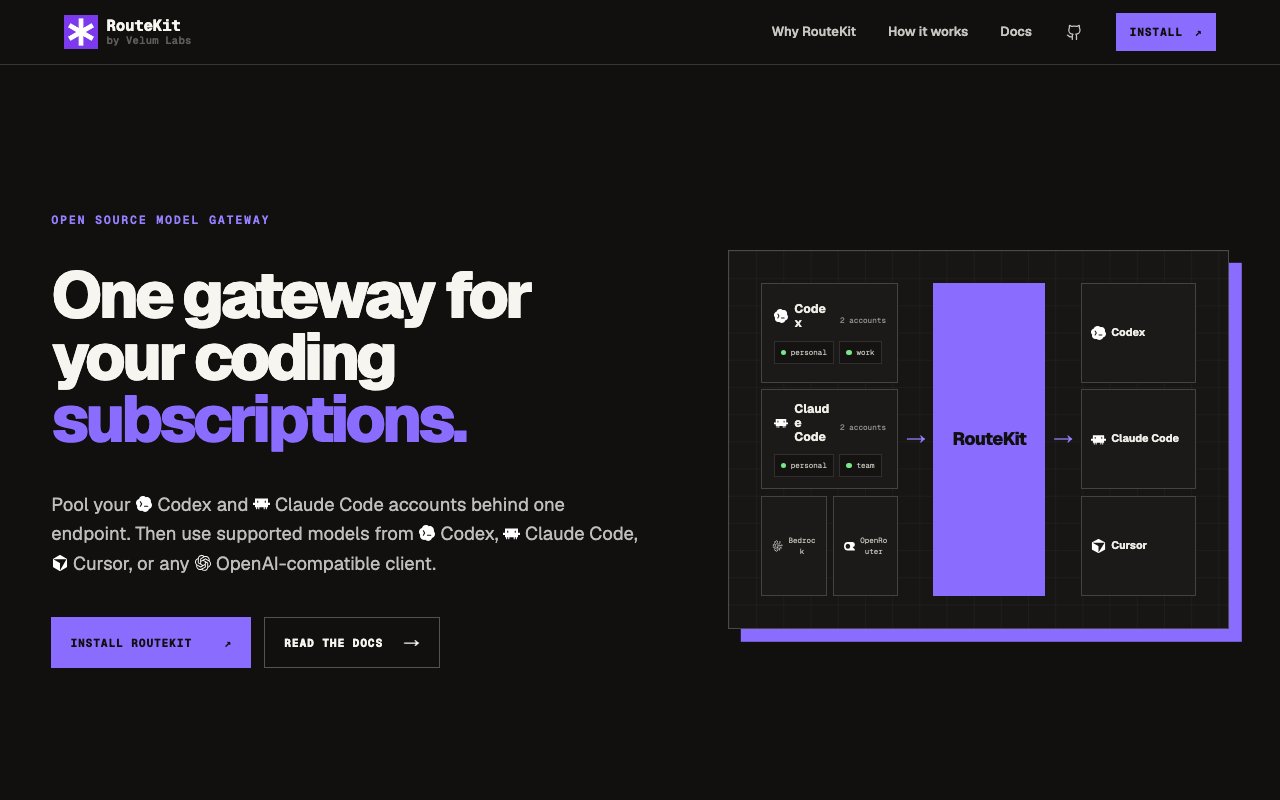
RouteKit is an open source model gateway that lets developers consolidate multiple AI coding subscriptions into a single, stable endpoint. If you have accounts with Codex, Claude Code, Cursor, Bedrock, OpenRouter, or any OpenAI compatible provider, RouteKit puts them all behind one API so your tools do not need to know which subscription is actually serving each request. The problem it solves is the juggling act that comes with using several coding assistants at once, where context windows run dry, rate limits hit, or one provider goes down and suddenly your workflow stalls. Instead of managing credentials across different tools, you configure them once in RouteKit and let the gateway handle routing. The result is a unified interface that abstracts away the complexity of multiple accounts.
The core idea is subscription pooling. You log in your various accounts through the command line, and RouteKit routes requests across them. When one account's quota is exhausted, it automatically rolls over to the next available account in the pool. That means an afternoon of heavy code generation does not grind to a halt just because a single subscription hit its ceiling. The gateway selects eligible accounts from the appropriate pool for each request, maintaining session continuity even as it switches backends. You can also specify models explicitly with commands like routekit claude codex/gpt 5.6 sol when you want direct control over which provider handles a particular task. This flexibility lets you optimize for cost, capability, or speed depending on what the moment requires.
For teams, the pooling extends across multiple people's accounts. Named, revocable tokens let you share capacity without distributing raw credentials. Each token can be attributed to a user, so you maintain visibility into who is consuming what. This setup works for small teams that need to stretch their collective subscriptions further without the overhead of managing individual account access or worrying about credential leakage. When someone leaves or a token needs to be rotated, you revoke it without touching the underlying subscription credentials.
RouteKit runs locally on your machine rather than routing through a third party cloud. Every request stays under your control, which matters if you are passing proprietary code through the gateway. The local first architecture means your code never touches an intermediary server between your machine and the provider you have configured. The routing logic is explicit and inspectable because the project is open source, hosted on GitHub under Velum Labs. You can read exactly how it decides which account to hit next, and you can fork it if you need custom behavior. For security conscious teams, the ability to audit the gateway code provides assurance that there are no hidden data paths.
Installation is simple. There is a curl one liner that fetches the latest release, or you can install globally via npm with @velum labs/routekit. Once installed, you configure accounts through the CLI and start the gateway. Any tool that speaks OpenAI's API format can point at your local RouteKit endpoint and use whatever subscriptions you have connected. That includes editors like Cursor, CLI tools like Codex, or your own scripts that call language models. The stable endpoint means you do not need to reconfigure each tool when you add or rotate accounts. You just update the gateway configuration and every connected tool picks up the change automatically.
The audience is developers who pay for multiple coding AI subscriptions and want to treat them as one resource pool rather than separate silos. It appeals to anyone wary of funneling code through external proxies, or who simply wants the flexibility to use the best model for a given task without swapping credentials. RouteKit is open source and free to use with no licensing fee. The project is relatively new, which means documentation is lean and community support is still growing. If you hit an edge case, you will likely be reading source code rather than Stack Overflow threads. For developers comfortable with the command line and willing to self host, RouteKit offers a clean solution to a real annoyance in the modern AI coding stack where subscription sprawl has become the norm rather than the exception. The tradeoff is the setup time and ongoing maintenance, but for anyone who crosses provider rate limits regularly, the investment pays back quickly. If you are tired of swapping API keys mid session or watching your productivity halt because one subscription ran dry, RouteKit is worth the initial configuration effort.
Key Features
- Subscription pooling across multiple accounts
- Cross provider routing via single endpoint
- Local first architecture with no cloud relay
- Named revocable tokens for team access
- OpenAI compatible API interface
- Open source with explicit route control
Pros & Cons
What we like
- Combines multiple AI coding subscriptions into one endpoint
- Local execution keeps proprietary code off third party servers
- Automatic failover when one account hits quota
- Open source so you can inspect and modify routing logic
Room for improvement
- Young project with limited documentation
- Requires command line comfort to configure
- Community support is still small
- Only useful if you already have multiple subscriptions
Frequently Asked Questions
What is RouteKit?
Is RouteKit free?
Does RouteKit send my code to the cloud?
Who is RouteKit for?
Best For
Featured in
Alternatives to RouteKit
Cursor
VS Code fork built around an AI pair-programmer

Replit
Browser IDE plus Replit Agent that builds and deploys apps from a prompt
Windsurf
Codeium's AI editor with Cascade agent and deep IDE integration
Vibe Built
Building real apps with agentic AI. What worked, what broke, what shipped.
Reviews (0)
Badge builder
Add RouteKit to your website
Choose a badge style and size, preview it here, then copy the generated HTML. Badge images are self-contained SVGs and do not require an external script.

<a href="https://toolindex.net/tools/routekit?ref=badge" target="_blank" rel="noopener">
  <img src="https://toolindex.net/badge/routekit/medium.svg" alt="RouteKit - Listed on Tool Index" width="180" height="50" />
</a>How to use the badge
- 1. Pick the style, size, and theme that fit your layout.
- 2. Copy the generated HTML from the code block.
- 3. Paste it into your footer, homepage, or press page.
Standard badge available
The standard listing badge is available now. Score and circle badges are limited to tools currently ranked in the top 10 of a category.
Badge clicks return visitors to this profile with a referral tag so the source remains identifiable.
Related Tools

Bolt.new
Prompt-to-deployed full-stack app inside the browser

Tabnine
Privacy-first enterprise AI code assistant you control, with SaaS, VPC, on-prem, or fully air-gapped deployment
Cursor
VS Code fork built around an AI pair-programmer

Skeezo
Agent-native macOS IDE for coordinating Claude Code and AI agents
Work on RouteKit? Request listing access or correction