
SEOdata.dev
Simple API for keyword search volume, CPC, and competition data
Gallery
About SEOdata.dev
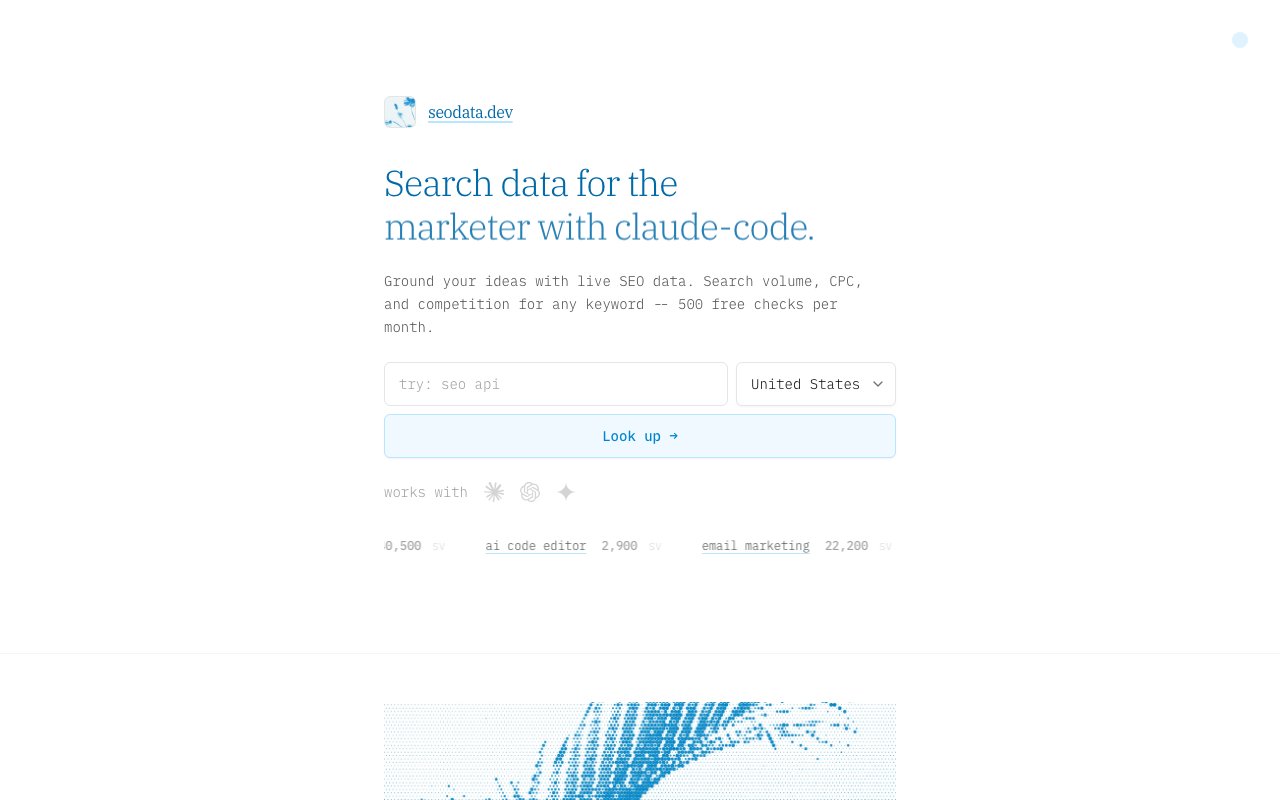
SEOdata.dev is an API for pulling live SEO data into your own code, starting with keyword metrics like monthly search volume, cost-per-click, and competition. Instead of logging into a dashboard and exporting spreadsheets, you make an HTTP request and get structured numbers back. It aggregates data from established providers behind the scenes, so you hit one consistent endpoint rather than juggling separate accounts and formats from each source.
The core call is about as plain as an API gets. You send a GET request to the keyword endpoint with a search term and a two-letter country code, and it returns the search volume, CPC, and competition score for that term in that market. It covers more than fifty countries using standard ISO codes, which means the same request shape works whether you're checking demand in the United States, Germany, or Brazil. The response is built for programmatic use, so it slots straight into a script, a spreadsheet function, or a product feature without any scraping or cleanup.
Those three numbers each answer a different question. Search volume tells you how many people look for a term in a month, which is the raw demand signal. CPC hints at how much advertisers are willing to pay for a click on it, a decent proxy for commercial intent. Competition scores how crowded the paid landscape is. Together they let you sort a messy list of ideas into the ones worth chasing and the ones that are either too quiet or too contested to bother with, and you get that judgment programmatically instead of eyeballing a dashboard.
The reason a developer reaches for something like this is that raw keyword data is usually locked behind heavy, expensive SEO suites that are priced and shaped for marketers clicking around a UI. If all you want is the search volume for a list of terms so you can rank them, feed a content planner, or show demand data inside your own tool, those suites are overkill and their exports fight you. SEOdata.dev strips the offering down to the data itself and hands it to you over a clean interface you can call from anywhere.
Getting started is low-ceremony. You can hit the keyword endpoint anonymously for a small daily allowance with no signup at all, which is enough to test whether the data fits your use case before committing to anything. Registration is a lightweight email step, where you post an email address and confirm with a six-digit code sent to your inbox, and from there you get an API key that works as a standard bearer token on authenticated requests. There's even an llms.txt file published, a nod to the fact that a lot of the people wiring this in are doing it through AI coding assistants that read that file to learn the API.
It fits indie developers, builders, and small teams who want SEO data as an ingredient rather than a destination. Think a niche keyword tool, a content-planning app, a dashboard that shows clients their search demand, or an internal script that scores hundreds of terms overnight. Anyone who has tried to bolt keyword data onto a side project and run headfirst into enterprise pricing is squarely the target here, because the whole design assumes you're writing code, not booking a sales demo.
What makes it different is the deliberate narrowness and the pricing to match. Big platforms bundle rank tracking, site audits, backlink explorers, and reporting into one seat, and you pay for all of it whether you use it or not. SEOdata.dev does one job, serves it over an API, and prices it for individual builders. The roadmap points at filling out the picture with SERP results, showing the top ten organic rankings with their titles, URLs, and descriptions, plus domain analysis for estimated traffic and backlink counts, but the shipped product today is squarely the keyword data. That focus means the numbers you get back are the ones a keyword-research workflow actually starts from, and the pieces on the way extend the same API surface rather than pushing you into a separate dashboard to use them.
On pricing, it's freemium and cheap. The anonymous tier gives you twenty requests a day with no account, a free registered account raises that to five hundred requests a month, and the premium plan removes the limit for about five dollars a month. That puts unlimited keyword lookups within reach of a hobby project, which is unusual in a category where four-figure annual plans are the norm. For a lot of builders, that price gap is the entire reason to choose it over the incumbents. And because the free registered tier is generous enough for light real use, plenty of small projects never end up needing to pay at all.
Key Features
- Keyword search volume, CPC, competition
- Simple GET request per keyword
- Coverage across 50-plus countries
- Anonymous free tier, no signup
- Bearer-token API authentication
- Aggregated from multiple SEO sources
Pros & Cons
What we like
- Clean API for developers rather than a UI
- Very low pricing versus SEO suites
- Free tier works with no account
- Broad country coverage via ISO codes
Room for improvement
- Keyword data only for now, SERP and domain data pending
- No dashboard for non-developers
- Depends on upstream data providers
- Younger service with a smaller track record
Frequently Asked Questions
What is SEOdata.dev?
Is SEOdata.dev free?
How do I use the API?
Who is SEOdata.dev for?
Best For
Featured in
Alternatives to SEOdata.dev

Moz Pro
SEO toolset with keyword research, site audits, link analysis, and the well-known Domain Authority and Page Authority metrics.

Frase
AI-assisted SEO content tool that turns SERP research into briefs, outlines, and optimized drafts inside one editor.

AgentScore
See how AI search represents your business and what to fix first

Screaming Frog SEO Spider
Desktop website crawler trusted by SEO professionals for technical audits, broken link checks, and structured data analysis.
Reviews (13)
Quietly excellent
Picked SEOdata.dev for the price, stayed for the quality. The interface stays out of my way, which I appreciate. Performance has been steady even when I lean on it hard. It fits well for adding search-volume data to your own tool. No regrets so far.
Quietly excellent
Three months of SEOdata.dev later, here is what holds up. The aggregated from multiple seo sources is more useful than I expected. It just works, day after day, without surprises. No regrets so far.
Solid daily driver
Tried SEOdata.dev on a side project first, then rolled it out everywhere. What stands out is how it handles free tier works with no account.
Quietly excellent
Picked SEOdata.dev for the price, stayed for the quality. Their take on clean api for developers rather than a ui is genuinely good. No regrets so far.
Quietly excellent
Have been running SEOdata.dev for a while, here is where I land. The keyword search volume, cpc, competition is more useful than I expected. The thing I keep coming back to is how reliable it is. It fits well for showing clients demand data in a dashboard. No regrets so far.
Pulled its weight from week one
SEOdata.dev has quietly become part of my daily flow. Where it really wins is anonymous free tier, no signup. Glad I made the switch.
Pulled its weight from week one
Picked SEOdata.dev for the price, stayed for the quality. Support actually answered when I had a question, which surprised me. Mostly using it for ranking a list of keywords by demand in a script. Recommending it to people in a similar spot.
It just works
SEOdata.dev solves a real problem for me without making a fuss about it. Support actually answered when I had a question, which surprised me. It slotted into my routine without much fuss. It earns its place in my stack.
Finally something that fits
SEOdata.dev has quietly become part of my daily flow. It just works, day after day, without surprises. Mostly using it for building a lightweight keyword-research app.
Genuinely impressed
Picked SEOdata.dev for the price, stayed for the quality. Their take on coverage across 50-plus countries is genuinely good. Found it works best for adding search-volume data to your own tool. Worth it for what I get out of it.
Recommended without reservation
Tried SEOdata.dev on a side project first, then rolled it out everywhere. Where it really wins is anonymous free tier, no signup. Glad I made the switch.
Exactly what I needed
Three months of SEOdata.dev later, here is what holds up. Their take on anonymous free tier, no signup is genuinely good. The interface stays out of my way, which I appreciate. Found it works best for ranking a list of keywords by demand in a script.
Quietly excellent
Found SEOdata.dev on a Show HN thread and I am glad I clicked. Their take on broad country coverage via iso codes is genuinely good. Mostly using it for showing clients demand data in a dashboard.
Badge builder
Add SEOdata.dev to your website
Choose a badge style and size, preview it here, then copy the generated HTML. Badge images are self-contained SVGs and do not require an external script.

<a href="https://toolindex.net/tools/seodata?ref=badge" target="_blank" rel="noopener">
  <img src="https://toolindex.net/badge/seodata/medium.svg" alt="SEOdata.dev - Listed on Tool Index" width="180" height="50" />
</a>How to use the badge
- 1. Pick the style, size, and theme that fit your layout.
- 2. Copy the generated HTML from the code block.
- 3. Paste it into your footer, homepage, or press page.
Score badge available
SEOdata.dev qualifies for the score and circle badges based on its current top-10 positionin SEO Tools.
Badge clicks return visitors to this profile with a referral tag so the source remains identifiable.
Related Tools
Frase
AI-assisted SEO content tool that turns SERP research into briefs, outlines, and optimized drafts inside one editor.

Surfer SEO
Content optimization tool that scores drafts in real time against the top-ranking pages for any target keyword.
Screaming Frog SEO Spider
Desktop website crawler trusted by SEO professionals for technical audits, broken link checks, and structured data analysis.

Semrush
Comprehensive SEO and digital marketing suite covering keywords, backlinks, competitive research, content, and PPC.
Work on SEOdata.dev? Request a listing correction