
Moz Pro
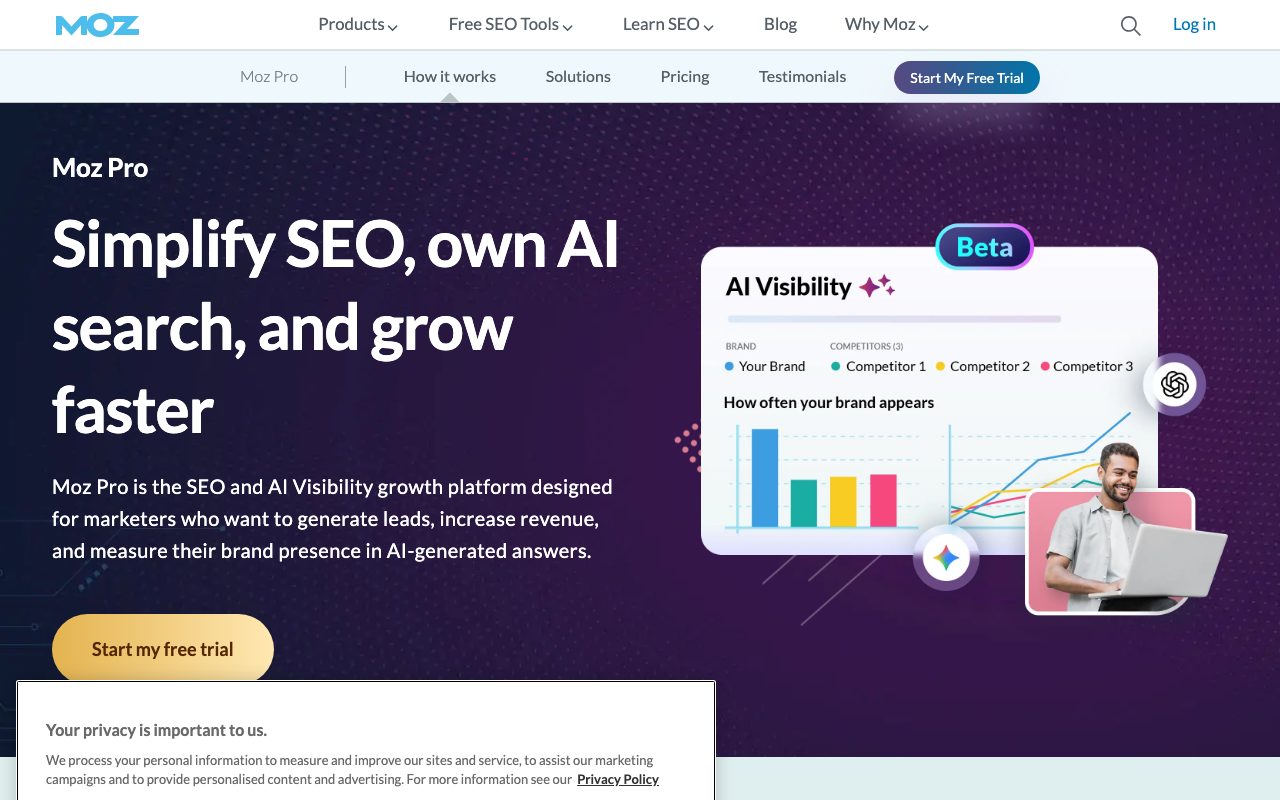
SEO toolset with keyword research, site audits, link analysis, and the well-known Domain Authority and Page Authority metrics.
Gallery
About Moz Pro
Moz Pro is the original SEO suite. It's been around since the keyword stuffing era and somehow stayed relevant through every Google update. The pitch in 2026 is the same as 2008: rank tracking, site audits, link analysis, keyword research, all in one tool. The execution has gotten quietly excellent.
Moz pioneered the Domain Authority metric, which became the SEO industry's shorthand for "is this domain worth a backlink." Whether DA is a perfect predictor or not, it's the most-cited SEO metric outside of Google itself.
If Ahrefs and Semrush feel overpriced or overwhelming, Moz Pro is the friendly middle option. It does most of what they do at a lower price, with a learning curve that's actually approachable.
What Moz Pro actually does
Moz Pro is an SEO suite with five core modules: keyword research, rank tracking, site audits, link explorer, and on-page optimization. You set up a campaign for your site, Moz crawls it weekly, and you get reports on issues, opportunities, and competitor gaps.
The data depth is solid. Keyword research uses Moz's own database (smaller than Ahrefs' but credible). Link Explorer pulls from Moz's link index. Rank tracking is daily on higher tiers. Site audits cover crawlability, on-page, and technical issues.
Domain Authority and Page Authority
Moz's signature metrics. DA scores domains 1-100 based on backlink profile and ranking patterns. PA does the same for individual pages. Imperfect, but everyone uses them. Moz's DA is the de facto industry standard for "should I bother getting a link from this site?"
Keyword research and SERP analysis
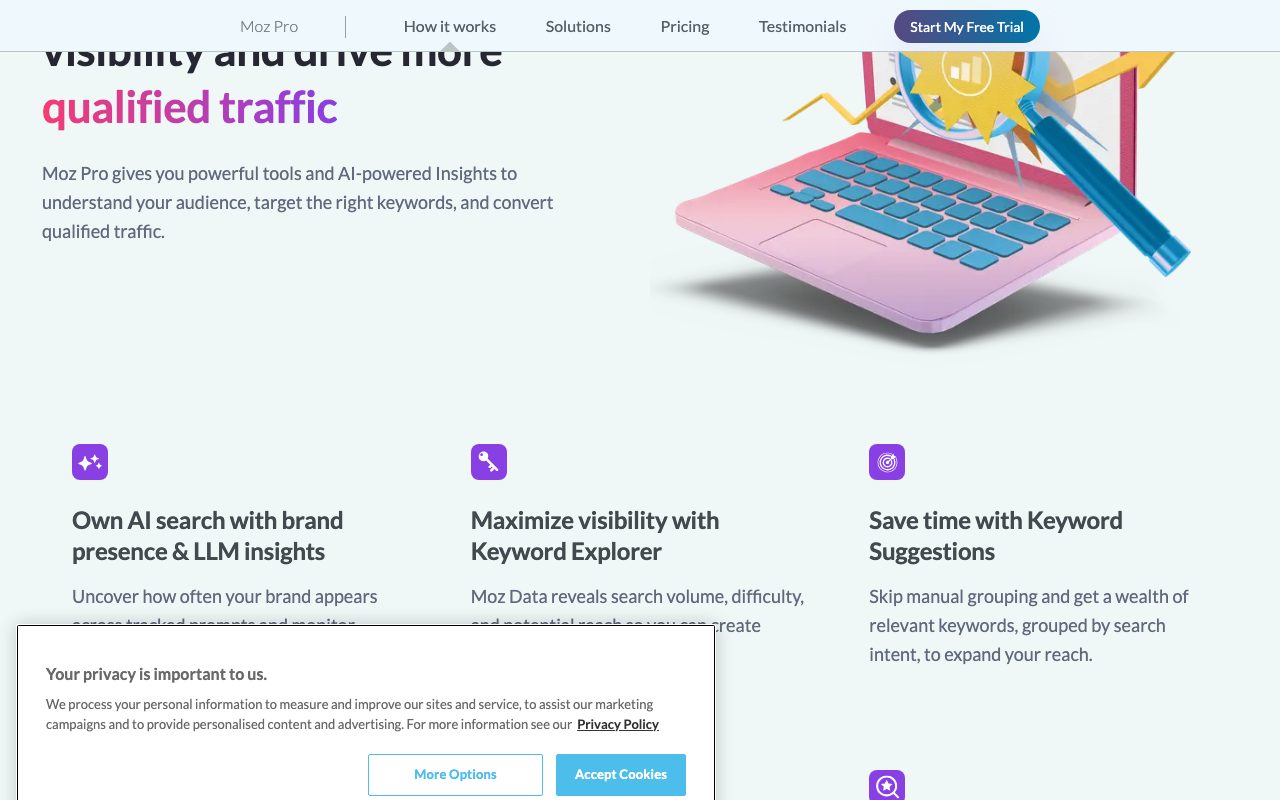
The Keyword Explorer surfaces volume, difficulty, organic CTR, and priority score. It's not as deep as Ahrefs but covers the major use cases. The SERP analysis shows what types of results rank, which informs content strategy.
Moz Pro is the SEO suite that doesn't pretend you need 47 features. It picks the essentials, executes them well, and gets out of your way.
Who Moz Pro is for
In-house marketers, small SEO agencies, and content teams who need a real SEO tool but find Ahrefs and Semrush overpriced. Moz hits a sweet spot for teams between "I'll just use Google Search Console" and "we have a six-figure SEO budget."
It's also great for non-specialists. The interface is friendlier than competitors. The learning resources (Moz Academy, the Beginner's Guide to SEO) are first-class. Many marketers learn SEO via Moz before they ever touch Ahrefs.
Moz Pro pricing
Standard at $99 a month covers 3 campaigns and 1,000 keywords. Medium at $179 a month covers 10 campaigns and 5,000 keywords. Large at $299 a month covers 25 campaigns. Premium at $599 a month is for larger agencies.
30-day free trial with no credit card. The pricing is meaningfully cheaper than Ahrefs ($129+) and Semrush ($139+) for comparable feature scope. That gap matters at small budgets.
Features worth knowing
Site Crawl
Weekly crawls of your site that surface broken links, missing alts, duplicate titles, slow pages, and other technical SEO issues. Less granular than Screaming Frog but easier to live with.
Link Explorer
Backlink analysis with anchor text, follow/nofollow, and DA scoring. The link index isn't as massive as Ahrefs' but covers most of the relevant web.
Keyword Explorer
Find keywords, group them, prioritize. The Priority score combines volume, difficulty, and CTR into one signal, which is more actionable than raw difficulty.
MozBar
Free Chrome extension that shows DA/PA on any SERP. Even if you don't pay for Moz Pro, the bar is everywhere in SEO workflows.
The tradeoffs
Moz's data depth is smaller than Ahrefs and Semrush. The keyword database has fewer terms. The link index has fewer backlinks. For most small businesses this doesn't matter. For enterprise SEO, it does.
The product also moves slower than competitors. Ahrefs ships features at a clip. Moz ships steadily but conservatively. If you want bleeding-edge SEO toys, Moz isn't where they show up first.
Moz Pro vs alternatives
The usual comparisons are Moz Pro vs Ahrefs, Moz Pro vs Semrush, and Moz Pro vs Ubersuggest. Ahrefs is the data king. Semrush is the all-in-one. Ubersuggest is cheaper but lighter.
Moz earns its place by being approachable and complete. See Moz Pro alternatives or browse the best SEO tools.
Bottom line on Moz Pro
Moz Pro is the SEO suite for teams who want capability without complexity. It does the core SEO jobs well, prices fairly, and teaches you the craft along the way.
If you're picking your first real SEO tool, Moz is a great place to start. If you outgrow it, Ahrefs is the next stop. But plenty of teams never need to outgrow it, and that's the whole point.
Common Moz Pro questions
Is Domain Authority a real Google metric? No. DA is Moz's invention. Google doesn't use it. That said, DA correlates with ranking strongly enough that the SEO industry treats it as a useful proxy. It's directional, not authoritative.
Is Moz Pro enough for serious SEO? For most small businesses, yes. For enterprise SEO with millions of pages or international setups, you'll want Ahrefs or BrightEdge. The data depth matters at that scale.
How accurate is Moz's keyword data? Reasonably accurate. Search volumes are estimates and vary across tools. Moz pulls from clickstream data and Google Keyword Planner. The numbers are close enough for prioritization. Don't read them as truth.
Does Moz handle local SEO?
Yes via Moz Local, sold separately. It manages business listings across directories, monitors reviews, and tracks local rankings. For local-focused businesses, the Moz Local + Moz Pro combo covers most needs.
What about technical SEO?
Moz's site crawl covers technical issues: broken links, redirect chains, missing tags, duplicate content. For deep technical audits with crawl simulation and log file analysis, Screaming Frog is more capable. Pair them for thorough technical work.
Workflow tips for Moz Pro
Set up campaigns for your top 3-5 properties. Don't try to track everything. Focus the audits on properties you can actually improve.
Use Keyword Explorer for prioritization. The Priority score (volume, difficulty, CTR) is more actionable than raw difficulty. Focus on Priority above 50 with reasonable difficulty.
Audit competitors monthly. Moz's competitor tracking shows what they rank for, what links they earn, and where they're growing. Cherry-pick from their playbook.
Keep MozBar enabled. Even if you only check Moz Pro weekly, MozBar surfaces DA on every SERP you visit. Free intelligence on every link prospect. Browse tools for marketers for adjacent picks.
Real-world Moz Pro scenarios
A small business uses Moz Pro to track local keyword rankings and audit site issues. Weekly site crawl catches broken links and missing tags. Keyword Explorer prioritizes content. They rank in their local market within 9 months. Moz did the heavy lifting on direction.
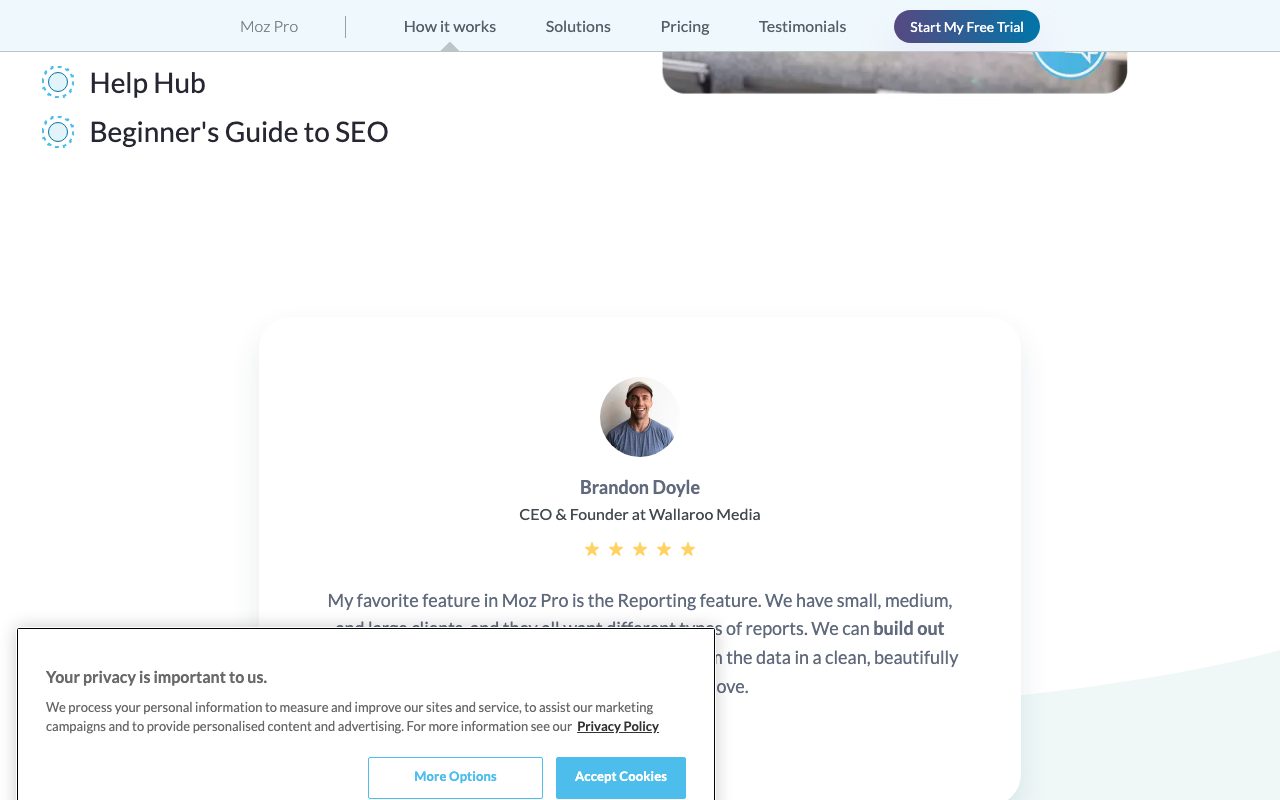
A content marketing agency uses Moz for client reporting. White-label reports, monthly cadence. Clients see DA increasing, rankings improving, traffic growing. The reporting alone justifies the tool, even before the SEO insights.
An in-house marketer at a B2B SaaS uses Moz for backlink monitoring and competitor research. They track when competitors earn high-DA links and reverse-engineer the content. Less guesswork, more replication.
Setup checklist
Set up your main campaign first: domain, target keywords, competitors. Let it run a week to gather baseline data. Then expand to additional campaigns if needed.
Use the Site Crawl reports to fix obvious issues. Broken links, missing alts, duplicate titles. Quick wins that compound.
Track keywords you can realistically rank for. Don't chase head terms with DA 90 sites blocking the SERP. Focus on long-tail and specific queries where your content can compete.
For non-specialists getting started in SEO, Moz Pro is the friendliest entry point. The learning resources and approachable interface help build skills, not just generate reports. Browse the Moz Pro page for community reviews.
Why Moz Pro is still around
Moz launched in 2004. Most contemporaries are gone. The SEO tool market shifted toward Ahrefs and Semrush, with their bigger data sets and faster shipping. Moz survived by carving out a different position: friendlier, cheaper, more educational.
The Moz brand has cultural weight in SEO. Whiteboard Friday, the Beginner's Guide to SEO, MozCon. Generations of SEOs learned the craft from Moz content. That brand affinity translates to product loyalty even when feature comparisons favor competitors.
The tool itself in 2026 is a competent SEO suite. Maybe it's not the best at any individual feature. It's reasonable at all of them. For small businesses and in-house marketers without specialist SEO expertise, that all-around competence matters more than depth in any one dimension.
For SEO beginners, Moz is the friendliest entry point. For mid-size in-house teams, it's a solid middle ground. For enterprise SEO with millions of pages, you'd outgrow it. The tool knows what it is and serves that audience well.
Moz Pro for the long term
SEO tools have a high churn rate among users. Teams sign up for one, then switch to a competitor, then back. Moz Pro is one of the few that retains users through that churn because of its educational position. Even teams that primarily use Ahrefs often keep Moz around for the brand authority context and the friendly UI.
For 2026 and beyond, Moz's challenge is keeping pace with how AI is changing search. Generative search experiences (Google's AI Overviews, Perplexity) reshape what ranking means. Moz's data and tooling will need to evolve. The team has been steady about it but not aggressive.
For teams that need solid mid-tier SEO tooling without paying enterprise rates, Moz Pro continues to be a credible choice. The brand and educational resources add value that pure feature comparisons miss. That intangible has kept Moz relevant through twenty years of category change.
Tutorial / Demo
Key Features
- Keyword research with difficulty and priority
- Rank tracking across regions and devices
- Site crawls and technical SEO audits
- Link explorer with Domain Authority metrics
- On-page recommendations and reports
- Integrations with Google Search Console and Analytics
Pros & Cons
What we like
- Clean interface that suits newer SEOs
- Trusted brand metrics like Domain Authority
- Strong educational ecosystem and community
Room for improvement
- Smaller backlink and keyword dataset than top competitors
- Reporting customization is less flexible than enterprise tools
Frequently Asked Questions
Is Moz Pro still worth it in 2026?
How much does Moz Pro cost?
Moz Pro vs Ahrefs vs Semrush, which one?
What is Domain Authority and is it real?
Does Moz Pro have an API?
Best For
Featured in
Tags
Alternatives to Moz Pro
View all
Encited
Technical and Content optimization platform for SEO and AI search. Alternative to Prerender.io, Rankability, Profound
Frase
AI-assisted SEO content tool that turns SERP research into briefs, outlines, and optimized drafts inside one editor.
Screaming Frog SEO Spider
Desktop website crawler trusted by SEO professionals for technical audits, broken link checks, and structured data analysis.

Semrush
Comprehensive SEO and digital marketing suite covering keywords, backlinks, competitive research, content, and PPC.
Our take
Tool Index Editorial · May 2026· 4.8/5
If you're evaluating Moz Pro, the headline is simple: seo toolset with keyword research, site audits, link analysis, and the well-known domain authority and page authority metrics, and most teams will get value out of the box.
Where it wins: Clean interface that suits newer SEOs, Trusted brand metrics like Domain Authority, and Strong educational ecosystem and community. Less impressive: Smaller backlink and keyword dataset than top competitors and Reporting customization is less flexible than enterprise tools.
In short: Moz Pro is a strong pick when you need sEO research for small and mid-sized businesses, and a harder sell if smaller backlink and keyword dataset than top competitors would be a dealbreaker.
Editorial opinion from the Tool Index team, written from the public product pages. Not a user review.
Reviews (9)
Quietly excellent
The last quarter of using Moz Pro, here's what holds up. Honestly impressed by how strong educational ecosystem and community. Link explorer with domain authority metrics works the way you'd hope. Found it works best for site audits and technical issue tracking. Worth the price for what I get out of it.
Pros
- Clean interface that suits newer SEOs
- Trusted brand metrics like Domain Authority
It just works
Tried half a dozen options before landing on Moz Pro. Genuine strength: strong educational ecosystem and community. Got real value out of keyword research with difficulty and priority. Hard to imagine going back to my previous setup.
Pros
- Clean interface that suits newer SEOs
- Trusted brand metrics like Domain Authority
Solid product, even better support
Came to Moz Pro after frustration with what I had before. Where it really wins is clean interface that suits newer SEOs. Main use case: SEO research for small and mid-sized businesses. Glad I made the switch.
Pros
- Clean interface that suits newer SEOs
- Strong educational ecosystem and community
- Trusted brand metrics like Domain Authority
Did exactly what I needed
Adopted Moz Pro for one project, ended up using it for more. The thing I keep coming back to: clean interface that suits newer SEOs. Worth calling out the integrations with Google Search Console and Analytics too. Found it works best for link profile monitoring and outreach. Hard to imagine going back to my previous setup.
Pros
- Strong educational ecosystem and community
- Trusted brand metrics like Domain Authority
Quietly excellent
Moz Pro has quietly become part of my daily flow. The biggest win has been strong educational ecosystem and community. Their take on keyword research with difficulty and priority is solid. Mostly using it for educational use for teams learning SEO. Hard to imagine going back to my previous setup.
Stuck the landing for our team
Adopted Moz Pro for one project, ended up using it for more. The thing I keep coming back to: strong educational ecosystem and community.
Pros
- Clean interface that suits newer SEOs
Moz Pro has been a quiet upgrade
Moz Pro has quietly become part of my daily flow. The biggest win has been clean interface that suits newer SEOs. The keyword research with difficulty and priority is more useful than I expected. Hard to imagine going back to my previous setup.
Pros
- Strong educational ecosystem and community
- Trusted brand metrics like Domain Authority
- Clean interface that suits newer SEOs
Solid daily driver
Tried Moz Pro on a side project first. Genuine strength: trusted brand metrics like Domain Authority. Found it works best for site audits and technical issue tracking. Glad I made the switch.
Pros
- Trusted brand metrics like Domain Authority
- Clean interface that suits newer SEOs
- Strong educational ecosystem and community
Onboarded the team in a day
Moz Pro is one of those tools you stop noticing because it just works. Where it really wins is clean interface that suits newer SEOs. The link explorer with Domain Authority metrics is more useful than I expected. Found it works best for SEO research for small and mid-sized businesses. Easy yes for anyone weighing the same trade-offs.
Pros
- Trusted brand metrics like Domain Authority
Badge builder
Add Moz Pro to your website
Choose a badge style and size, preview it here, then copy the generated HTML. Badge images are self-contained SVGs and do not require an external script.

<a href="https://toolindex.net/tools/moz-pro?ref=badge" target="_blank" rel="noopener">
  <img src="https://toolindex.net/badge/moz-pro/medium.svg" alt="Moz Pro - Listed on Tool Index" width="180" height="50" />
</a>How to use the badge
- 1. Pick the style, size, and theme that fit your layout.
- 2. Copy the generated HTML from the code block.
- 3. Paste it into your footer, homepage, or press page.
Score badge available
Moz Pro qualifies for the score and circle badges based on its current top-10 positionin SEO Tools.
Badge clicks return visitors to this profile with a referral tag so the source remains identifiable.
Related Tools
Apatero AI
The creator studio for AI image, video, audio, 3D, and avatars, now at apatero.ai.

SEOdata.dev
Simple API for keyword search volume, CPC, and competition data
SEObot
Autonomous AI SEO agent that runs your blog and link building on autopilot
Substack
Hosted newsletter and publication platform with built-in payments, recommendations, and an audience network for writers.
Work on Moz Pro? Request listing access or correction